Erragudi
Village in Pattikonda taluk, Kurnool district, near Gooty. Asoka's fourteen Rock Edicts and Minor Rock Edicts I–II are carved on boulders of the Yenakonda hill nearby.
Erragudi is a village in Pattikonda taluk of Kurnool district, near the district’s southern border. D. C. Sircar gives its position as about 15° 12′ N, 77° 39′ E. It lies about eight miles north-west of Gooty (in Anantapur district) on the road from Gooty to Pattikonda. The name is often spelled Yerragudi, following local pronunciation.1 Pattikonda taluk had belonged to Bellary district until 1858, when it was transferred to Kurnool.2
The edict hill
West of the village is a range of low hills. One of them is locally called Yenakonda (“elephant hillock”) or Nallayenakonda (“black elephant hillock”). Six large boulders on this hill carry the edicts of the Mauryan emperor Asoka.1 The geologist who found them reported that the boulders are hornblendic gneiss, which he assigned to the Archaean, the oldest rock series in India.3 He suggested that the hill was named after a carving of an elephant, such as accompanies Asoka’s edicts at Dhauli, Girnar and Kalsi. D. R. Sahni searched and found no such carving, and thought the name was simply a villagers’ fancy. Sircar also found no elephant.31
The largest boulder stands on the summit above a drop of about 20 feet, and the others lie on its eastern slope. The Minor Rock Edicts are on the lowest and most accessible boulder.4 See Erragudi edicts of Asoka for the inscriptions themselves.
Discovery
The edicts were found at the end of 1928 by A. Ghose of Calcutta, an officer of the Geological Survey of India. He had been prospecting in the old diamond-mining country of Guntur, Kurnool and Anantapur districts.51 Sahni and Hirananda Sastri reached Gooty on 8 February 1929 and spent about eight days copying the inscriptions. The discovery was announced in a press communiqué on 11 February 1929.6
In 1953 a second copy of Asoka’s Minor Rock Edicts was found about 20 miles away at Rajula-Mandagiri, also near Pattikonda.7
Footnotes
-
D. C. Sircar, “Erragudi Edicts of Asoka”, Epigraphia Indica XXXII (1959), p. 1 (archive.org (opens in a new tab)). ↩ ↩2 ↩3 ↩4
-
Imperial Gazetteer of India, Provincial Series: Madras, Vol. I (1908), p. 407 (archive.org (opens in a new tab)). ↩
-
D. R. Sahni, “The Yerragudi Rock Edicts of Asoka”, Annual Report of the Archaeological Survey of India 1928–29 (1933), p. 162 (archive.org (opens in a new tab)). ↩ ↩2
-
D. C. Sircar, “Erragudi Edicts of Asoka”, Epigraphia Indica XXXII (1959), pp. 2–3 (archive.org (opens in a new tab)). ↩
-
H. Hargreaves (ed.), Annual Report of the Archaeological Survey of India 1928–29 (1933), Introduction, p. 5 (archive.org (opens in a new tab)). ↩
-
D. R. Sahni, “The Yerragudi Rock Edicts of Asoka”, Annual Report of the Archaeological Survey of India 1928–29 (1933), p. 161 (archive.org (opens in a new tab)). ↩
-
D. C. Sircar, “Rajula-Mandagiri Inscription of Asoka”, Epigraphia Indica XXXI (1960), p. 212 (archive.org (opens in a new tab)). ↩
Photos
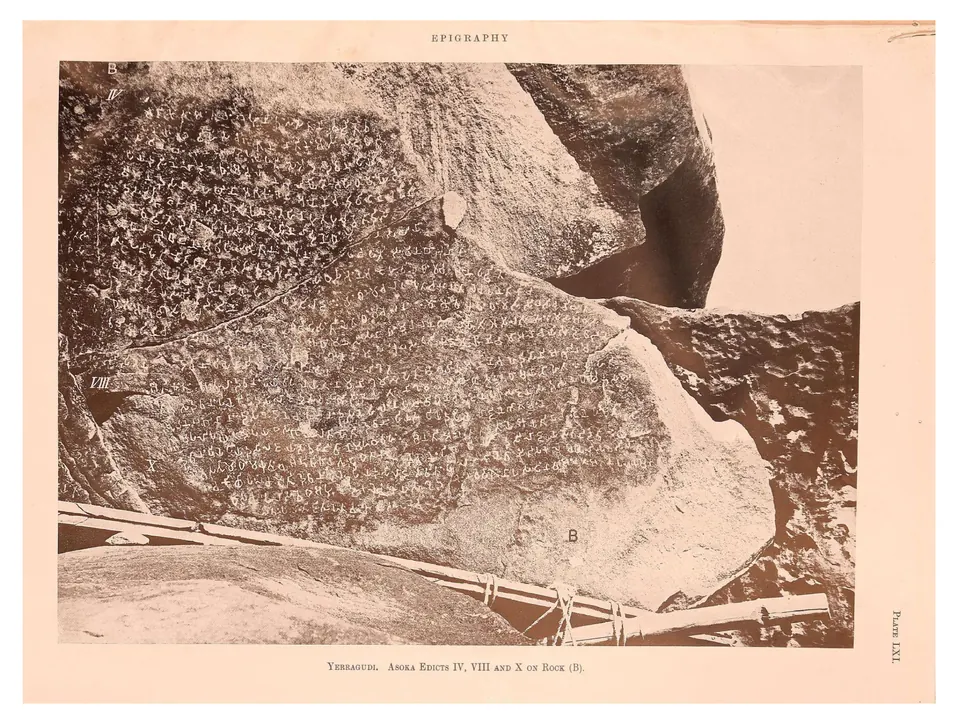
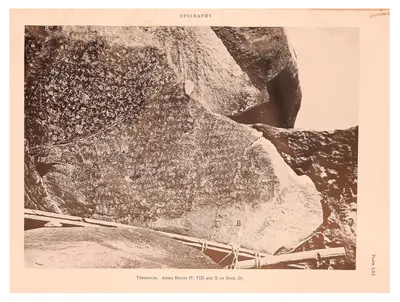 Erragudi: "Yerragudi. Asoka Edicts IV, VIII and X on Rock B" (ASI Annual Report 1928-29, Pl. LXI)Historic photograph · 1933
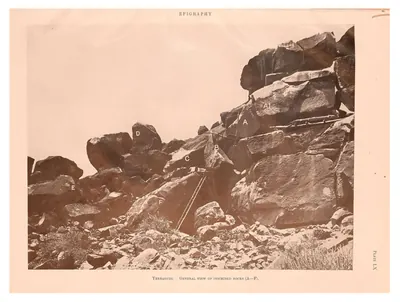 Erragudi: "Yerragudi. General view of inscribed rocks (A-F)" (ASI Annual Report 1928-29, Pl. LX)Historic photograph · 1933
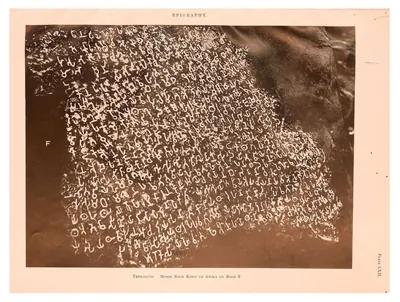 Erragudi: "Yerragudi. Minor Rock Edict of Asoka on Rock F" (ASI Annual Report 1928-29, Pl. LXII)Historic photograph · 1933
Related
People
Inscriptions
References
Notes (0)
Sources (4)
Spotted an error on this page? Tell us
Last updated: