Mauryas
The Mauryan empire of Magadha (c. 322–185 BCE) held part of the Telugu country in the 3rd century BCE. Asoka's edicts at Erragudi and Rajula-Mandagiri in Kurnool district are among the earliest written records found in the region. His conquest of Kalinga reached the coast north of the Godavari.
Swipe sideways to see the whole chart; tap a bar for details.
Each bar is a ruling power in its region; time runs left to right. Dashed = approximate dates. Select a bar for details.
Show as a list
Mauryas & Satavahanas 300 BCE – 225 CE
- Telangana
- Mauryas (c. 272 BCE – 185 BCE) · Satavahanas (c. 220 BCE – 225 CE) · Kotilingala coin kings (c. 200 BCE – 52 BCE)
- Coastal Andhra
- Mauryas (c. 260 BCE – 185 BCE) · Satavahanas (c. 220 BCE – 225 CE)
- Rayalaseema
- Mauryas (c. 268 BCE – 185 BCE)
Kingdoms and empires
Mauryas
Open page- Telangana: c. 272 BCE – 185 BCE (c. 87 years)
IG Hyderabad says Asoka's dominions covered a considerable part of the eastern tracts of the Nizam's State; no Telangana edict cited. Asoka 272-231 BCE in IG Hyderabad, 268-226 BCE in Sewell
- Rayalaseema: c. 268 BCE – 185 BCE (c. 83 years)
Asokan edicts at Erragudi and Rajula-Mandagiri, Pattikonda taluk, Kurnool; Bindusara (296-268 BCE) is believed to have extended rule south
- Coastal Andhra: c. 260 BCE – 185 BCE (c. 75 years)
Asoka's Kalinga war (260 BCE in the Godavari gazetteer, 256 BCE in Sewell) and a Mauryan-script record at Amaravati; empire ended 185/184 BCE
Rulers
Inscriptions
Sources (5)
Kingdoms and empires
Satavahanas
Open page- Telangana: c. 220 BCE – 225 CE (c. 445 years)
IG Hyderabad: rise c. 220 BCE, end about a century after Pulumayi II (acc. c. 138 CE); Sewell: by c. 170 BCE the Andhra king ruled Hyderabad as well as the Telugu tracts
- Coastal Andhra: c. 220 BCE – 225 CE (c. 445 years)
Sources disagree: IG Madras 220 BCE-236 CE; Sewell 'from at least 250 BCE' to c. 225 CE when the Pallava Bappa ended the line; Godavari gazetteer dates the known kings c. 110-220 CE, last inscriptions c. 218
- Rayalaseema: c. 1–225 CE (c. 224 years)
Sewell: about 1 CE the Andhra king ruled parts of Cuddapah and Kurnool; an inscription of Pulumayi II (c. 145 CE) in Adoni taluk proves Andhra rule there; Bellary gazetteer: the Andhras ruled that district in the 2nd century CE. When their rule here began is not recorded
Rulers (12)
- Simuka (c. 220 BCE – 197 BCE)
- Krishna (Kanha) (c. 197 BCE – 179 BCE)
- Sri Satakarni (c. 179 BCE – 169 BCE)
- Sivasvati (c. 85–113 CE)
- Gautamiputra Satakarni (c. 113–138 CE)
- Vasishthiputra Pulumavi (c. 138–170 CE)
… and 6 more
- Siva Sri Satakarni (c. 170–177 CE)
- Sivaskanda Satakarni (c. 177–184 CE)
- Yajna Sri Satakarni (c. 184–213 CE)
- Vijaya Satakarni (c. 213–219 CE)
- Chandra Sri Satakarni (c. 219–229 CE)
- Pulumavi III (c. 229–236 CE)
Capitals
Inscriptions
Sources (5)
Kingdoms and empires
Kotilingala coin kings
Open page- Telangana: c. 200 BCE – 52 BCE (c. 148 years)
Partial: the Godavari country of the old Karimnagar district (Kotilingala, Peddabankur, Dhulikatta), known only from coins of four kings: Gobhada, Kamvaya, Narana and Samagopa, in that order (Lodaya). Dating disputed: the excavators date Gobhada to the first half of the 2nd century BCE, K. D. Bajpai to c. 125-100 BCE; Samagopa to the 1st century BCE. Lodaya has Simuka oust Samagopa about 52 BCE and Shastri puts the Satavahana rise in the mid-1st century BCE; Parabrahma Sastry instead took Gobhada and Samagopa for Sunga kings with the early Satavahanas as their subordinates, and Krishna Sastry left open whether such local rulers served the Satavahanas or another power
Sources (3)
Reigns
Each bar is one ruler’s reign; time runs left to right. c. = approximate date.
- Chandragupta Mauryac. 322 BCE – 296 BCE · c. 26 yrs
- Bindusarac. 296 BCE – 268 BCE · c. 28 yrs
- Asokac. 268 BCE – 226 BCE · c. 42 yrs
Reign years after Sewell (1932). Asoka's years run from his father's death; Sewell dates his coronation to 264 BCE.
Family tree
The rulers and the relatives who explain the succession. Every line rests on a cited statement on a person page; the sources are listed below the tree. Select a card to open that page.
- parent and child
- marriage
- adoption
- the sources disagree (see below)
- order of succession
Generation 1
- 1Chandraguptac. 322 BCE – 296 BCE
Generation 2
- 2Bindusarac. 296 BCE – 268 BCESon of Chandragupta
Generation 3
- 3Asokac. 268 BCE – 226 BCESon of Bindusara
Sources for every line of the tree
- Chandragupta → Bindusara (parent and child)
- Bindusara was the son of Chandragupta Maurya and the father of Asoka. →
- E. Hultzsch, Corpus Inscriptionum Indicarum, Vol. I: Inscriptions of Asoka (1925), p. xxxii (archive.org (opens in a new tab)).
- He was succeeded by his son Bindusara. →
- Sewell, Historical Inscriptions of Southern India (1932), p. 6 (archive.org (opens in a new tab)).
- Bindusara was the son of Chandragupta Maurya and the father of Asoka. →
- Bindusara → Asoka (parent and child)
- Bindusara was the son of Chandragupta Maurya and the father of Asoka. →
- E. Hultzsch, Corpus Inscriptionum Indicarum, Vol. I: Inscriptions of Asoka (1925), p. xxxii (archive.org (opens in a new tab)).
- A struggle among Bindusara's sons followed, which Asoka, a younger son, won. →
- Robert Sewell, The Historical Inscriptions of Southern India (1932), p. 6 (archive.org (opens in a new tab)).
- Bindusara was the son of Chandragupta Maurya and the father of Asoka. →
A line from one parent only means that the cited sources name no other parent.
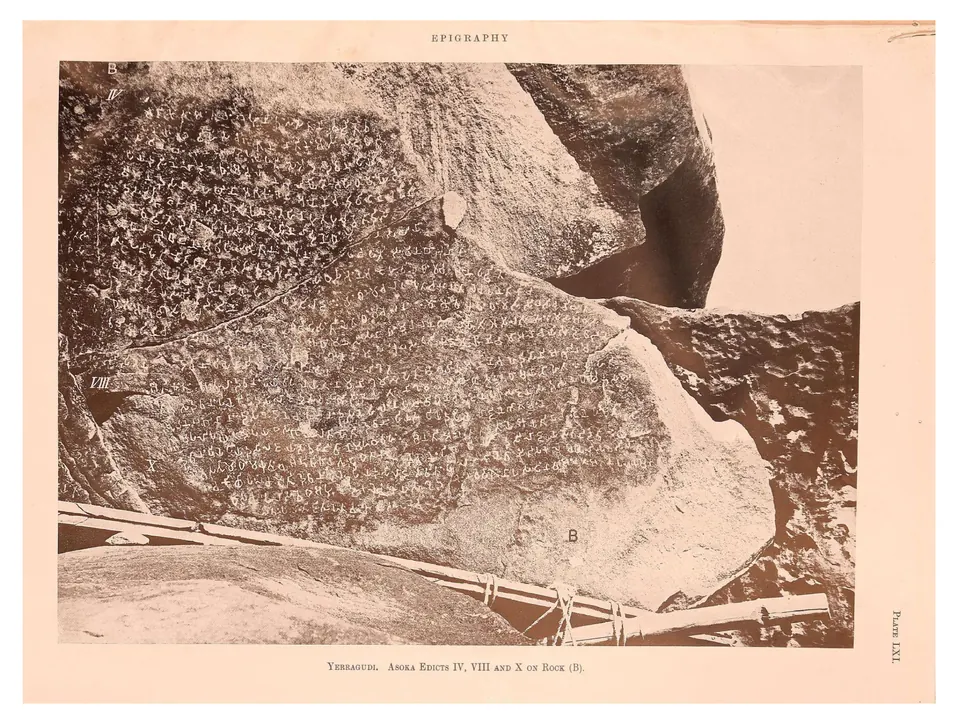
The Mauryas of Magadha ruled an empire whose edicts are found from the north-west frontier to Mysore and from Kathiawar to Orissa. Its capital was Pataliputra, the modern Patna.12
Under Asoka (3rd century BCE) the empire took in the western part of the Telugu country.34 His edicts are carved on rocks there, at Erragudi and Rajula-Mandagiri in Kurnool district.34 His war against Kalinga reached the coast north of the Godavari.56 These two facts and a few early Buddhist inscriptions from the Krishna valley are most of what is known of the Mauryas in the region.
The main evidence is Asoka’s own edicts, above all the copies at Erragudi. Two other sources describe India in general rather than the Andhra country.78 One is the Greek ambassador Megasthenes, whose lost account of Chandragupta’s India survives in quotations by later writers.78 The other is the Arthashastra, a Sanskrit treatise on government that Robert Sewell doubted was wholly Mauryan.78 This page says when it relies on them.
Origins and the conquest of the south
According to Sewell, Chandragupta Maurya overthrew the Nanda kings of Magadha and took the throne in 322 or 321 BCE. He then drove out the garrisons Alexander had left in the north-west.8 He defeated Seleukos Nikator, who gave up territory west of the Indus in exchange for 500 elephants.8 Vincent Smith thought Chandragupta’s empire reached the Narbada river, which would leave the Telugu country outside it.7 See Chandragupta Maurya.
When the south was added is not recorded. Smith thought the southern provinces were probably annexed in the reign of Chandragupta’s son Bindusara.9 Sewell wrote that Bindusara was believed to have enlarged his dominions towards the south and to have ruled northern Mysore.10 Smith also noted that the Tibetan historian Taranatha credited Bindusara with extending the empire southwards.11 See Bindusara.
Asoka inherited this empire. Smith saw no reason to think that Asoka added any territory before the Kalinga war.12 In his Rock Edict XIII, of which a copy survives at Erragudi, Asoka says he conquered the country of the Kalingas.13 He did so eight years after his coronation.13
In D. C. Sircar’s translation of the Erragudi text, 150,000 people were carried off, 100,000 were killed, and many times that number died.13 The edict goes on to describe the king’s remorse.13 He felt special grief that Brahmanas, Sramanas (ascetics) and householders had suffered.13
Scholars date the war differently:1015614
- 256 BCE (Sewell and Hultzsch)101
- 261 BCE (Smith)5
- 260 BCE (the Godavari and Vizagapatam gazetteers)614
Kalinga is usually described as the coast between the Mahanadi and the Godavari.56 The Salihundam excavation report extends it north to the Rupnarayan, a tributary of the Ganges.15 On either view the northern Telugu coast lay inside the conquered country. The Imperial Gazetteer of 1908 thought the whole of Visakhapatnam (then Vizagapatam) district had probably been included in Asoka’s Kalinga.16
Megasthenes, as quoted by Pliny, had described the king of the Calingae, whose royal city was called Parthalis.17 The king was guarded by 60,000 foot-soldiers, 1,000 horsemen and 700 elephants.17
After the war Asoka issued two special edicts for Kalinga. They survive at Dhauli in Puri district and at Jaugada in Ganjam, addressed to his officers at Tosali and at Samapa.18 As the Imperial Gazetteer of 1908 noted, Jaugada held the only Asokan edicts then known in the Madras Presidency.19
Territory in the Telugu country
The Kurnool edicts
Until 1928 no Asokan edict was known in the Telugu districts. The Imperial Gazetteer of 1908 could only infer that “perhaps” the northern half of the Madras Presidency had been Mauryan around 250 BCE.20 It based this on Jaugada and on the edicts in Mysore.20 At the end of 1928 the geologist A. Ghose found Asoka’s fourteen Rock Edicts and his Minor Rock Edicts I and II on boulders near Erragudi, about eight miles north-west of Gooty.21
D. R. Sahni copied them in 1929.3 He wrote that the find “adds the district of Kurnool and, presumably, a large tract of the country around it to the dominions of Asoka”.3 A second copy of the Minor Rock Edicts was found in 1953 at Rajula-Mandagiri near Pattikonda, about 20 miles from Erragudi.4 See Erragudi edicts and Rajula-Mandagiri inscription.
Hultzsch and H. Hargreaves both observed that Asoka’s rock edicts stand on the borders of his dominions.122 Hultzsch drew the southern edge through Raichur district in the Nizam’s Dominions and Chitradurga (then Chitaldroog) in Mysore.1 The Kurnool sites belong to a cluster of southern edicts. The others are at these places:232425
- Maski in Raichur district, found in 1915
- Siddapura, Brahmagiri and Jatinga-Ramesvara in northern Mysore
- Koppal (Kopbal), found in 1931232425
Sahni put Erragudi about eighty miles north-east of Siddapura.26
Suvarnagiri, the southern province
The three Mysore edicts open with an address from “Suvarnagiri, at the word of the prince (aryaputra) and of the Mahamatras”.27 It is sent to the officers at a district called Isila.27 From this Hultzsch concluded that Suvarnagiri was the headquarters of Asoka’s southernmost province, governed by a royal prince.18 Its site is unknown. Hultzsch suggested Kanakagiri in the Nizam’s Dominions, south of Maski, a place whose name means the same thing (“golden hill”). Others looked to the gold-working country around Maski, or to a hill near Rajagriha in Bihar.2728 See Suvarnagiri.
Whether the Kurnool edicts were sent through Suvarnagiri is also disputed. The Erragudi copy of the Minor Rock Edicts leaves out the opening address to Isila.29 Sahni read the bare “at the word of the Beloved of the Gods” as a sign that the Telugu districts were governed directly from Pataliputra.3 Sircar thought the order was addressed to the mahamatras stationed at Suvarnagiri.30
Telangana and the coast south of the Godavari
No source used here records an Asokan edict in Telangana. The 1909 Imperial Gazetteer of Hyderabad State nevertheless held that Asoka’s dominions covered all of Berar.31 It held that they also covered “a considerable portion of the north-western and eastern tracts” of the State.31
South of the Godavari, the lower Krishna valley was the home of the Andhras.32 No edict has been found there. Rock Edict XIII names the Andhras, but scholars have read the passage in different ways, as set out under Evidence and disagreements below.
How far south?
Writing before the Kurnool finds, Smith drew the empire’s southern frontier from Nellore, at the mouth of the Pennar river, to the west coast.9 Sahni, who had seen Erragudi, was more cautious: how much further south Asoka’s empire reached “cannot at present be stated”.3 The Ballari (then Bellary) gazetteer of 1904, also written before the Kurnool finds, went further.33 It argued that the Mysore edicts did not prove Ballari district Mauryan, since Asoka also sent missions beyond his empire.33
Rulers
Indian, Sri Lankan and Burmese traditions agree on the first three kings.3435 Their approximate dates are worked out from Greek synchronisms (links with dated Greek history) and from reign lengths in the Puranas and the Sri Lankan chronicles.3435
- Chandragupta reigned 24 years in all the traditions.34 Sewell dated his reign 322/321–296 BCE.36 Hultzsch preferred a working date of 320–296 BCE.35
- Bindusara reigned 25 years according to the Puranas and 28 according to the Sri Lankan chronicles.34 Both Sewell and Hultzsch date him to about 296–268 BCE.3635
- Asoka, according to Sewell, won a struggle for the throne and was crowned in 264 BCE, four years after his father’s death. Sewell put his death in about 226 BCE.1037 Smith accepted the four-year delay but found no independent evidence of a struggle. His chronology has Asoka succeed in 273, be crowned in 269 and die in 232 BCE.3839 Sircar gave about 272–232 BCE.21 See Asoka.
After Asoka, his grandsons Dasaratha and Samprati are said to have ruled the eastern and western parts of the empire, but little is known of them.37 Dasaratha’s name survives in three cave inscriptions in the Nagarjuni hills of Bihar.40 The sources used here give no dated reigns for the later Mauryas, so they are not included in the reign chart.
How the empire was governed
The empire was divided into provinces, and several of them were held by royal princes (kumara or aryaputra): Ujjayini, Tosali and Suvarnagiri.41 Smith counted four princely viceroys, adding Taxila.42
Each governor was assisted by high officers called mahamatras, and other mahamatras ran the districts within each province.41 Those at Isila, for example, answered to the prince and the mahamatras at Suvarnagiri.41 Smith thought that frontier and forest peoples were left under their own chiefs.42 But he noted that the edicts do not mention local kings in the settled provinces.42
The copies at Erragudi show this chain of command at work in the Telugu country:
- Minor Rock Edict II tells the officers to instruct the Rajjuka, who is to instruct the people of the countryside and the Rashtrikas. Sircar took the Rajjukas to be district governors and the Rashtrikas governors of parts of a district.30 He repeated this reading for the Rajula-Mandagiri copy.43
- Rock Edict III, issued twelve years after Asoka’s coronation, orders the Rajjuka and the Pradesika to set out every five years on a tour of their charges. Their task on tour was to preach dhamma as well as attend to other duties. Sircar thought the Pradesika ruled a group of districts and the Rajjuka a single one. The same edict mentions a council of ministers.44
- Rock Edict VI orders that the king be told of public business at any hour, wherever he is. It also tells officers to report at once any dispute in the council over his oral orders.4546
- Rock Edict V records that Asoka created a new class of officers, the dhamma-mahamatras, thirteen years after his coronation, to promote dhamma among all religious communities.4748
- Rock Edict XII names further officers: mahamatras in charge of the ladies of the royal household, and officers in charge of the king’s cattle and pasture lands.49
Hultzsch explained the title Rajjuka as “rope-holder”.50 The officer originally held the measuring rope to survey fields for the land tax.50 In the same way the head of a district in British India was called a collector.50 Asoka also kept envoys at foreign courts, and agents (purusha) who controlled the Rajjukas.50 The Kalinga edicts show mahamatras at Tosali and Samapa acting as judges in the cities and as superintendents of the unconquered borderers.41
The Arthashastra describes a much fuller bureaucracy. Smith treated it as the best commentary on the edicts.7 But Sewell would not quote it, and it is in any case not evidence for the Andhra country.8
Taxes and revenue
No record from the Telugu country says what its people paid. The general evidence is as follows.
- Asoka’s own words. At Rummindei, the Buddha’s birthplace in the Nepal lowlands, Asoka made the village of Lummini free of taxes.51 It was to pay only an eighth share of its produce.51 Hultzsch saw Asoka’s idea of a king’s “debt” to his subjects as a return for the revenue taken from them.52
- Megasthenes. In Diodorus’s version, the farmers paid a land-tribute, because all land belonged to the crown, and in addition a fourth part of the produce.53 Strabo’s version says the farmers tilled the king’s land in return for a fourth of the produce.54 Sewell read Strabo as saying that the farmers kept only a quarter.10 Smith reports from Megasthenes a tax of one-tenth on sales in the capital.55
- The Arthashastra. It lists the sources of revenue as forts, the countryside, mines, gardens, forests, herds and trade routes.56 Among the taxes it names are a share of produce, normally one-sixth (shadbhaga), and the levy called bali.57 Smith took from it irrigation water rates of a quarter to a third of the produce.58
These figures come from different places and periods, do not agree, and cannot be applied to Kurnool or the Andhra coast.
Law and order
The Erragudi copies contain Asoka’s own statements on justice. In Rock Edict V the new dhamma-mahamatras are told to attend to prisoners. They were to give money to prisoners burdened with children, free those who had offended at another’s instigation, and release the aged.48 In Rock Edict XIII Asoka says he will forgive wrongs that can be forgiven. He also warns the forest peoples within his dominions that, despite his remorse, he still has the power to punish them.59
The Kalinga edicts at Jaugada go further, though they were addressed to Kalinga only. They tell the mahamatras of Samapa, the judicial officers of the city, that men sometimes suffer imprisonment or harsh treatment.60 A single prisoner may be freed by chance while many others continue to suffer.60 The officers are to deal with all of them impartially, and to guard against envy, anger, cruelty, hurry, laziness and fatigue.60
A mahamatra was to be sent out every five years to check that these orders were obeyed.6160 The Dhauli version adds that the princes at Ujjayini and Taxila were to send similar officers at least every three years.6160 Sewell read these edicts as an admission that people had suffered undeserved imprisonment and torture.10
Two later measures appear only in the pillar edicts of northern India. Asoka left rewards and punishments to the discretion of the Rajjukas, and gave condemned prisoners three days’ respite before execution. By his twenty-sixth year he had ordered the release of prisoners twenty-five times.62 Smith noted that otherwise the penal law of the Mauryas, as reported by the Greeks and the Arthashastra, remained severe.63
Army
The edicts say nothing of the army’s organisation.64 Megasthenes credited Chandragupta with a standing army of 600,000 infantry, 30,000 cavalry and 9,000 elephants.65 According to Smith, a War Office of thirty members, in six boards, managed the navy, transport, infantry, cavalry, chariots and elephants. He thought the Kalinga casualties showed that Asoka had used a large force.66
The only army figures for the Telugu people come from the passage of Pliny that drew on Megasthenes. It describes the Andarae as
a still more powerful race, which possesses numerous villages, and thirty towns defended by walls and towers, and which supplies its king with an army of 100,000 infantry, 2000 cavalry, and 1000 elephants.67
Hultzsch and J. W. McCrindle both identified the Andarae with the Andhras.6867
Economy and trade
Rock Edict II at Erragudi describes public works throughout the king’s dominions and in the neighbouring lands. Asoka had arranged medical treatment for men and for animals.6944 He had medicinal herbs, roots and fruits brought in and planted.6944 He had trees planted and wells dug along the roads.6944
A pillar edict of later years adds banyan trees, mango groves, wells and watering places along the roads.62 Megasthenes described a royal road running from the north-west frontier to Pataliputra, with pillars marking the distances.62 Smith described Tamralipti in Bengal as the principal port for traffic with Ceylon, Burma and China in Asoka’s time.70 The sources used here say nothing of Mauryan roads or ports in the Telugu country.
The southern edicts were found by prospectors. Maski was discovered by a gold-mining engineer and Erragudi by a geologist searching for precious minerals.71 H. Krishna Sastri linked the name Suvarnagiri (“gold mountain”) with the ancient gold workings around Maski.27 No source used here shows that the Mauryas mined in Kurnool.
Coins
The coins of the period are the silver pieces now called punch-marked coins, which bear marks stamped on with separate punches. Walter Elliot (1886) described such coins “from all parts of the South”, marked with elephants, oxen, fish, suns and other signs. He found no inscription on them and nothing to connect them with any dynasty.72 The Arthashastra has a superintendent of coinage among the officers of the revenue.56
One dated find comes from the region. At Salihundam in Srikakulam district, a single silver punch-marked coin was found in the earliest layer of the Buddhist site. The excavators dated that layer to the 2nd–3rd century BCE from the black-and-red pottery found with it.73 No coin has been found that names a Mauryan king.
Social life
The Erragudi edicts say a good deal about the customs Asoka wanted to change.
- Animals. Rock Edict I forbids killing animals for sacrifice.69 It says the royal kitchen, which once killed many thousands of creatures a day for curry, now killed only two birds and one animal.69
- Festivals. Rock Edict I discourages the popular festive gatherings (samaja), though it allows one kind of which the king approved.69 Hultzsch thought the approved kind were religious shows.74 Examples were the displays of celestial chariots, elephants and fire mentioned in Rock Edict IV, which he took to be staged by Asoka to encourage moral living.74 In Sircar’s translation of the Erragudi copy, such displays are instead contrasted with the greater effect of Asoka’s instruction in dhamma.75
- Ceremonies and women. Rock Edict IX observes that people hold auspicious ceremonies at illness, at the weddings of sons and daughters and at births. It singles out the women as performing many trivial and useless ones. Asoka recommended instead the “ceremony of dhamma”.76 This meant courtesy to slaves and servants, respect for elders, restraint towards living beings, and gifts to Sramanas and Brahmanas.76
- Classes and communities. Rock Edict V lists the people the dhamma-mahamatras were to serve. They include the servile class, the Aryas (which Sircar explained as traders and farmers), Brahmanas, the ruling class, the destitute and the aged.48 Rock Edict XIII says there is no country except the Greeks’ where Brahmanas and Sramanas are not found.59
- Teaching. Minor Rock Edict II asks elephant-riders, scribes, charioteers and Brahmana teachers to pass on the duties of obedience to parents, kindness to living beings and truthfulness to their pupils, as ancient custom required. The teacher’s male relatives were to teach them to the women of the family.77 Sahni’s earlier reading of the same lines differs in details.78
- Tolerance. Rock Edict XII asks all religious sects to honour one another and to avoid praising their own sect and running down others’.49 Rock Edict VII wishes that all sects might live everywhere.48
Religion
Asoka called his moral teaching dhamma (Sanskrit dharma). Hultzsch found it in close agreement with early Buddhist ethics, and Smith described its ethics as “Buddhist rather than Brahmanical”.6279 In Minor Rock Edict I at Erragudi, Asoka says he has been a lay follower (upasaka) of the Buddha for more than two and a half years.8030 He has also been closely associated with the Buddhist order (Sangha) for more than a year.8030
Rock Edict XIII lists the Andhras among the peoples who follow his instructions in dhamma.59 Smith took the same passage as a record of missionaries sent to them.81 The Sri Lankan chronicles give a different list of missions, with names of missionaries. It includes Mahishamandala (Mysore) and Vanavasi (North Kanara), but no mission to the Andhra country.82
Early Buddhist remains in the region are dated mainly by their Asoka-like script.
- At Bhattiprolu, G. Bühler judged that the relic-casket inscriptions could not be later than about 200 BCE.83 See Bhattiprolu caskets.
- At Amaravati, James Burgess read a fragment in letters “of the Mauryan type” as recording “a pillar of the General Mudakutala”. He took it as evidence that the great stupa was first built in about 200 BCE.8485 The inscription records a gift of a pillar by a private donor. None of the sources used here connects it with Asoka or with Mauryan polished pillars. See Amaravati Mahachaitya.
- At Jaggayyapeta, Burgess found a few letters of the Maurya type which he thought might be as early as the beginning of the 2nd century BCE.8687 See Jaggayyapeta stupa.
- At Salihundam, the 1964 excavation report dates the first Buddhist settlement to the early Mauryan age or perhaps before it.88 The Chinese pilgrim Xuanzang (Hiuen Tsang) saw a stupa built by Asoka south of the Kalinga capital in the 7th century CE. R. Subrahmanyam tentatively identified it with Salihundam.8990
The Godavari gazetteer of 1907 took the Amaravati remains as proof that Asoka’s faith had reached south of the Godavari.6 These finds show that Buddhism and writing were present in the Krishna valley and on the northern coast by about the end of the Mauryan period. None of them names a Mauryan king or official.
Art and architecture
No polished Mauryan pillar and no building dated to the Mauryan period is recorded in the Telugu country in the sources used here. The Erragudi edicts themselves were cut on rough boulders that were never dressed (smoothed).91 Hargreaves wondered how anyone in Mauryan times was expected to find and read them.22
K. P. Jayaswal and R. D. Banerji reported fragments of bas-reliefs “of the Maurya period” in the temples of Mukhalingesvara and Kurmesvara in Srikakulam (then Chicacole) taluk, then in Ganjam district. The attribution was based on style alone.92 The early stupas at Amaravati, Jaggayyapeta and Bhattiprolu are described above.
Decline
According to Sewell, the empire broke up after Asoka’s death. The last Maurya, Brihadratha, was killed by his commander-in-chief Pushyamitra in about 184 BCE.37 Smith dated the murder to 188 BCE.39
Sewell’s list of inscriptions notes that the Andhras of the Telugu country began to gain power after Asoka’s conquest of their northern neighbours, the Kalingas.93 By about 220 BCE they dominated the east coast.93 The Imperial Gazetteer of Hyderabad also dated the rise of the Andhra kings to about 220 BCE.31
E. J. Rapson thought both the Kalingas and the Andhras used the decline of the empire to become independent.32 The Satavahanas, whom the Puranas call Andhras, are discussed under Mauryas & Satavahanas and Satavahanas.
Evidence and disagreements
Dates. All Mauryan dates are reconstructed. Asoka’s coronation is put at 269 BCE (Smith) or 264 BCE (Sewell, Hultzsch).391035 His death is put at 232 (Smith), 237 or 236 (Cambridge History of India) or 226 BCE (Barnett, followed by Sewell).3937
The Andhras in Rock Edict XIII. The edict names the Andhras, but its meaning is disputed:
- Inside the empire. Sircar’s translation of the Erragudi copy places the Andhras within the king’s own dominions, together with the Yavanas, Kambojas, Bhojas and others.59 Hultzsch read the passage the same way, rendering it “here in the king’s territory”.68
- Under imperial control, but not part of the settled provinces. This was Smith’s view.81
- Acknowledging Magadha’s overlordship while keeping some independence, and never conquered. This was Rapson’s view.32
- Sovereigns recognised by Asoka. Sewell wrote this in his introduction.10
- Conquered. The Godavari gazetteer said Asoka claimed to have subdued the Andhras.6 The Imperial Gazetteer article on Godavari district says they were conquered in 260 BCE.94
Who held the coast. The coast north of the Godavari was part of conquered Kalinga.516 For the Krishna–Guntur coast there is no edict. Whether it was ruled from Pataliputra, by Andhra kings under Mauryan overlordship, or by independent Andhras depends on how Rock Edict XIII is read.
Megasthenes and the Andarae. Pliny wrote in the 1st century CE.95 Hultzsch held that Pliny took his account of the Andarae from Megasthenes.68 That would place a powerful Andhra kingdom in Chandragupta’s time.68 McCrindle placed that people between the middle Godavari and Krishna rivers.67
Walter Elliot (1886) proposed a different history.96 In his view the Andhras and Kalingas were still in the lower Ganges valley in the 3rd century BCE.96 The Andhras moved to the Krishna only about a century before the Christian era.96 Rapson, by contrast, took the Telugu country between the Krishna and Godavari to have been the Andhras’ home from early times.32
The Satiyaputra. Rock Edict II names a neighbouring people called the Satiyaputra. The Erragudi copy reads Satika-putra and leaves out the Keralaputra.69 Burgess (1887) took the name to mean the Telugu country.97 Smith (1920) identified it with Satyamangalam taluk in Coimbatore.9 Hultzsch (1925) thought it had not yet been identified.68
“Three Kalingas” and Telingana. Hultzsch, citing Caldwell, derived Pliny’s Modogalingae from Telugu mudu, “three”, plus Kalinga.18 McCrindle quoted Alexander Cunningham’s guess that Telingana was a contraction of Tri-Kalingana.98 These are philological guesses (guesses from the form of words), not evidence of Mauryan rule.
The Hathigumpha date. Rapson (1908) dated King Kharavela of Kalinga by a “Maurya era” that he read in Kharavela’s inscription.99 Jayaswal and Banerji re-examined the rock and found that the inscription contains no date in a Maurya era.100
Footnotes
-
Hultzsch, Inscriptions of Asoka (1925), pp. xxxvi–xxxvii (archive.org (opens in a new tab)). ↩ ↩2 ↩3 ↩4 ↩5
-
Hultzsch, Inscriptions of Asoka (1925), p. xxxvii (archive.org (opens in a new tab)). ↩
-
Sahni, “The Yerragudi Rock Edicts of Asoka” (1933), p. 167 (archive.org (opens in a new tab)). ↩ ↩2 ↩3 ↩4 ↩5 ↩6
-
D. C. Sircar, “Rajula-Mandagiri Inscription of Asoka”, Epigraphia Indica XXXI (1960), pp. 211–212 (archive.org (opens in a new tab)). ↩ ↩2 ↩3
-
Smith, Asoka (1920), p. 24 (archive.org (opens in a new tab)). ↩ ↩2 ↩3 ↩4 ↩5
-
F. R. Hemingway, Madras District Gazetteers: Godavari, Vol. I (1907), p. 17 (archive.org (opens in a new tab)). ↩ ↩2 ↩3 ↩4 ↩5 ↩6
-
Smith, Asoka (1920), p. 17 and n. 1 (archive.org (opens in a new tab)). ↩ ↩2 ↩3 ↩4 ↩5
-
Robert Sewell, The Historical Inscriptions of Southern India (1932), p. 5 (archive.org (opens in a new tab)). ↩ ↩2 ↩3 ↩4 ↩5 ↩6
-
Smith, Asoka (1920), p. 80 and n. 3 (archive.org (opens in a new tab)). ↩ ↩2 ↩3
-
Sewell, Historical Inscriptions of Southern India (1932), p. 6 (archive.org (opens in a new tab)). ↩ ↩2 ↩3 ↩4 ↩5 ↩6 ↩7 ↩8
-
Smith, Asoka (1920), p. 18 and n. 1 (archive.org (opens in a new tab)). ↩
-
Smith, Asoka (1920), p. 23 (archive.org (opens in a new tab)). ↩
-
Sircar, “Erragudi Edicts of Asoka” (1959), p. 23 (archive.org (opens in a new tab)). ↩ ↩2 ↩3 ↩4 ↩5
-
W. Francis, Madras District Gazetteers: Vizagapatam, Vol. I (1907), p. 25 (archive.org (opens in a new tab)). ↩ ↩2
-
Subrahmanyam, Salihundam (1964), p. 10 (archive.org (opens in a new tab)). ↩
-
Imperial Gazetteer: Madras, Vol. I (1908), p. 233 (archive.org (opens in a new tab)). ↩ ↩2
-
McCrindle, Megasthenes and Arrian (1877), pp. 135–136 (archive.org (opens in a new tab)). ↩ ↩2
-
Hultzsch, Inscriptions of Asoka (1925), p. xxxviii and n. 3 (archive.org (opens in a new tab)). ↩ ↩2 ↩3
-
Imperial Gazetteer: Madras, Vol. I (1908), p. 224 (archive.org (opens in a new tab)). ↩
-
Imperial Gazetteer of India, Provincial Series: Madras, Vol. I (1908), p. 15 (archive.org (opens in a new tab)). ↩ ↩2
-
D. C. Sircar, “Erragudi Edicts of Asoka”, Epigraphia Indica XXXII (1959), p. 1 (archive.org (opens in a new tab)). ↩ ↩2
-
H. Hargreaves (ed.), Annual Report of the Archaeological Survey of India 1928–29 (1933), Introduction, p. 6 (archive.org (opens in a new tab)). ↩ ↩2
-
E. Hultzsch, Corpus Inscriptionum Indicarum, Vol. I: Inscriptions of Asoka (1925), p. xxvi (archive.org (opens in a new tab)). ↩ ↩2
-
Hultzsch, Inscriptions of Asoka (1925), pp. xxvi–xxvii (archive.org (opens in a new tab)). ↩ ↩2
-
Annual Report of the Archaeological Department of His Exalted Highness the Nizam’s Dominions, 1930–31 (1933), p. 9 (archive.org (opens in a new tab)). ↩ ↩2
-
Sahni, “The Yerragudi Rock Edicts of Asoka” (1933), p. 162 (archive.org (opens in a new tab)). ↩
-
Hultzsch, Inscriptions of Asoka (1925), p. 177 and n. 5, Brahmagiri edict (archive.org (opens in a new tab)). ↩ ↩2 ↩3 ↩4
-
Smith, Asoka (1920), p. 94 and n. 1 (archive.org (opens in a new tab)). ↩
-
Sahni, “The Yerragudi Rock Edicts of Asoka” (1933), p. 164 (archive.org (opens in a new tab)). ↩
-
Sircar, “Erragudi Edicts of Asoka” (1959), p. 9 and nn. 6–7 (archive.org (opens in a new tab)). ↩ ↩2 ↩3 ↩4
-
Imperial Gazetteer of India, Provincial Series: Hyderabad State (1909), p. 10 (archive.org (opens in a new tab)). ↩ ↩2 ↩3
-
E. J. Rapson, Catalogue of the Coins of the Andhra Dynasty (1908), p. xvi and n. 2 (archive.org (opens in a new tab)). ↩ ↩2 ↩3 ↩4
-
W. Francis, Madras District Gazetteers: Bellary (1904), p. 27 (archive.org (opens in a new tab)). ↩ ↩2
-
Hultzsch, Inscriptions of Asoka (1925), p. xxxii (archive.org (opens in a new tab)). ↩ ↩2 ↩3 ↩4
-
Hultzsch, Inscriptions of Asoka (1925), p. xxxv (archive.org (opens in a new tab)). ↩ ↩2 ↩3 ↩4 ↩5
-
Sewell, Historical Inscriptions of Southern India (1932), p. 320, genealogical table of the Maurya dynasty (archive.org (opens in a new tab)). ↩ ↩2
-
Sewell, Historical Inscriptions of Southern India (1932), p. 7 and n. 2 (archive.org (opens in a new tab)). ↩ ↩2 ↩3 ↩4
-
Smith, Asoka (1920), p. 20 (archive.org (opens in a new tab)). ↩
-
Smith, Asoka (1920), pp. 73–74, “Chronology of the Maurya Period” (archive.org (opens in a new tab)). ↩ ↩2 ↩3 ↩4
-
Hultzsch, Inscriptions of Asoka (1925), p. xxviii (archive.org (opens in a new tab)). ↩
-
Hultzsch, Inscriptions of Asoka (1925), p. xl (archive.org (opens in a new tab)). ↩ ↩2 ↩3 ↩4
-
Smith, Asoka (1920), p. 93 (archive.org (opens in a new tab)). ↩ ↩2 ↩3
-
Sircar, “Rajula-Mandagiri Inscription of Asoka” (1960), p. 215 (archive.org (opens in a new tab)). ↩
-
Sircar, “Erragudi Edicts of Asoka” (1959), p. 12 and n. 8 (archive.org (opens in a new tab)). ↩ ↩2 ↩3 ↩4
-
Sircar, “Erragudi Edicts of Asoka” (1959), p. 13 (archive.org (opens in a new tab)). ↩
-
Sircar, “Erragudi Edicts of Asoka” (1959), p. 14 (archive.org (opens in a new tab)). ↩
-
Sircar, “Erragudi Edicts of Asoka” (1959), p. 16 (archive.org (opens in a new tab)). ↩
-
Sircar, “Erragudi Edicts of Asoka” (1959), p. 17 (archive.org (opens in a new tab)). ↩ ↩2 ↩3 ↩4
-
Sircar, “Erragudi Edicts of Asoka” (1959), p. 26 (archive.org (opens in a new tab)). ↩ ↩2
-
Hultzsch, Inscriptions of Asoka (1925), p. xli (archive.org (opens in a new tab)). ↩ ↩2 ↩3 ↩4
-
Hultzsch, Inscriptions of Asoka (1925), pp. 164–165, Rummindei pillar (archive.org (opens in a new tab)). ↩ ↩2
-
Hultzsch, Inscriptions of Asoka (1925), p. xlviii (archive.org (opens in a new tab)). ↩
-
J. W. McCrindle, Ancient India as Described by Megasthenes and Arrian (1877), p. 42 (archive.org (opens in a new tab)). ↩
-
McCrindle, Megasthenes and Arrian (1877), p. 84 (archive.org (opens in a new tab)). ↩
-
Smith, Asoka (1920), p. 88 (archive.org (opens in a new tab)). ↩
-
R. Shamasastry (tr.), Kautilya’s Arthasastra (1915), pp. 65–66 (archive.org (opens in a new tab)). ↩ ↩2
-
Shamasastry (tr.), Kautilya’s Arthasastra (1915), p. 112 (archive.org (opens in a new tab)). ↩
-
Smith, Asoka (1920), p. 95 (archive.org (opens in a new tab)). ↩
-
Sircar, “Erragudi Edicts of Asoka” (1959), p. 24 (archive.org (opens in a new tab)). ↩ ↩2 ↩3 ↩4
-
Hultzsch, Inscriptions of Asoka (1925), pp. 114–115, first separate edict at Jaugada (archive.org (opens in a new tab)). ↩ ↩2 ↩3 ↩4 ↩5
-
Hultzsch, Inscriptions of Asoka (1925), pp. 96–97, first separate edict at Dhauli (archive.org (opens in a new tab)). ↩ ↩2
-
Hultzsch, Inscriptions of Asoka (1925), p. xlix and n. 2 (archive.org (opens in a new tab)). ↩ ↩2 ↩3 ↩4
-
Smith, Asoka (1920), pp. 99–100 (archive.org (opens in a new tab)). ↩
-
Smith, Asoka (1920), p. 101 (archive.org (opens in a new tab)). ↩
-
Vincent A. Smith, Asoka, the Buddhist Emperor of India, 3rd ed. (1920), p. 16 (archive.org (opens in a new tab)). ↩
-
Smith, Asoka (1920), p. 102 (archive.org (opens in a new tab)). ↩
-
McCrindle, Megasthenes and Arrian (1877), p. 138 and note † (archive.org (opens in a new tab)). ↩ ↩2 ↩3
-
Hultzsch, Inscriptions of Asoka (1925), p. xxxix (archive.org (opens in a new tab)). ↩ ↩2 ↩3 ↩4 ↩5
-
Sircar, “Erragudi Edicts of Asoka” (1959), p. 11 (archive.org (opens in a new tab)). ↩ ↩2 ↩3 ↩4 ↩5 ↩6 ↩7
-
Smith, Asoka (1920), pp. 78–79 (archive.org (opens in a new tab)). ↩
-
D. R. Sahni, “The Yerragudi Rock Edicts of Asoka”, Annual Report of the Archaeological Survey of India 1928–29 (1933), p. 161 (archive.org (opens in a new tab)). ↩
-
Elliot, Coins of Southern India (1886), p. 50 (archive.org (opens in a new tab)). ↩
-
Subrahmanyam, Salihundam (1964), p. 21 (archive.org (opens in a new tab)). ↩
-
Hultzsch, Inscriptions of Asoka (1925), p. xlv (archive.org (opens in a new tab)). ↩ ↩2
-
Sircar, “Erragudi Edicts of Asoka” (1959), p. 19 (archive.org (opens in a new tab)). ↩
-
Sircar, “Erragudi Edicts of Asoka” (1959), pp. 27–28 (archive.org (opens in a new tab)). ↩ ↩2
-
Sircar, “Erragudi Edicts of Asoka” (1959), p. 10 (archive.org (opens in a new tab)). ↩
-
Sahni, “The Yerragudi Rock Edicts of Asoka” (1933), p. 165 (archive.org (opens in a new tab)). ↩
-
Smith, Asoka (1920), p. 30 (archive.org (opens in a new tab)). ↩
-
Sircar, “Erragudi Edicts of Asoka” (1959), p. 8 (archive.org (opens in a new tab)). ↩ ↩2
-
Smith, Asoka (1920), p. 42 (archive.org (opens in a new tab)). ↩ ↩2
-
Smith, Asoka (1920), p. 44 (archive.org (opens in a new tab)). ↩
-
G. Bühler, “The Bhattiprolu Inscriptions”, Epigraphia Indica II (1894), p. 325 (archive.org (opens in a new tab)). ↩
-
Burgess, Amaravati and Jaggayyapeta (1887), p. 101 (archive.org (opens in a new tab)). ↩
-
Burgess, Amaravati and Jaggayyapeta (1887), p. 12 (archive.org (opens in a new tab)). ↩
-
Burgess, Amaravati and Jaggayyapeta (1887), p. 108 (archive.org (opens in a new tab)). ↩
-
Burgess, Amaravati and Jaggayyapeta (1887), p. 111 (archive.org (opens in a new tab)). ↩
-
R. Subrahmanyam, Salihundam: A Buddhist Site in Andhra Pradesh (1964), Foreword, p. ii (archive.org (opens in a new tab)). ↩
-
Subrahmanyam, Salihundam (1964), p. 13 (archive.org (opens in a new tab)). ↩
-
Subrahmanyam, Salihundam (1964), p. 14 (archive.org (opens in a new tab)). ↩
-
Sircar, “Erragudi Edicts of Asoka” (1959), p. 2 (archive.org (opens in a new tab)). ↩
-
Jayaswal and Banerji, “The Hathigumpha Inscription of Kharavela” (1933), p. 83, note 19 (archive.org (opens in a new tab)). ↩
-
Sewell, Historical Inscriptions of Southern India (1932), p. 12 (archive.org (opens in a new tab)). ↩ ↩2
-
Imperial Gazetteer: Madras, Vol. I (1908), p. 271 (archive.org (opens in a new tab)). ↩
-
Imperial Gazetteer: Madras, Vol. I (1908), p. 192 (archive.org (opens in a new tab)). ↩
-
Walter Elliot, Coins of Southern India (1886), pp. 14–16 (archive.org (opens in a new tab)). ↩ ↩2 ↩3
-
James Burgess, The Buddhist Stupas of Amaravati and Jaggayyapeta (1887), p. 3 (archive.org (opens in a new tab)). ↩
-
McCrindle, Megasthenes and Arrian (1877), p. 136, note (archive.org (opens in a new tab)). ↩
-
Rapson, Coins of the Andhra Dynasty (1908), p. xvii (archive.org (opens in a new tab)). ↩
-
K. P. Jayaswal and R. D. Banerji, “The Hathigumpha Inscription of Kharavela”, Epigraphia Indica XX (1933), p. 74 (archive.org (opens in a new tab)). ↩
Photos
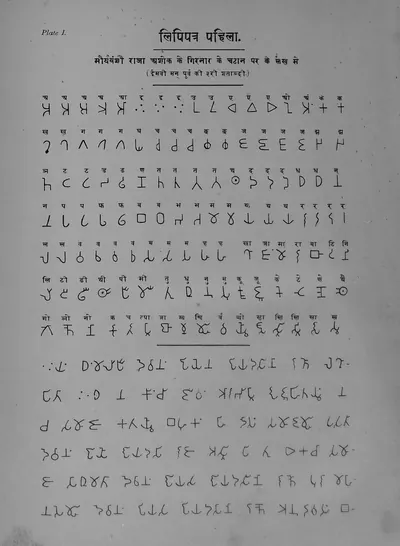 Alphabet table from Asoka's rock edict at Girnar, 3rd century BCE (Ojha, Bharatiya Prachin Lipimala, 1918, Plate 1)Book plate · 1918
 Amaravati inscription No. 4, "... Senagopasa Mudakutalasa thabho ..." ("a pillar of the General Mudakutala"), in letters of the Mauryan type (Burgess 1887, Pl. LVI, No. 4)Inscription rubbing · 1887
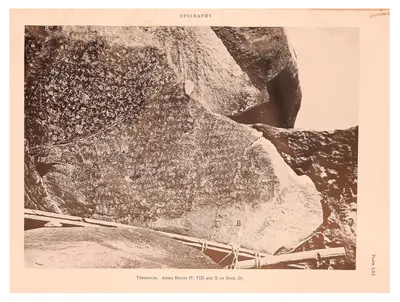 Erragudi: "Yerragudi. Asoka Edicts IV, VIII and X on Rock B" (ASI Annual Report 1928-29, Pl. LXI)Historic photograph · 1933
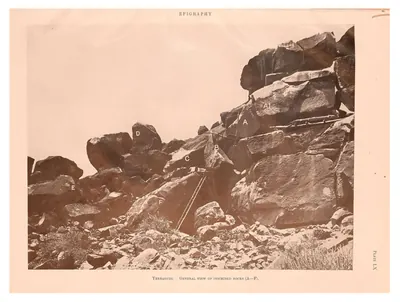 Erragudi: "Yerragudi. General view of inscribed rocks (A-F)" (ASI Annual Report 1928-29, Pl. LX)Historic photograph · 1933
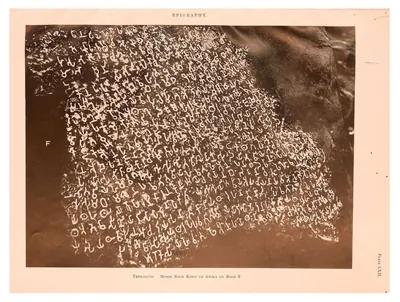 Erragudi: "Yerragudi. Minor Rock Edict of Asoka on Rock F" (ASI Annual Report 1928-29, Pl. LXII)Historic photograph · 1933
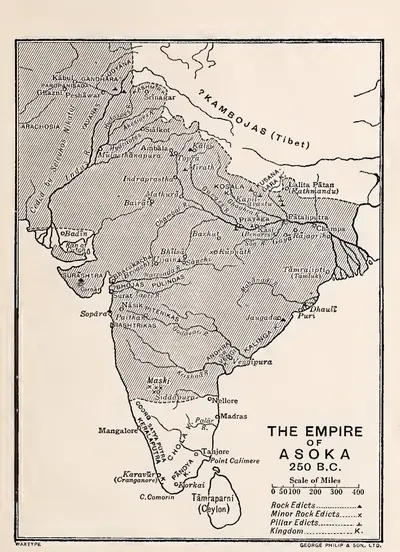 The Empire of Asoka, 250 B.C. (Smith 1920, map at end)Map · 1920
Related
People
Chandragupta Maurya
c. 322 BCE – 296 BCE
Founder of the Maurya empire (reigned c. 322–296 BCE). His empire probably did not reach the Telugu country, but Megasthenes, the Greek envoy at his court, described the Andhras and the Kalingas as powerful peoples with kings and armies of their own.
Bindusara
c. 296 BCE – 268 BCE
Second Maurya emperor (reigned c. 296–268 BCE), son of Chandragupta and father of Asoka. Later writers believed he carried Mauryan rule into the south. But no record says when the Telugu country came under the empire.
Asoka
c. 268 BCE – 226 BCE
Third Maurya emperor (3rd century BCE). His edicts at Erragudi and Rajula-Mandagiri in Kurnool district are among the oldest written records found in Andhra Pradesh. His Kalinga war reached the coast north of the Godavari, and his Rock Edict XIII names the Andhras.
Inscriptions
Erragudi edicts of Asoka
c. 250 BCE
Asoka's fourteen Rock Edicts and his Minor Rock Edicts I–II, carved on six boulders of the Yenakonda hill near Erragudi in Kurnool district in the mid-3rd century BCE. They were found in 1928.
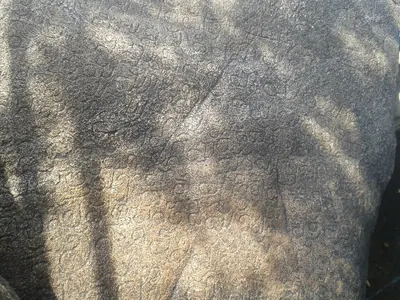
Rajula-Mandagiri inscription of Asoka
c. 250 BCE
A badly weathered 15-line copy of Asoka's Minor Rock Edicts I–II on a rock beside the Ramalingesvara temple at Rajula-Mandagiri near Pattikonda, Kurnool district. A Mackenzie surveyor copied part of it around 1800, and the stone was found again in 1953.
References
Notes (0)
Sources (20)
Spotted an error on this page? Tell us
Last updated: