Fateh Ali Khan, Nawab of Banganapalle
Ruler of Banganapalle from 1868 to 1905, and its first ruler to hold the hereditary title of Nawab, granted in 1876. He was born in 1848, a nephew and son-in-law of Ghulam Muhammad Ali Khan. The Madras government accepted him over the claims of his uncle's widow and of a son-in-law. He was made a Companion of the Star of India. He reorganised the State's courts, police, jail and dispensary, and borrowed three lakhs of rupees from the government in 1877. In January 1905 he was removed from the direct running of the State for bad government, and he died three months later.
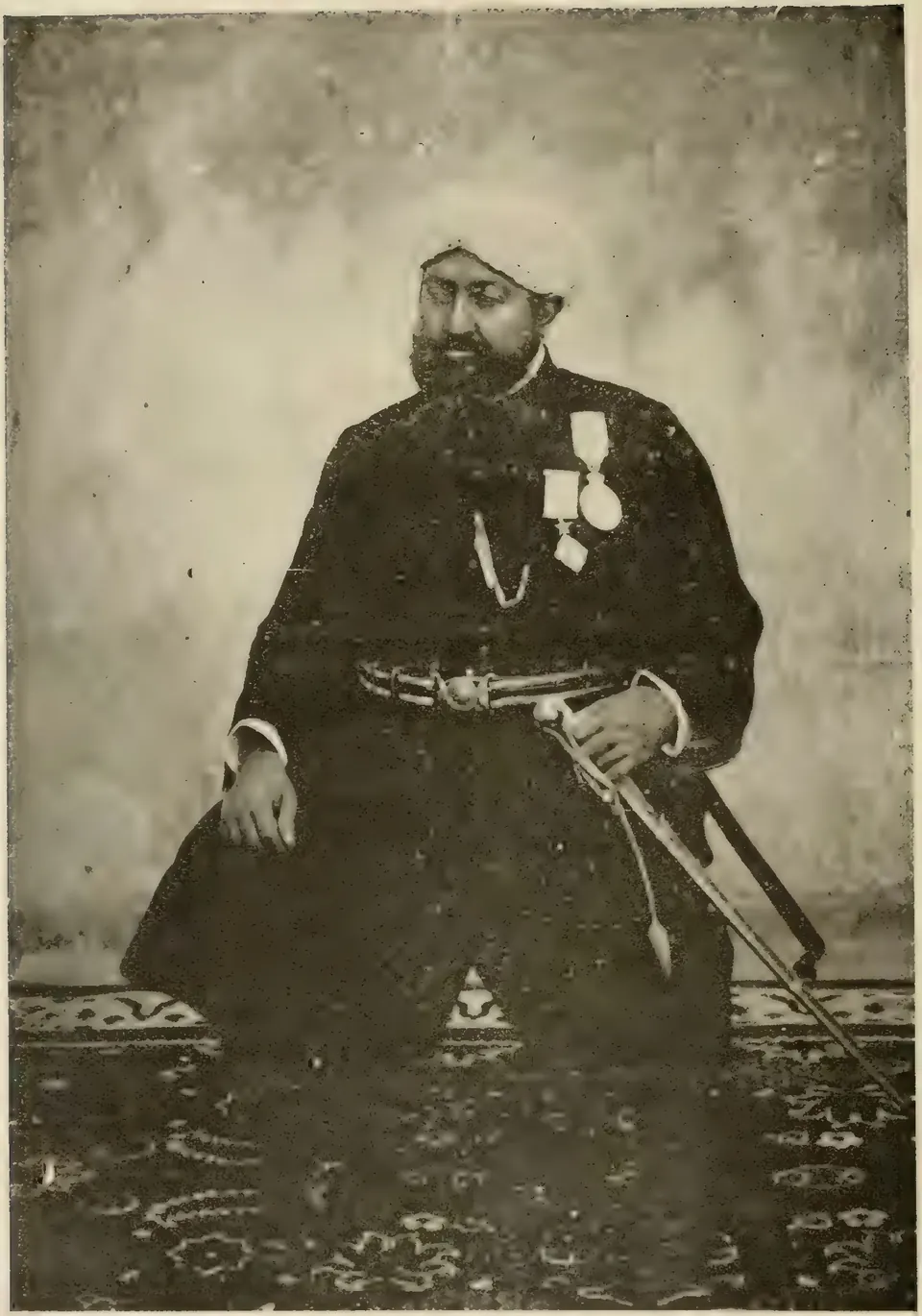
Fateh Ali Khan ruled Banganapalle for thirty-seven years, the longest reign of the line under British rule.12 A. Vadivelu opened his Aristocracy of Southern India (1903) with a life of “His Highness the Nawab Saiyid Fateh Ali Khan Bahadur, c.s.i., the present ruler of Banganapalli”.12 The book carries his photograph.12
Roper Lethbridge’s Golden Book of India (1893) records that he was born on 10 July 1848 and became ruler in 1868.3 It says he was “a Shiah Muhammadan, and a Sayyid (or descendant of the Prophet)”.3 See the Banganapalle State.
Family
Fateh Ali Khan was the son of Asad Ali Khan, the elder brother of Ghulam Muhammad Ali Khan.45 He married his uncle’s daughter, Abasi Begum.45
Vadivelu says that after a quarrel between his father and his uncle, the family had to leave the jagir (land grant) for Hyderabad.46 He spent most of his youth there and learned Persian, Arabic and Hindustani.46 His first wife died after three years, and he then married into the family of Nur-ul-Umara of Hyderabad.46
By his first wife he had three sons, Ghulam Ali Khan, Asad Ali Khan and Husain Ali Khan, and a daughter.6 See Ghulam Muhammad Ali Khan.
The succession of 1868
His uncle died in October 1868.6 The succession was then disputed by three people: the widow, Imdad Husaini Begum; Nazim-ud-daula, who had married the late ruler’s eldest daughter; and Fateh Ali Khan.6
The Madras government found that he was, “after his father Asad Ali Khan who advances no claim to the succession, the nearest heir in the sense of the Sunnud of 1849”.7 He was married to a daughter of the late jagirdar (holder of the land grant).7 He had also been named successor in a deed of 22 June 1866.7 The government ordered that a sanad (grant) be issued to him “and his heirs for ever”.7
Chase, the Collector of Kurnool, installed him.8 Aitchison’s collection (1892) adds that the estate “has been exempted from the payment of nazarana on succession”.9 (Nazarana was a fee paid on succession.) The widow went on defying him.810 The government then told the Collector to make her understand “that his authority must be respected”.810
Nawab, 1876
A sanad of Lord Northbrook dated 24 January 1876 gave him “the title of Nawab as a hereditary distinction to be assumed by your successors”.11 Aitchison says that the Nawab “is not entitled to a salute”.93 He says he was made a Companion of the Star of India in 1878.93 Lethbridge dates the honour to 1 January 1877, when Queen Victoria was proclaimed Empress of India.93
Vadivelu says that at Madras the Prince of Wales gave him a silver medal and a double-barrelled revolver.121311 He describes the ceremonies when the Nawab visited the Governor of Madras in 1895 and the Viceroy in 1892.121311
Government
Under the old system, a single amildar (revenue officer) helped the jagirdar hear every case.1415 Vadivelu credits Fateh Ali Khan with replacing it by four offices:1415
- a tahsildar in charge of the revenue and the treasury
- a magistrate
- a munsif (civil judge) for civil suits up to 3,000 rupees
- a Sadar Court with the Nawab at its head1415
Vadivelu also credits him with a new jail, a trained police force, a dispensary “worked on English lines” and schools, including an English school at the capital.1415
The Kurnool manual says that in 1877 he “was allowed by Government a loan of 3 lakhs of rupees to extricate him from his difficulties”.16 He was paying it back at 30,000 rupees a year.16 Aitchison says that in 1880 and 1881 the making of earth-salt in the State was stopped, for a yearly payment of 3,000 rupees.9 In 1891 his force numbered 103 irregular foot soldiers or police “and 2 unmounted guns of an obsolete pattern”.9
Removal and death
The Imperial Gazetteer (1908) says that “in consequence of his misgovernment, he was removed in January, 1905, from the direct administration of the State”.17 The State “was placed under the management of an Assistant Political Agent”.17 It goes on: “The Nawab died three months later, and has been succeeded by his son Saiyid Ghulam Ali Khan”.17
It adds that the “late Nawab” had had the State surveyed by a British survey party, with a view to fixing the revenue.1819 The Nawab had also built a road from his capital to the railway station at Panyam.1819
Where the sources disagree
- The title of Nawab. Aitchison, Lethbridge, the Kurnool manual and the Imperial Gazetteer date it to 1876, and Vadivelu prints the sanad of 24 January 1876.9320171121 Thurston’s Madras Presidency (1913) says that “in 1871, the Muhammadan head of the State received the hereditary title of Nawab”.9320171121
- The Star of India. Aitchison dates his appointment to 1878, Lethbridge to 1 January 1877.93
Footnotes
-
A. Vadivelu, The Aristocracy of Southern India (1903), p. 1 (archive.org (opens in a new tab)). ↩ ↩2 ↩3
-
Vadivelu, Aristocracy of Southern India (1903), plate facing p. 1, “H. H. The Nawab of Banganapally, C. S. I.” (archive.org (opens in a new tab)). ↩ ↩2 ↩3
-
Roper Lethbridge, The Golden Book of India (1893), p. 50, “Banganapale” (archive.org (opens in a new tab)). ↩ ↩2 ↩3 ↩4 ↩5 ↩6 ↩7 ↩8
-
Vadivelu, Aristocracy of Southern India (1903), p. 13 (archive.org (opens in a new tab)). ↩ ↩2 ↩3 ↩4 ↩5
-
Vadivelu, Aristocracy of Southern India (1903), p. 15, quoting the Madras government’s order on the succession (archive.org (opens in a new tab)). ↩ ↩2
-
Vadivelu, Aristocracy of Southern India (1903), p. 14 (archive.org (opens in a new tab)). ↩ ↩2 ↩3 ↩4 ↩5 ↩6
-
Vadivelu, Aristocracy of Southern India (1903), p. 18 (archive.org (opens in a new tab)). ↩ ↩2 ↩3 ↩4
-
Vadivelu, Aristocracy of Southern India (1903), p. 19 (archive.org (opens in a new tab)). ↩ ↩2 ↩3
-
C. U. Aitchison, A Collection of Treaties, Engagements and Sanads, Vol. VIII (1892), Part I, p. 98, “Banganapalle” (archive.org (opens in a new tab)). ↩ ↩2 ↩3 ↩4 ↩5 ↩6 ↩7 ↩8 ↩9
-
Vadivelu, Aristocracy of Southern India (1903), p. 20 (archive.org (opens in a new tab)). ↩ ↩2
-
Vadivelu, Aristocracy of Southern India (1903), p. 26 (archive.org (opens in a new tab)). ↩ ↩2 ↩3 ↩4 ↩5
-
Vadivelu, Aristocracy of Southern India (1903), p. 22 (archive.org (opens in a new tab)). ↩ ↩2
-
Vadivelu, Aristocracy of Southern India (1903), p. 25 (archive.org (opens in a new tab)). ↩ ↩2
-
Vadivelu, Aristocracy of Southern India (1903), p. 29 (archive.org (opens in a new tab)). ↩ ↩2 ↩3 ↩4
-
Vadivelu, Aristocracy of Southern India (1903), p. 30 (archive.org (opens in a new tab)). ↩ ↩2 ↩3 ↩4
-
Narahari Gopalakristnamah Chetty, A Manual of the Kurnool District (1886), p. 251 (archive.org (opens in a new tab)). ↩ ↩2
-
Imperial Gazetteer of India, Provincial Series: Madras, Vol. II (1908), p. 474, “Banganapalle State” (archive.org (opens in a new tab)). ↩ ↩2 ↩3 ↩4 ↩5
-
Imperial Gazetteer: Madras, Vol. II (1908), p. 475 (archive.org (opens in a new tab)). ↩ ↩2
-
Imperial Gazetteer: Madras, Vol. II (1908), p. 476 (archive.org (opens in a new tab)). ↩ ↩2
-
Chetty, Kurnool District (1886), p. 249 (archive.org (opens in a new tab)). ↩ ↩2
-
Edgar Thurston, The Madras Presidency, with Mysore, Coorg and the Associated States (1913), p. 5 (archive.org (opens in a new tab)). ↩ ↩2
Photos
Related
Dynasties
References
Notes (0)
Sources (6)
Spotted an error on this page? Tell us
Last updated: