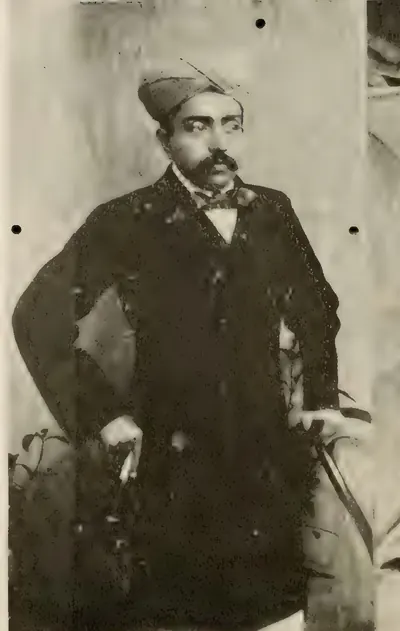
Ghulam Muhammad Ali Khan of Banganapalle
Jagirdar of Banganapalle from 1848 to 1868, called Ghulam Ali Khan in the treaties and in the family history. A grandson of Mansur-ud-daula, he was adopted by his uncle Husain Ali Khan and married to his daughter. In 1848 the Madras government handed back the jagir after clearing the family's debts, but Husain Ali Khan died before his sanad (grant) was issued. Ghulam Ali Khan received the sanad of 1849, with civil and criminal jurisdiction short of the death penalty. In 1862 he received the Crown's sanad permitting succession under Muslim law. He was made a Companion of the Star of India and died on 7 October 1868.
Ghulam Muhammad Ali Khan was the first ruler of Banganapalle to hold it under a written grant from the British. The Kurnool manual (1886) and the Imperial Gazetteer (1908) call him Ghulam Muhammad Ali.12 The sanads (grants) in Aitchison’s collection of treaties and A. Vadivelu’s family history (1903) call him Ghulam Ali Khan.34 See the Banganapalle State.
Family
Ghulam Muhammad Ali Khan was the younger son of Fateh Ali Khan, the second son of Ghulam Ali Khan (Mansur-ud-daula).56 His elder brother was Asad Ali Khan.56 His uncle Husain Ali Khan, who had no son, adopted him and married him to his daughter, Imdad Husaini Begum.54
The Imperial Gazetteer accordingly calls him the “grandson of Ghulam Ali Khan”.2 Aitchison calls him Husain Ali Khan’s nephew.3 The manual says that Husain Ali Khan “had, however, adopted his nephew, Gulam Muhammad Ali, and married to him his daughter, Imdad Begum”.1 See Ghulam Ali Khan (Mansur-ud-daula).
The jagir restored, 1848–1849
The family’s debts had led the Madras government to take over the management of the jagir (land grant) in the 1820s.3 At one stage the government had meant to annex it.3 It gave up the plan when it found that the Nizam had made its continuance a condition in 1800.3 It gave three-fourths of the net revenue to the creditors.3
In 1848, Aitchison writes, “the accounts were closed, and the jagir was restored to Husain Ali Khan, the eldest surviving heir”.3 Husain Ali Khan died before a sanad confirming the grant could be issued.3 He was succeeded by his nephew, Ghulam Ali Khan, “to whom a Sanad … was issued in 1849”.3
Vadivelu quotes the government’s reasons for choosing him.6 It preferred him to his elder brother because he “was son-in-law as well as nephew to the late Hussain Ali Khan”.6 It also cited “his experience in revenue matters and his favor with his father-in-law”.6
The sanad, dated 20 March 1849, confirmed the jagir to him “free of peshcush and pecuniary demand”, that is, free of tribute and money claims.789 It gave him “the general management of the revenue and police of your jaghire, and also the duty of administering civil justice”.789 It bound him to “maintain faith and allegiance to the Honorable Company”.789
In criminal cases he was to “abstain from the punishment of mutilating criminals”.789 He was not to execute anyone without the government’s approval.789 Every transfer of land was to be reported to the Agent at Kurnool.789 Aitchison adds that “at the same time all frontier duties were abolished”.3 See Kurnool.
The adoption sanad and his death
In 1862 he received the Crown’s sanad, signed by Lord Canning.8 It assured him that if he had no natural heirs, the British Government would “permit and confirm any succession to your State which may be legitimate according to Mahomedan law”.8
He was made a Companion of the Order of the Star of India, in 1867 according to the manual and in 1861 according to Vadivelu.1011 He died on 7 October 1868 without a male heir.1213
His widow, Imdad Husaini Begum, claimed the succession.141516 So did Nazim-ud-daula, the husband of his eldest daughter, under a deed of 1863.141516 The government rejected both claims.141516 It recognised his nephew Fateh Ali Khan, whom he had named his successor in a deed executed on 22 June 1866 in the presence of the Collector of Kurnool.141516 See Fateh Ali Khan.
Footnotes
-
Narahari Gopalakristnamah Chetty, A Manual of the Kurnool District (1886), p. 248 (archive.org (opens in a new tab)). ↩ ↩2
-
Imperial Gazetteer of India, Provincial Series: Madras, Vol. II (1908), p. 473, “Banganapalle State” (archive.org (opens in a new tab)). ↩ ↩2
-
C. U. Aitchison, A Collection of Treaties, Engagements and Sanads, Vol. VIII (1892), Part I, p. 97, “Banganapalle” (archive.org (opens in a new tab)). ↩ ↩2 ↩3 ↩4 ↩5 ↩6 ↩7 ↩8 ↩9 ↩10
-
A. Vadivelu, The Aristocracy of Southern India (1903), p. 10 (archive.org (opens in a new tab)). ↩ ↩2
-
Vadivelu, Aristocracy of Southern India (1903), p. 9 (archive.org (opens in a new tab)). ↩ ↩2 ↩3
-
Vadivelu, Aristocracy of Southern India (1903), p. 16, quoting the Madras government’s order on the succession of 1868 (archive.org (opens in a new tab)). ↩ ↩2 ↩3 ↩4 ↩5
-
Aitchison, Treaties, Vol. VIII (1892), Part I, p. 99, Sanad No. XVIII (archive.org (opens in a new tab)). ↩ ↩2 ↩3 ↩4 ↩5 ↩6
-
Aitchison, Treaties, Vol. VIII (1892), Part I, p. 100, Sanads Nos. XVIII–XIX (archive.org (opens in a new tab)). ↩ ↩2 ↩3 ↩4 ↩5 ↩6 ↩7 ↩8
-
Vadivelu, Aristocracy of Southern India (1903), p. 12 (archive.org (opens in a new tab)). ↩ ↩2 ↩3 ↩4 ↩5 ↩6
-
Chetty, Kurnool District (1886), p. 249 (archive.org (opens in a new tab)). ↩
-
Vadivelu, Aristocracy of Southern India (1903), p. 13 (archive.org (opens in a new tab)). ↩
-
Vadivelu, Aristocracy of Southern India (1903), p. 14 (archive.org (opens in a new tab)). ↩
-
Aitchison, Treaties, Vol. VIII (1892), Part I, p. 98 (archive.org (opens in a new tab)). ↩
-
Vadivelu, Aristocracy of Southern India (1903), p. 15 (archive.org (opens in a new tab)). ↩ ↩2 ↩3 ↩4
-
Vadivelu, Aristocracy of Southern India (1903), p. 17 (archive.org (opens in a new tab)). ↩ ↩2 ↩3 ↩4
-
Vadivelu, Aristocracy of Southern India (1903), p. 18 (archive.org (opens in a new tab)). ↩ ↩2 ↩3 ↩4
Related
Dynasties
References
Notes (0)
Sources (4)
Spotted an error on this page? Tell us
Last updated: