Ganda-Trinetra (Vaidumba)
Vaidumba Maharaja of the Renandu country in the late 9th century, known from hero-stones near Madanapalle in early Telugu and Kannada. Three of them were edited by R. S. Panchamukhi in 1938. They place him in the wars against the Nolamba king Mahendra and the Gangas, culminating in the battle at Soremati, where he fought on the side of the Bana king Vijayaditya II. The battle has been dated about 877–78, about 885 and 900.
Ganda-Trinetra was a king of the Vaidumbas in the late 9th century.12 His records are hero-stones near Madanapalle, in the old Chittoor district.3 He is remembered for the battle at Soremati, fought against the Nolambas and Gangas.32
The hero-stones
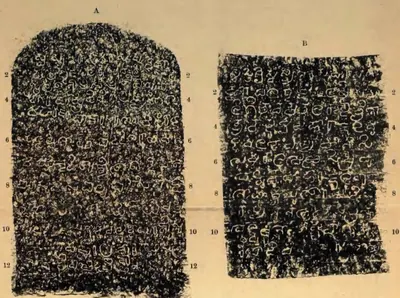
R. S. Panchamukhi edited three inscriptions of his reign in 1938.3 They had been copied in 1905, 1906 and 1922.3 The first is on a slab in a field west of Basinikonda, near Madanapalle.3 Its script, Telugu-Kannada of the 9th century, resembles that of the Bana and Chola records of the Punganur and Kadapa (then Cuddapah) country.3 Its language is ancient Kannada.3
This record tells of the death of a hero in a fight near the fort of Soremati.3 In Panchamukhi’s reading, the Maharaja (Ganda-Trinetra) and a Bana chief raided the fort.34 The Nolamba, Dadiga, Rachamalla, Mayindadi and Gundige-gulla gathered their forces against them.3 The record is dated in the reign of Vaidumba-Maharaja Ganda-Trinetra.3 A third record, at Veligallu, is partly in archaic Telugu and partly in Kannada.4
Panchamukhi noted that Manuja-Trinetra and Ganda-Trinetra are both said to have ruled the Renandu Seven Thousand country.1 Sewell and Aiyangar (1932) thought Manuja-Trinetra was probably the same man.5
Soremati
Sewell and Aiyangar described the battle.2 The Nolamba king Mahendra’s generals raided Pulinadu, the Bana country round Punganur.2 The Bana chief Vira-Chulamani, Vijayaditya II, attacked them, helped by Ganda-Trinetra.2 At Soremati the Nolamba and Ganga allies were beaten back.2
V. Venkayya (1912) had already linked a hero-stone at Madanapalle with a battle at Soremati.6 He thought it probably took place in Ganda-Trinetra’s reign.6 See Vijayaditya II and Mahendra I.
Where the sources disagree
The date of Soremati, and so of Ganda-Trinetra, is uncertain.278
- Sewell and Aiyangar put the battle about 877–78.2
- Panchamukhi argued for about 885.7
- The Cuddapah gazetteer of 1915 gave 900.8
Footnotes
-
Panchamukhi, “Three Inscriptions” (1938), p. 185 (archive.org (opens in a new tab)). Paraphrased. ↩ ↩2
-
Sewell and Aiyangar, Historical Inscriptions of Southern India (1932), p. 38 (archive.org (opens in a new tab)). Paraphrased. ↩ ↩2 ↩3 ↩4 ↩5 ↩6 ↩7 ↩8
-
R. S. Panchamukhi, “Three Inscriptions of Vaidumba-Maharaja Gandatrinetra”, Epigraphia Indica XXIV (1937–38), p. 183 (archive.org (opens in a new tab)). Paraphrased. ↩ ↩2 ↩3 ↩4 ↩5 ↩6 ↩7 ↩8 ↩9 ↩10 ↩11
-
Panchamukhi, “Three Inscriptions” (1938), p. 184 (archive.org (opens in a new tab)). Paraphrased. ↩ ↩2
-
Robert Sewell and S. Krishnaswami Aiyangar, The Historical Inscriptions of Southern India (1932), p. 35 (archive.org (opens in a new tab)). Paraphrased. ↩
-
V. Venkayya, “Five Bana Inscriptions from Gudimallam”, Epigraphia Indica XI (1911–12), p. 235 (archive.org (opens in a new tab)). ↩ ↩2
-
Panchamukhi, “Three Inscriptions” (1938), p. 189 (archive.org (opens in a new tab)). Paraphrased. ↩ ↩2
-
C. F. Brackenbury, Madras District Gazetteers: Cuddapah (1915), p. 29 (archive.org (opens in a new tab)). ↩ ↩2
Photos
References
Notes (0)
Sources (4)
Spotted an error on this page? Tell us
Last updated: