Vijayaditya II Prabhumeru (Bana)
Bana king of the country west of the Andhra road (the Chittoor country), also called Prabhumeru, Vira-Chulamani and Mahavali-Vanaraya. He was the son of Vikramaditya Jayameru (Banavidyadhara) and the father of Vikramaditya II, donor of the Gudimallam plates. His stone records at Gudimallam and in the Kolar country are dated Saka 820, 827 and 831 (898, 905 and 909), with no overlord named. He drove back the Nolamba invasion of Pulinadu and fought, with the Vaidumbas, at Soremati.
Vijayaditya II, also called Prabhumeru, was a king of the Banas about 900.1 He ruled the country round Punganur and Gudimallam, in the old Chittoor district.23 His records are dated from Saka 820 (Saka is an Indian way of counting years) to Saka 831, that is from 898 to 909.1
Family and names
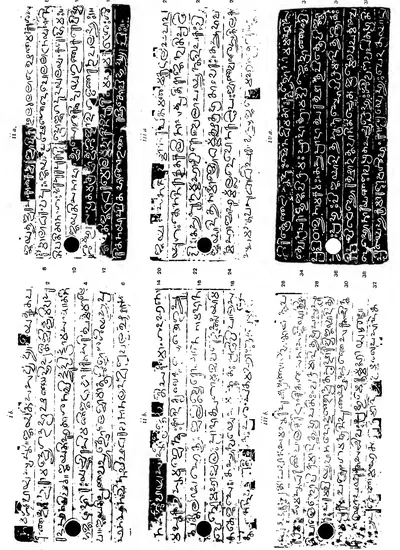
The Gudimallam plates make him the son of Jayameru, also called Vikramaditya.4 His own son was Vikramaditya, the donor of those plates.4 E. Hultzsch (1924) showed from the plates that he was the Prabhumeru of the older Udayendiram plates.4 He also bore the title Vira-Chulamani, according to the epigraphical report for 1912–13.2
A Gudimallam record of Saka 820 names him as a son of the chief queen of Banavidyadhara.13 Hultzsch took Banavidyadhara to be his father, Vikramaditya Jayameru.1
His records
Three of his records have Saka dates.1
- Saka 820 (898): a gift of thirty kalanju (a gold weight) of gold for a lamp and offerings at the Parasuramesvara temple at Gudimallam.3
- Saka 827 (905): a perpetual lamp at the same temple, paid for by a headman of Viramangalam.56
- Saka 831 (909): a record in the Kolar country.1
None of them names an overlord.7 V. Venkayya (1912) explained this by the times.7 The Ganga-Pallava kings, the old overlords of the Banas, had fallen.7 The Cholas had not yet taken their place in this country.7
The Nolamba invasion
In his time the Nolamba king Mahendra sent two officers to seize Pulinadu, the home district of the Banas.2 They burnt the town of Perravi.2 According to an inscription at Kalakattur, Vira-Chulamani set out with his army and scattered the enemy.2 A record at Punganur says that Koyarrur (Laddigam, near Punganur) was attacked in his reign by a chief named Kaduvatti Muttarasa.2
Sewell and Aiyangar (1932) linked these events with the battle of Soremati.8 There, they wrote, Vira-Chulamani and the Vaidumba chief Ganda-Trinetra beat back the Nolamba and Ganga forces.8 They thought he was then probably still a prince, fighting for his father.8 See the Vaidumbas.
The same report noted Bana records in the Kolar country.9 They show that the Banas for a time held the Ganga district of Gangarusasira.9 Its author suggested that this was a counter-attack against the Nolambas.9
Footnotes
-
Hultzsch, “Gudimallam Plates” (1924), p. 3 (archive.org (opens in a new tab)). ↩ ↩2 ↩3 ↩4 ↩5 ↩6
-
H. Krishna Sastri, Annual Report on Epigraphy, Southern Circle, for 1912–13, Part II, para. 13, p. 91 (archive.org (opens in a new tab)). ↩ ↩2 ↩3 ↩4 ↩5 ↩6
-
V. Venkayya, “Five Bana Inscriptions from Gudimallam”, Epigraphia Indica XI (1911–12), p. 227 (archive.org (opens in a new tab)). ↩ ↩2 ↩3
-
E. Hultzsch, “Gudimallam Plates of the Bana King Vikramaditya II”, Epigraphia Indica XVII (1923–24), p. 2 (archive.org (opens in a new tab)). ↩ ↩2 ↩3
-
Venkayya, “Five Bana Inscriptions” (1912), p. 228 (archive.org (opens in a new tab)). ↩
-
Sewell and Aiyangar, Historical Inscriptions of Southern India (1932), p. 41 (archive.org (opens in a new tab)). Paraphrased. ↩
-
Venkayya, “Five Bana Inscriptions” (1912), p. 237 (archive.org (opens in a new tab)). ↩ ↩2 ↩3 ↩4
-
Robert Sewell and S. Krishnaswami Aiyangar, The Historical Inscriptions of Southern India (1932), pp. 38–39 (archive.org (opens in a new tab)). Paraphrased. ↩ ↩2 ↩3
-
Krishna Sastri, Annual Report on Epigraphy for 1912–13, Part II, para. 15, p. 92 (archive.org (opens in a new tab)). ↩ ↩2 ↩3
Photos
References
Notes (0)
Sources (4)
Spotted an error on this page? Tell us
Last updated: