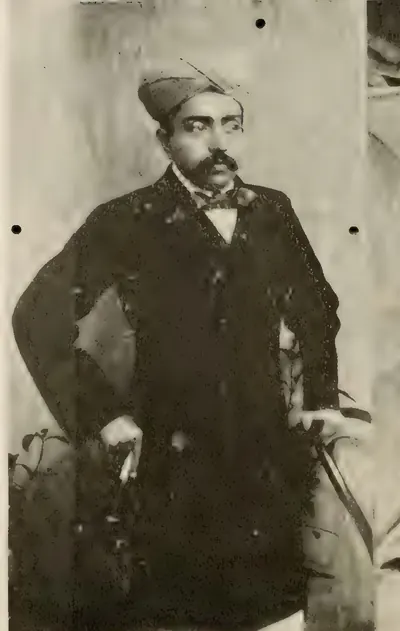
Ghulam Ali Khan (Mansur-ud-daula) of Banganapalle
Jagirdar (holder of the land grant) of Banganapalle from 1790 to the early 1820s, titled Mansur-ud-daula. The family later regarded him as the founder of the State. A son of Husain Ali Khan, he was confirmed in the jagir by Tipu Sultan in 1783 and at once expelled. With his uncle Asad Ali Khan and troops from the Nizam he won it back at Tammadapalle in 1790. He lived mostly at Hyderabad and fought in the Nizam's army, and he lost the use of his right hand against the Marathas. Under the cession of 1800 the jagir passed under the Company's control free of tribute. Before his death he divided villages among his relatives as sub-jagirs and placed his son Husain Ali Khan on the musnad (throne).
Ghulam Ali Khan held Banganapalle for about thirty years after it was won back from Tipu Sultan.1 The family’s later chroniclers called him “Mansurud-daulah, the founder of the State”.1 The Imperial Gazetteer (1908) says that “the present family traces its descent from Ghulam Ali Khan”.2
Chetty’s Kurnool manual (1886) calls the same man Muhammad Ali Khan in one passage.3 There he is “the jaghiredar of Banganapalle” (holder of the land grant), who “was honored with the title of Mansur-ud-daulah and resided at Hyderabad”.3 See the Banganapalle State.
Family and exile
Ghulam Ali Khan was the eldest of the four sons of Husain Ali Khan.4 The others were Mustafa Ali Khan, Ahmad Ali Khan and Fateh Ali Khan, the youngest.4 Fateh Ali Khan was killed at Tammadapalle in 1790.4
A. Vadivelu’s family history (1903) says that their father had served Haidar Ali in Mysore.56 He died on his way home after Tipu’s accession.56 The widow was slow to bring her young sons to Tipu’s capital.56 So “the over-exacting and impulsive Tippu Sultan” ordered the jagir (land grant) confiscated.56 She took the boys to Hyderabad, where the Nizam Nizam Ali Khan noticed them.56 His minister granted each boy an allowance of 3,000 rupees a year.56 See Haidar Ali and Nizam Ali Khan.
Among the Madras records the Imperial Gazetteer found a translation of a letter of Tipu, dated 1783.7 It praised “the recently deceased Husain Ali Khan” and conferred the jagir on his son Ghulam Ali Khan.7 But Tipu “at once resumed the jagir” (took it back) “and expelled Ghulam Ali Khan”.7 Letters of the same year summon him and “refuse to accept his excuses for not coming”.7 See Tipu Sultan.
Recovery and the Nizam’s wars
About seven years later Ghulam Ali Khan and his uncle Asad Ali Khan, with troops from the Nizam, beat Tipu’s officer at Tammadapalle and recovered the country.47 Chetty dates the battle to 1203 of the Hijra (1790).4 Ghulam Ali Khan then “assumed the management of Banganapalle territory, leaving Chenchelimala to his uncle”.3 His uncle gave him his daughter in marriage, and later Chenchelimala as well.3 See Asad Ali Khan.
Vadivelu says that he “remained for the most part of his time at Hyderabad”.8 There he “fought the battles of the Nizam, side by side with the English, against their common enemies”.8 Vadivelu writes that “in a battle against the Maharattas, he lost the fingers of his right hand”.8 This ended his career as a soldier.8
Chetty says that he fought at “the battle of Kurdla against the Mahrattas and received a wound in his right arm”.3 Chetty dates it to “Hejairi 1230 or A.D. 1794”, but the battle of Kharda was fought in 1795.3 See Kharda.
Under the Company
In 1800 the Nizam transferred his control over Banganapalle to the Company with the Ceded Districts. The partition treaty had rated the territory at 45,000 Kanthirayi pagodas, “or Rs. 1,31,250”.3 But at the Nizam’s request “the tribute was remitted by the British Government” (let off).3
The Imperial Gazetteer says that the Company at first took no tribute and used no authority there.2 It adds that “the jagirdar as late as 1821 seemed to consider himself still dependent on the Nizam”.2 It says he usually lived at Hyderabad, and that civil and criminal justice had nearly come to a stop.2
He made, the Imperial Gazetteer says, “a settlement in 1820 with a view to prevent future disputes among his relatives”.9 Under it he gave villages, called sub-jagirs, to his cousins and other members of the family.9 Chetty adds a condition: a sub-jagir should go back to the head of the family if its holder died without heirs.3
Succession and death
He had two sons, Husain Ali Khan and Fateh Ali Khan. Chetty says that he placed the elder on the musnad (throne) in his lifetime, in 1237 of the Hijra (1821).3 He died, Chetty says, on 17 Shawwal 1240 (1824), “after a reign of thirty-two years”.3
Vadivelu says that he gave Banganapalle to Husain Ali Khan, while the second son already held a jagir at Hyderabad.10 In Vadivelu’s account he died three years later, in 1822.10 See Ghulam Muhammad Ali Khan, his grandson.
Footnotes
-
A. Vadivelu, The Aristocracy of Southern India (1903), p. 13 (archive.org (opens in a new tab)). ↩ ↩2
-
Imperial Gazetteer of India, Provincial Series: Madras, Vol. II (1908), p. 473, “Banganapalle State” (archive.org (opens in a new tab)). ↩ ↩2 ↩3 ↩4
-
Narahari Gopalakristnamah Chetty, A Manual of the Kurnool District (1886), p. 248 (archive.org (opens in a new tab)). ↩ ↩2 ↩3 ↩4 ↩5 ↩6 ↩7 ↩8 ↩9 ↩10 ↩11
-
Chetty, Kurnool District (1886), p. 247 (archive.org (opens in a new tab)). ↩ ↩2 ↩3 ↩4 ↩5
-
Vadivelu, Aristocracy of Southern India (1903), p. 6 (archive.org (opens in a new tab)). ↩ ↩2 ↩3 ↩4 ↩5 ↩6
-
Vadivelu, Aristocracy of Southern India (1903), p. 7 (archive.org (opens in a new tab)). ↩ ↩2 ↩3 ↩4 ↩5 ↩6
-
Imperial Gazetteer: Madras, Vol. II (1908), p. 472 (archive.org (opens in a new tab)). ↩ ↩2 ↩3 ↩4 ↩5
-
Vadivelu, Aristocracy of Southern India (1903), p. 8 (archive.org (opens in a new tab)). ↩ ↩2 ↩3 ↩4
-
Imperial Gazetteer: Madras, Vol. II (1908), p. 477 (archive.org (opens in a new tab)). ↩ ↩2
-
Vadivelu, Aristocracy of Southern India (1903), p. 9 (archive.org (opens in a new tab)). ↩ ↩2
Related
Dynasties
References
Notes (0)
Sources (3)
Spotted an error on this page? Tell us
Last updated: