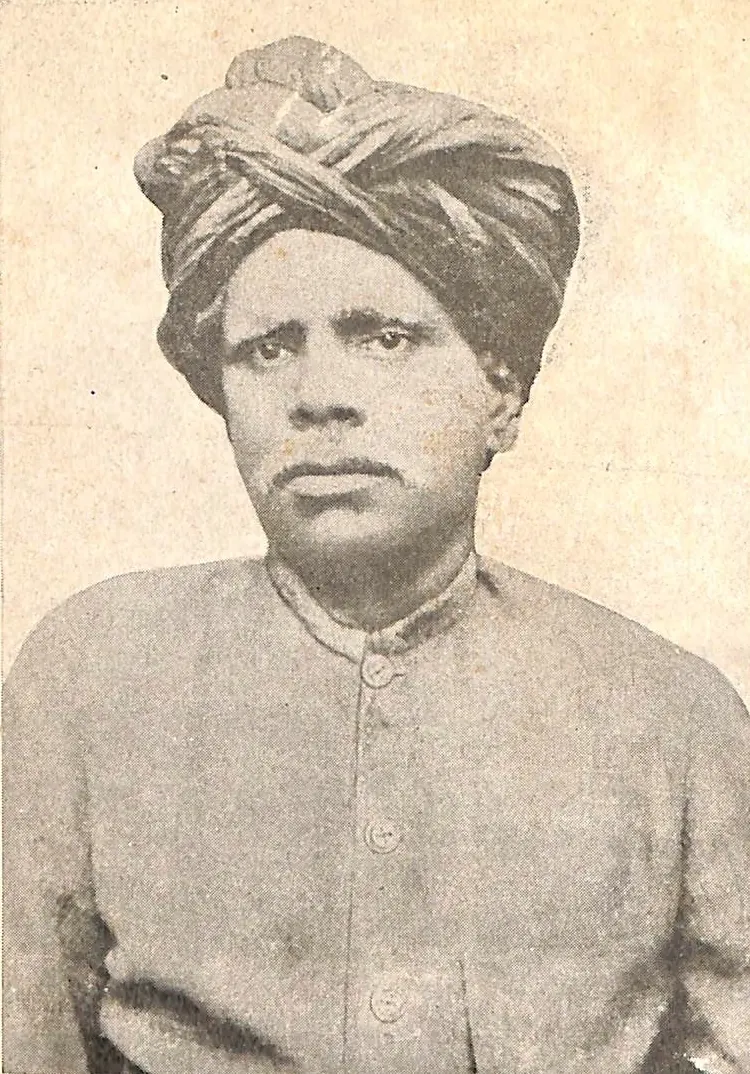
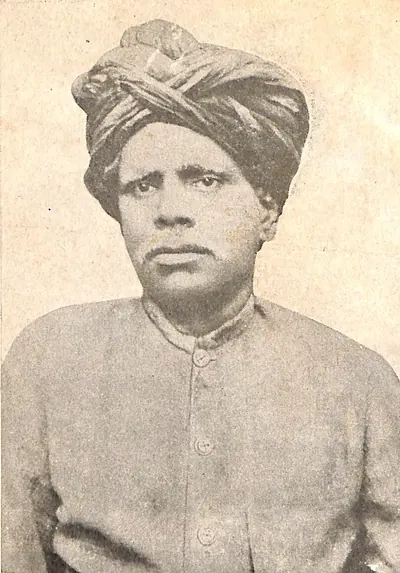
Kandukuri Veeresalingam
Social reformer, journalist and writer of Rajahmundry (1848–1919). He worked for the education of girls and the remarriage of widows, and conducted the first widow remarriage in the Madras Presidency in 1881. He wrote the early Telugu social novel Rajasekhara Charitramu.
Early life
Kandukuri Veeresalingam was born at Rajahmundry on 16 April 1848 into a Niyogi Brahmin family.1 His father died when he was four, and his mother and a paternal uncle brought him up.1
He joined the Government District School in 1860.2 At about thirteen he was married to a girl of nine, Bapamma, later called Rajyalakshmi.2 He passed the entrance examination in 1870.2 He chose teaching rather than government service or the law. He taught at Rajahmundry, Korangi and Dhavaleswaram.3
At Dhavaleswaram in 1874 he started a girls’ school with friends.3 According to his biographer D. Anjaneyulu, it was one of the earliest such private schools in the Andhra region.3
Journalist
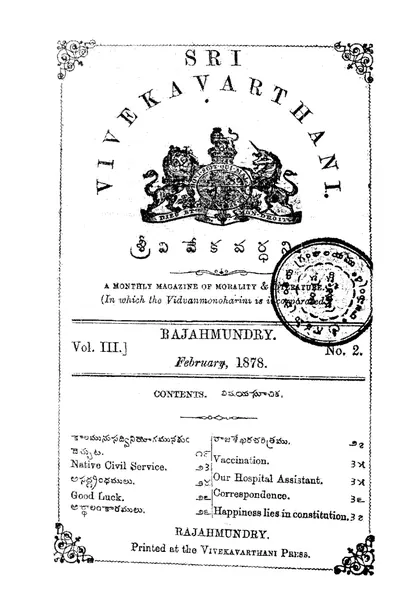
In 1874 Veeresalingam began a journal, Vivekavardhini, which he soon printed on his own press at Rajahmundry. In it he attacked bribery among local officials, the sale of pleaders’ certificates, and the custom of officials keeping dancing girls. One exposure was built on drafts of judgments found in a lawyer’s waste paper, and it led to an inquiry and the dismissal of several court officials.4
He carried on a long quarrel in print with Kokkonda Venkataratnam Pantulu, a defender of orthodox custom.5 He answered Kokkonda’s arguments against educating women with satire.5
Widow remarriage
From 1879 Veeresalingam lectured in favour of the remarriage of child widows. He cited the smritis (law books) as well as arguments from reason. His first lecture was given at Rajahmundry on 3 August 1879. Opponents tried to break up his meetings, and his students formed a bodyguard for him.6
With friends he founded an association for widow remarriage, and found money from Pydah Ramakrishnaiah, a merchant of Kakinada.7 On 11 December 1881 he conducted at Rajahmundry the first widow remarriage in the Madras Presidency. Priests, cooks and musicians boycotted it.8
The district police posted constables to guard the house and the procession.8 By the middle of 1884 he had arranged ten such marriages, and the families who attended faced orders of excommunication (expulsion from the caste) from a Sankaracharya.9
Religion and later work
In 1878 Veeresalingam and a few friends formed a Prarthana Samaj at his house, meeting for prayer without image worship. In 1906, Anjaneyulu writes, he gave up the sacred thread and became a full Brahmo.10 He received the title Rao Bahadur in 1893, and became Telugu pandit at the Presidency College, Madras, in 1899. In 1906 he founded the Hitakarini Samaj to carry on his widows’ home and schools at Rajahmundry, and in 1908 he gave his property and savings to it.11
The history of the freedom movement in Hyderabad names him as president of the Vignana Chandrika Parishad.12 Komarraju Lakshmana Rao set up this body to hold competitions in history, science and literature.12 Veeresalingam died at Madras on 27 May 1919.13
Writer
Veeresalingam wrote widely in Telugu prose and verse. His novel Rajasekhara Charitramu came out in parts in 1878 and as a book in 1880. It was long called the first Telugu novel. Anjaneyulu notes earlier claimants, but calls it the first social novel in the language.14 It was translated into English as Fortune’s Wheel.14
Sarojini Regani’s history of the freedom movement calls him “the father of the rennaissance movement in Andhra and the founder of modern Telugu”.15 It lists the journals he founded, including one for women.15 In them he wrote against child marriage, caste and the institution of dancing girls, and for widow remarriage.15
Footnotes
-
D. Anjaneyulu, Kandukuri Veeresalingam (1976), pp. 6–7 (archive.org (opens in a new tab)). ↩ ↩2
-
Anjaneyulu, Veeresalingam (1976), pp. 8–11 (archive.org (opens in a new tab)). ↩ ↩2 ↩3
-
Anjaneyulu, Veeresalingam (1976), pp. 12–15 (archive.org (opens in a new tab)). ↩ ↩2 ↩3
-
Anjaneyulu, Veeresalingam (1976), pp. 15–16, 19–23 (archive.org (opens in a new tab)). ↩
-
Anjaneyulu, Veeresalingam (1976), pp. 16–17 (archive.org (opens in a new tab)). ↩ ↩2
-
Anjaneyulu, Veeresalingam (1976), pp. 25–28 (archive.org (opens in a new tab)). ↩
-
Anjaneyulu, Veeresalingam (1976), pp. 28–29 (archive.org (opens in a new tab)). ↩
-
Anjaneyulu, Veeresalingam (1976), pp. 31–32 (archive.org (opens in a new tab)). ↩ ↩2
-
Anjaneyulu, Veeresalingam (1976), pp. 32–33 (archive.org (opens in a new tab)). ↩
-
Anjaneyulu, Veeresalingam (1976), pp. 37–38, 130 (archive.org (opens in a new tab)). ↩
-
Anjaneyulu, Veeresalingam (1976), pp. 64, 130 (archive.org (opens in a new tab)). ↩
-
The Freedom Struggle in Hyderabad, Vol. III (1957), p. 151 (archive.org (opens in a new tab)). ↩ ↩2
-
Anjaneyulu, Veeresalingam (1976), p. 130 (archive.org (opens in a new tab)). ↩
-
Anjaneyulu, Veeresalingam (1976), p. 88 (archive.org (opens in a new tab)). ↩ ↩2
-
Sarojini Regani, Highlights of the Freedom Movement in Andhra Pradesh (1956), pp. 18–19 (archive.org (opens in a new tab)). ↩ ↩2 ↩3
Photos
References
Notes (0)
Sources (3)
Spotted an error on this page? Tell us
Last updated: