Kulottunga II (Chola)
Chola king, son and successor of Vikrama-Chola, who reigned from the 1130s to the late 1140s. Coastal Andhra still recognised him: Telugu inscriptions at Bapatla are dated in his regnal years, the Velanandu chief Gonka II ruled at Draksharama as his vassal, and a copper-plate grant of his reign by Kolani-Katamanayaka, governor of Sarasipuri, survives as the Chellur plates (1143). The Godavari gazetteer thought the Cholas had little real power in Vengi by then.
Kulottunga II followed Vikrama-Chola as Chola king.12 He was the last Chola king whose regnal years were widely used in the inscriptions of the coastal Telugu country.34 See the Cholas of Tanjore.
Family
Hultzsch’s pedigree of 1903 makes him Vikrama-Chola’s son and the father of Rajaraja II.1 The Chellur plates of his reign call him “Kulottunga-Chodadeva II., the son of Vikrama-Choda”.2
The Chellur plates
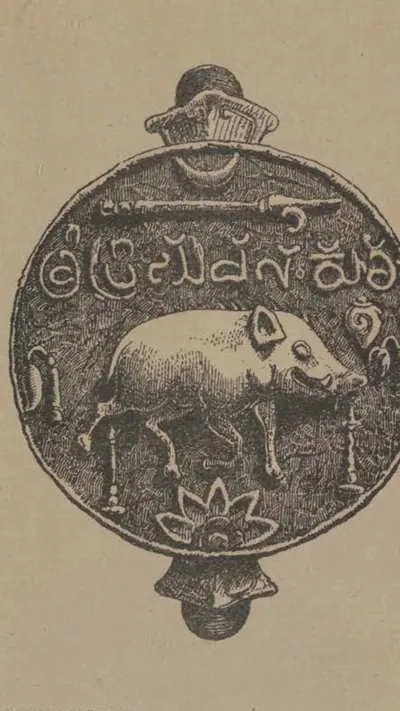
A copper-plate grant of his reign has five plates on a ring, with the Eastern Chalukya boar seal.2 J. F. Fleet edited it in 1885.2 After the usual Eastern Chalukya family tree, it names the city of Sarasipuri, in a lake in the Vengi country.2 Its governor, Kolani-Katamanayaka, granted a village with its hamlet to a number of Brahmins.25 F. Kielhorn later showed that the date given, Saka 1056 (Saka is an Indian way of counting years), was an error for 1065, which is 24 March 1143.6 See the Chellur plates of Kulottunga II.
Inscriptions in the Telugu country
Kielhorn published five dates of Kulottunga-Choda II from Telugu inscriptions in the temple at Bapatla, in the Guntur district.37 The earliest is of his 4th year, 4 August 1136.3 Another, of his 16th year, falls on 25 March 1149.7
Robert Sewell listed records of his reign at Vijayawada (then Bezwada) and in the Guntur country from 1135.4 At Draksharama, in 1138 and 1139, the Velanandu chief Gonka II appears as his vassal.8 In 1140 Katama-Nayaka of Kolanu, one of his generals in Sewell’s view, made a gift there.9 The 1942 Nellore gazetteer says that Gonka II and the Telugu Chola chiefs of Kadapa (then Cuddapah), Nellore and Kondavidu all accepted his rule.10
The Godavari District Gazetteer (1907) took a different view.1112 It wrote that after 1135 neither Vikrama-Chola “nor his successors took an active part in the government of Vengi”.11 In its view the Velanandu chiefs were the real rulers.12 See the Velanandu Chodas.
Dates
Sewell’s table gives Kulottunga II the years 1133 to 1146.13 His own note puts the accession in 1136.13 He thought Kulottunga had probably retired by 1148.14 The Bapatla inscriptions fit neither figure exactly.7
Footnotes
-
Hultzsch, South-Indian Inscriptions III, pt. II (1903), p. 196, “Pedigree of the Chola Dynasty” and note 2 (archive.org (opens in a new tab)). ↩ ↩2
-
J. F. Fleet, “Sanskrit and Old-Canarese Inscriptions, No. CLIV: Chellur Plates of Kulottunga-Chodadeva II.—Saka 1056”, Indian Antiquary XIV (1885), p. 55 (archive.org (opens in a new tab)). ↩ ↩2 ↩3 ↩4 ↩5 ↩6
-
F. Kielhorn, “Dates of Chola Kings”, Epigraphia Indica X (1909–10), p. 136, No. 186 (archive.org (opens in a new tab)). ↩ ↩2 ↩3
-
Robert Sewell and S. Krishnaswami Aiyangar, The Historical Inscriptions of Southern India (1932), p. 102 (archive.org (opens in a new tab)). Paraphrased. ↩ ↩2
-
Fleet, “Chellur Plates of Kulottunga-Chodadeva II” (1885), p. 56 (archive.org (opens in a new tab)). ↩
-
E. Hultzsch, South-Indian Inscriptions, Vol. III, pt. II (1903), p. 181 (archive.org (opens in a new tab)). ↩
-
Kielhorn, “Dates of Chola Kings”, Epigraphia Indica X, pp. 136–137, Nos. 187–190 (archive.org (opens in a new tab)). ↩ ↩2 ↩3
-
Sewell and Aiyangar, Historical Inscriptions of Southern India (1932), p. 103 (archive.org (opens in a new tab)). Paraphrased. ↩
-
Sewell and Aiyangar, Historical Inscriptions of Southern India (1932), p. 104 (archive.org (opens in a new tab)). Paraphrased. ↩
-
Gazetteer of the Nellore District, brought up to 1938 (1942), p. 43 (archive.org (opens in a new tab)). Paraphrased. ↩
-
F. R. Hemingway, Madras District Gazetteers: Godavari, Vol. I (1907), p. 22 (archive.org (opens in a new tab)). ↩ ↩2
-
Hemingway, Godavari (1907), p. 23 (archive.org (opens in a new tab)). ↩ ↩2
-
Sewell and Aiyangar, Historical Inscriptions of Southern India (1932), pp. 341–342, table of the Chola kings and notes (archive.org (opens in a new tab)). Paraphrased. ↩ ↩2
-
Sewell and Aiyangar, Historical Inscriptions of Southern India (1932), pp. 106–107 (archive.org (opens in a new tab)). Paraphrased. ↩
Photos
References
Notes (0)
Sources (6)
Spotted an error on this page? Tell us
Last updated: