Vikrama-Chola
Son of the Chola emperor Kulottunga I who governed Vengi for his father from about 1092–93 and left it in 1118 to be crowned Chola king. In his absence the Western Chalukya Vikramaditya VI took the Vengi province, holding Draksharama from 1120–21 to 1123–24; Vikrama-Chola won it back, and his records are found at Chebrolu and Nidubrolu in 1127 and 1135. An inscription of his ninth year records the building of the temple at Gudimallam, and his records are at Nandalur and Tripurantakam.
Vikrama-Chola governed Vengi for his father, the Chola emperor Kulottunga I, and then became Chola king himself.1 His departure from Vengi in 1118 let the Western Chalukyas seize the province for a few years.2 See the Cholas of Tanjore and the Eastern Chalukyas.
Family
The Teki plates, Hultzsch wrote, show that Vikrama-Choda was not the eldest son of Kulottunga I, but a younger brother of Vira-Choda, the third son.1 It was uncertain whether his mother was Madhurantaki or another queen.1 In Hultzsch’s pedigree his son was Kulottunga II and his grandson Rajaraja II.3 See Vira-Choda.
Viceroy of Vengi
His Tamil inscriptions say that he first stayed in the Vengai country and then left it to take the Chola throne.1 They also tell of a war in Kalinga, where he defeated “the Telinga or Telunga Bhima of Kulam”.12 E. Hultzsch thought his time as viceroy could not have begun before 1092–93, the last known date of his brother Vira-Choda.2 It probably lasted until his coronation in 1118.2 The Godavari District Gazetteer (1907) says he “ruled the Vengi country till about 1118”.4
The loss and recovery of Vengi
F. Kielhorn placed his coronation about 29 June 1118.5 Hultzsch thought it first made him his ageing father’s co-regent.6 A Pithapuram inscription says that after he left, Vengi “became devoid of a ruler”.12
The Western Chalukya king Vikramaditya VI took his chance.2 His inscriptions at Draksharama run from 1120–21 to 1123–24.2 Hultzsch went on: “Shortly after, Vikrama-Chola must have re-conquered his northern dominions.”2 Two of his inscriptions, at Chebrolu and Nidubrolu, are dated in 1127 and 1135.2
The Godavari gazetteer agrees that Vikramaditya was “undisputed king of Vengi” from 1120 to 1124.4 Robert Sewell found Vikramaditya’s general ruling the Vengi country in December 1118.7 He found Vikrama-Chola again supreme at Chebrolu by 1127.8 See the Tripurantakam inscription of Anantapala.
In the southern Telugu districts
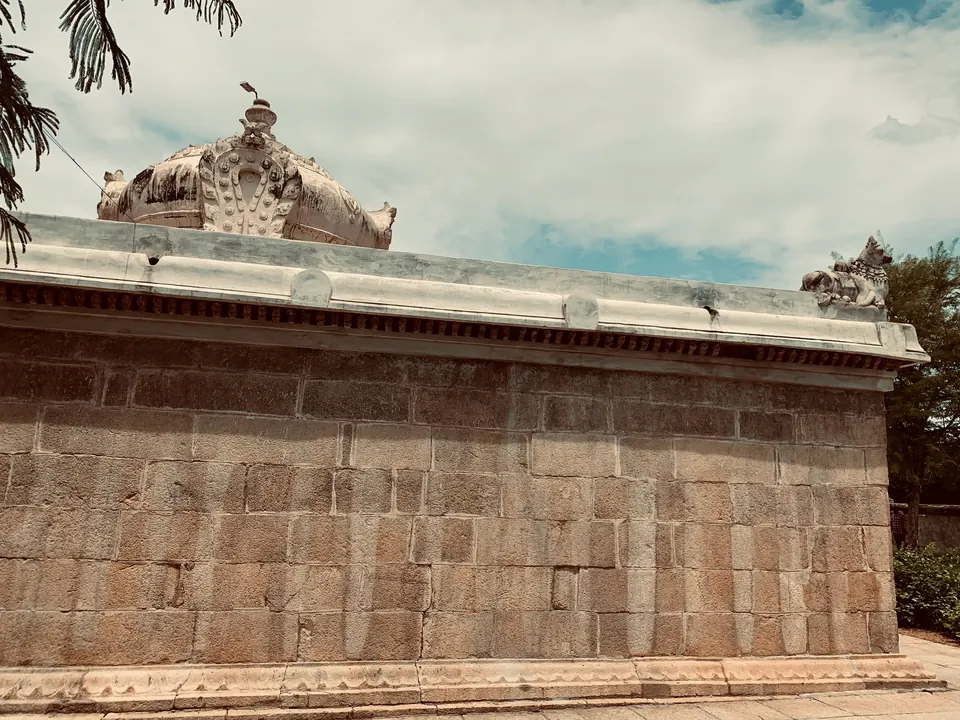
At Gudimallam, near Kalahasti, an inscription of his ninth year “records the building of the temple”.9 At Nandalur, in the Kadapa (then Cuddapah) district, two of his records are dated in Saka 1044 (Saka is an Indian way of counting years) and 1047.10 The Manual of the Kurnool District (1886) lists a Chola inscription of 1123 at Tripurantakam, in the reign of Vikrama-Chola.11
The end of the reign
An inscription of his 17th year at Nidubrolu was dated by Kielhorn to 18 April 1135.6 Sewell put his death in 1133.12 The Godavari gazetteer says that after 1135 “neither he nor his successors took an active part in the government of Vengi”.4
Where the sources disagree
- Who defeated Telunga Bhima. Hultzsch and S. Krishnaswami Aiyangar credit Vikrama-Chola.213 Sewell, from other records, gives the victory to the Velanandu chief Rajendra-Choda.14
- When Vengi was won back. By 1123–24 (the 1942 Nellore gazetteer), or after 1124 and before 1127 (Hultzsch, the Godavari gazetteer, Sewell).15248
- The end of the reign. 1133 (Sewell), against a record of his 17th year dated April 1135 (Kielhorn).126
Footnotes
-
E. Hultzsch, South-Indian Inscriptions, Vol. III, pt. II (1903), p. 179 (archive.org (opens in a new tab)). ↩ ↩2 ↩3 ↩4 ↩5 ↩6
-
Hultzsch, South-Indian Inscriptions III, pt. II (1903), p. 180 (archive.org (opens in a new tab)). ↩ ↩2 ↩3 ↩4 ↩5 ↩6 ↩7 ↩8 ↩9 ↩10 ↩11
-
Hultzsch, South-Indian Inscriptions III, pt. II (1903), p. 196, “Pedigree of the Chola Dynasty” (archive.org (opens in a new tab)). ↩
-
F. R. Hemingway, Madras District Gazetteers: Godavari, Vol. I (1907), p. 22 (archive.org (opens in a new tab)). ↩ ↩2 ↩3 ↩4
-
F. Kielhorn, “Dates of Chola Kings”, Epigraphia Indica IX (1907–08), p. 219 (archive.org (opens in a new tab)). ↩
-
Hultzsch, South-Indian Inscriptions III, pt. II (1903), p. 181 (archive.org (opens in a new tab)). ↩ ↩2 ↩3
-
Robert Sewell and S. Krishnaswami Aiyangar, The Historical Inscriptions of Southern India (1932), p. 96 (archive.org (opens in a new tab)). Paraphrased. ↩
-
Sewell and Aiyangar, Historical Inscriptions of Southern India (1932), p. 100 (archive.org (opens in a new tab)). Paraphrased. ↩ ↩2
-
V. Rangacharya, A Topographical List of the Inscriptions of the Madras Presidency, Vol. I (1919), p. 478, Chittoor No. 46 (archive.org (opens in a new tab)). ↩
-
Rangacharya, Topographical List I (1919), pp. 643–647, Cuddapah Nos. 784–816 (archive.org (opens in a new tab)). ↩
-
Narahari Gopalakristnamah Chetty, A Manual of the Kurnool District (1886), p. 21 (archive.org (opens in a new tab)). ↩
-
Sewell and Aiyangar, Historical Inscriptions of Southern India (1932), p. 101 (archive.org (opens in a new tab)). Paraphrased. ↩ ↩2
-
S. Krishnaswami Aiyangar, Ancient India (1911), pp. 152–153 (archive.org (opens in a new tab)). ↩
-
Robert Sewell and S. Krishnaswami Aiyangar, The Historical Inscriptions of Southern India (1932), p. 90 (archive.org (opens in a new tab)). Paraphrased. ↩
-
Gazetteer of the Nellore District, brought up to 1938 (1942), p. 43 (archive.org (opens in a new tab)). Paraphrased. ↩
Photos
References
Notes (0)
Sources (8)
Spotted an error on this page? Tell us
Last updated: