Chellur plates of Kulottunga II (1143)
Sanskrit copper-plate grant of the reign of the Chola king Kulottunga-Chodadeva II, obtained from the karnam of Chellur in the Godavari district and presented by Sir Walter Elliot to the British Museum. After the full Eastern Chalukya family tree, which carries the line through Kulottunga I and Vikrama-Choda to Kulottunga II, it records a grant of villages to Brahmins by Kolani-Katamanayaka, governor of Sarasipuri in a lake in the Vengi country. Its date, written as Saka 1056, was corrected by F. Kielhorn to 24 March 1143.
These copper plates record a grant of villages made in the Vengi country in the reign of the Chola king Kulottunga II.1 The donor was Kolani-Katamanayaka, governor of a city called Sarasipuri.1 F. Kielhorn dated the grant to 1143.2
The plates
J. F. Fleet edited this grant in 1885.1 The plates had belonged to Sir Walter Elliot, who gave them to the British Museum.1 He got them from Rajahmundry, through a Mr. Smith, who had them from the karnam (village accountant) of Chellur.1 See Chellur.
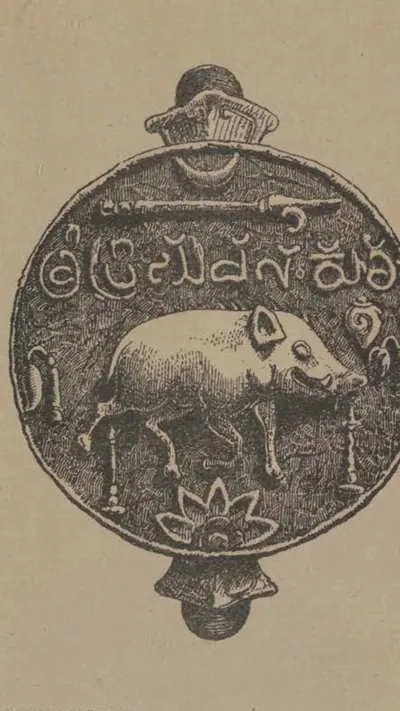
There are five plates, about 10½ inches by 4.1 The round seal carries the words Sri-Tribhuvanankusa, with a boar below them.1 Fleet wrote that “the language is Sanskrit throughout”, in Old Kanarese letters.1
What it says
After a verse to Vishnu, the grant lists the Eastern Chalukya kings.1 It gives Kulottunga-Chodadeva I forty-nine years and his son Vikrama-Choda fifteen years.1 Then comes Kulottunga-Chodadeva II, “the son of Vikrama-Choda”.1
It names “the city of Sarasipuri, in a lake in the Vengi mandala”.1 Its governor was Kolani-Katamanayaka, also called Kata the army commander.1 He gave the village of Mandadorru, with Ponduvagrama in the Savattili country, to a number of learned Brahmins.3 Robert Sewell listed a gift at Draksharama in 1140 by Katama-Nayaka of Kolanu, whom he took to be one of the Chola king’s generals.4
The date
The date is written as Saka 1056 (Saka is an Indian way of counting years), which Fleet took to be 1134–35.3 E. Hultzsch reported in 1903 that F. Kielhorn had shown this to be an error for Saka 1065.2 The date then corresponds to 24 March 1143.2 Hultzsch also noted that the grant gives Vikrama-Chola only fifteen years, though inscriptions of his 16th and 17th years exist.2 Sewell entered the plates under 24 March 1143.5 See Vikrama-Chola.
Footnotes
-
J. F. Fleet, “Sanskrit and Old-Canarese Inscriptions, No. CLIV: Chellur Plates of Kulottunga-Chodadeva II.—Saka 1056”, Indian Antiquary XIV (1885), p. 55 (archive.org (opens in a new tab)). ↩ ↩2 ↩3 ↩4 ↩5 ↩6 ↩7 ↩8 ↩9 ↩10 ↩11 ↩12 ↩13
-
E. Hultzsch, South-Indian Inscriptions, Vol. III, pt. II (1903), p. 181 (archive.org (opens in a new tab)). ↩ ↩2 ↩3 ↩4
-
Fleet, “Chellur Plates of Kulottunga-Chodadeva II” (1885), p. 56 (archive.org (opens in a new tab)). ↩ ↩2
-
Robert Sewell and S. Krishnaswami Aiyangar, The Historical Inscriptions of Southern India (1932), p. 104 (archive.org (opens in a new tab)). Paraphrased. ↩
-
Sewell and Aiyangar, Historical Inscriptions of Southern India (1932), p. 105 (archive.org (opens in a new tab)). Paraphrased. ↩
Photos
References
Notes (0)
Sources (3)
Spotted an error on this page? Tell us
Last updated: