Draksharama
Temple town in the Godavari delta, four miles south of Ramachandrapuram. It is famous as the 'Southern Benares' for its temple of Bhimesvara, whose walls carry hundreds of inscriptions from the 11th century onwards. Tradition derives its name from Daksharama, the garden of Daksha. It counts the temple's linga among the five Pancharama shrines.
Draksharama (Draksharamam) lies in the Godavari delta, four miles south by east of Ramachandrapuram.1 The Godavari district gazetteer of 1907 gave its population as 11,213.1 It described a large cattle market and a choultry (rest house) for feeding Brahmins.1 It called the village “noted for its fine temple and for its sanctity”.1
The Imperial Gazetteer of 1908 named Draksharama and Kotipalli as the two well-known places of pilgrimage in the Ramachandrapuram taluk.2 Among the temples of the district, it singled out the Draksharama temple for “inscriptions of value”.3
The name and the legends
The gazetteer reports that the name is said to be more correctly Daksharama, “the Garden of Daksha”.1 It retells the story from the Siva Purana.1 Daksha, Shiva’s father-in-law, held a sacrifice without inviting him.1 His daughter went uninvited and was insulted, and she threw herself into the fire.1 Virabhadra, born of Shiva’s anger, then killed Daksha.1
For this reason, the gazetteer says, orthodox Brahmins would not perform a sacrifice inside the village.1 M. Rama Rao, writing in 1964, told the same legend from the Godavari section of the Skanda Purana.45 He also told it from the Telugu poet Srinatha’s Bhimesvara Puranamu.45
The tank at Draksharama is called Sapta-Godavari, “the seven Godavaris”.1 Legend says that seven sages made the seven mouths of the Godavari.1 Each of them brought water from his river underground to this tank.1 A bath at its sacred ghat was believed to give, in condensed form, the merit of bathing in all seven.1
Rama Rao gives the Skanda Purana story of the seven sages leading the river underground to Daksharama.56 There they found that Shiva had already installed himself in the linga (stone emblem of Shiva).56
Like other holy places, the gazetteer adds, the town is called the southern Benares.1 Some believed that a night’s halt there made future births unnecessary.17 Rama Rao also notes a tradition about the name Trilinga.8 In it, the god Bhimesvara of Draksharama, with Mallikarjuna of Srisailam and Kalesvara of Kalesvaram, gave the Telugu country this name.8
The temple and its inscriptions
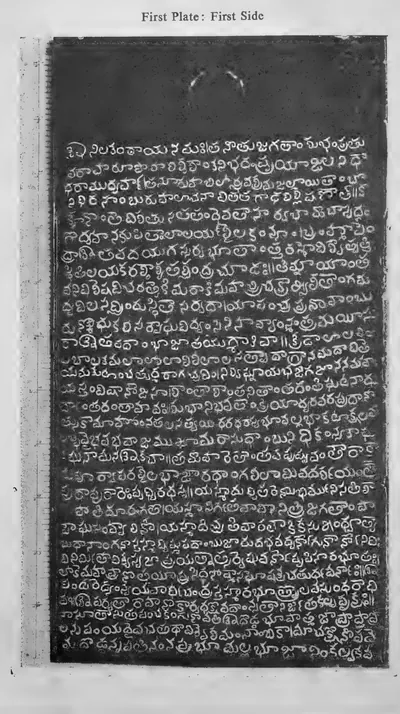
The temple of Bhimesvara is the centre of the town’s religious life.1 The gazetteer counted 271 inscriptions transcribed by the Government Epigraphist (Nos. 181 to 451 of 1893).7 The earliest dated record it found was of 1055, in the reign of the Rajaraja whose capital was at Rajahmundry.7 The latest was of 1447.7
Robert Sewell had printed a list of the temple’s inscriptions in 1882.9 He took it from copies made by a clerk who had worked under Walter Elliot.9 He warned that he felt sure they were “very untrustworthy”, but did not like to omit them.9 See Bhimesvara temple, Draksharama and Rajaraja Narendra.
The Chellur plates of the Chola-Chalukya viceroy Vira-Choda praise a certain Medamarya.1011 He founded two sattras (feeding houses) where Brahmins were fed daily, “at holy Draksharama and at the sacred place of Pithapuri”.1011
Records of the regional houses
Hultzsch used a Draksharama record to identify Sanadavrolu, the residence of the Velanati chief Gonka III, with Tsandavolu.12 He noted that the Pithapuram inscription credits Gonka II with placing a golden pinnacle on the temple of Bhimanatha.121314 The same inscription records rich gifts to the temple by a later Rajendra Choda.121314 See the Velanati Chodas.
The Haihaya chiefs of the Kona country, in the Godavari delta, appear in the temple’s records from 1128.15 One of them, Rajendra Choda I of Kona, built a mandapa (pillared hall) in the temple.15 See the Haihayas of Kona and Palnadu.
Dutch and Muslim Draksharama
Sewell recorded two “handsomely carved Dutch tombs” dated 1673 and 1728.9 They stood at a place still called Ollandu Dibba, “Holland mound”.9
The gazetteer describes Draksharama as sacred to Muslims as well.7 The Muslims of the neighbourhood greatly revered the mosque and tomb of a saint called Saiyid Shah Bhaji Aulia.7 In the legend the gazetteer recorded, the saint won a contest of holiness with the Saiva head-priest of a local matha (monastery).7 He then turned the matha into a mosque.7
Footnotes
-
F. R. Hemingway, Madras District Gazetteers: Godavari (1907), p. 250, s.v. Draksharamam (archive.org (opens in a new tab)). ↩ ↩2 ↩3 ↩4 ↩5 ↩6 ↩7 ↩8 ↩9 ↩10 ↩11 ↩12 ↩13 ↩14 ↩15 ↩16 ↩17
-
Imperial Gazetteer of India: Madras, Vol. I (1908), p. 291 (archive.org (opens in a new tab)). ↩
-
Imperial Gazetteer of India: Madras, Vol. I (1908), p. 273 (archive.org (opens in a new tab)). ↩
-
Rama Rao, Eastern Calukyan Temples (1964), p. 15 (archive.org (opens in a new tab)). ↩ ↩2
-
Rama Rao, Eastern Calukyan Temples (1964), p. 16 (archive.org (opens in a new tab)). ↩ ↩2 ↩3 ↩4
-
Rama Rao, Eastern Calukyan Temples (1964), p. 17 (archive.org (opens in a new tab)). ↩ ↩2
-
Hemingway, Godavari (1907), p. 251 (archive.org (opens in a new tab)). ↩ ↩2 ↩3 ↩4 ↩5 ↩6 ↩7 ↩8
-
M. Rama Rao, Eastern Calukyan Temples of Andhra Desa (1964), p. 11 (archive.org (opens in a new tab)). ↩ ↩2
-
Robert Sewell, Lists of the Antiquarian Remains in the Presidency of Madras, Vol. I (1882), p. 25, s.v. Drakshārāmam (archive.org (opens in a new tab)). ↩ ↩2 ↩3 ↩4 ↩5
-
E. Hultzsch, South-Indian Inscriptions, Vol. I (1890), No. 39, Chellur plates of Vira-Choda, p. 60 (archive.org (opens in a new tab)). ↩ ↩2
-
Hultzsch, South-Indian Inscriptions, Vol. I (1890), p. 61 (archive.org (opens in a new tab)). ↩ ↩2
-
E. Hultzsch, “Pithapuram Pillar Inscription of Prithvisvara”, Epigraphia Indica IV (1897), p. 33 (archive.org (opens in a new tab)). ↩ ↩2 ↩3
-
Hultzsch, “Pithapuram Inscription of Prithvisvara” (1897), p. 36 (archive.org (opens in a new tab)). ↩ ↩2
-
Hultzsch, “Pithapuram Inscription of Prithvisvara” (1897), p. 37 (archive.org (opens in a new tab)). ↩ ↩2
-
E. Hultzsch, “Pithapuram Inscription of Mallideva and Manma-Satya II”, Epigraphia Indica IV (1897), p. 86 (archive.org (opens in a new tab)). ↩ ↩2
Photos
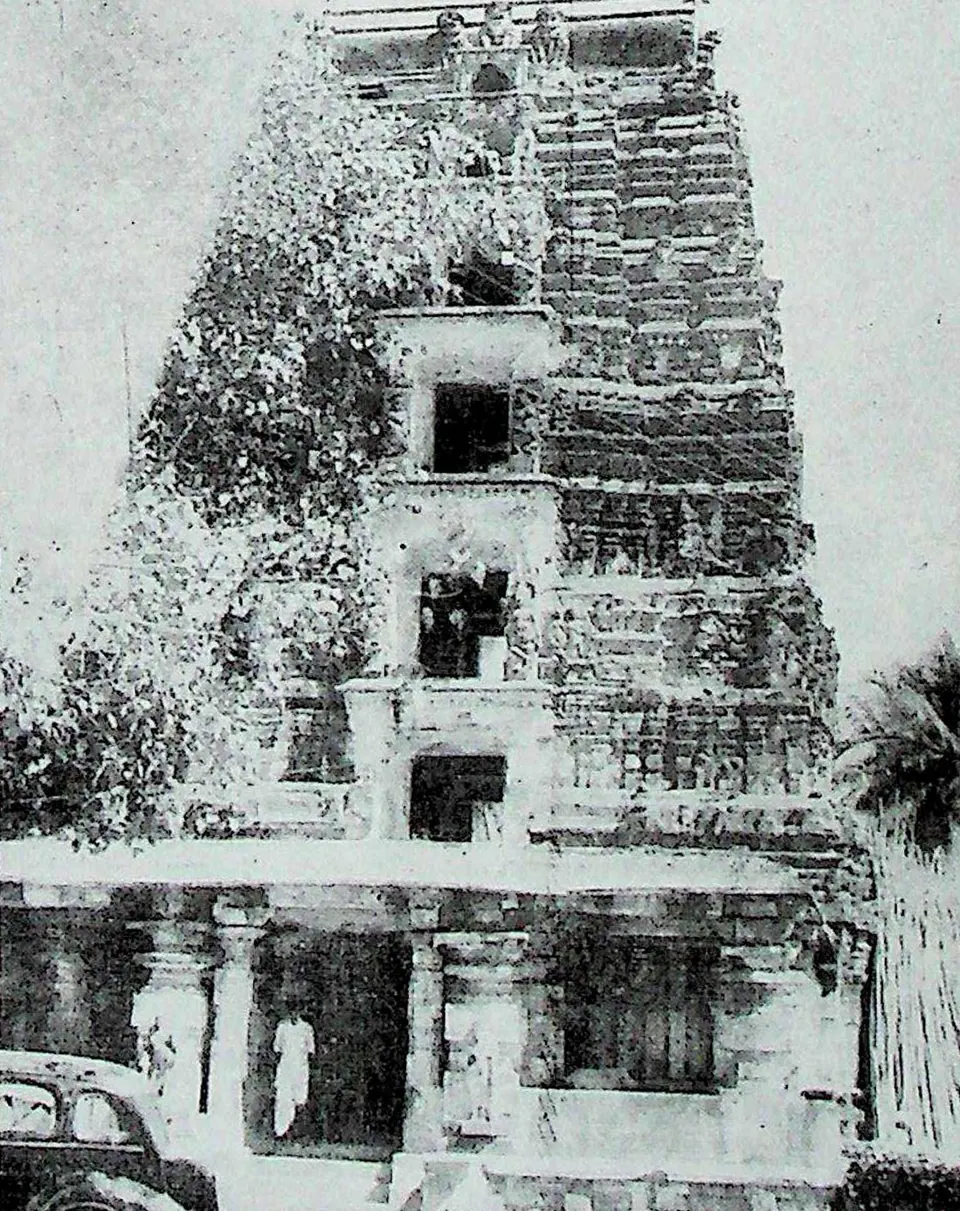
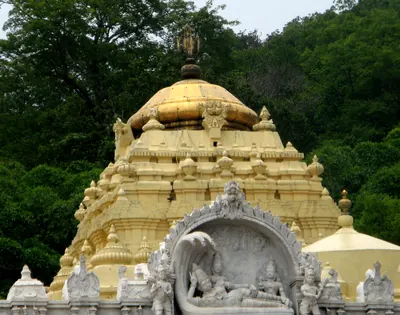
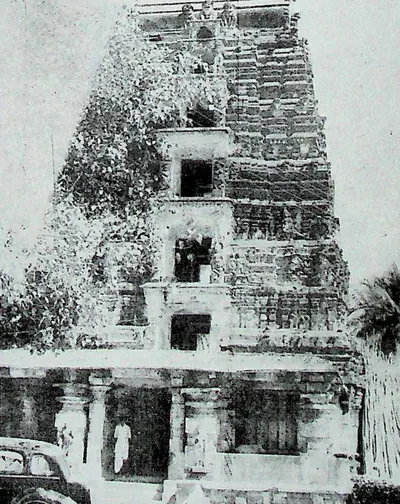 "22. West Gōpuram - Bhīmēśvara Temple - Drākshārāma" (M. Rama Rao, Eastern Calukyan Temples of Andhra Desa, 1964, Fig. 22 (PDF p. 77))Historic photograph · 1964
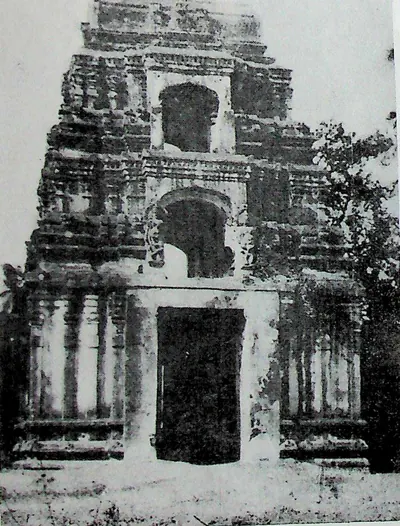 "23. North Gōpura - Bhīmēśvara Temple - Drākshārāma" (M. Rama Rao, Eastern Calukyan Temples of Andhra Desa, 1964, Fig. 23 (PDF p. 79))Historic photograph · 1964
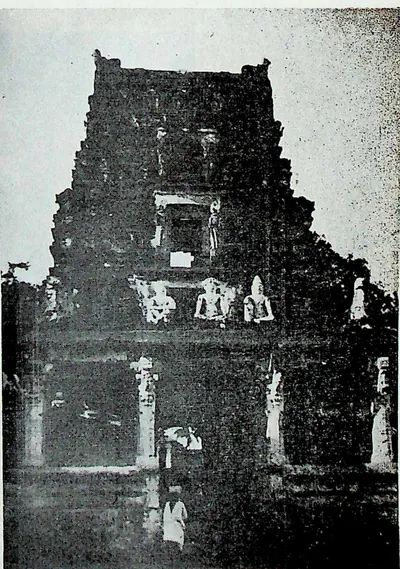 "24. South Gōpura - Bhīmēśvara Temple - Drākshārāma" (M. Rama Rao, Eastern Calukyan Temples of Andhra Desa, 1964, Fig. 24 (PDF p. 79))Historic photograph · 1964
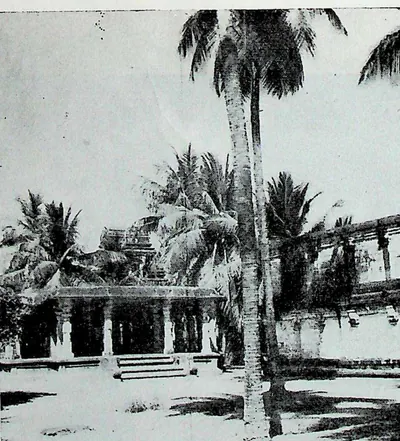 "25. Maṇṭapa in the North-east Corner of outer enclosure - Bhīmēśvara Temple, Drākshārāma" (M. Rama Rao, Eastern Calukyan Temples of Andhra Desa, 1964, Fig. 25 (PDF p. 81))Historic photograph · 1964
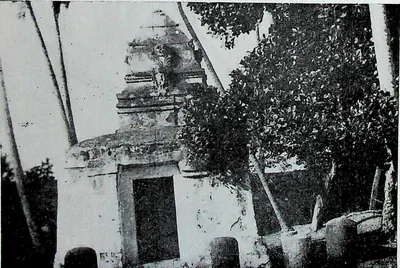 "26. Kālabhairava Shrine - Bhīmēśvara Temple, Drākshārāma" (M. Rama Rao, Eastern Calukyan Temples of Andhra Desa, 1964, Fig. 26 (PDF p. 83))Historic photograph · 1964
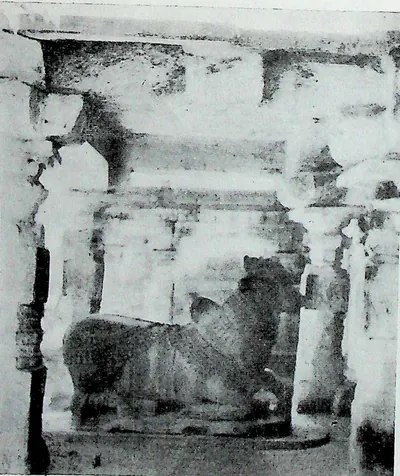 "27. Nandi Maṇṭapa - Bhīmēśvara Temple, Drākshārāma" (M. Rama Rao, Eastern Calukyan Temples of Andhra Desa, 1964, Fig. 27 (PDF p. 85))Historic photograph · 1964
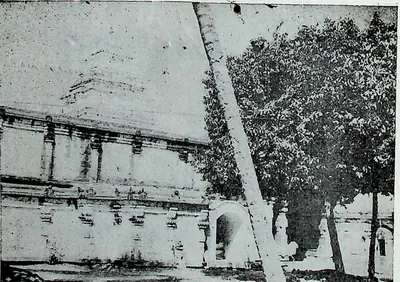 "28. Southern entrance to inner enclosure - Bhīmēśvara Temple - Drākshārāma" (M. Rama Rao, Eastern Calukyan Temples of Andhra Desa, 1964, Fig. 28 (PDF p. 87))Historic photograph · 1964
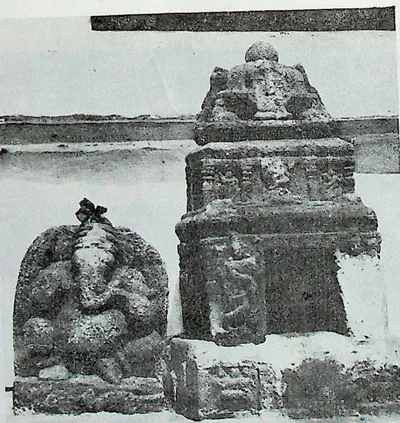 "29. Miniature Shrine - Bhīmēśvara Temple - Drākshārāma" (M. Rama Rao, Eastern Calukyan Temples of Andhra Desa, 1964, Fig. 29 (PDF p. 89))Historic photograph · 1964
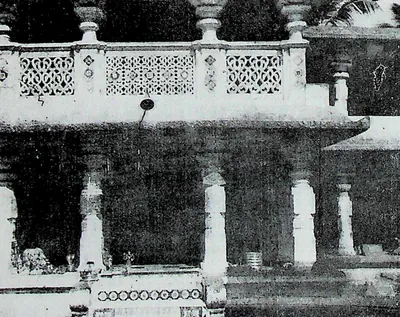 "30. Māṇikyāmba Shrine - Bhīmēśvara Temple, Drākshārāma" (M. Rama Rao, Eastern Calukyan Temples of Andhra Desa, 1964, Fig. 30 (PDF p. 91))Historic photograph · 1964
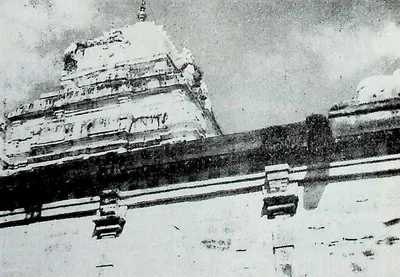 "31. Vimāna - Bhīmēśvara Temple - Drākshārāma" (M. Rama Rao, Eastern Calukyan Temples of Andhra Desa, 1964, Fig. 31 (PDF p. 93))Historic photograph · 1964
Related
People
Karunakara Tondaiman
c. 1076–1112 CE
General and minister of the Chola king Kulottunga I, the hero of the Tamil poem Kalingattupparani, which describes how he marched an army north from Kanchi across the Penna, the Krishna and the Godavari to defeat the king of northern Kalinga. A Sanskrit inscription of 1103 at Draksharama, which K. V. Subrahmanya Aiyer identified as his, records the burning of Kalinga, a victory pillar on the borders of Orissa and his gifts in the Vengi country. The date of the war is disputed: about 1076–77, 1084–90, before 1095–96, or about 1111–12.
Vikramaditya VI
c. 1076–1126 CE
Western Chalukya king of Kalyani, called Tribhuvanamalla. He deposed his brother Somesvara II in 1076 and reigned for fifty years, to 1126. He replaced the Saka era with his own Chalukya-Vikrama era, in which most Telangana records of the time are dated. As a prince he fought the Cholas and their Eastern Chalukya allies for Vengi. Late in his reign, after the Chola viceroy left in 1118, he was recognised as king in Vengi and the coastal Telugu country. His feudatories in Telangana included the Kakatiyas Beta II and Prola II and the Choda chiefs of Kandur.
Anantavarman Chodaganga
c. 1078–1146 CE
Eastern Ganga king of Kalinga, crowned in 1078 and still reigning in his 72nd regnal year (1146–47). He was a son of the Ganga king Rajaraja and of Rajasundari, a daughter of Kulottunga I, so he was a grandson of the Chola-Chalukya emperor whose armies invaded Kalinga in his reign. Dozens of his Telugu and Sanskrit inscriptions survive at Mukhalingam, Srikurmam, Simhachalam, Draksharama and other places in the north of the Telugu country. His grants trace the Ganga family back to Brahma.
Rajendra Choda I (Velanati)
c. 1117–1132 CE
Velanati chief, son of Gonka I. The Chola–Chalukya emperor Kulottunga I adopted him as his son and made him governor of the Vengi country, between 1100 and 1112 according to E. Hultzsch. When the Chola viceroy left Vengi in 1118 he accepted the Western Chalukya Vikramaditya VI as overlord. M. Rama Rao dated his rule from 1117 to 1132.
Vikrama-Chola
c. 1118–1135 CE
Son of the Chola emperor Kulottunga I who governed Vengi for his father from about 1092–93 and left it in 1118 to be crowned Chola king. In his absence the Western Chalukya Vikramaditya VI took the Vengi province, holding Draksharama from 1120–21 to 1123–24; Vikrama-Chola won it back, and his records are found at Chebrolu and Nidubrolu in 1127 and 1135. An inscription of his ninth year records the building of the temple at Gudimallam, and his records are at Nandalur and Tripurantakam.
Gonka II (Velanati)
c. 1132–1163 CE
Velanati chief, called Kulottunga Choda Gonka, who ruled from about 1132 to 1163 according to M. Rama Rao. The Pithapuram inscription says that he set a golden pinnacle on the Bhimesvara temple at Draksharama, and ruled the kings between Kalahasti and the Mahendra mountain. His minister built the Suresvara temple at Karempudi in 1154.
Kulottunga II (Chola)
c. 1133–1146 CE
Chola king, son and successor of Vikrama-Chola, who reigned from the 1130s to the late 1140s. Coastal Andhra still recognised him: Telugu inscriptions at Bapatla are dated in his regnal years, the Velanandu chief Gonka II ruled at Draksharama as his vassal, and a copper-plate grant of his reign by Kolani-Katamanayaka, governor of Sarasipuri, survives as the Chellur plates (1143). The Godavari gazetteer thought the Cholas had little real power in Vengi by then.
Rajaraja II (Chola)
c. 1146–1163 CE
Chola king from 1146, son of Kulottunga II, in whose reign the Chola hold on the Telugu country became nominal. Telugu inscriptions at Bapatla, Appikatla and Draksharama are still dated in his regnal years, but they were set up by the Velanandu chiefs Gonka II and Kulottunga-Rajendra-Choda and other local rulers.
Mallideva of Kona
c. 1155–1195 CE
Haihaya chief of Konamandala, the Godavari delta. He ruled jointly with Manma-Satya II, a great-grandson of his uncle Satya I. In 1195 the two gave the village of Odiyuru to the Kunti-Madhava temple at Pithapuram. Their inscription traces the family from the legendary Kartavirya and praises the Velanati queen Jayamamba. P. V. Parabrahma Sastry held that Mallideva and a Satya of the Kona family took part in the battle in which the Kakatiya Prola II was killed.
Rajendra Choda II (Velanati)
c. 1163–1181 CE
Velanati chief, son of Gonka II, who ruled from about 1163 to 1181. His copper plates of 1169, issued at Chandavolu, call him a general of the Chola king Rajaraja II. They say he killed Bhima of Kolanu and received the Andhra country between the eastern sea, Kalahasti, the Mahendra mountain and Srisailam. P. V. Parabrahma Sastry made him the master of the coast from Darsi to Simhachalam after 1172; his death in 1181 opened the way for the Kakatiyas.
Narasimha I (Eastern Ganga)
c. 1250–1268 CE
Eastern Ganga king of Kalinga and Orissa in the mid-13th century, son of Anangabhima. The Vizagapatam gazetteer credits him with building the central shrine, the halls and the enclosing verandah of the Simhachalam temple in black stone in 1267–68. His feudatories and ministers left records at Srikurmam. The Orissa temple chronicle remembers him as Languliya Narsinh, builder of the Sun temple at Konarak. His dates differ widely between the sources.
Anavema Reddi
c. 1364–1386 CE
Third Reddi king (c. 1364–1386), younger son of Prolaya Vema, who ruled from Kondavidu and carried the kingdom's grants into the Godavari delta. He is known from five copper-plate grants (Pachchanitandiparru 1374, Nadupuru, Pedapalakaluru 1378, Vanapalli 1380 and others) and from records at Srisailam and Draksharama. He was surnamed Vasantaraya for his spring festival. The poet Srinatha's connection with the Reddis probably began under him.
Kataya Vema
c. 1386–1415 CE
Minister and brother-in-law of Kumaragiri of Kondavidu. He received 'the eastern country' with Rajahmundry as its capital in the 1380s, and ruled the Godavari delta and the coast to Simhachalam until about 1414–16. A grandson of Prolaya Vema through his mother, he was also a Sanskrit scholar. He wrote the Kumaragirirajiyam, a commentary on Kalidasa's plays.
Allada Reddi
c. 1416–1420 CE
Reddi noble of the Duvvuri branch of the Panta family who took control of the Rajahmundry kingdom after Kataya Vema's death (c. 1416–1420). It seems he ruled first as regent for Kataya Vema's son and daughter. His sons' grants credit him with victories over the Kondavidu king Peda Komati Vema and over 'Alpa Khan', and with friendship with the Gajapati and the king of Vijayanagara. His sons Allaya Vema and Virabhadra ruled Rajahmundry after him.
Deva Raya II (Vijayanagara)
1422–1446 CE
King of Vijayanagara from 1422 or 1423 to 1446, the greatest ruler of the first dynasty. He enlisted Muslim archers in his army, survived an attempt on his life in 1443 and received the Persian envoy Abdur Razzaq. His inscriptions reach the Godavari delta and the Guntur and Nellore country. The Telugu poet Vallabharaya governed Vinukonda for him, and Srinatha was bathed in gold in his Pearl Hall. After his death the Bahmani sultan and the Gajapati of Orissa besieged his capital together.
Vemulavada Bhimakavi
Telugu poet known mostly from legend, linked by tradition with Vemulavada in Karimnagar district and with Draksharama. Chenchiah and Bhujanga Rao called him 'a poet of mystery': he has been placed in every century from the 12th to the 16th, and no work can be given to him with certainty. Later poets remembered him for 'words of power', and one tradition makes him the first to write verse with two meanings.
Monuments
Inscriptions
Draksharama inscription of Kulottunga I (1103)
1103 CE
Sanskrit inscription in Telugu characters on the south wall of the Bhimesvara temple at Draksharama, dated in the 33rd year of the Chola king Kulottunga I (1103). It records the deeds of his general Vanduvaraja, also called Pallavaraja, who burnt the Kalinga country, defeated the Ganga king and Devendravarman and set up a pillar of victory on the borders of the Odra country, and his gifts in the Vengi country, including a pavilion at Draksharama. K. V. Subrahmanya Aiyer identified him with Karunakara Tondaiman, the hero of the Kalingattupparani.
Draksharama inscriptions of Kulottunga I (1107)
1107 CE
Two lamp-gift inscriptions, in Telugu and in Sanskrit and Telugu, on a wall of the Bhimesvara temple at Draksharama, dated both in the 37th year of the Chalukya-Chola king Kulottunga I and in Saka 1029 (1107). Because they give the regnal year and the Saka year together, they helped fix the beginning of Kulottunga's reign as Chola king in 1070. The same wall carries an inscription of the Western Chalukya Vikramaditya VI, recognised at Draksharama after 1118.
References
Notes (0)
Sources (6)
Spotted an error on this page? Tell us
Last updated: