Tarigonda Vengamamba
Telugu woman poet and devotee of Tarigonda, near Vayalpad in the old Kadapa district, who lived in the first half of the 19th century. She wrote the Venkatachala Mahatmyamu on the holy hill of Tirupati, the Rajayogasaramu and a Telugu couplet version of the Bhagavata. C. P. Brown noted in 1852 that she was living in 1840.
Tarigonda Vengamamba, also called Venkamma, was a Telugu woman poet of the first half of the 19th century.12 She came from Tarigonda, a village near Vayalpad in the old Kadapa (then Cuddapah) district.1 She dedicated her works to the god Narasimha of Tarigonda.1 Kandukuri Veeresalingam knew of no earlier long poem in Telugu verse by a Brahmin woman.2
Life
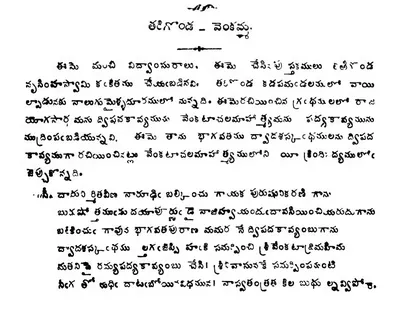
Veeresalingam wrote about her in the third part of his Andhra Kavula Charitramu (lives of the Telugu poets).1 He called her a learned woman.1 He placed Tarigonda four miles from Vayalpad.1 From one of her verses he judged that she was a Brahmin of the Nandavarika group.2
In her poems she calls herself the daughter of Krishnayamatya of the Vasishtha gotra (family line).2 She does not name a husband.2 From this Veeresalingam guessed that she was a child widow, who spent her life in the study of Vedanta.2 This was his own inference.2
Charles Philip Brown wrote in 1852 that the Telugu couplet Bhagavatam “was written by a poetess who was living in the year 1840”.3 Brown did not name her.3 Veeresalingam took this note in Brown’s dictionary to refer to Vengamamba.2 P. Chenchiah and Raja M. Bhujanga Rao, in their history of Telugu literature (1928), dated her from 1839.4
Her works
Veeresalingam names these works:1
- the Rajayogasaramu (the essence of royal yoga), in couplets (dvipada), already printed
- the Venkatachala Mahatmyamu (the greatness of the Venkata hill), in verse, already printed
- the twelfth book of the Bhagavata Purana, in couplets1
In a verse of that poem, she says she had put the twelfth book of the Bhagavata into couplets and offered it to the god.1 Chenchiah and Bhujanga Rao give the same three works.4 So does P. T. Raju, in 1944.5
How she was judged
Veeresalingam found small faults in her verse, but thought it gentle and sweet on the whole.2 He contrasted her with Muddupalani.2 Unlike that poet, he wrote, she kept from frank love poetry, as befitted a woman of a respectable family.2
Chenchiah and Bhujanga Rao wrote that her poems were “full of elevated sentiments”.4 In their view they were “an eloquent protest against the debased literary tastes of the day”.4 K. Sitaramaiya, in 1943, remembered her as “a great devotee”.6
Footnotes
-
Kandukuri Veeresalingam, Andhra Kavula Charitramu, Part III (1911), p. 218 (archive.org (opens in a new tab)). ↩ ↩2 ↩3 ↩4 ↩5 ↩6 ↩7 ↩8 ↩9
-
Veeresalingam, Andhra Kavula Charitramu, Part III (1911), p. 219 (archive.org (opens in a new tab)). ↩ ↩2 ↩3 ↩4 ↩5 ↩6 ↩7 ↩8 ↩9 ↩10 ↩11
-
Charles Philip Brown, A Dictionary, Telugu and English (1852), p. xii (archive.org (opens in a new tab)). ↩ ↩2
-
P. Chenchiah and Raja M. Bhujanga Rao, A History of Telugu Literature (1928), p. 104 (archive.org (opens in a new tab)). ↩ ↩2 ↩3 ↩4
-
P. T. Raju, Telugu Literature (1944), p. 42 (archive.org (opens in a new tab)). Cite-only; paraphrased. ↩
-
K. Sitaramaiya, A Hand Book of Telugu Literature (1943), p. 57 (archive.org (opens in a new tab)). Cite-only; paraphrased. ↩
Photos
References
Notes (0)
Sources (5)
Spotted an error on this page? Tell us
Last updated: