Kadapa (Cuddapah)
Town near the Penner river and headquarters of the district to which it gave its name. A Golconda officer is thought to have built its fort about 1570. In the early eighteenth century it became the capital of the Pathan Nawabs of Cuddapah. Haidar Ali took it in 1779 and gave the country to his brother-in-law Mir Sahib. Tipu Sultan ceded the Cuddapah districts to the Nizam in 1792, and the Nizam ceded them to the East India Company in 1800. The town became the district headquarters in 1817.
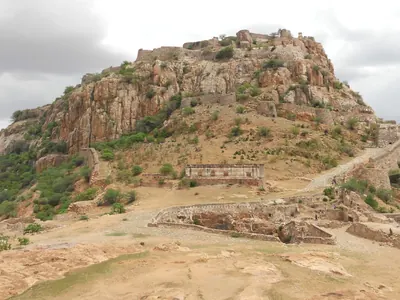
Kadapa is Cuddapah in the older spelling and “Kurpa” in Orme and Wilks.12 It lies a few miles from the south bank of the Penner, and rocky hills enclose it on three sides.3 The Imperial Gazetteer of Madras (1908) reports two explanations of the name.13 Some derive it “from the Sanskrit kripa, ‘mercy’”.13 Others “connect it with kadapa, meaning in Telugu a ‘gate,’ since the place is in some sense the gate from the north to the sacred town of Tirupati”.13
Gribble’s district manual of 1875 noted that “a modern reader of Orme, Wilks, and Thornton will come across the name of Kurpa without ever dreaming to what it refers”.2 See Mysore under Haidar Ali and Tipu Sultan.
The Nawabs’ town
The Imperial Gazetteer thought the town “comparatively modern”.3 It says: “It is probable that one of the lieutenants of the Golconda army erected the fort about 1570”.3 Under Muslim rule the town was called Neknamabad, after its supposed founder Neknam Khan.3 It became the capital of a separate principality only at the beginning of the eighteenth century.3 By then the Pathan Nawab “had absorbed the whole of the neighbouring tracts except Gooty”.3
The Cuddapah gazetteer names Abdul Nabi Khan, whose governorship began in 1714, as the first Nawab to assert his control over the district.4 He kept garrisons at Gandikota and Gurramkonda.4 In May 1740 a Maratha army defeated the Nawab in a day’s fighting before Kadapa.4 In 1757 the Marathas under Balwant Rao won “a decisive battle over the Muhammadans near the town of Cuddapah”.5 See Gandikota and Balwant Rao Mendle.
Haidar Ali and Tipu Sultan
Wilks says that Haidar Ali levied contributions on Kadapa in 1769.6 Haidar conquered it in 1779.78 According to Wilks, Haidar first defeated the Nawab’s Pathan horse at Duvvur.678 Then “Hyder turned from hence to the south-east, and took possession of the town of Kurpa without resistance”.678 The Nawab had withdrawn to Sidhout (Siddhavatam), where he surrendered on 27 May.678 Haidar then gave the conquered country, with Gurramkonda, to his brother-in-law Mir Sahib as a military fief (land held for military service).9
The Madras government complained of the conquest and called Kadapa an ancient dependency of the Carnatic.10 Wilks answered in a note that it “was an ancient portion of Telingana”.10 He added that it had never depended on the Carnatic below the Ghats.10
Orme gave a figure of nearly a million sterling for the tribute laid on the Nawabs of Cuddapah and Kurnool in 1751.11 Gribble doubted it, because “the highest amount ever levied by Hyder did not exceed 23 lakhs of rupees, or £230,000”.11 See Mir Ali Raza Khan (Mir Sahib) and Siddhavatam.
Under Tipu Sultan a diwan (revenue minister) governed at Kadapa.1213 One of Tipu’s letters orders the diwan, Mohyuddin Ali Khan, to collect the lead of a newly found mine in the fort of Sidhout.1213 By the treaty of Seringapatam in 1792 the Nizam received “Talook Kurpah, 61 Talooks” among his share of Tipu’s territory.14
The Marathas defeated the Nizam at Kharda in 1795.151617 After this the Nizam assigned the Kadapa revenues to his French officer Raymond to pay his battalions.151617 This lasted until the Madras government threatened to march troops into the province.151617 See Kharda.
The Company
By the treaty of 12 October 1800 the Nizam ceded to the Company all the districts he had gained in 1792 and 1799.18 The cession paid for the subsidiary force (British troops kept in his state).18 The Cuddapah gazetteer says that Munro was posted as Principal Collector of the whole of the ceded territory, with four Sub-Collectors under him.19
According to the Imperial Gazetteer, Kadapa became the headquarters of the district in 1817.3 It was a military cantonment (army station) until 1868, and it became a municipality in 1866.3
Footnotes
-
Imperial Gazetteer of India, Provincial Series: Madras, Vol. I (1908), p. 392 (archive.org (opens in a new tab)). ↩ ↩2 ↩3 ↩4
-
J. D. B. Gribble, A Manual of the District of Cuddapah (1875), p. 93 (archive.org (opens in a new tab)). ↩ ↩2
-
Imperial Gazetteer: Madras, Vol. I (1908), p. 393 (archive.org (opens in a new tab)). ↩ ↩2 ↩3 ↩4 ↩5 ↩6 ↩7 ↩8 ↩9 ↩10 ↩11
-
C. F. Brackenbury, Madras District Gazetteers: Cuddapah, Vol. I (1915), p. 41 (archive.org (opens in a new tab)). ↩ ↩2 ↩3
-
Brackenbury, Cuddapah (1915), p. 44 (archive.org (opens in a new tab)). ↩
-
Mark Wilks, Historical Sketches of the South of India, Vol. II (1817), p. 131 (archive.org (opens in a new tab)). ↩ ↩2 ↩3 ↩4
-
Wilks, Historical Sketches, Vol. II (1817), p. 191 (archive.org (opens in a new tab)). ↩ ↩2 ↩3 ↩4
-
Gribble, Cuddapah (1875), p. 98 (archive.org (opens in a new tab)). ↩ ↩2 ↩3 ↩4
-
Wilks, Historical Sketches, Vol. II (1817), p. 198 (archive.org (opens in a new tab)). ↩
-
Wilks, Historical Sketches, Vol. II (1817), p. 242 and note (archive.org (opens in a new tab)). ↩ ↩2 ↩3
-
Gribble, Cuddapah (1875), p. 95 (archive.org (opens in a new tab)). ↩ ↩2
-
William Kirkpatrick (tr.), Select Letters of Tippoo Sultan (1811), p. 227, Letter CXCV (archive.org (opens in a new tab)). ↩ ↩2
-
Kirkpatrick, Select Letters of Tippoo Sultan (1811), p. 228 (archive.org (opens in a new tab)). ↩ ↩2
-
Aitchison, Treaties, Vol. IX (1909), p. 214 (archive.org (opens in a new tab)). ↩
-
Gribble, Cuddapah (1875), p. 102 (archive.org (opens in a new tab)). ↩ ↩2 ↩3
-
Gribble, Cuddapah (1875), p. 103 (archive.org (opens in a new tab)). ↩ ↩2 ↩3
-
Mark Wilks, Historical Sketches of the South of India, Vol. III (1817), p. 321 (archive.org (opens in a new tab)). ↩ ↩2 ↩3
-
C. U. Aitchison, A Collection of Treaties, Engagements and Sanads, Vol. IX (4th ed., 1909), p. 69, treaty of 12 October 1800, Article 5 (archive.org (opens in a new tab)). ↩ ↩2
-
Brackenbury, Cuddapah (1915), p. 46 (archive.org (opens in a new tab)). ↩
Photos
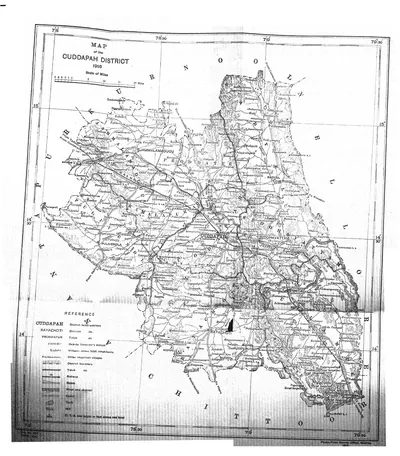 "Map of the Cuddapah District 1915" (Brackenbury 1915, folding map, PDF p. 1)Map · 1915
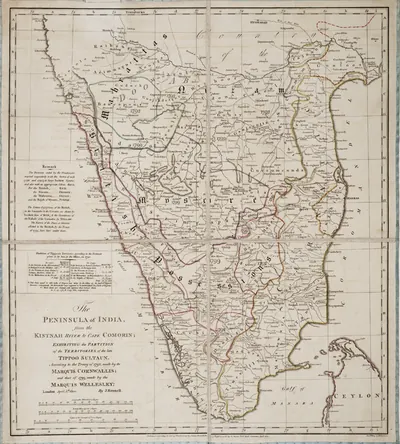 James Rennell, "The Peninsula of India ... exhibiting the partition of the territories of the late Tippoo Sultaun, according to the treaty of 1792 ... and that of 1799" (London, 1800), Royal Museums Greenwich K1047Map · 1800
Related
Dynasties
People
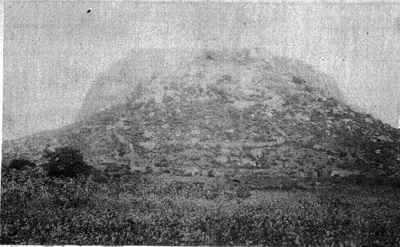
Abdul Nabi Khan (Nawab of Cuddapah)
c. 1714 CE
Pathan (Miana) Nawab of Cuddapah in the early eighteenth century. Gribble's chronology calls him 'the greatest of the Cuddapah Nabobs'. Kirmani says that the emperor Bahadur Shah gave him Cuddapah as a land grant, and the Cuddapah gazetteer dates his governorship from 1714. He took Sidhout from its fort commander in 1714 and held Gandikota, Cumbum and Gurramkonda. He made the poligar of Punganur pay him tribute, raided the Baramahal and joined the Nawab of Arcot in taking money from Mysore. Local tradition says he founded the town of Cuddapah. He had stopped ruling by 1732, when an inscription names his son as Nawab.
Ranmast Khan (Munawwar Khan, Nawab of Kurnool)
1752–1792 CE
Pathan Nawab of Kurnool from 1752 to 1792, the brother of Himmat Bahadur Khan, called Ranmast Khan and Munawwar Khan. His brother died, and the French stormed Kurnool in 1751. He came back from Arcot and raised troops with money from the Nawab of Cuddapah and the help of the deshmukh of Kurnool. In 1752 he won back his capital from the Nizam's officer and the raja of Gadwal. He paid tribute to the Nizam and, from 1769 or about 1775, to Haidar Ali. Local tradition says he paid Haidar after a holy man's attempt to frighten Haidar failed. Tipu Sultan pressed him for unpaid tribute. His son Alif Khan led his horsemen with the Nizam's army against Tipu in 1790–92, and he died in 1792.
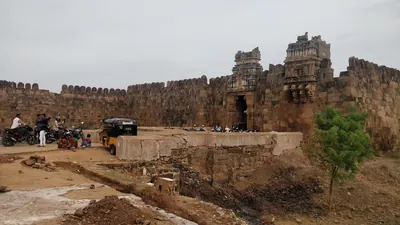
Abdul Halim Khan (Nawab of Cuddapah)
1761–1779 CE
The last Pathan Nawab of Cuddapah. He ruled Cuddapah and Sidhout from 1761 until Haidar Ali conquered him in 1779. A Telugu account translated by C. P. Brown says he was freed from prison in the fort of Sidhout in 1761 and became ruler when the Nawab Mohsin Khan left. Gribble says he followed his uncle, whom he calls Mahasim Khan. He paid Haidar money in 1769 and sent him horsemen in 1776, but he sided with the Nizam's general against him. In 1779 Haidar and Mir Sahib defeated his Pathan horsemen near Duvvur, took Cuddapah and forced him to surrender at Sidhout. He died a prisoner at Seringapatam, and his sister became Haidar's wife as Bakhshi Begum.
Haidar Ali
1761–1782 CE
A soldier who made himself master of Mysore in 1761 and ruled it until he died in December 1782. In the Telugu country he took Penukonda and Madakasira from the Maratha Morari Rao in 1762. He won back Gurramkonda through his brother-in-law Mir Sahib in 1768, took Bellary in 1775 and took Gooty from Morari Rao in 1776. In 1779 he conquered the Nawab of Cuddapah, and the Nawab of Kurnool and the poligars of the Bellary and Anantapur country paid him tribute. His invasion of the Carnatic in 1780 began the Second Mysore War.
Sir Thomas Munro
1761–1827 CE
Sir Thomas Munro (1761–1827) was a Scottish soldier and administrator. As the first Principal Collector of the Ceded Districts of Rayalaseema, from 1800 to 1807, he put down the poligars (local military chiefs) and made the ryotwari settlement with each cultivator. He became Governor of Madras in 1820. He died in office at Pattikonda, then in the Bellary district, on 6 July 1827. In the Ceded Districts he was remembered with ballads and as a 'father'.
Qamar-ud-din Khan
1781–1799 CE
Son of Mir Sahib and cousin of Tipu Sultan. He followed his father in command of the Gurramkonda and Cuddapah country in 1781–82. In 1783 he defeated a claimant to the Nawabship of Cuddapah and the English force that had taken Cumbum. Tipu arrested him in 1785 and took away his jagirs, but he led Mysore troops again in 1791. After the fall of Seringapatam in 1799 he surrendered to the British. The partition treaty bound the Nizam to give him a personal jagir in the Gurramkonda districts.
Tipu Sultan
1782–1799 CE
Son of Haidar Ali and ruler of Mysore from December 1782 until he was killed at the fall of Seringapatam on 4 May 1799. As a young commander he took Gurramkonda back from the Marathas in 1773–74. As Sultan he held Gooty, Gurramkonda, Cuddapah, Bellary and the Anantapur country. He gave Gooty and Gurramkonda the new names Faiz Hisar and Zafarabad and struck copper coins at both. He besieged Adoni in 1786 and seized the poligars of Rayadurg and Harpanahalli. By the treaty of 1792 he gave up Cuddapah, Gurramkonda, Bellary and Tadpatri to the Nizam. The rest of his Telugu districts went to the Nizam after his death and were ceded to the East India Company in 1800.
Asad Ali Khan (Muzaffar-ul-Mulk) of Banganapalle
c. 1783–1815 CE
Co-ruler of the Banganapalle jagir (land grant) in the late eighteenth century, titled Muzaffar-ul-Mulk. Through his mother he was a grandson of the line of the Mughal killedar (fort commander) Muhammad Beg Khan. He held Chenchelimala and managed Banganapalle for his young nephews. When Tipu Sultan seized the jagir in 1783, he took refuge with a poligar. In 1790, with troops from the Nizam, he and his nephew Ghulam Ali Khan beat Tipu's officer at Tammadapalle and recovered the country. He served the Nizam against Tipu in 1791 and was briefly subahdar of Cuddapah. In 1800 the Nizam stipulated with the Company that the jagir should be continued to him and his nephew.
Uyyalawada Narasimha Reddy
1846 CE
Member of a family of former poligars (local chiefs) of Uyyalawada and Nossam, in the Kurnool country. In 1846 he raised the kattubadis (village revenue peons) against the Company's government, looted the Koilkuntla treasury and fought troops at Giddalur. He was captured in October 1846 and hanged at Koilkuntla. The district manuals of 1875 and 1886 tell the story from the government's side.
Mir Ali Raza Khan (Mir Sahib)
before 1781 CE
Brother-in-law of Haidar Ali and governor of Gurramkonda, who died in 1781. His family had held Gurramkonda as a jagir (land grant) under Golconda until the Nawabs of Cuddapah took it from them. As Haidar's commander at Sira, he surrendered the fort to the Marathas in 1767 and received Gurramkonda from them. He came back to Haidar's side in 1768 and held Gurramkonda for him. In 1779 he led the first attack on the Nawab of Cuddapah. Haidar gave him the conquered country, with Gurramkonda, as a military grant, for which he had to keep 3,000 horse. He was buried in a mosque at the foot of Gurramkonda fort.
Tarigonda Vengamamba
Telugu woman poet and devotee of Tarigonda, near Vayalpad in the old Kadapa district, who lived in the first half of the 19th century. She wrote the Venkatachala Mahatmyamu on the holy hill of Tirupati, the Rajayogasaramu and a Telugu couplet version of the Bhagavata. C. P. Brown noted in 1852 that she was living in 1840.
Vavilikolanu Subbarao
Telugu scholar-poet of the early 20th century who translated Valmiki's Ramayana into Telugu verse line by line and dedicated it to Rama. K. Sitaramaiya records that he believed Ontimitta in Kadapa district was the birthplace of Bammera Potana, renovated the Rama temple there and founded a school of Rama devotees. He was one of the classical scholars criticised by Gidugu Ramamurti in the language quarrel.
References
Notes (0)
Sources (7)
Spotted an error on this page? Tell us
Last updated: