Gudimallam
Village near Renigunta in the Kalahasti country of the old Chittoor district, called Tiruvippirambedu (Sanskrit Viprapitha) in its inscriptions. Its Parasuramesvara temple holds the earliest records of the Bana chiefs, dated under the Pallava and Ganga-Pallava kings and in Saka 820 and 827 (898 and 905), and a copper-plate grant of the Bana king Vikramaditya II was found there. Later Tamil inscriptions of the Chola kings include a record of Vikrama-Chola's ninth year on the building of the temple.
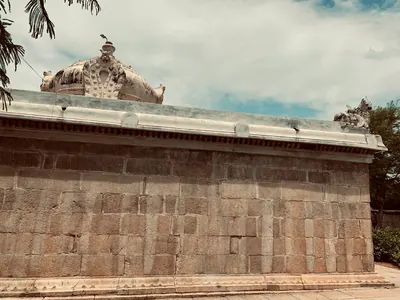
Gudimallam is a village in the Kalahasti country of the old Chittoor district, near Renigunta.12 Its old name was Tiruvippirambedu, in Sanskrit Viprapitha.3 Its Parasuramesvara temple holds the earliest known records of the Banas, a family of local kings of the 9th century.4 Later the Cholas left many Tamil inscriptions on its walls.5
The old name
V. Rangacharya (1919) listed a Chola record from elsewhere in the district that names the god Parasuramesvara at Vippirambedu.1 He noted that “Vippirambedu is the ancient name of modern Gudimallam near Renigunta”.1 E. Hultzsch (1924) showed that the Viprapitha of a Bana copper-plate grant was the Sanskrit form of the same name.3
V. Venkayya (1912) found that the temple had always been called Parasuramesvara, from its earliest inscriptions to his own day.4 None of the records explains the name.4
The Bana inscriptions
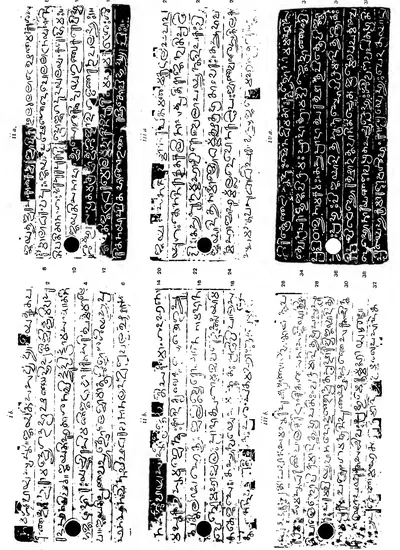
Venkayya published five Bana inscriptions from the temple.4 Most of the stones were found lying in the courtyard.4 Three of them record gifts to the Parasuramesvara temple.4
- One is dated in the 23rd year of the Pallava king Nandippottaraiyar.6
- One is of the 49th year of the Ganga-Pallava king Dantivikramavarman.7
- The last two are dated Saka 820 and 827 (898 and 905; Saka is an Indian way of counting years), under the Bana king Vijayaditya.89
Venkayya thought the stones may have come away from the temple when it was rebuilt under the Chola king Vikrama-Chola.4 He noted that the tract round Kalahasti and Gudimallam had belonged to the Pallavas.10
The copper plates
A set of five copper plates found at Gudimallam reached the Government Museum, Madras.2 It records a grant of the Bana king Vikramaditya II.3 He confirmed an old grant of the village Viprapitha to its Brahmins, after receiving a favour from the god of the Parasuramesvara temple.3 See the Gudimallam plates.
Chola inscriptions
The walls of the temple carry many Tamil records of a Chola king Rajarajadeva.5 Rangacharya thought he was “evidently the third of that name”.5 Two records belong to Vikrama-Chola.11 The one of his ninth year “records the building of the temple” by a son for the merit of his father.11
Footnotes
-
Rangacharya, Topographical List I (1919), p. 496, Chittoor No. 199 (archive.org (opens in a new tab)). ↩ ↩2 ↩3
-
E. Hultzsch, “Gudimallam Plates of the Bana King Vikramaditya II”, Epigraphia Indica XVII (1923–24), p. 1 (archive.org (opens in a new tab)). ↩ ↩2
-
Hultzsch, “Gudimallam Plates” (1924), p. 2 (archive.org (opens in a new tab)). ↩ ↩2 ↩3 ↩4
-
V. Venkayya, “Five Bana Inscriptions from Gudimallam”, Epigraphia Indica XI (1911–12), p. 223 (archive.org (opens in a new tab)). ↩ ↩2 ↩3 ↩4 ↩5 ↩6 ↩7
-
V. Rangacharya, A Topographical List of the Inscriptions of the Madras Presidency, Vol. I (1919), p. 477, Chittoor No. 38 (archive.org (opens in a new tab)). ↩ ↩2 ↩3
-
Venkayya, “Five Bana Inscriptions” (1912), p. 224 (archive.org (opens in a new tab)). ↩
-
Venkayya, “Five Bana Inscriptions” (1912), p. 225 (archive.org (opens in a new tab)). ↩
-
Venkayya, “Five Bana Inscriptions” (1912), p. 227 (archive.org (opens in a new tab)). ↩
-
Venkayya, “Five Bana Inscriptions” (1912), p. 228 (archive.org (opens in a new tab)). ↩
-
Venkayya, “Five Bana Inscriptions” (1912), p. 229 (archive.org (opens in a new tab)). ↩
-
Rangacharya, Topographical List I (1919), p. 478, Chittoor No. 46 (archive.org (opens in a new tab)). ↩ ↩2
Photos
Related
People
Vijayaditya II Prabhumeru (Bana)
c. 898–909 CE
Bana king of the country west of the Andhra road (the Chittoor country), also called Prabhumeru, Vira-Chulamani and Mahavali-Vanaraya. He was the son of Vikramaditya Jayameru (Banavidyadhara) and the father of Vikramaditya II, donor of the Gudimallam plates. His stone records at Gudimallam and in the Kolar country are dated Saka 820, 827 and 831 (898, 905 and 909), with no overlord named. He drove back the Nolamba invasion of Pulinadu and fought, with the Vaidumbas, at Soremati.
Vikrama-Chola
c. 1118–1135 CE
Son of the Chola emperor Kulottunga I who governed Vengi for his father from about 1092–93 and left it in 1118 to be crowned Chola king. In his absence the Western Chalukya Vikramaditya VI took the Vengi province, holding Draksharama from 1120–21 to 1123–24; Vikrama-Chola won it back, and his records are found at Chebrolu and Nidubrolu in 1127 and 1135. An inscription of his ninth year records the building of the temple at Gudimallam, and his records are at Nandalur and Tripurantakam.
Inscriptions
References
Notes (0)
Sources (3)
Spotted an error on this page? Tell us
Last updated: