Bheemunipatnam
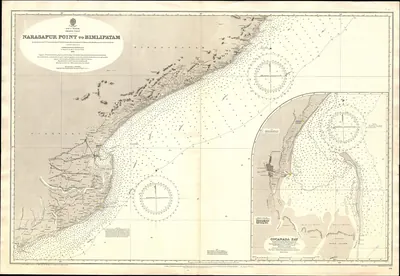
Small port north of Visakhapatnam, at the mouth of the Chittivalasa river, known in old records as Bimlipatam. The Dutch East India Company built a fortified factory (trading post) and a mint here in the seventeenth century, under grants of the Rajas of Vizianagaram. The Marathas burnt it in 1754. The English took it in 1781 and 1795, gave it back to the Dutch in 1785 and 1819, and received it for good in 1825. Francis dates the tombstones of its Dutch cemetery from 1661 to 1720 and calls the 1661 tomb the oldest in the Northern Circars, but Rea reports stones dated 1623.
Bheemunipatnam, the Bimlipatam of the old records, lies “at the mouth of the Chittivalasa river, close under the big laterite-topped Narasimha hill”.1 The Narasimha temple stands half way up the hill.1 In 1907 Francis’s Vizagapatam gazetteer called it a municipality of 10,212 people and “the busiest sea-port in the district”.1 See Dutch East India Company.
The Dutch factory
According to the gazetteer, Bheemunipatnam “first came into notice as a settlement of the Dutch, who built a fort and factory here in the seventeenth century”.1 The English factory (trading post) at Visakhapatnam (then Vizagapatam) was founded in 1682, and its records speak of the “bitter hostility” of its Dutch neighbours.2
W. Hodgson wrote a report on the Dutch settlements, and Francis and Alexander Rea both quote it.13 It says that the Dutch held the factory under farmans (royal orders) dated from 1628 to 1713.13 They also held cowles (grants) from the Nizam’s deputies in 1734 and 1752.13 The report says that the factory was granted “by the ancestors of the present Zemindar” of Vizianagaram.13
After Visakhapatnam surrendered to the French in 1757, Orme says, the Company’s ship Marlborough lay “at the Dutch factory of Bimlapatam, 12 miles to the northward”.4 In 1754 the Marathas burnt the factory.51 In the same year the zamindar (landholder) of Vizianagaram renewed the Dutch permission to build a fort, keep a bleaching ground and set up a mint.1
Hodgson accepted “that the Dutch did actually coin copper there”.673 But he found that no territorial jurisdiction (right to rule land) went with the factory.673 In his words it “appears to have been merely a commercial factory or lodge with certain privileges”.673
Wars and the end of the Dutch
The place changed hands several times:896
- in 1781 the English seized Bheemunipatnam with the other Dutch settlements and destroyed it6
- in 1785 it was restored to the Dutch6
- in 1795 it surrendered to the English again896
- after the convention of 1814 it was restored once more, on 31 March 1818 by the Fifth Report’s table and in 1819 by the gazetteer896
On 1 June 1825 the Dutch handed it to the English Company.6 The Collector gave a receipt for “the ruins of the Fort and Factory, with three bleaching grounds of Bimlipatam”.6 The bleaching grounds were still called the “Hollanders’ lands”, and from 1826 they were let to the Rajas of Vizianagaram.6
An old plan of 1819 shows the fort as a rectangle about 135 by 145 yards.6 It had round bastions (towers) at the corners and the ruins of its magazines and mint.6
The Dutch cemetery
Francis describes a half-forgotten cemetery among the gardens of Kummaripalem, about half a mile from the fort.610 It has “thirteen tombstones, made of the local garnetiferous gneiss, bearing Dutch inscriptions and coats-of-arms”.610 They range “in date from 1661 (the oldest tomb in the Northern Circars) to 1720”.610 Other Dutch tombs of later date stand in a second cemetery on the beach.610
See Visakhapatnam and Vizianagaram.
Where the sources disagree
The sources give different dates for the oldest tombstones.67
- Francis’s Vizagapatam gazetteer (1907) says that the stones range “in date from 1661 (the oldest tomb in the Northern Circars) to 1720”.610
- Rea (1897) says that there are “some tombstones dated 1623” in the old cemetery.7 In the same passage he says that the Dutch built their fort and factory “in the middle of the seventeenth century”.7
Footnotes
-
W. Francis, Madras District Gazetteers: Vizagapatam, Vol. I (1907), p. 226 (archive.org (opens in a new tab)). ↩ ↩2 ↩3 ↩4 ↩5 ↩6 ↩7 ↩8 ↩9 ↩10
-
Francis, Vizagapatam (1907), p. 36 (archive.org (opens in a new tab)). ↩
-
Alexander Rea, Monumental Remains of the Dutch East India Company in the Presidency of Madras (1897), p. 46 (archive.org (opens in a new tab)). ↩ ↩2 ↩3 ↩4 ↩5 ↩6 ↩7
-
Robert Orme, A History of the Military Transactions of the British Nation in Indostan, Vol. II (Madras reprint, 1861), p. 263 (archive.org (opens in a new tab)). ↩
-
Francis, Vizagapatam (1907), p. 31 (archive.org (opens in a new tab)). ↩
-
Francis, Vizagapatam (1907), p. 227 (archive.org (opens in a new tab)). ↩ ↩2 ↩3 ↩4 ↩5 ↩6 ↩7 ↩8 ↩9 ↩10 ↩11 ↩12 ↩13 ↩14 ↩15 ↩16 ↩17 ↩18 ↩19
-
Rea, Monumental Remains (1897), p. 45 (archive.org (opens in a new tab)). ↩ ↩2 ↩3 ↩4 ↩5 ↩6
-
“Acquisitions of Territory by the British in the Presidency of Fort St. George”, in W. K. Firminger (ed.), The Fifth Report from the Select Committee … on the Affairs of the East India Company, Vol. III (1918), p. xxv, No. XXXVI (archive.org (opens in a new tab)). ↩ ↩2 ↩3
-
“Acquisitions of Territory”, in Firminger, Fifth Report, Vol. III (1918), p. xxvi (archive.org (opens in a new tab)). ↩ ↩2 ↩3
-
Francis, Vizagapatam (1907), p. 228 (archive.org (opens in a new tab)). ↩ ↩2 ↩3 ↩4 ↩5
Photos
Related
People
Tenneti Viswanatham
Congress leader of Visakhapatnam. In the 1920s he was among the Andhra leaders who pressed for complete independence, and in 1928 he was treasurer of the Andhra Provincial Independence League. He led the salt satyagraha in Visakhapatnam district in 1930, was banned from public work in 1932, sat on the Andhra Congress Working Committee in 1937 and was detained in the Quit India movement of 1942.

Vijayarama Raju II of Vizianagaram
before 1794 CE
Raja of Vizianagaram from 1759 to 1794. He was adopted as a boy after Vijayarama Raju I died at Bobbili (1757) and Ananda Raju died (1759). With his half-brother Sitarama Raju he made the Vizianagaram family the strongest power in the Vizagapatam country under the East India Company, and they took the lands of the smaller zamindars. In 1793 his estate was seized for unpaid revenue and he was ordered to leave the district. He camped at Padmanabham, and he was killed there with his Rajput followers when the Company's troops attacked on 10 July 1794.
References
Notes (0)
Sources (4)
Spotted an error on this page? Tell us
Last updated: