Bhattiprolu
Village in the Krishna delta. In 1892 its great brick stupa yielded three relic caskets inscribed in an early and unusual variety of Brahmi, dated to about 200 BCE.
Bhattiprolu is a village in the Krishna delta, about four miles from the main channel of the river.1 It is some 24 miles west by south of Machilipatnam (then Masulipatam).1 Rea, writing in 1892, placed it in Repalle taluk of Krishna district.1 By 1908 it was in Tenali taluk of Guntur district, and its population in 1901 was 3,568.2 The Imperial Gazetteer gives its position as 16° 6′ N, 80° 47′ E.2
The stupa
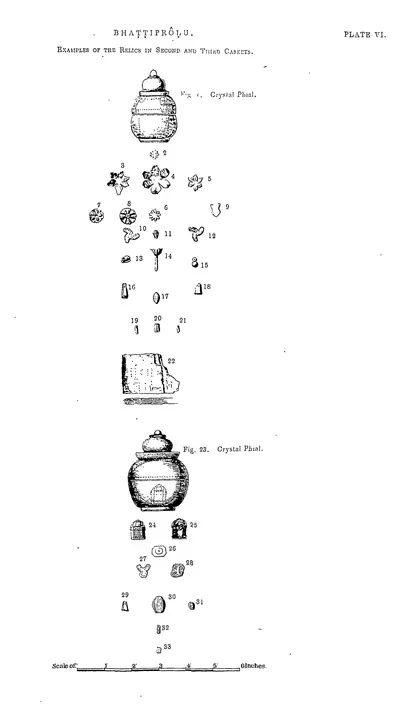
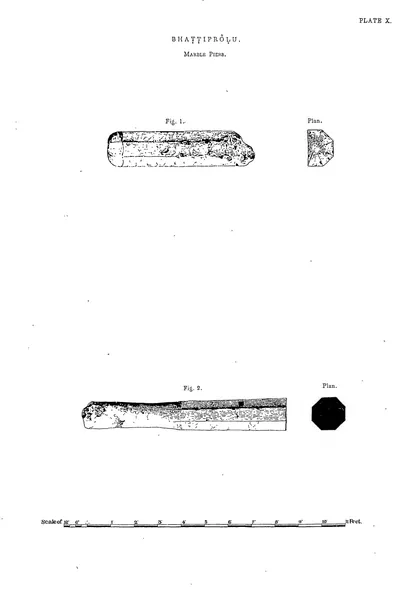
South of the village stood a large brick Buddhist stupa (relic mound), known locally as Lanja dibba. In the 1870s much of it was pulled down for bricks to build roads.13 Its marble slabs were reused in a sluice on the Krishna canal at Vellatur.13 In 1892 Alexander Rea excavated what remained. He found that the dome had measured 132 feet across, and 148 feet with its surrounding platform. In the brickwork at the centre he found three stone relic caskets.45 They held crystal phials, fragments of bone, gold flowers, pearls and silver coins.45
The caskets carry ten short inscriptions in Prakrit.67 G. Bühler judged their script to be a previously unknown variety of Brahmi.67 He dated it no later than about 200 BCE, close in age to the edicts of Asoka.67 See Bhattiprolu stupa and Bhattiprolu relic-casket inscriptions.
Other remains
Immediately east of the stupa is a slightly raised piece of ground called Chinna-Lanja dibba, which has bricks in its soil.8 Rea thought it the probable site of another Buddhist building.8 A local story told of a stone box found there many years before.8
On the eastern edge of the village is a long low mound called Vikramarka kota dibba.8 It was said to mark the wall of the fort of a former king, and large bricks had been dug from it.8
Later inscriptions
The village temples carry later inscriptions. Sewell listed grants of 1144, 1252 and 1542.9 The 1252 grant was made by the son of the family priest of the Kakatiya king Ganapati.9 A 16th-century record of repairs says that the temple had been built and endowed by a “Vishnuvardhana Chakravarti”.9
Footnotes
-
Alexander Rea, South Indian Buddhist Antiquities (1894), p. 7 (archive.org (opens in a new tab)). ↩ ↩2 ↩3 ↩4 ↩5
-
Imperial Gazetteer of India: Madras, Vol. I (1908), p. 334 (archive.org (opens in a new tab)). ↩ ↩2
-
Rea, South Indian Buddhist Antiquities (1894), p. 8 (archive.org (opens in a new tab)). ↩ ↩2
-
Rea, South Indian Buddhist Antiquities (1894), p. 9 (archive.org (opens in a new tab)). ↩ ↩2
-
Rea, South Indian Buddhist Antiquities (1894), p. 15 (archive.org (opens in a new tab)). ↩ ↩2
-
G. Bühler, “The Bhattiprolu Inscriptions”, Epigraphia Indica II (1894), p. 323 (archive.org (opens in a new tab)). ↩ ↩2 ↩3
-
Bühler, Epigraphia Indica II (1894), p. 325 (archive.org (opens in a new tab)). ↩ ↩2 ↩3
-
Rea, South Indian Buddhist Antiquities (1894), p. 17 (archive.org (opens in a new tab)). ↩ ↩2 ↩3 ↩4 ↩5
-
Robert Sewell, Lists of the Antiquarian Remains in the Presidency of Madras, Vol. I (1882), p. 78 (archive.org (opens in a new tab)). ↩ ↩2 ↩3
Photos
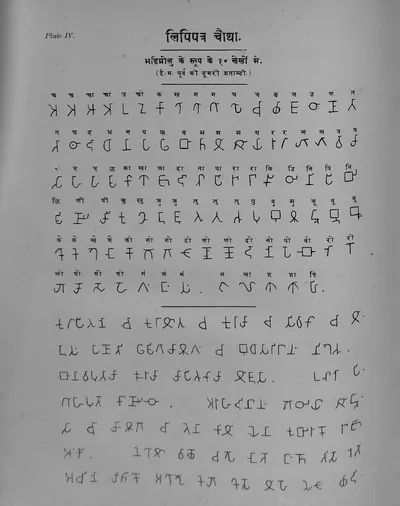 Alphabet table from the ten inscriptions of the Bhattiprolu stupa, 2nd century BCE (Ojha, Bharatiya Prachin Lipimala, 1918, Plate 4)Book plate · 1918
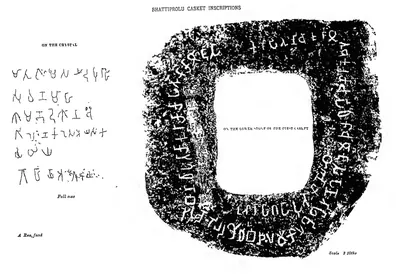 Bhattiprolu casket inscriptions: on the crystal, and on the lower stone of the first casket (Epigraphia Indica II)Inscription rubbing · 1894
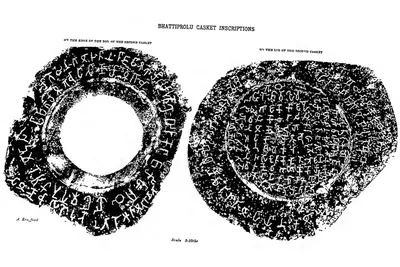 Bhattiprolu casket inscriptions: on the edge of the box and on the lid of the second casket (Epigraphia Indica II)Inscription rubbing · 1894
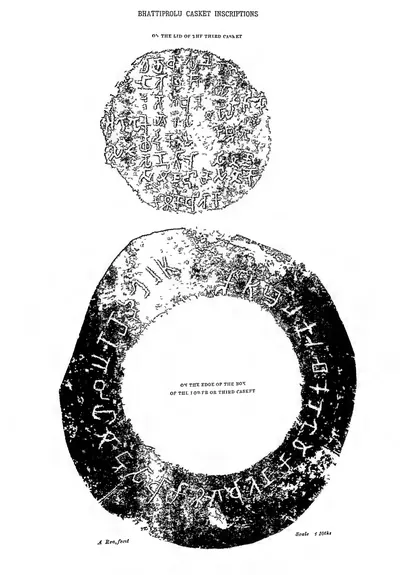 Bhattiprolu casket inscriptions: on the lid of the third casket, and on the edge of the box of the lower or third casket (Epigraphia Indica II)Inscription rubbing · 1894
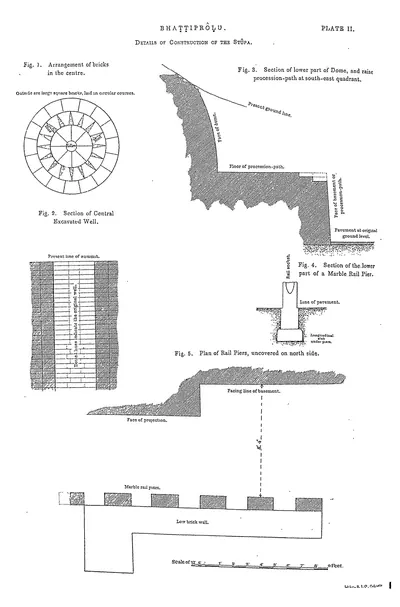 Bhattiprolu: details of construction (Rea 1894, Pl. II)Plan · 1894
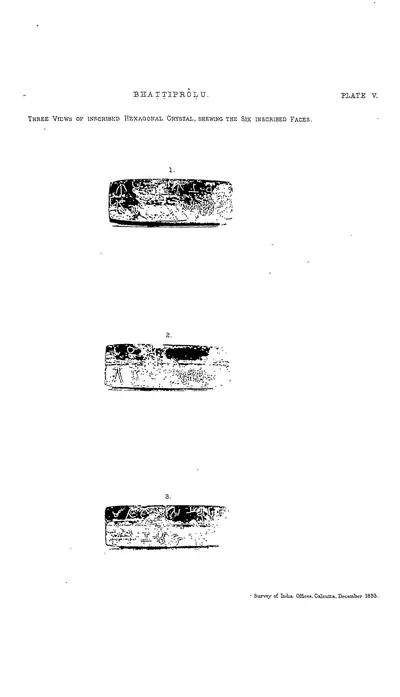 Bhattiprolu: inscribed crystal hexagon ("Three views of inscribed hexagonal crystal, shewing the six inscribed faces") (Rea 1894, Pl. V)Drawing · 1894
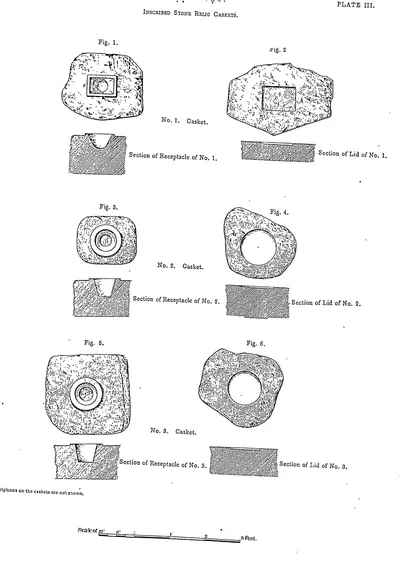 Bhattiprolu: large stone caskets (Rea 1894, Pl. III)Drawing · 1894
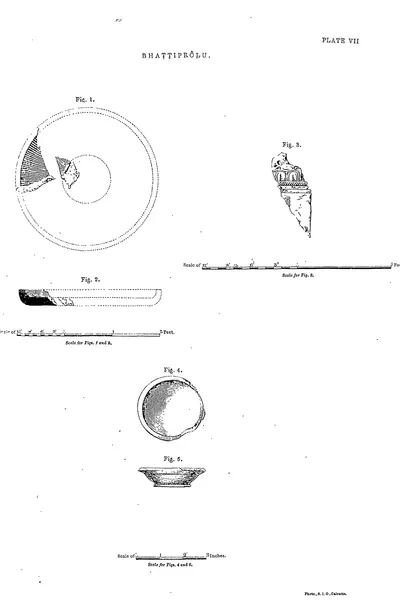 Bhattiprolu: marble umbrella, and pilaster base (Rea 1894, Pl. VII)Drawing · 1894
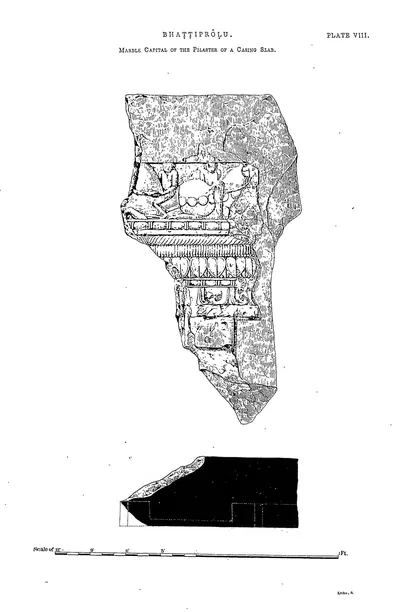 Bhattiprolu: pilaster capital (Rea 1894, Pl. VIII)Drawing · 1894
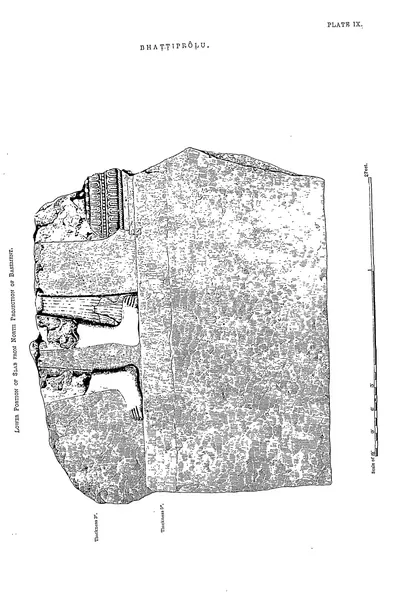 Bhattiprolu: portion of a slab from the stupa (Rea 1894, Pl. IX)Drawing · 1894
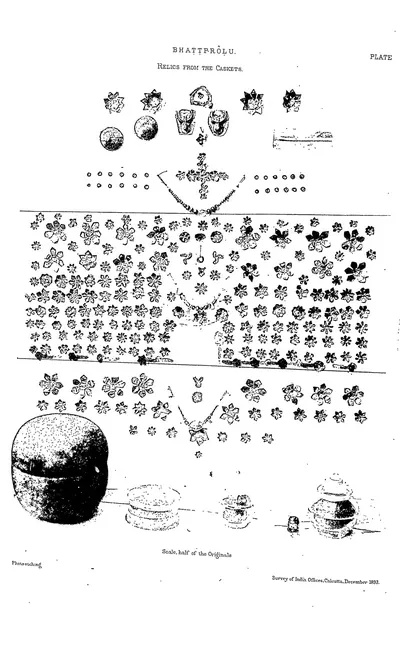 Bhattiprolu: relics and crystal caskets ("Relics from the caskets") (Rea 1894, Pl. I)Drawing · 1894
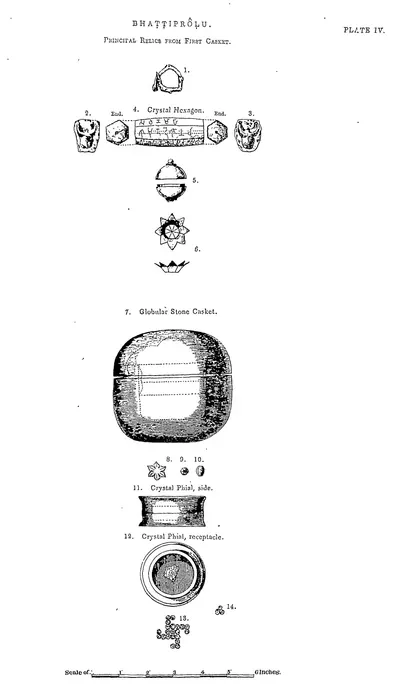 Bhattiprolu: relics of first casket (Rea 1894, Pl. IV)Drawing · 1894
References
Notes (0)
Sources (4)
Spotted an error on this page? Tell us
Last updated: