Visakhapatnam
Port on the Vizagapatam coast, known to the English as Vizagapatam, where the East India Company founded a factory (trading post) in 1682. The factory was seized under Aurangzeb in 1689 and besieged by the Faujdar of Chicacole in 1710–11. It surrendered to Bussy in 1757, and the Raja of Vizianagaram gave it to the English in 1758. From 1769 it was the seat of a Chief and Council, and then of the Collector of the Vizagapatam district. Its old cemetery holds the graves of Chiefs of the settlement from 1705.
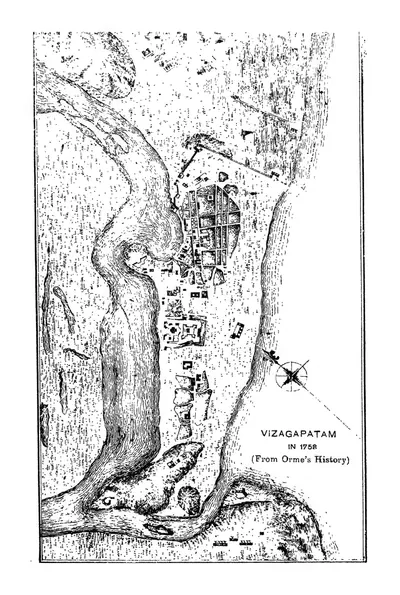
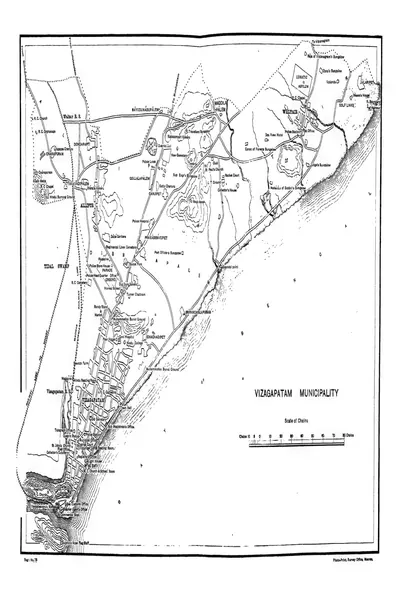
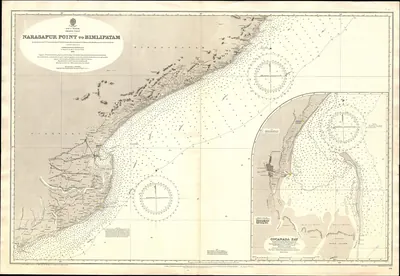
Visakhapatnam stands on the coast where a river turns east into the sea, under the headland called the Dolphin’s Nose. Orme described the English settlement there in 1757.1 It stood on “an arm of land, a mile and half in length, and 600 yards in breadth”, between the river and the sea.1 Francis’s Vizagapatam gazetteer (1907) says that the southernmost part of the town was still called “the Fort”, although “not a vestige of the fortifications survives”.23 See East India Company.
The English factory
The gazetteer dates the settlement to 1682.45 The Madras consultations of 1 August 1682 sent George Ramsden “as Chiefe” to buy cloth and to keep out interlopers (private traders).45 That year he obtained a cowle (grant) from the Faujdar of Srikakulam (then Chicacole), in spite of “the bitter hostility of the Dutch at Bimlipatam”.45 The Fifth Report’s table had found no earlier record, and it gives 1683 as the “supposed date”.6
In 1689 the Company was at war with Aurangzeb.76 On 13 September 1689 the Faujdar’s men surrounded the factory and killed the Chief, John Stables, and two others.76 After the peace of 1690 the factory was restored and allowed to fortify itself.86
In December 1710 Fakir-ullah, the Faujdar (“Seer Lascar”) of Srikakulam, besieged the factory with several thousand men.910 He was demanding the repayment of a loan made to the Chief, Simon Holcombe.910 The small garrison held out for months, until the Company paid 20,000 pagodas.910 In 1727 the Company’s cloth-washers were settled at Waltair, where the water whitened cloth better.11 See Crafts and textiles.
Bussy and the English return
Bussy’s French army appeared before Visakhapatnam (then Vizagapatam) on 24 June 1757.112 The engineers thought it could not be held.112 The capitulation was signed at eleven that night, and the English became prisoners.112 The gazetteer reproduces a plan of the town in 1758, from Orme.1314
In 1758 the Raja of Vizianagaram took the town from the French.615 The Fifth Report says that he presented it to the English on 12 September.6 Colonel Forde landed there on 20 October to begin the campaign that drove the French from the Circars.15
In 1769 John Andrews was sent from Machilipatnam (then Masulipatam) to be “the first Chief in Council” at Visakhapatnam.416 So the town became the capital of the district.416 See French East India Company and Vijayarama Raju II.
Monuments
The gazetteer says that the old cemetery lies north of the old fort.17 It is “often wrongly called ‘the Dutch Cemetery’”, and it has burials from 1699 to 1823.17 Among them are four Chiefs of the settlement:17
- Simon Holcombe (1705)
- Sandys Davis (1734)
- Charles Simpson (1741)
- Alexander Davidson (1791)17
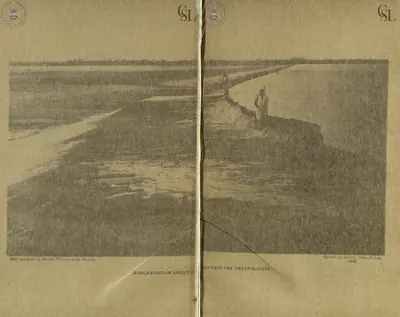
St John’s church, by the Collector’s office, “was built in 1844 by Sir Arthur Cotton and consecrated in 1846”.318 Cotton’s stone groins (sea walls) of 1844 still protected the shore below the Dolphin’s Nose.318 See Arthur Cotton.
Footnotes
-
Robert Orme, A History of the Military Transactions of the British Nation in Indostan, Vol. II (Madras reprint, 1861), p. 261 (archive.org (opens in a new tab)). ↩ ↩2 ↩3 ↩4 ↩5
-
W. Francis, Madras District Gazetteers: Vizagapatam, Vol. I (1907), p. 329 (archive.org (opens in a new tab)). ↩
-
Francis, Vizagapatam (1907), p. 330 (archive.org (opens in a new tab)). ↩ ↩2 ↩3
-
Francis, Vizagapatam (1907), p. 35 (archive.org (opens in a new tab)). ↩ ↩2 ↩3 ↩4 ↩5
-
Francis, Vizagapatam (1907), p. 36 (archive.org (opens in a new tab)). ↩ ↩2 ↩3
-
“Acquisitions of Territory by the British in the Presidency of Fort St. George”, in W. K. Firminger (ed.), The Fifth Report from the Select Committee … on the Affairs of the East India Company, Vol. III (1918), p. xv, No. XII, Vizagapatam (archive.org (opens in a new tab)). ↩ ↩2 ↩3 ↩4 ↩5 ↩6
-
Francis, Vizagapatam (1907), p. 37 (archive.org (opens in a new tab)). ↩ ↩2
-
Francis, Vizagapatam (1907), p. 38 (archive.org (opens in a new tab)). ↩
-
Francis, Vizagapatam (1907), p. 40 (archive.org (opens in a new tab)). ↩ ↩2 ↩3
-
Francis, Vizagapatam (1907), p. 41 (archive.org (opens in a new tab)). ↩ ↩2 ↩3
-
Francis, Vizagapatam (1907), p. 42 (archive.org (opens in a new tab)). ↩
-
Orme, Military Transactions, Vol. II (1861), p. 262 (archive.org (opens in a new tab)). ↩ ↩2 ↩3
-
Francis, Vizagapatam (1907), p. 44, and the map facing it, “Vizagapatam in 1758 (From Orme’s History)” (archive.org (opens in a new tab)). ↩
-
Francis, Vizagapatam (1907), p. 45 (archive.org (opens in a new tab)). ↩
-
Francis, Vizagapatam (1907), p. 33 (archive.org (opens in a new tab)). ↩ ↩2
-
Francis, Vizagapatam (1907), p. 46 (archive.org (opens in a new tab)). ↩ ↩2
-
Francis, Vizagapatam (1907), p. 331 (archive.org (opens in a new tab)). ↩ ↩2 ↩3 ↩4
-
Francis, Vizagapatam (1907), p. 327 (archive.org (opens in a new tab)). ↩ ↩2
Photos
Related
Dynasties
People
Charles de Bussy
1718 CE
French general, born in 1718, who commanded the French troops at the court of the Nizams Muzaffar Jang and Salabat Jang from 1751 to 1758. He raised Salabat Jang to the throne and obtained from him the four Northern Circars for the French Company in 1753. He governed them through the Raja of Vizianagaram and the zamindars. In 1757 he destroyed the fort of Bobbili and took the English factories on the coast. Lally recalled him to the Carnatic in 1758, and he left the Circars to be lost to Colonel Forde.
Sir Arthur Cotton
1803–1899 CE
Engineer officer of the Madras army (1803–1899). He planned and built the anicut (dam) across the Godavari at Dowlaishweram (1847–1852), which turned the Godavari delta into irrigated rice land. He backed the plan for the Krishna anicut at Bezwada (built 1852–1855). At Vizagapatam he built sea groins and St John's church in 1844. He planned the upper Godavari navigation, of which the Dummagudem anicut survives.
Chandrayya of Rampa
c. 1879–1881 CE
Leader of hill bands in the Rampa rebellion of 1879–1880 in the Godavari and Visakhapatnam hill tracts, a rising against the exactions of the mansabdar of Rampa, new toddy rules and the police. He burnt the Addatigala police station in 1879, held out for months, and was killed in 1880 or 1881, the sources differ, after being betrayed by another rebel.
Karam Tammanna Dora
1879–1880 CE
One of the chief leaders of the Rampa rebellion of 1879–1880 in the Godavari and Visakhapatnam hill tracts. The police history calls him the chief leader of the rising and says a police officer shot him on 25 July 1880; the Godavari gazetteer has him leading a raid into Visakhapatnam district in October 1880.
Gam Mallu Dora
1900 CE
Koya leader from Battapanukulu in the Visakhapatnam hill tracts (born 1900), one of the two chief lieutenants of Alluri Sitarama Raju in the Rampa rebellion of 1922–1924. He was captured in September 1923, sentenced to death in May 1924, and served his commuted sentence in the Andamans and an internment camp until 1937. In 1952 he was elected to the first Lok Sabha for Visakhapatnam.
Gam Gantam Dora
1922–1924 CE
Koya leader from Battapanukulu in the Visakhapatnam hill tracts, elder brother of Gam Mallu Dora and one of the two chief lieutenants of Alluri Sitarama Raju in the Rampa rebellion of 1922–1924. He kept a small band together after Sitarama Raju's death in May 1924 and was killed by a police patrol on 7 June 1924.
Francis Forde
before 1770 CE
Irish officer of the 39th Foot, sent by Clive from Bengal in 1758. He routed the French under Conflans at Condore (Chandurti) near Pithapuram on 9 December 1758 and stormed Masulipatam in April 1759, so winning the Northern Circars from the French for the East India Company. He had earlier led the English detachment in the failed attack on Nellore (1757). Appointed one of the Company's Supervisors in 1769, he was lost at sea when the frigate Aurora disappeared after leaving the Cape at the end of that year.
Tenneti Viswanatham
Congress leader of Visakhapatnam. In the 1920s he was among the Andhra leaders who pressed for complete independence, and in 1928 he was treasurer of the Andhra Provincial Independence League. He led the salt satyagraha in Visakhapatnam district in 1930, was banned from public work in 1932, sat on the Andhra Congress Working Committee in 1937 and was detained in the Quit India movement of 1942.
Vijayarama Raju II of Vizianagaram
before 1794 CE
Raja of Vizianagaram from 1759 to 1794. He was adopted as a boy after Vijayarama Raju I died at Bobbili (1757) and Ananda Raju died (1759). With his half-brother Sitarama Raju he made the Vizianagaram family the strongest power in the Vizagapatam country under the East India Company, and they took the lands of the smaller zamindars. In 1793 his estate was seized for unpaid revenue and he was ordered to leave the district. He camped at Padmanabham, and he was killed there with his Rajput followers when the Company's troops attacked on 10 July 1794.
References
Notes (0)
Sources (3)
Spotted an error on this page? Tell us
Last updated: