Erragudi edicts of Asoka
Asoka's fourteen Rock Edicts and his Minor Rock Edicts I–II, carved on six boulders of the Yenakonda hill near Erragudi in Kurnool district in the mid-3rd century BCE. They were found in 1928.
The Erragudi inscriptions include both Asoka’s series of fourteen Rock Edicts (sometimes called Major Rock Edicts) and his Minor Rock Edicts I and II. When they were found, only six complete sets of the Rock Edicts were known.1 These were at Girnar, Kalsi, Shahbazgarhi, Mansehra, Dhauli and Jaugada, along with a fragment from Sopara.1
Where and how it was found
The edicts are carved on six large boulders in a range of low hills west of the village of Erragudi (also written Yerragudi), in Pattikonda taluk of Kurnool district. The village is about eight miles north-west of Gooty. The hill is locally called Yenakonda or Nallayenakonda, “elephant hillock” or “black elephant hillock”.2 But no carving of an elephant has been found there.2
At the end of 1928 A. Ghose, a Calcutta geologist looking for precious minerals, saw the inscriptions. He recognized the words Devanam… Piyadasi, a title of Asoka. In January 1929 he reported the find to the Archaeological Survey. D. R. Sahni and the Government Epigraphist Hirananda Sastri copied the inscriptions in February 1929.23 S. V. Viswanatha traced Rock Edicts VI and XII that August.23
The boulders
Sahni labelled the boulders A to F.3 They carry the edicts as follows:4
- Boulder A, the largest, stands on the summit above a drop of about 20 feet.4 Its east face carries Rock Edicts I–III, VI and XIV, and its north face Rock Edicts V, VII and XI.4
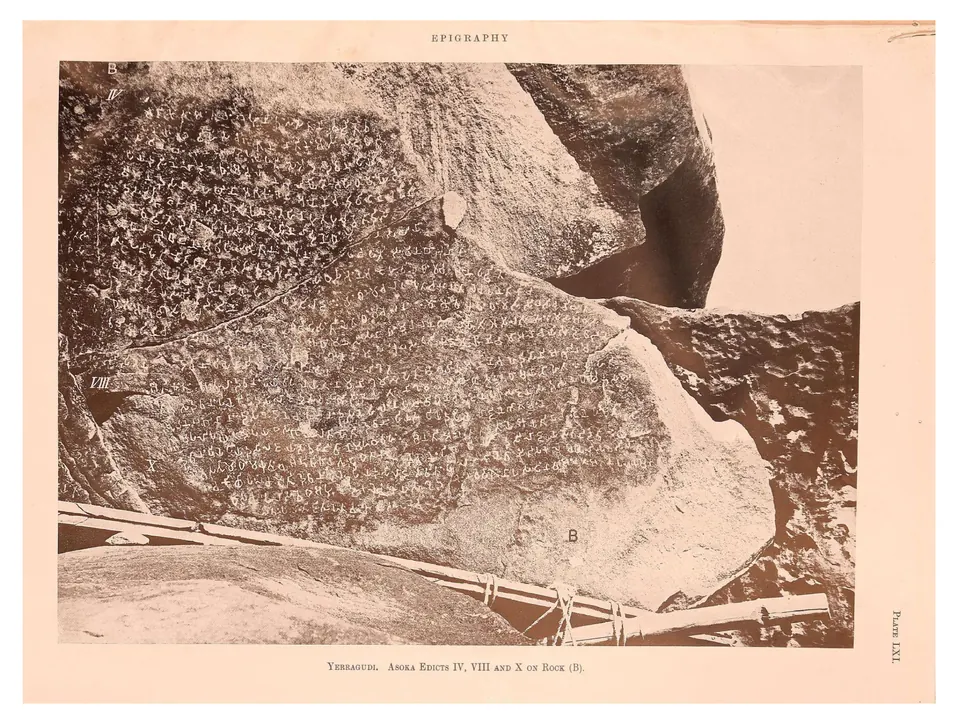
- Boulder B has Rock Edicts IV, VIII and X, and the first 29 lines of Rock Edict XIII.4
- The edict continues on Boulder C.4
- Boulder D carries Rock Edict XII, and Boulder E Rock Edict IX.4
- The Minor Rock Edicts are on Boulder F, lower down the slope.4 This is the easiest of the six to reach and the best preserved, and Sircar thought its text was engraved before the series of fourteen.4
None of the rock surfaces was smoothed before carving, and many lines are hard to read.5 The officiating Director-General of Archaeology remarked that scaffolding was needed to take impressions. He wondered how anyone in Mauryan times was expected to find and read the edicts.6
Language and script
The script is Brahmi. The Minor Rock Edicts on Boulder F are unusual. Some lines, half-lines or parts of lines run from right to left, some groups of letters are carved in the wrong line, and some words are left out. Sircar suggested that the engraver came from north-western India.7 There, he thought, the engraver was used to writing Kharoshthi, a script that runs from right to left.7 Sahni had described the same text in 1929 as written partly in boustrophedon, that is, with lines running in turn left-to-right and right-to-left.8
The language is Prakrit, but the two sets of edicts differ. The Minor Rock Edicts keep the sound r and are close to the versions found in Mysore. The Rock Edicts change r to l, as in the eastern (Magadhan) dialect, and are close to the versions at Dhauli, Jaugada and Kalsi. Sircar concluded that the two sets reached Erragudi separately, at different times.79
Content
In Minor Rock Edict I, Asoka says he has been a lay follower of the Buddha for more than two and a half years. He also says that for more than a year he has been closely associated with the Buddhist order (Sangha) and has worked hard for dhamma (right conduct). Even a poor person who makes the effort can reach heaven. The edict ends by saying it was issued while the king had been on tour for 256 days.10
Minor Rock Edict II tells the officials to instruct the Rajjuka (a district officer), who is to tell the people of the countryside and the Rashtrikas. They are to obey their parents and elders, be kind to living beings and speak the truth. Teachers, including elephant-riders, scribes, charioteers and Brahmins, are to pass these principles on to their pupils.11
The fourteen Rock Edicts have the same content as Asoka’s other copies of this series. Rock Edict II, for example, says that Asoka had arranged two kinds of medical treatment.12 He had wells dug and trees planted along roads for people and animals.12 He did this throughout his lands and in the bordering lands of the Chodas, Pandyas and others.12 Rock Edict XIII describes the conquest of Kalinga and Asoka’s sorrow over it. It also lists the Andhras among the peoples within his lands who follow his teaching.13
Significance and editions
Sahni called the find further proof of Asoka’s rule over part of southern India.1 The Minor Rock Edicts were published first: by Sircar in the Indian Historical Quarterly in 1931, from a photograph printed in the Telugu periodical Bharati, by B. M. Barua, and by Sahni in the Archaeological Survey’s report for 1928–29. The full set appeared only in Sircar’s edition in Epigraphia Indica XXXII. It was delayed for three decades.3 The scholars asked to edit the text retired, were transferred or died before finishing.3
Footnotes
-
D. R. Sahni, “The Yerragudi Rock Edicts of Asoka”, Annual Report of the Archaeological Survey of India 1928–29 (1933), p. 161 (archive.org (opens in a new tab)). ↩ ↩2 ↩3
-
D. C. Sircar, “Erragudi Edicts of Asoka”, Epigraphia Indica XXXII (1959), p. 1 (archive.org (opens in a new tab)). ↩ ↩2 ↩3 ↩4
-
D. C. Sircar, “Erragudi Edicts of Asoka”, Epigraphia Indica XXXII (1959), p. 2 (archive.org (opens in a new tab)). ↩ ↩2 ↩3 ↩4 ↩5
-
D. C. Sircar, “Erragudi Edicts of Asoka”, Epigraphia Indica XXXII (1959), p. 3 (archive.org (opens in a new tab)). ↩ ↩2 ↩3 ↩4 ↩5 ↩6 ↩7 ↩8
-
D. R. Sahni, “The Yerragudi Rock Edicts of Asoka”, Annual Report of the Archaeological Survey of India 1928–29 (1933), p. 162 (archive.org (opens in a new tab)). ↩
-
H. Hargreaves (ed.), Annual Report of the Archaeological Survey of India 1928–29 (1933), Introduction, p. 6 (archive.org (opens in a new tab)). ↩
-
D. C. Sircar, “Erragudi Edicts of Asoka”, Epigraphia Indica XXXII (1959), p. 4 (archive.org (opens in a new tab)). ↩ ↩2 ↩3
-
D. R. Sahni, “The Yerragudi Rock Edicts of Asoka”, Annual Report of the Archaeological Survey of India 1928–29 (1933), pp. 164–165 (archive.org (opens in a new tab)). ↩
-
D. C. Sircar, “Erragudi Edicts of Asoka”, Epigraphia Indica XXXII (1959), p. 5 (archive.org (opens in a new tab)). ↩
-
D. C. Sircar, “Erragudi Edicts of Asoka”, Epigraphia Indica XXXII (1959), pp. 8–9 (archive.org (opens in a new tab)). ↩
-
D. C. Sircar, “Erragudi Edicts of Asoka”, Epigraphia Indica XXXII (1959), pp. 9–10 (archive.org (opens in a new tab)). ↩
-
D. C. Sircar, “Erragudi Edicts of Asoka”, Epigraphia Indica XXXII (1959), p. 11 (archive.org (opens in a new tab)). ↩ ↩2 ↩3
-
D. C. Sircar, “Erragudi Edicts of Asoka”, Epigraphia Indica XXXII (1959), pp. 23–24 (archive.org (opens in a new tab)). ↩
Photos
 Erragudi: "Yerragudi. Asoka Edicts IV, VIII and X on Rock B" (ASI Annual Report 1928-29, Pl. LXI)Historic photograph · 1933
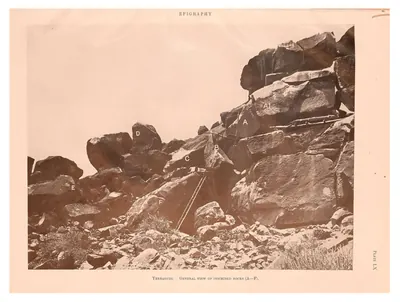 Erragudi: "Yerragudi. General view of inscribed rocks (A-F)" (ASI Annual Report 1928-29, Pl. LX)Historic photograph · 1933
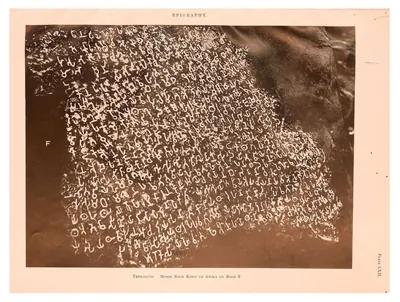 Erragudi: "Yerragudi. Minor Rock Edict of Asoka on Rock F" (ASI Annual Report 1928-29, Pl. LXII)Historic photograph · 1933
References
Notes (0)
Sources (2)
Spotted an error on this page? Tell us
Last updated: