Rajula-Mandagiri
Hamlet of Juthru near Pattikonda, Kurnool district, where a damaged copy of Asoka's Minor Rock Edicts is carved on the rock of the Ramalingesvara temple.
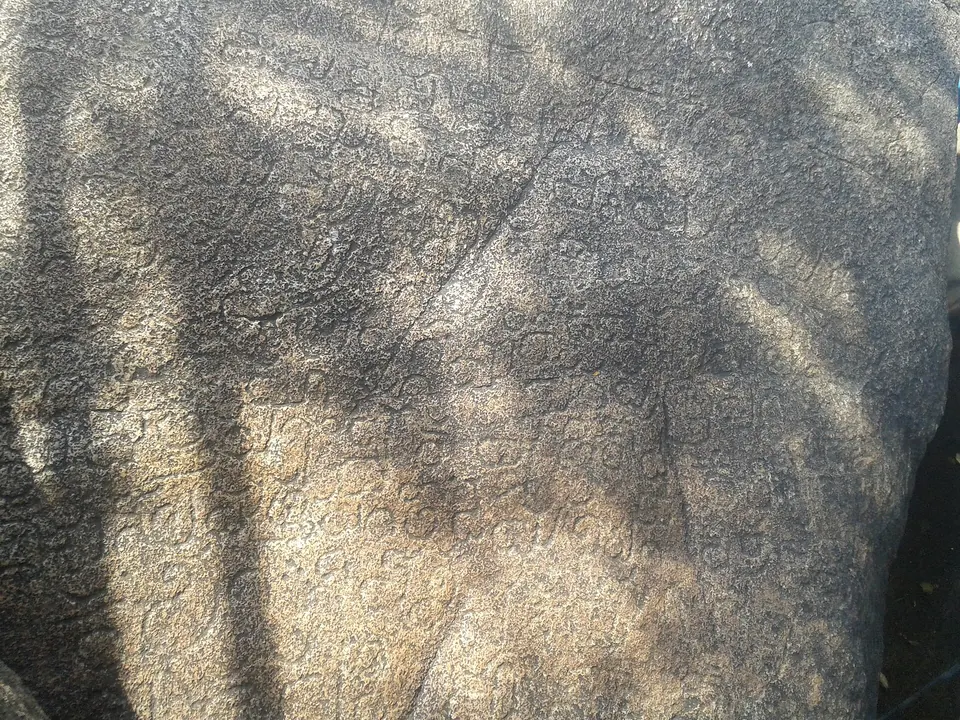
Rajula-Mandagiri is a hamlet attached to the village of Juthru in Pattikonda taluk of Kurnool district. According to D. C. Sircar it lies about 3 miles north-west of Pattikonda town and about 20 miles from Erragudi, where Asoka’s edicts had been found in 1928–29. When Sircar wrote, in the 1950s, there was no road from Pattikonda and the hamlet could be reached only by bullock cart.1
The Ramalingesvara rock
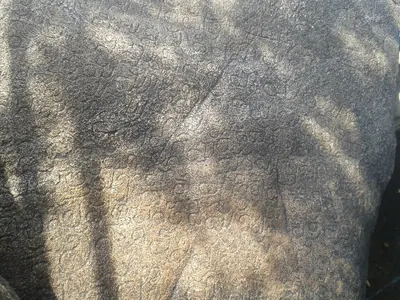
The hamlet’s temple of Ramalingesvara stands on a sheet of rock. About ten yards from the temple entrance, the rock carries a 15-line copy of Asoka’s Minor Rock Edicts I and II, in Prakrit and Brahmi script. It is badly weathered. Four other early and medieval inscriptions were found in the same locality.1 For the text, see Rajula-Mandagiri inscription of Asoka.
In the Mackenzie records
The place was first recorded around 1800 by the survey of Colin Mackenzie. A volume of his “Local Records” contains a partial hand-copy of the inscription. It locates the inscription opposite the west gateway of the Pedda Ramalinga temple at Rajula-Mandagiri in a “Panchapalayam” district.2 Neither name could be found in the official village list of the Madras Presidency. For a time the inscription was sought at Mandigiri in Adoni taluk, Bellary district. M. Venkataramayya of the epigraphy department finally found the hamlet near Pattikonda and located the inscription on 26 December 1953.21 Pattikonda taluk itself had belonged to Bellary district until 1858, when it was transferred to Kurnool.3
Footnotes
-
D. C. Sircar, “Rajula-Mandagiri Inscription of Asoka”, Epigraphia Indica XXXI (1960), p. 212 (archive.org (opens in a new tab)). ↩ ↩2 ↩3
-
D. C. Sircar, “Rajula-Mandagiri Inscription of Asoka”, Epigraphia Indica XXXI (1960), p. 211 (archive.org (opens in a new tab)). ↩ ↩2
-
Imperial Gazetteer of India, Provincial Series: Madras, Vol. I (1908), p. 407 (archive.org (opens in a new tab)). ↩
Photos
Related
People
Inscriptions
References
Notes (0)
Sources (2)
Spotted an error on this page? Tell us
Last updated: