Kalingapatnam
Seaport at the mouth of the Vamsadhara in the Srikakulam district, long supposed to be Kalinganagara, the capital of the Ganga kings of Kalinga. E. Hultzsch still thought so in 1895. But G. V. Ramamurti found no antiquities there fit for a capital, and he placed Kalinganagara at Mukhalingam instead.
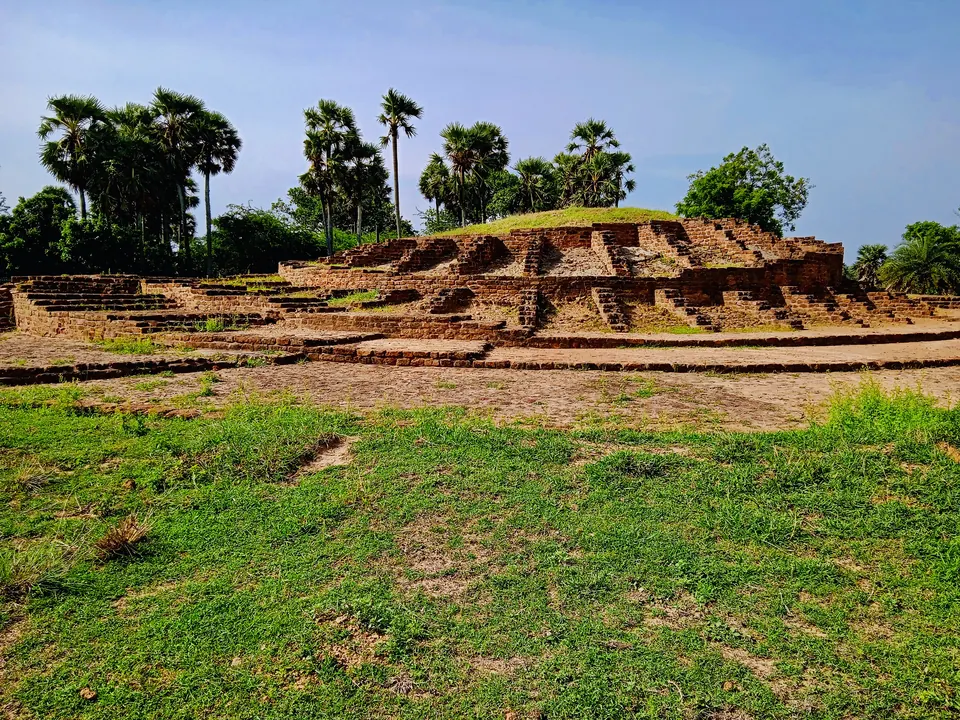
Robert Sewell’s Lists of Antiquities (1882) describes Kalingapatnam (then Calingapatam) as a “seaport at the mouth of the Vamsadhara river”.1 He calls it “the presumed old capital of the kingdom of Kalinga”.1 It had a large mosque and a Dargah (shrine of a Muslim saint).1 A mound near the town “was plainly the site of the ancient city”, and small gold coins were sometimes found there.1
The old capital?
W. W. Hunter wrote in 1872 that the capital of ancient Kalinga was “still surviving in the present city of Kalingapatnam”.2 E. Hultzsch edited the Alamanda plates in 1895.3 He took Kalinganagara, the residence named in the Ganga grants, to be “probably the modern Calingapatam”.3
G. V. Ramamurti rejected the identification in 1897. He wrote that it was not “based on any recorded facts, but seems to have been suggested only by the similarity between the two names”.4 There were no antiquities at Kalingapatam “of a nature which could suggest the fact of its ever having been the capital of the Kalinga kingdom”.4 The idea that the sea had swallowed them was a “gratuitous” (baseless) assumption.4
Ramamurti placed Kalinganagara at Mukhalingam instead, and the Imperial Gazetteer (1908) followed him.45 See Mukhalingam. Four miles north of Kalingapatnam, at Dirghasi, stands an inscription of a general of the Ganga king Rajaraja I.6 See the Dirghasi inscription.
Footnotes
-
Robert Sewell, Lists of the Antiquarian Remains in the Presidency of Madras, Vol. I (1882), p. 7 (archive.org (opens in a new tab)). ↩ ↩2 ↩3 ↩4
-
W. W. Hunter, Orissa, Vol. I (1872), pp. 170–171 (archive.org (opens in a new tab)). ↩
-
E. Hultzsch, “Alamanda Plates of Anantavarman”, Epigraphia Indica III (1894–95), p. 18, note 1 (archive.org (opens in a new tab)). ↩ ↩2
-
G. V. Ramamurti, “Nadagam Plates of Vajrahasta; Saka-Samvat 979”, Epigraphia Indica IV (1896–97), p. 187 (archive.org (opens in a new tab)). ↩ ↩2 ↩3 ↩4
-
Imperial Gazetteer of India, Provincial Series: Madras, Vol. I (1908), p. 228 (archive.org (opens in a new tab)). ↩
-
G. V. Ramamurti, “Dirghasi Inscription of Vanapati; Saka-Samvat 997”, Epigraphia Indica IV (1896–97), p. 314 (archive.org (opens in a new tab)). ↩
Photos
References
Notes (0)
Sources (5)
Spotted an error on this page? Tell us
Last updated: