Kalidindi
Village on the eastern edge of the Kolleru lake, in the old Kaikalur taluk of Krishna district. A copper-plate grant of the Eastern Chalukya king Rajaraja I was dug up here in 1938. It says that the king built three Shiva temples at Kalidindi in memory of Chola generals killed in battle. He gave the temples the village, renamed Madhurantakanallur. In the 18th and 19th centuries Kalidindi was a pargana (revenue division) of the Nuzvid zamindari (estate).
Kalidindi is a village in the Kaikalur taluk of Krishna district. N. Venkataramanayya, writing in 1952, placed it on the eastern edge of the Kolleru (Colair) lake, with the nearby village of Avakuru.1 It is known for a copper-plate grant of the Eastern Chalukya king Rajaraja I, found here in 1938.23
The epigraphy report of 1937–38 identified the Kalidindi of the copper plates with this village in the Kaikalur taluk.4 The report also took the Gudravara district, in which the village lay, to be named after Gudivada.4
The Eastern Chalukya grant
In 1938 a farmer digging for earth at Kalidindi found a set of five copper plates.23 They belong to the Eastern Chalukya king Rajaraja Narendra (Rajaraja I), who was crowned in 1022.23
The plates record that a Chola army marched into the Andhra country under three generals.5 The generals were Rajaraja Brahma-Maharaja, Uttama-Choda Chodakon and Uttama-Chola Miladudaiyan.5 The army fought the commanders of the king of Karnata, and the commanders on both sides died.5
Rajaraja then built a Shiva temple at Kalidindi, called Rajarajesvaram, in memory of the first general.54 He built two other Shiva temples for the other generals.54 For their worship, and for a feeding house for fifty students, he gave Kalidindi together with Kadaparru and Avakuru.54 He renamed Kalidindi Madhurantakanallur, after the Chola emperor Rajendra-Chola Madhurantaka.54
Venkataramanayya thought the battle had probably been fought near the village.56 His reason was that memorial temples were sometimes built where the dead were buried or cremated.56 The report of 1937–38 had made the same suggestion.4
The grant gives Kalidindi’s neighbours as Potumbarru to the north, Konneki to the east, Kadaparru to the west and Tadinadu to the north-west.1 Venkataramanayya identified Potumbarru with Potumarru and Tadinadu with Tadinada.1 No source used here says whether any of the three temples survives. See the Kalidindi grant of Rajaraja I.
Later history
Gordon Mackenzie’s manual of the Krishna (then Kistna) district (1883) lists eighteen parganas (revenue divisions) held by the Nuzvid zamindars (landholders) in the time of Sobhanadri.7 Kalidindi was one of them.7
According to the manual, the Mogalturu Raja gave up his portion of Kalidindi in 1805, and it was then sold.8 Vasireddi Venkatadri Naidu outbid Malraju Venkata Gunda Rao for it and paid more than it was worth.8
Footnotes
-
Venkataramanayya, “Kalidindi Grant” (1952), p. 64 (archive.org (opens in a new tab)). ↩ ↩2 ↩3
-
N. Venkataramanayya, “Kalidindi Grant of Eastern Chalukya Rajaraja I”, Epigraphia Indica XXIX (1951–52), p. 57 (archive.org (opens in a new tab)). ↩ ↩2 ↩3
-
Venkataramanayya, “Kalidindi Grant” (1952), p. 60 (archive.org (opens in a new tab)). ↩ ↩2 ↩3
-
Annual Report on South Indian Epigraphy for the Year ending 31st March 1938 (1942), Part II, para. 14, p. 82 (archive.org (opens in a new tab)). ↩ ↩2 ↩3 ↩4 ↩5 ↩6 ↩7
-
Venkataramanayya, “Kalidindi Grant” (1952), p. 62 (archive.org (opens in a new tab)). ↩ ↩2 ↩3 ↩4 ↩5 ↩6 ↩7 ↩8 ↩9
-
Venkataramanayya, “Kalidindi Grant” (1952), p. 63 (archive.org (opens in a new tab)). ↩ ↩2
-
Gordon Mackenzie, A Manual of the Kistna District in the Presidency of Madras (1883), p. 296 (archive.org (opens in a new tab)). ↩ ↩2
-
Mackenzie, Manual of the Kistna District (1883), p. 348 (archive.org (opens in a new tab)). ↩ ↩2
Photos
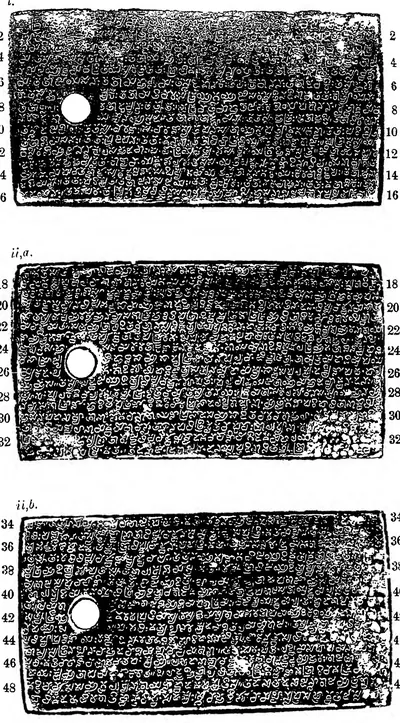 "Kalidindi Grant of Eastern Chalukya Rajaraja I", plates i, ii a and ii b (Epigraphia Indica XXIX, Plate I, between pp. 66 and 67 (PDF p. 140))Inscription rubbing · 1952
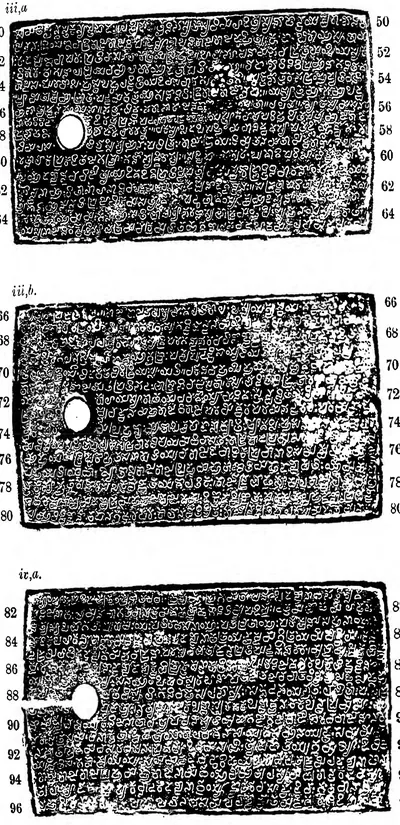 "Kalidindi Grant of Eastern Chalukya Rajaraja I", plates iii a, iii b and iv a (Epigraphia Indica XXIX, Plate I, between pp. 66 and 67 (PDF p. 141))Inscription rubbing · 1952
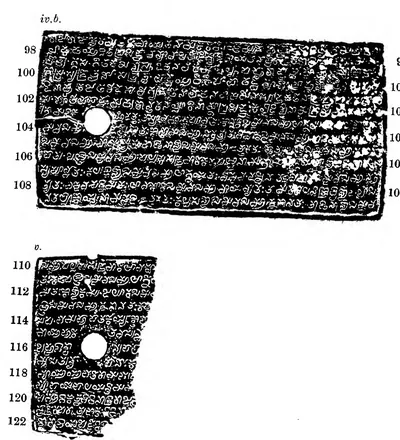 "Kalidindi Grant of Eastern Chalukya Rajaraja I", plates iv b and v (Epigraphia Indica XXIX, Plate II, between pp. 70 and 71 (PDF p. 146))Inscription rubbing · 1952
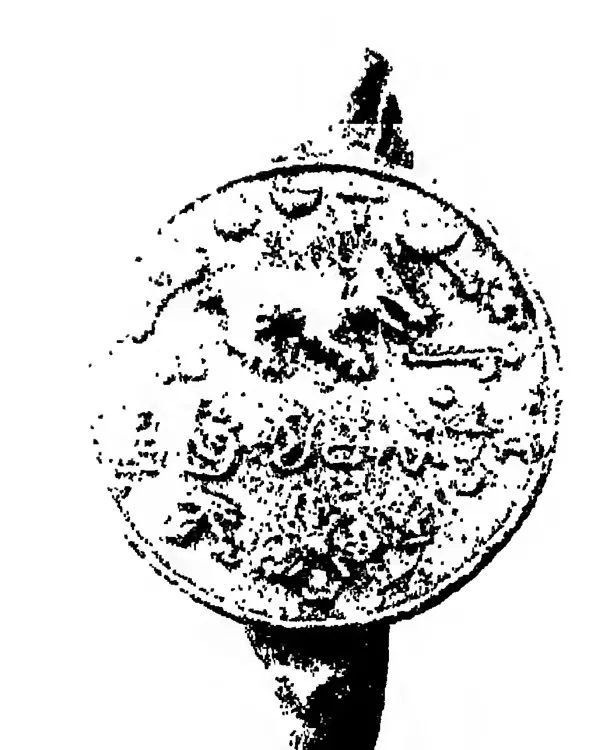
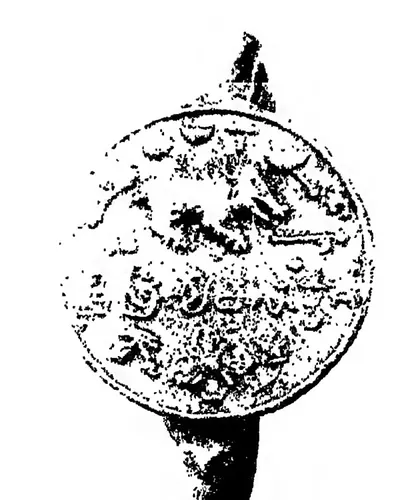 "Seal (From a photograph)", seal of the Kalidindi grant of Rajaraja I (Epigraphia Indica XXIX, Plate II, between pp. 70 and 71 (PDF p. 146))Historic photograph · 1952
Related
Inscriptions
References
Notes (0)
Sources (3)
Spotted an error on this page? Tell us
Last updated: