Kalyani (Basavakalyan)
Town in the Bidar district of Karnataka, outside the Telugu country, formerly in the Nizam's Dominions. J. F. Fleet identified it with Kalyana or Kalyanapura, the capital of the Western Chalukyas from the time of Somesvara I, and of the Kalachuris after them. According to the poet Bilhana, Somesvara I 'made the town'. Fleet found no ancient remains there.
J. F. Fleet identified Kalyana, or Kalyanapura, the capital of the Western Chalukyas of Kalyani, with the modern Kalyani in the Nizam’s Dominions.1 He followed an identification by Sir Walter Elliot, which he saw no grounds for questioning.1 He noted that an account of the place “shews that there are now no ancient remains at it”.1
Kalyana was made the capital by Somesvara I.12 One of his inscriptions, dated 1053, mentions it as the capital.12 It remained the capital of his successors, and of the Kalachuris after them.12 The poet Bilhana says that Somesvara I “made the town”.3 Fleet took this to mean that he either founded it or developed it into the capital.3
Fleet rejected the idea that Kalyana had been the capital of the earlier Chalukyas of Badami.12 He pointed out that the place is not mentioned in their records, or in those of the Rashtrakutas.12 In his words, “the idea in question is nothing but a pure mistake”.12 Even so, the Imperial Gazetteer of Hyderabad (1909) says that the Chalukyas who rose to power about 550 founded a kingdom “with their capital at Kalyani”.4
A Kannada inscription at Kalyani is dated 10 November 1326, in the reign of Sultan Muhammad Tughluq.5 It describes how the linga (emblem of Shiva) of Madhukesvara was installed again, and worship began again in its temple.5 The temple had been damaged in the disturbances that followed the rebellion of Bahauddin Gurshasp.5
Footnotes
-
J. F. Fleet, “Dynasties of the Kanarese Districts”, Gazetteer of the Bombay Presidency I, pt. II (1896), p. 427 and note 3 (archive.org (opens in a new tab)). ↩ ↩2 ↩3 ↩4 ↩5 ↩6 ↩7 ↩8 ↩9
-
Fleet, “Dynasties of the Kanarese Districts” (1896), p. 428 (archive.org (opens in a new tab)). ↩ ↩2 ↩3 ↩4 ↩5 ↩6
-
Fleet, “Dynasties of the Kanarese Districts” (1896), p. 440 (archive.org (opens in a new tab)). ↩ ↩2
-
Imperial Gazetteer of India, Provincial Series: Hyderabad State (1909), p. 10 (archive.org (opens in a new tab)). ↩
-
P. B. Desai, introduction to P. Sreenivasachar, Kannada Inscriptions of Andhra Pradesh (Andhra Pradesh Government Archaeological Series 3, 1961), p. 31, No. 79 (archive.org (opens in a new tab)). Paraphrased. ↩ ↩2 ↩3
Photos
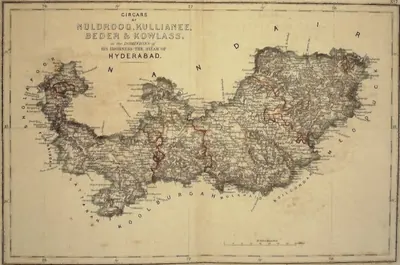 "Circars of Nuldroog, Kullianee, Beder & Kowlass, in the Dominions of His Highness the Nizam of Hyderabad" (map No. 7, atlas presented to the Nizam, 1865); Kullianee is Kalyani (identification ours)Map · 1865
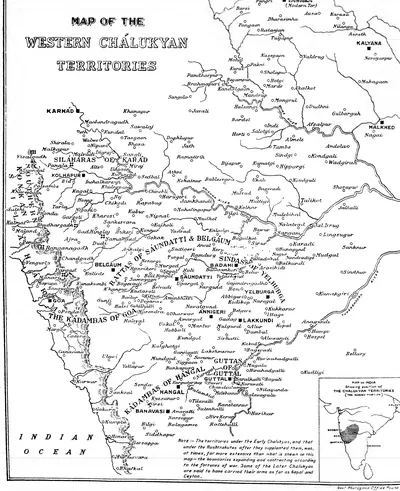 "Map of the Western Chalukyan Territories" (H. Cousens, The Chalukyan Architecture of the Kanarese Districts, 1926, map before the list of plates (PDF p. 5))Map · 1926
References
Notes (0)
Sources (3)
Spotted an error on this page? Tell us
Last updated: