Mangalagiri
Town at the foot of a hill twelve miles north-east of Guntur, with a temple of Narasimha on a rock-cut platform up the hill and a deep square reservoir in the town. A four-sided pillar near the steps of the hill temple records that Saluva Timma, minister of Krishnadeva Raya, captured Kondavidu on 23 June 1515. It also records the gifts of his nephew Nadindla Appa, among them a temple with nine golden pinnacles for the god of Mangalasaila.
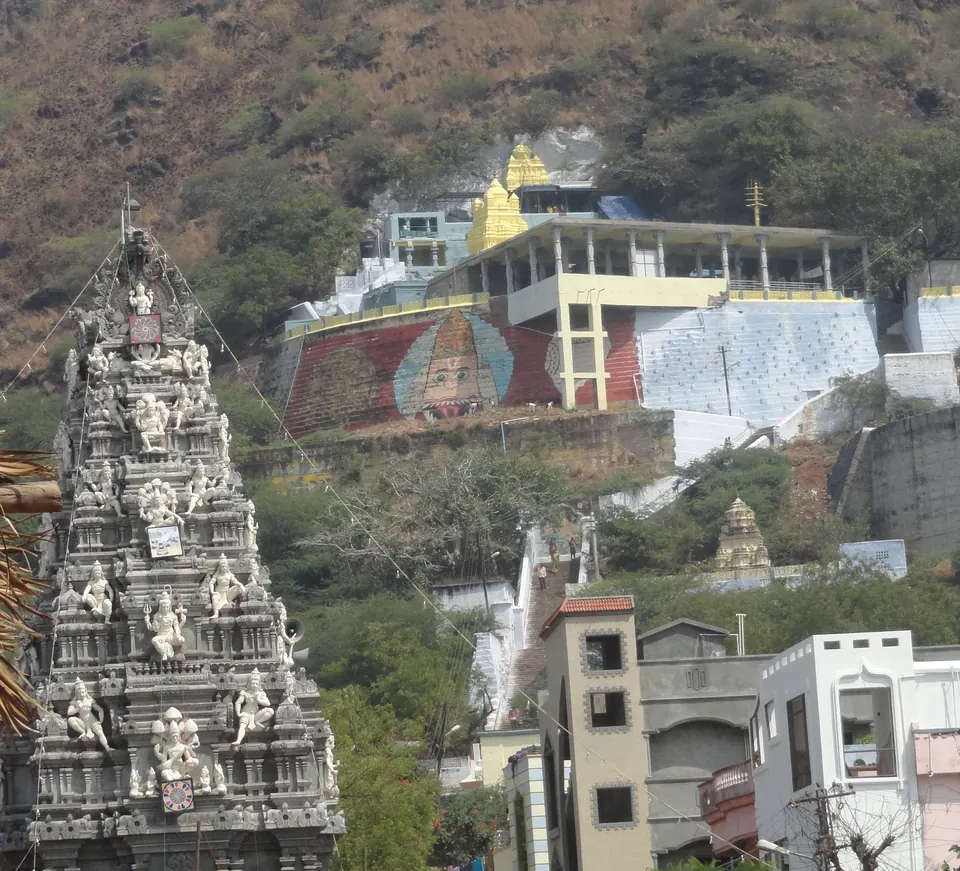
The Imperial Gazetteer of 1908 describes Mangalagiri, “Hill of happiness”, as a town of 7,702 people in the Guntur taluk.1 “Some distance up the hill after which it is named is a rock-cut platform with a temple of Narasimhaswami”.1 Thousands of Hindus flock there “during the annual festival held at the full moon in March”.1
“In the town is a large deep reservoir, built square with stone steps.”1 Local legends used to say that it had no bottom and had a golden temple at the bottom.1 But “in the great famine of 1833 it dried up”.1 “In it were found nearly 10,000 old matchlocks, thrown there, doubtless, during one of the many wars which have swept over this part of the country.”1
The pillar of 1515
In 1901 H. Luders edited an inscription “engraved on the four faces of a pillar”.2 The pillar was “lying on the ground near the steps leading to the temple on the hill at Mangalagiri, 12 miles north-east of Guntur”.2 It records that Saluva Timma, the minister of Krishnadeva Raya, captured Kondavidu from the Gajapati’s governors on 23 June 1515.3 It also records the gifts of his nephews Nadindla Appa and Gopa.3
Among these gifts, in Saka 1438 (1516–17; Saka is an Indian way of counting years), Appa presented “a solid temple (prasada), adorned with nine golden pinnacles (kumbha)”.4 He gave it with “a beautiful large hall (mantapa) to the temple of Hari, the lord of Mangalasaila”.4 He “gave also the village of Mangalasaila to the temple of Nrisimha”.4 Luders added: “Mangalasaila is, of course, identical with Mangalagiri, where the inscription was found.”4
A second pillar with almost the same text stands at Kaza, 9 miles north-east of Guntur.5 See the Mangalagiri pillar inscription, Saluva Timma and Kondavidu.
Footnotes
-
Imperial Gazetteer of India: Madras, Vol. I (1908), p. 337 (archive.org (opens in a new tab)). ↩ ↩2 ↩3 ↩4 ↩5 ↩6 ↩7
-
H. Luders, “Two Pillar Inscriptions of the time of Krishnaraya of Vijayanagara”, Epigraphia Indica VI (1900–01), p. 108 (archive.org (opens in a new tab)). ↩ ↩2
-
Luders, “Two Pillar Inscriptions”, Epigraphia Indica VI (1900–01), p. 111 (archive.org (opens in a new tab)). ↩ ↩2
-
Luders, “Two Pillar Inscriptions”, Epigraphia Indica VI (1900–01), p. 115 (archive.org (opens in a new tab)). ↩ ↩2 ↩3 ↩4
-
Luders, “Two Pillar Inscriptions”, Epigraphia Indica VI (1900–01), p. 116 (archive.org (opens in a new tab)). ↩
Photos
Related
Inscriptions
References
Notes (0)
Sources (2)
Spotted an error on this page? Tell us
Last updated: