Mangalagiri and Kaza pillar inscriptions (1515–1518)
Two four-sided pillars in the Guntur country, one lying near the steps of the hill temple at Mangalagiri and the other in the Kodandaramasvamin temple at Kaza. They carry almost the same Sanskrit text of about 257 lines. H. Luders edited them in 1901. They record that Saluva Timma, minister of Krishnadeva Raya, took Kondavidu from the Gajapati's governors on 23 June 1515. They also list the gifts that his nephews Nadindla Appa and Gopa made as governors of Vinukonda and Kondavidu between 1516 and 1518.
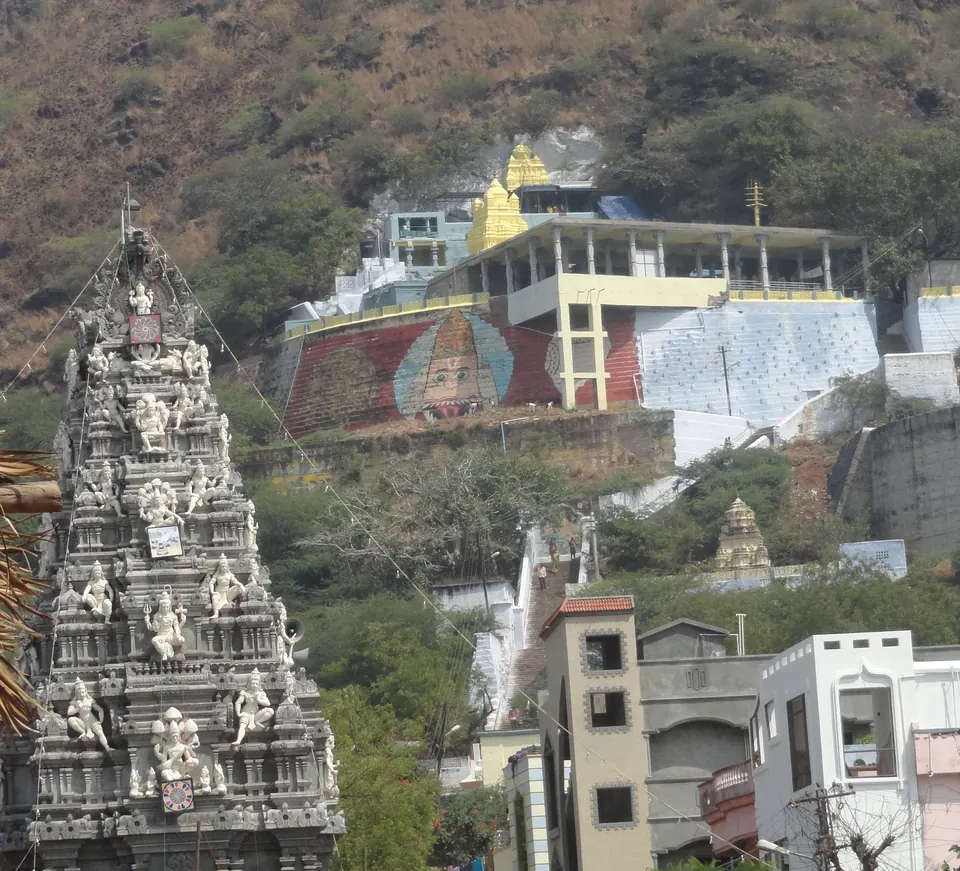
These two pillar inscriptions record a grant by Salva-Timma, “the prime-minister of king Krishnaraya of Vijayanagara”.1 They describe his capture of Kondavidu, which Luders dated to “Saturday, the 23rd June, A.D. 1515”.12 Most of the text lists the gifts of his nephews Appa and Gopa.23
Two pillars, one text
H. Luders edited both inscriptions in 1901, from inked estampages (ink copies on paper) sent to him by E. Hultzsch.4 “The first is engraved on the four faces of a pillar lying on the ground near the steps leading to the temple on the hill at Mangalagiri”.4 Mangalagiri is “12 miles north-east of Guntur in the Kistna district”.4 The pillar “contains 257 lines of writing.”4
At the top of the fourth face is a picture of the sun and the moon.4 The alphabet is Telugu, and Luders described it in detail.4 “The language is Sanskrit, and the whole text is in verse”.1 Only the opening and closing words and a few explanatory remarks are in Telugu.1
The second inscription is also in Telugu letters.5 It “is engraved on the four faces of a pillar lying in the temple of Kodandaramasvamin at Kaza, 9 miles north-east of Guntur”.5 It has 258 lines.5 Luders wrote that “with the exception of the last verse … the whole text of the inscription is identical with that of the Mangalagiri inscription. Only the order of the verses differs.”5 See Mangalagiri.
Saluva Timma and the fall of Kondavidu
In Luders’s words, “The proper object of the inscription is to record a grant by Salva-Timma, the prime-minister of king Krishnaraya of Vijayanagara.”1 It opens with prayers to Vishnu, among them to Vishnu as lord of Kakula, which Luders took for Srikakulam in the Krishna (then Kistna) district.1 Then come verses on the king.1 These contain “no historical information besides the statement that ‘king Krishna’s pillar of victory is shining in the court of Kalinga,’”.1 Luders called this “an allusion to his conquest of the eastern coast”.1
The minister is then praised.1 He was of the Kaundinya gotra (clan), son of the minister Racha and grandson of the minister Vema.1 His wife was named Lakshmi.1 Two verses describe his conquest of Kondaviti, that is Kondavidu.1
One verse says that he captured “the swan-like kings appointed by Gajapati in Kondaviti”.6 From this, Luders concluded that Kondavidu was then governed by chiefs under the Gajapatis of Orissa.6 See Saluva Timma, Kondavidu and the Gajapatis.
Luders compared the inscription with the Portuguese chronicle of Nuniz.6 In Nuniz, Krishnaraya besieged Kondavidu and defeated the king of Orissa on the bank of a great river.6 He took the fortress after two months, and made Saluva Timma its governor.6 Luders judged that the chronicle “has the appearance of being, on the whole, perfectly reliable”.6 He thought the inscription gives the credit to Saluva Timma alone “only because he was the general in command of the Vijayanagara forces”.6
J. A. C. Boswell had reported a local tradition about the capture.2 In it, Krishnaraya took the fort by having a Brahman lure the seventy-two Reddi chiefs into a temple and throw them one by one into a well.2 Luders rejected this: “the story, as it stands, is incompatible with the historical facts”.2 He added that “local traditions and local chronicles, by themselves, have no historical value, even when they refer to events of comparatively modern times.”2
The date of the capture “is given several times, expressed in words, letters and figures.”2 In Luders’s words, “It took place on Saturday, the Harivasara of the bright half of the month Ashadha in the Saka year 1437”.2 Using F. Kielhorn’s calculation, Luders equated this with “Saturday, the 23rd June, A.D. 1515”.2 The Amaravati inscription of Krishnaraya gives the same day for the king’s tulapurusha gift at Amaravati (a gift of his own weight in gold).7 See the Amaravati inscription and the Kondavidu fort.
Nadindla Appa and Gopa
The rest of the text belongs to two brothers, Appa and Gopa.2 They were sons of the minister Timma of the Nadindla family and of Krishnamba, the sister of Saluva Timma.2
One verse lists what Nadindla Appa received from the king and the minister:8
- a palanquin, two chauris (fly-whisks) and a parasol8
- the command of an army8
- the charge “of Vinikonda, Gutti and Amaravati”8
- the sole governorship of the kingdom8
Other verses give Gopa the governorship of the town and country of Kondaviti.8 Luders explained the difference by supposing that Appa was placed at Kondavidu straight after its capture.8 Later, when Saluva Timma settled the province, Gopa took Kondavidu and Appa received Vinukonda, Gooty and Amaravati.8 See the Kondavidu pillar inscription of 1520, which shows Gopa still governing Kondavidu.
Appa’s gifts fill the longest section.3 Of nineteen grants, “six were made in Saka 1438, ten in Saka 1439, one in Saka 1440, whereas one … lies as far back as Saka 1414”.3 Luders thought this last date open to grave doubt.3 The villages lie in the old Vinukonda, Narasaraopet, Guntur, Bapatla, Vijayawada (then Bezwada), Ongole and perhaps Palnad taluks.3
In Saka 1438 (1516–17; Saka is an Indian way of counting years), Appa made gifts to the temple of Hari, the lord of Mangalasaila.9 He gave it “a solid temple (prasada), adorned with nine golden pinnacles (kumbha), and a beautiful large hall (mantapa)”.9 He “gave also the village of Mangalasaila to the temple of Nrisimha.”9 Luders added: “Mangalasaila is, of course, identical with Mangalagiri, where the inscription was found.”9
In Saka 1440 (1518–19), Appa built a large hall for the temple of Agastya-Mahesvara at Kranja, “the modern Kaza, 9 miles north-east of Guntur”.10 He did this for the merit of Saluva Timma and his wife Lakshmi.10 The last verse of the Mangalagiri text records that Saluva Timma himself gave the village of Kondakavuri, 8 miles south of Narasaraopet, to a temple.5
Footnotes
-
Luders, “Two Pillar Inscriptions”, Epigraphia Indica VI (1900–01), p. 109 (archive.org (opens in a new tab)). ↩ ↩2 ↩3 ↩4 ↩5 ↩6 ↩7 ↩8 ↩9 ↩10 ↩11 ↩12 ↩13
-
Luders, “Two Pillar Inscriptions”, Epigraphia Indica VI (1900–01), p. 111 (archive.org (opens in a new tab)). ↩ ↩2 ↩3 ↩4 ↩5 ↩6 ↩7 ↩8 ↩9 ↩10 ↩11
-
Luders, “Two Pillar Inscriptions”, Epigraphia Indica VI (1900–01), p. 113 (archive.org (opens in a new tab)). ↩ ↩2 ↩3 ↩4 ↩5
-
H. Luders, “Two Pillar Inscriptions of the time of Krishnaraya of Vijayanagara”, Epigraphia Indica VI (1900–01), p. 108 (archive.org (opens in a new tab)). ↩ ↩2 ↩3 ↩4 ↩5 ↩6
-
Luders, “Two Pillar Inscriptions”, Epigraphia Indica VI (1900–01), p. 116 (archive.org (opens in a new tab)). ↩ ↩2 ↩3 ↩4 ↩5
-
Luders, “Two Pillar Inscriptions”, Epigraphia Indica VI (1900–01), p. 110 (archive.org (opens in a new tab)). ↩ ↩2 ↩3 ↩4 ↩5 ↩6 ↩7
-
H. Luders, “Amaravati Inscription of Krishnaraya of Vijayanagara; Saka-Samvat 1437”, Epigraphia Indica VII (1902–03), p. 20 (archive.org (opens in a new tab)). ↩
-
Luders, “Two Pillar Inscriptions”, Epigraphia Indica VI (1900–01), p. 112 (archive.org (opens in a new tab)). ↩ ↩2 ↩3 ↩4 ↩5 ↩6 ↩7 ↩8
-
Luders, “Two Pillar Inscriptions”, Epigraphia Indica VI (1900–01), p. 115 (archive.org (opens in a new tab)). ↩ ↩2 ↩3 ↩4
-
Luders, “Two Pillar Inscriptions”, Epigraphia Indica VI (1900–01), p. 114 (archive.org (opens in a new tab)). ↩ ↩2
Photos
References
Notes (0)
Sources (2)
Spotted an error on this page? Tell us
Last updated: