Teki
Village in the eastern Godavari delta, formerly in Ramachandrapuram taluk. In 1901 a cultivator ploughing his field here found the copper plates of the Chola-Chalukya viceroy Rajaraja-Chodaganga. Before the Godavari anicut (dam) the village also gave its name to one of the old irrigation channels on the eastern side of the delta.
Teki is a village in the Godavari delta. In 1901 it was in the Ramachandrapuram taluk of Godavari district.1 V. Rangacharya’s list of 1919 accordingly gives its copper-plate grant under that taluk.2
The Teki plates
The Collector of Godavari wrote a letter on 30 April 1901 about the plates.1 He reported that Kodi Dosigadu “of Teki” had found them about two months earlier, while working in his field.1 Hultzsch added that the village is No. 122 on the Madras survey map of the taluk.1
The plates are an edict of Chodaganga, surnamed Rajaraja, the son of Kulottunga I and viceroy of Vengi.12 The edict is dated in the 17th year of the reign.12 It gives honours at weddings to the Teliki families, hereditary servants of the Eastern Chalukyas.12 See Teki plates of Rajaraja-Chodaganga.
The Teki channel
Henry Morris’s account of the Godavari district (1878) describes the irrigation of the delta before the anicut (dam). According to Morris, the old channels drew water from the river only for about fifty days in the year.3 He wrote that “the channels on the eastern side were the Tulayya Bhaga, the Tsoppella, the Teki, and the Muskapalli channels”.3
Morris also records the scheme of channels planned for the anicut.4 In it, the Teki channel took the drainage of the lands watered by the Tsoppella and Tulayya Bhaga.4 It carried its surplus water into the Coringa river.4
Footnotes
-
E. Hultzsch, “Teki Plates of Rajaraja-Chodaganga”, Epigraphia Indica VI (1900–01), p. 334 and note 2 (archive.org (opens in a new tab)). ↩ ↩2 ↩3 ↩4 ↩5 ↩6 ↩7
-
V. Rangacharya, A Topographical List of the Inscriptions of the Madras Presidency, Vol. II (1919), p. 745, Ramachandrapuram taluk, No. 364 (archive.org (opens in a new tab)). ↩ ↩2 ↩3 ↩4
-
Henry Morris, A Descriptive and Historical Account of the Godavery District (1878), p. 141 (archive.org (opens in a new tab)). ↩ ↩2
-
Morris, Godavery District (1878), p. 144 (archive.org (opens in a new tab)). ↩ ↩2 ↩3
Photos
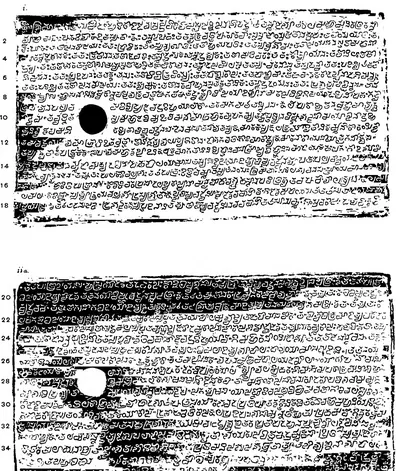 "Teki plates of Rajaraja-Chodaganga; dated in the seventeenth year (of Kulottunga I.)", plates i and ii a (Epigraphia Indica VI, Plate i, between pp. 338 and 339 (PDF p. 206))Inscription rubbing · 1901
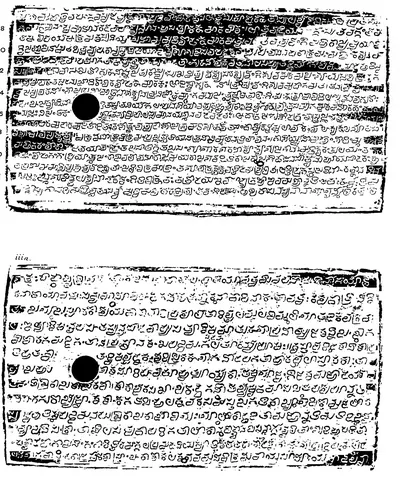 "Teki plates of Rajaraja-Chodaganga; dated in the seventeenth year (of Kulottunga I.)", plates ii b and iii a (Epigraphia Indica VI, Plate i, between pp. 338 and 339 (PDF p. 207))Inscription rubbing · 1901
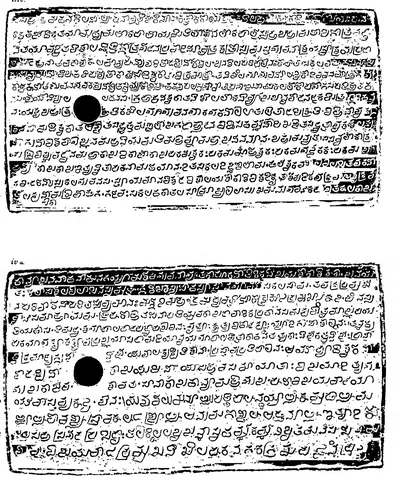 "Teki plates of Rajaraja-Chodaganga; dated in the seventeenth year (of Kulottunga I.)", plates iii b and iv a (Epigraphia Indica VI, Plate ii, between pp. 342 and 343 (PDF p. 212))Inscription rubbing · 1901
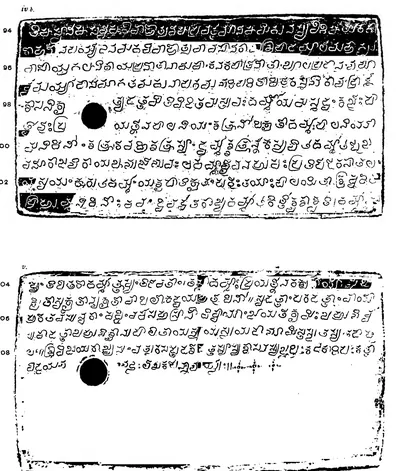 "Teki plates of Rajaraja-Chodaganga; dated in the seventeenth year (of Kulottunga I.)", plates iv b and v (Epigraphia Indica VI, Plate ii, between pp. 342 and 343 (PDF p. 213))Inscription rubbing · 1901
References
Notes (0)
Sources (3)
Spotted an error on this page? Tell us
Last updated: