Teki plates of Rajaraja-Chodaganga
A Sanskrit copper-plate edict of Chodaganga, surnamed Rajaraja, dated in the 17th year of the reign. Chodaganga was a son of the Chola-Chalukya emperor Kulottunga I and viceroy of Vengi. A cultivator found the plates at Teki in the Godavari delta in 1901. The edict confers honours at weddings on the Teliki families, hereditary servants of the Eastern Chalukyas said to have come from Vijayavata (Vijayawada). E. Hultzsch used it to revise the order of the viceroys of Vengi under Kulottunga I.
This edict comes from the last phase of Eastern Chalukya rule in Vengi.123 By then the kingdom had passed to the Chola-Chalukya emperor Kulottunga I, a son of Rajaraja Narendra by a Chola princess.123 It was governed for him by his uncle and his sons.123 The edict does not grant land, but confers honorary privileges on a community of hereditary servants of the dynasty.123
Discovery and description
The Collector of Godavari sent the plates to E. Hultzsch through the Government of Madras.4 The Collector reported in April 1901 that a man named Kodi Dosigadu had found them about two months earlier.4 He had found them while working in his field at Teki, in Ramachandrapuram taluk.4
There are five plates, about 11 inches broad and 6 high.4 The first and last are inscribed on the inner side only, and the raised rims of the plates have kept the writing in very good condition.4 A copper ring about 6 inches across passes through them.4 Its ends are fixed in a four-petalled flower beneath a round seal.4
The seal bears the legend Sri-Tribhuvanankusa.4 It shows a standing boar flanked by fly-whisks, with a crescent, an elephant-goad and the sun above it.4 Below are a conch, a drum, a flower, a bud and a throne.4
Script and language
The alphabet is Telugu, and the language is Sanskrit verse and prose.4 Letters peculiar to Telugu occur in a number of Telugu names quoted in lines 90 f.4
Content
The opening family tree is the same as in the Chellur and Pithapuram plates of Vira-Choda.4 It begins to differ at the reign of Kulottunga I.4
In Hultzsch’s translation, Kulottunga tells his son Mummadi-Choda that he had “formerly conferred the kingdom of the country of Vengi on my paternal uncle, prince Vijayaditya”.5 This uncle had ruled “for only fifteen years” and died.5
According to the edict, Mummadi-Choda took up the burden but returned to his parents after ruling Vengi for one year.6 His younger brother Vira-Choda then governed it for six years, before his father recalled him.6 Kulottunga then sent his first-born son Chodaganga, whom he called Rajaraja.6 He described Vengi to him as “the birth-place of the noble Chalukyas, as the ocean (is) of precious pearls”.6
Chodaganga, with the old titles Sarvalokasraya and Vishnuvardhana, issued the edict from the hall of his palace.7 The palace was at the city named after Jananatha.7 He addressed the edict to the Rashtrakutas and other cultivators living between the Manneru river and the Mahendra mountain.7
He honoured those servants of his family who had “come already at the beginning with king Vijayaditya, the lord of Ayodhya”.7 This Vijayaditya was the legendary ancestor of the Chalukyas.7 The servants lived in the town of Vijayavata, “the capital of the kings (who were) ornaments of the race of the Moon”.7 They were the people of the Teliki family, divided into a thousand families, ten of which are named.7
They were granted, “as long as the moon and the sun shall last”, the right to ride on horseback along the roads as a married couple during wedding festivals.78 This right held at Vijayavata and in every other town and village.78 At the end of the festival, when they laid a pair of fine cloths at the king’s feet, they were to receive betel in a golden vessel.78 This was what old custom required.78
The edict is dated in the seventeenth year of the reign.8 Its composer was Viddayabhatta and its writer Pennacharya.8 Hultzsch noted that the same two men composed and wrote the Chellur and Pithapuram plates of Vira-Choda.3
The places
Hultzsch took the Manneru and the Mahendra mountain to be the southern and northern limits of the province of Vengi.2 The Manneru flows past Singarayakonda in Kandukur taluk of Nellore district.2 The Mahendra mountain is in Ganjam district.2
The Teliki families were believed to have settled at Vijayavata, the modern Vijayawada (then Bezwada).3 Hultzsch thought that the town “seems to have been the former capital of the Eastern Chalukyas”.3 He also found two inscriptions of Saka 1076 (Saka is an Indian way of counting years) in the Bhavanarayana temple at Bapatla.3 They record gifts by merchants of the “Teliki thousand”, which claimed to have ruled over the towns of Ayodhya and Bejavala.3
H. Krishna Sastri proposed to identify Jananathanagari, the residence of Chodaganga and of Vira-Choda, with Rajamahendri (Rajahmundry).2 J. F. Fleet, writing earlier on the Chellur plates, had left the place unidentified.9
Date and the viceroys of Vengi
Verse 34 gives the date of Chodaganga’s accession to the throne of Vengi.6 It is Saka 1006, on a Thursday, the full-moon tithi (lunar day) of Jyaishtha, in the nakshatra (lunar mansion) Jyeshtha and the lagna (rising sign) Simha.6 Hultzsch took it to correspond probably to 22 May 1084.2
F. Kielhorn, in a postscript, found the date irregular.8 In Saka 1006 expired, the full moon of Jyaishtha ended on Wednesday, 22 May 1084, not on a Thursday.8 The other possible years did not fit either.8
The plates changed the accepted order of Kulottunga’s sons.2 Hultzsch had thought the eldest was Vikrama-Choda, Kulottunga’s successor on the Chola throne.2 The Teki plates showed that it was Chodaganga.2
They also forced him to revise the dates of the Chellur and Pithapuram plates of Vira-Choda, which are dated in the 21st and 23rd years.2 He had counted these years from Vira-Choda’s own installation.2 If the Teki plates were dated the same way, from Chodaganga’s accession in 1084, Vira-Choda’s Chellur grant would fall during his brother’s governorship.2
Hultzsch therefore counted all three from Kulottunga I’s accession in 1070.2 This put them in 1086–87, 1090–91 and 1092–93.2 On this view Vira-Choda governed Vengi a second time after Chodaganga.2 The Pithapuram plates say that he was recalled and then sent to Vengi again “in the fifth year”.2 Hultzsch’s table gives:2
- Mummadi-Choda (Rajaraja): 1077–78
- Vira-Choda: 1078–84, and again from 1088–89 to at least 1092–93
- Chodaganga (Rajaraja): 1084–1088–89
Hultzsch’s own earlier edition of the Chellur plates, in 1890, had dated that grant by Vira-Choda’s own reign, to Saka 1022.1 He also suspected that Chodaganga had fallen out with his father and his brother Vira-Choda.2 His reason was that the Chellur plates are silent about Chodaganga’s governorship, and the Pithapuram plates allude to it without naming him.2
Edition
E. Hultzsch edited the plates as “Teki Plates of Rajaraja-Chodaganga; dated in the Seventeenth Year (of Kulottunga I.)” in Epigraphia Indica VI (1900–01), No. 35, pp. 334–347, with text, translation and plates.4 V. Rangacharya summarised the record under Ramachandrapuram taluk in 1919.10
Footnotes
-
E. Hultzsch, South-Indian Inscriptions, Vol. I (1890), p. 51 (archive.org (opens in a new tab)). ↩ ↩2 ↩3 ↩4 ↩5
-
Hultzsch, “Teki Plates of Rajaraja-Chodaganga” (1901), p. 335 (archive.org (opens in a new tab)). ↩ ↩2 ↩3 ↩4 ↩5 ↩6 ↩7 ↩8 ↩9 ↩10 ↩11 ↩12 ↩13 ↩14 ↩15 ↩16 ↩17 ↩18 ↩19 ↩20 ↩21 ↩22
-
Hultzsch, “Teki Plates of Rajaraja-Chodaganga” (1901), p. 336 (archive.org (opens in a new tab)). ↩ ↩2 ↩3 ↩4 ↩5 ↩6 ↩7 ↩8 ↩9
-
E. Hultzsch, “Teki Plates of Rajaraja-Chodaganga”, Epigraphia Indica VI (1900–01), p. 334 (archive.org (opens in a new tab)). ↩ ↩2 ↩3 ↩4 ↩5 ↩6 ↩7 ↩8 ↩9 ↩10 ↩11 ↩12 ↩13 ↩14 ↩15
-
Hultzsch, “Teki Plates of Rajaraja-Chodaganga” (1901), p. 344, translation, verses 13–15 (archive.org (opens in a new tab)). ↩ ↩2
-
Hultzsch, “Teki Plates of Rajaraja-Chodaganga” (1901), p. 345, translation, verses 17–34 (archive.org (opens in a new tab)). ↩ ↩2 ↩3 ↩4 ↩5 ↩6
-
Hultzsch, “Teki Plates of Rajaraja-Chodaganga” (1901), p. 346, translation, lines 76–97 (archive.org (opens in a new tab)). ↩ ↩2 ↩3 ↩4 ↩5 ↩6 ↩7 ↩8 ↩9 ↩10 ↩11
-
Hultzsch, “Teki Plates of Rajaraja-Chodaganga” (1901), p. 347, translation and Kielhorn’s postscript (archive.org (opens in a new tab)). ↩ ↩2 ↩3 ↩4 ↩5 ↩6 ↩7 ↩8 ↩9
-
J. F. Fleet, “Chellur Copper-plate Grant of Vira-Chodadeva”, Indian Antiquary XIX (1890), p. 424 (archive.org (opens in a new tab)). ↩
-
V. Rangacharya, A Topographical List of the Inscriptions of the Madras Presidency, Vol. II (1919), p. 745, Ramachandrapuram taluk, No. 364 (archive.org (opens in a new tab)). ↩
Photos
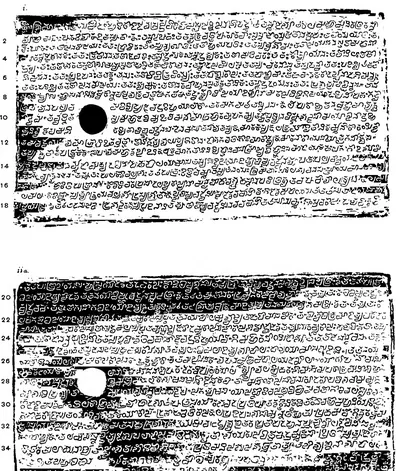 "Teki plates of Rajaraja-Chodaganga; dated in the seventeenth year (of Kulottunga I.)", plates i and ii a (Epigraphia Indica VI, Plate i, between pp. 338 and 339 (PDF p. 206))Inscription rubbing · 1901
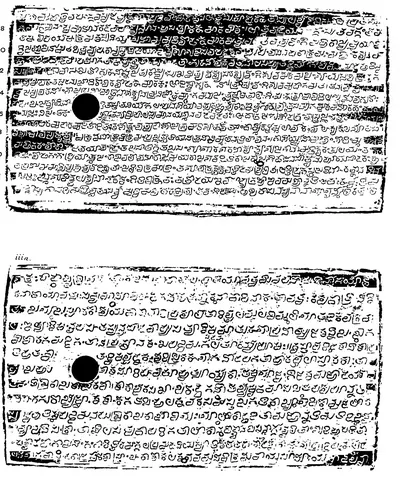 "Teki plates of Rajaraja-Chodaganga; dated in the seventeenth year (of Kulottunga I.)", plates ii b and iii a (Epigraphia Indica VI, Plate i, between pp. 338 and 339 (PDF p. 207))Inscription rubbing · 1901
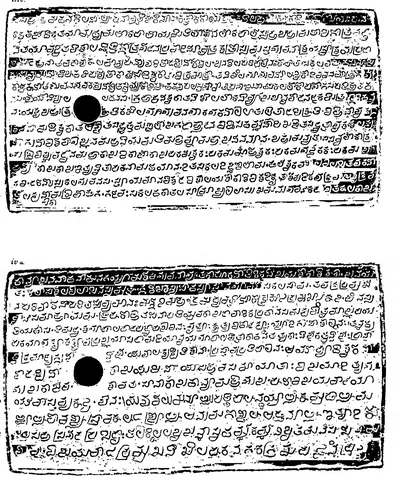 "Teki plates of Rajaraja-Chodaganga; dated in the seventeenth year (of Kulottunga I.)", plates iii b and iv a (Epigraphia Indica VI, Plate ii, between pp. 342 and 343 (PDF p. 212))Inscription rubbing · 1901
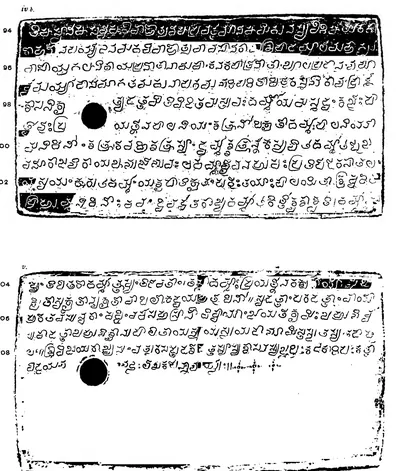 "Teki plates of Rajaraja-Chodaganga; dated in the seventeenth year (of Kulottunga I.)", plates iv b and v (Epigraphia Indica VI, Plate ii, between pp. 342 and 343 (PDF p. 213))Inscription rubbing · 1901
References
Notes (0)
Sources (4)
Spotted an error on this page? Tell us
Last updated: