Amaravati pillar inscription of Keta II
A Sanskrit and Telugu inscription dated in Saka 1104 (probably 1182–83) on a pillar of the Amaresvara temple at Amaravati. It records the grants made by the Kota chief Keta II, probably on the day he came to the throne: villages and lamps for the Buddha, and villages for Brahmans. A second inscription on the same pillar, of 1234, records a lamp given to the Buddha by Kota Bayyalamahadevi.
What it is
Two inscriptions, numbered 269 and 270 of 1897, are cut on the four sides of a pillar in the Amaresvara temple at Amaravati.1 The pillar stands at the southern entrance to the central shrine.1 Both are in the Telugu alphabet and in Sanskrit and Telugu.1 E. Hultzsch edited them in Epigraphia Indica in 1901 from an inked estampage (copy) made by H. Krishna Sastri in 1897.12
The inscription of Keta II
The first inscription has 52 Sanskrit verses with passages of Telugu prose.1 It opens with the city of Sri-Dhanyakataka, which contains the Siva temple of Amaresvara.1 Close to the temple, it says, stands “a very lofty Chaitya” of the Buddha.13 Hultzsch identified the chaitya (Buddhist shrine) with the great Amaravati stupa (relic mound), “which at the time of the inscription must have been still in good preservation”.13 See Amaravati Mahachaitya.
The inscription names four generations of a royal family of the Sudra caste: Bhima I, Keta I, Bhima II and Keta II.3 Hultzsch found that “nothing of historical importance is related of any of these princes” in the opening verses.3 The Telugu prose gives the titles of Keta II.3 He was the mahamandalesvara (great provincial lord) Kota Ketaraja, lord of the six-thousand country south of the Krishna and of Sri-Dhanyakataka.3
All five grants were made on one day in Saka 1104 (Saka is an Indian way of counting years).3 F. Kielhorn found that the details of the date do not agree.3 He judged the year to be Saka 1104 expired, which gives Wednesday, 5 January 1183.3 Either the weekday or the lunar day, he thought, was quoted wrongly.3 Hultzsch thought it “probably the very day of the accession of Keta II to the throne”.2 Two other inscriptions in the temple bear the same date.32
The grants were these:3
- Keta II gave the Buddha the village of Kranteru in the Kandravadi district, and Medukonduru and Donkiparru in the Kondapadumati district.3
- He also gave sheep for two lamps that were never to go out.3
- Two women of his household each gave sheep for a lamp.3
- He gave villages to Brahmans for the merit of his mother, father and elder brother.3 He renamed the villages after each of them and after his own title Jagamechchuganda.3
Hultzsch identified several of the villages in the Sattenapalle taluk.2 He placed the districts Kondapadumati and Gondanatavadi in its eastern and western parts.2
The inscription of Bayyamamba
The second inscription is below the first on the south face.4 It has twelve Sanskrit verses and a passage in Telugu prose.4 It is another grant to the Buddha at Sri-Dhanyaghati, made on a day that Kielhorn calculated as Thursday, 11 May 1234.4
The donor was Bayyamamba, or Kota Bayyalamahadevi.45 She was the daughter of the mahamandalesvara Rudradeva of Madapalli in the Nathavadi district.45 Hultzsch took her to be a wife of Keta II. The Annual Report on Epigraphy for 1916, using the Edavalli plates, made her the queen of Keta II’s grandson Manma-Keta.46
Significance
Hultzsch drew a conclusion from the grants.2 In his words, “at the time of Keta II. the Buddhist religion continued to have votaries in the Telugu country and was tolerated and supported by the Hindu rulers of Amaravati”.2 Gordon Mackenzie (1883) dated a Kota Keta inscription on a pillar west of the gopuram (gate tower) of this temple to 1192. He took it as evidence for a local family of “Jain kings”.72 But the inscription calls the family worshippers of Siva.72
Footnotes
-
E. Hultzsch, “Two Pillar Inscriptions at Amaravati”, Epigraphia Indica VI (1901), p. 146 (archive.org (opens in a new tab)). ↩ ↩2 ↩3 ↩4 ↩5 ↩6 ↩7 ↩8
-
Hultzsch, “Two Pillar Inscriptions at Amaravati” (1901), p. 148 (archive.org (opens in a new tab)). ↩ ↩2 ↩3 ↩4 ↩5 ↩6 ↩7 ↩8 ↩9
-
Hultzsch, “Two Pillar Inscriptions at Amaravati” (1901), p. 147 and notes (archive.org (opens in a new tab)). ↩ ↩2 ↩3 ↩4 ↩5 ↩6 ↩7 ↩8 ↩9 ↩10 ↩11 ↩12 ↩13 ↩14 ↩15 ↩16 ↩17
-
Hultzsch, “Two Pillar Inscriptions at Amaravati” (1901), p. 157 (archive.org (opens in a new tab)). ↩ ↩2 ↩3 ↩4 ↩5 ↩6
-
Hultzsch, “Two Pillar Inscriptions at Amaravati” (1901), p. 158, abridged translation (archive.org (opens in a new tab)). ↩ ↩2
-
Annual Report on Epigraphy, Madras, for 1915–16 (G.O. No. 99, Home (Miscellaneous), 29 August 1916), Part II, para. 55, p. 137 (archive.org (opens in a new tab)). ↩
-
Gordon Mackenzie, A Manual of the Kistna District (1883), p. 163 (archive.org (opens in a new tab)). ↩ ↩2
Photos
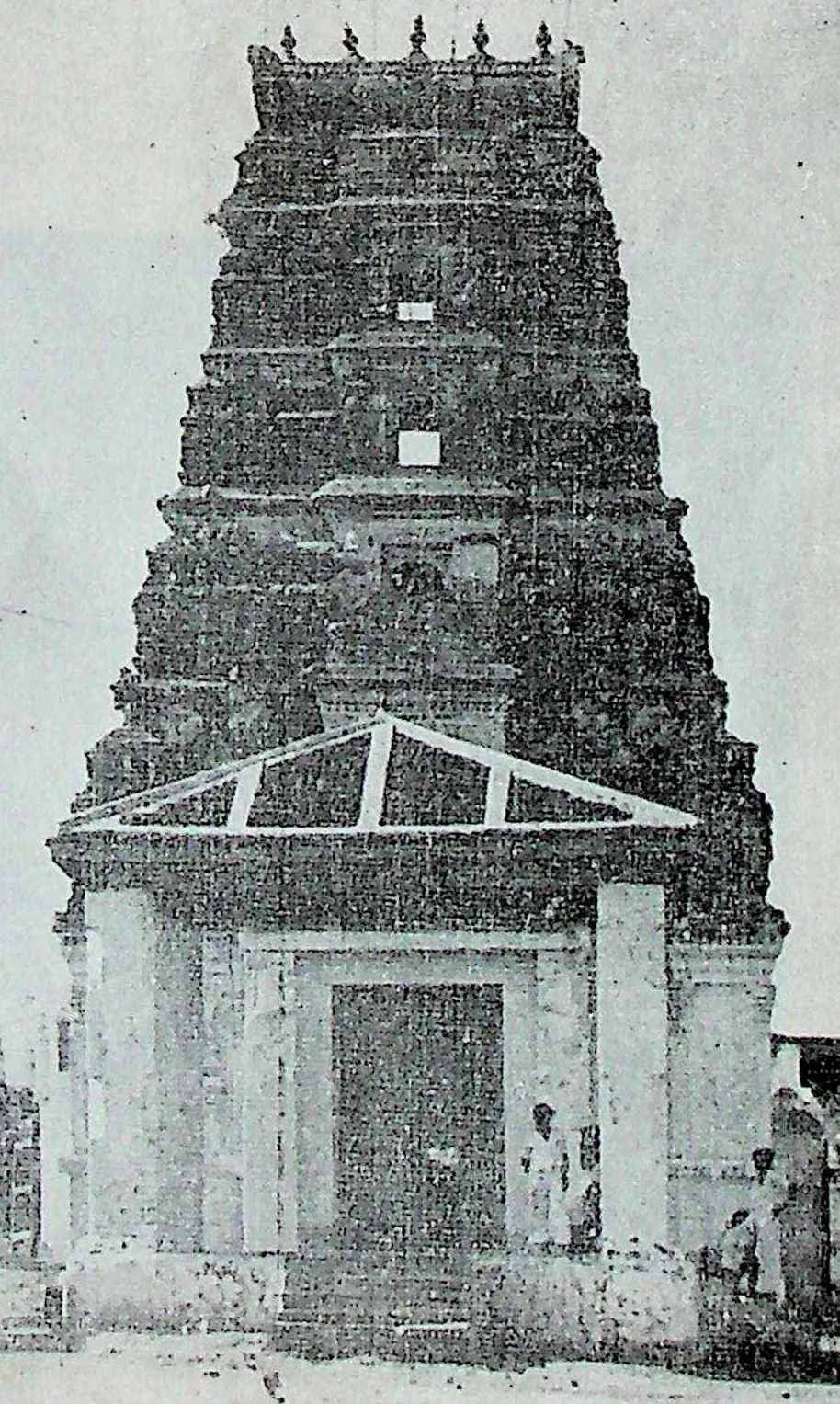
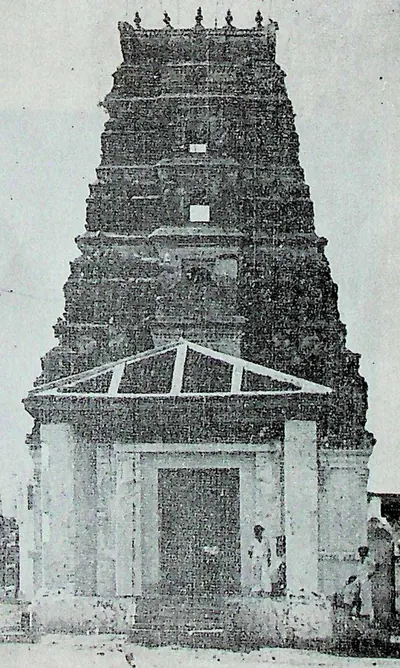 "43. Amarēśvara Temple - Amarāvati - South Gōpura" (M. Rama Rao, Eastern Calukyan Temples of Andhra Desa, 1964, Fig. 43 (PDF p. 115))Historic photograph · 1964
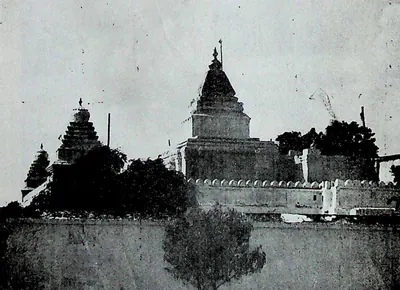 "45. Amarēśvara Temple—Amarāvati—Inner Enclosure" (M. Rama Rao, Eastern Calukyan Temples of Andhra Desa, 1964, Fig. 45 (PDF p. 119))Historic photograph · 1964
References
Notes (0)
Sources (3)
Spotted an error on this page? Tell us
Last updated: