Warangal fort inscription of Rudradeva
A broken Sanskrit inscription of Saka 1105 (1183–84) found inside Warangal fort. It records King Rudradeva's gift of the village of Modapalli and repeats verses of his Thousand Pillar Temple inscription. A short Telugu record of his brother Mahadeva comes from the same fort.
The stone
This badly damaged inscription is on a stone that was lying outside a house inside the fort of Warangal when it was copied for the 1956 Corpus of Inscriptions in the Telingana Districts. It is broken at the sides, the top and the bottom.1 The surviving text is Sanskrit verse on three faces.123
Contents
Its editor, P. Sreenivasachar, could still read the date, Saka 1105 (1183–84; Saka is an Indian way of counting years). He found that the record registers King Rudradeva’s gift of a village called Modapalli.1 The second face, where the date stands, also names the twelfth day of a lunar fortnight and a Thursday.2 The month, though, is lost.2
Sreenivasachar noticed that several of the verses are the same as verses in Rudradeva’s great inscription of 1163 at the Thousand Pillar Temple in Hanamkonda.1 The broken lines of the third face include the name Chododaya. The 1163 inscription calls him an enemy whose city Rudradeva burned.34
A record of Mahadeva
A second, shorter inscription from the same fort was printed next to it in the Corpus. It is in Telugu prose, on a slab lying in a mosque in the Saudagar Bazaar of the earthen fort. It records a gift of land at Kame-Oddapalli and other places to the god Rudreshvara by Mahadeva.3 The editor did not identify this Mahadeva further. Rudradeva’s younger brother Mahadeva succeeded him and ruled from 1195 to about 1199.5
Significance
In P. V. Parabrahma Sastry’s account, Rudradeva chose the site of Orugallu, about 5 km from Anumakonda, for a strong new fort after he became independent. He began fortifying it around the temple of Svayambhu Shiva.6 Ganapatideva completed the work.6
The latest dated record of Rudradeva that Parabrahma Sastry knew was the Bekkallu inscription of 26 April 1195.7 So this grant of 1183–84 falls in the last ten years of his reign.7 See also Warangal and Warangal fort.
Footnotes
-
P. Sreenivasachar (ed.), A Corpus of Inscriptions in the Telingana Districts of Andhra Pradesh, Part III (1956), p. 170, No. Wg. 20 (archive.org (opens in a new tab)). Paraphrased. ↩ ↩2 ↩3 ↩4
-
Sreenivasachar, Corpus, Part III (1956), p. 171, second face lines 7–10 (archive.org (opens in a new tab)). ↩ ↩2 ↩3
-
Sreenivasachar, Corpus, Part III (1956), p. 172, No. Wg. 20 third face and No. Wg. 21 (archive.org (opens in a new tab)). Paraphrased. ↩ ↩2 ↩3
-
J. F. Fleet, Sanskrit and Old-Canarese Inscriptions, No. CXVIII, Indian Antiquary XI (1882), p. 18 (archive.org (opens in a new tab)). ↩
-
Parabrahma Sastry, The Kakatiyas of Warangal (1978), p. 103. ↩
-
Parabrahma Sastry, The Kakatiyas of Warangal (1978), p. 172. ↩ ↩2
-
P. V. Parabrahma Sastry, The Kakatiyas of Warangal (1978), p. 100. ↩ ↩2
Photos
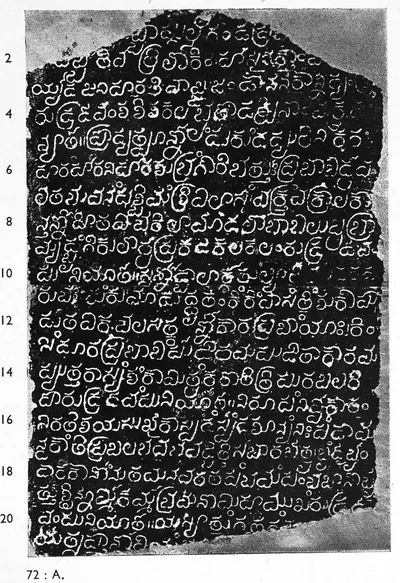 "Warangal inscription of Kakati Rudra-deva", face I (Sreenivasachar, Corpus of Inscriptions in the Telingana Districts III, Plate 1 (PDF p. 191))Inscription rubbing · 1956
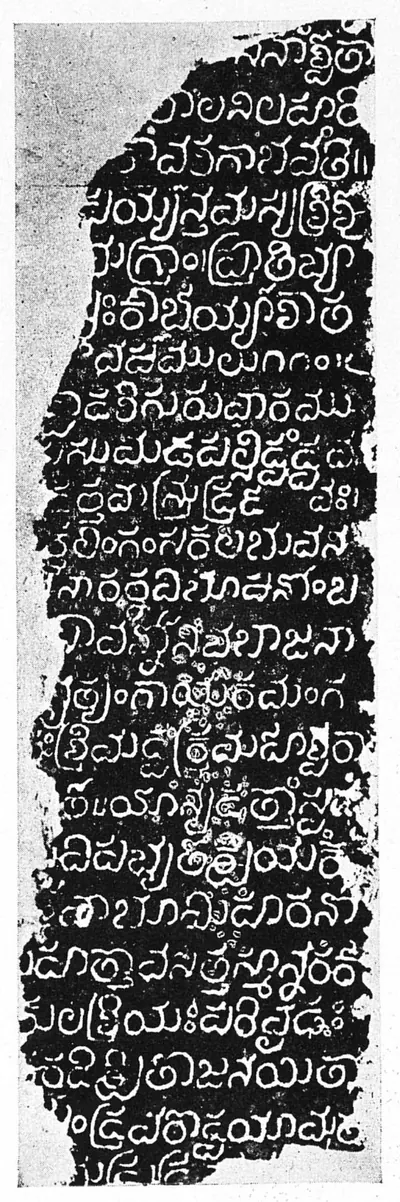 "Warangal inscription of Kakati Rudra-deva", face II (Sreenivasachar, Corpus of Inscriptions in the Telingana Districts III, Plate 1 (PDF p. 191))Inscription rubbing · 1956
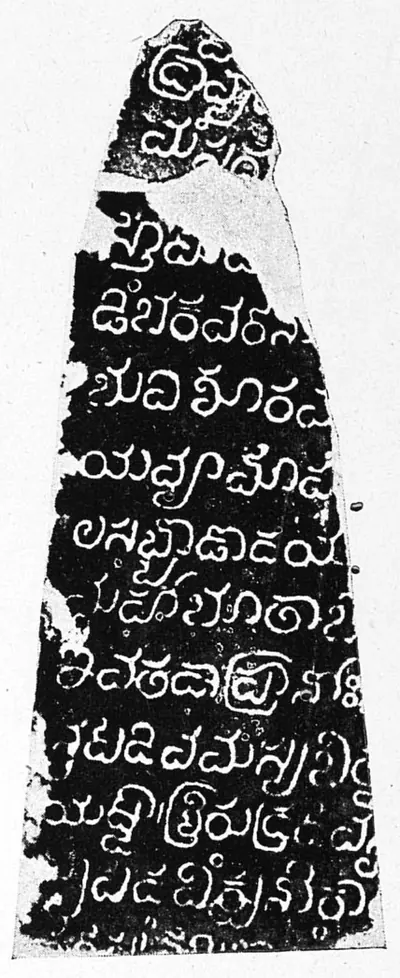 "Warangal inscription of Kakati Rudra-deva", face III (Sreenivasachar, Corpus of Inscriptions in the Telingana Districts III, Plate 1 (PDF p. 191))Inscription rubbing · 1956
References
Notes (0)
Sources (3)
Spotted an error on this page? Tell us
Last updated: