Chendalur plates of Kumaravishnu II
A Sanskrit copper-plate grant issued from Kanchipura in the second year of the Pallava king Kumaravishnu II. It gives a field of 432 pattikas (a land measure) in the village of Chendalura in Karmarashtra to the Brahman Bhavaskandatrata. It was found buried in a pot of paddy husk at Chendalur in the Ongole taluk, and E. Hultzsch edited it in 1906. With it he edited a grant of the same village by the Eastern Chalukya Sarvalokasraya of 673, which was reported found in the same way.
The Chendalur plates are the only record of the Pallava king Kumaravishnu II.12 They were issued at Kanchipura but found at Chendalur.12 So they show a king of Kanchi giving land in the Ongole country.12
Discovery
The plates “were found buried in a pot full of paddy husk”.1 This happened “when a ryot of Chendalur in the Ongole taluka of the Nellore district was digging his house-site for laying foundation”.1 That was some forty years before the plates reached E. Hultzsch.1
The plates passed from the ryot (farmer) to the village accountant (karnam), and then to N. Suryanarayana Rao, a pleader (lawyer) at Nellore.1 He sent them through A. Butterworth to V. Venkayya.1 The originals were returned to Suryanarayana Rao.1
Hultzsch gave the same account of the finding of a grant of the Eastern Chalukya king Sarvalokasraya.3 That grant gives the same village and passed through the same hands.3
Description
There are five plates on a ring whose ends are fixed in a seal with an indistinct symbol and a worn legend.1 With ring and seal they weigh 95 tolas.1 Plates i, iib, iiib and ivb are numbered 1 to 4.1 The language is Sanskrit prose, with four of the usual verses at the end.1
Content
The grant was issued “from the victorious Kanchipura”.4 The issuer was the Maharaja Kumaravishnu, “the fervent Bhagavata, the Bharadvaja”.4 He was the son of the Maharaja Buddhavarman, grandson of the Maharaja Kumaravishnu I and great-grandson of the Maharaja Skandavarman.4 He addressed the villagers of Chendalura in Karmmanka-rashtra and his officers.4
In the village, in the subdivision of Kavachakara-bhaga, the king’s land amounted to 800 pattikas.4 Of this, a field of 432 pattikas was given as a Brahman’s grant to Bhavaskandatrata of the Kaundinya gotra (clan) and the Chhandoga sutra.4 Land enjoyed by temples was excepted.4 The grant is dated on the fifth day of the bright fortnight of Karttika in the second year of the reign.4
Hultzsch identified Chendalura with Chendalur, where the plates were found.2 He identified Karmmanka-rashtra or Kammanka-rashtra with the Karma-rashtra and Kamma-rashtra of Eastern Chalukya grants.2 D. C. Sircar thought the form Karmmakarashtra the same as the Kamakaratha of a Nagarjunakonda inscription.5
The Chalukya grant from the same pot
The second grant is of the Eastern Chalukya Sarvalokasraya (Mangi-Yuvaraja).36 It gives the village of Chendapura in Kamma-rashtra to six Brahmans.36 Hultzsch took Chendapura to be Chendalur itself, and dated the grant to 6 May 673.36
He found that some of the praises of the Chalukya kings in it “were evidently copied from inscriptions or office records of the Pallavas”.3 These were the kings “who had been supplanted by the Eastern Chalukyas”.3
Date
Hultzsch found the alphabet more archaic than that of the Kuram and Kasakudi plates of the later Pallavas.2 But in some letters it was more modern than that of the Pikira, Mangalur and Uruvupalli grants.2 He placed the four kings of these plates between Simhavarman and Simhavishnu.2
G. Jouveau-Dubreuil first took the plates for a copy of a 4th-century record.789 Then, in 1920, he dated them about 450, as nearly contemporary with the Uruvupalli grant.789 R. Gopalan placed them after the Uruvupalli, Mangalur and Pikira grants.1011 Sircar placed their kings after Vishnugopa and before the kings of the Udayendiram plates.12
Footnotes
-
E. Hultzsch, “Chendalur Plates of Kumaravishnu II”, Epigraphia Indica VIII (1905–06), p. 233 (archive.org (opens in a new tab)). ↩ ↩2 ↩3 ↩4 ↩5 ↩6 ↩7 ↩8 ↩9 ↩10 ↩11 ↩12 ↩13
-
Hultzsch, “Chendalur Plates of Kumaravishnu II” (1906), p. 234 (archive.org (opens in a new tab)). ↩ ↩2 ↩3 ↩4 ↩5 ↩6 ↩7 ↩8
-
E. Hultzsch, “Chendalur Plates of Sarvalokasraya; A.D. 673”, Epigraphia Indica VIII (1905–06), pp. 236–237 (archive.org (opens in a new tab)). ↩ ↩2 ↩3 ↩4 ↩5 ↩6 ↩7
-
Hultzsch, “Chendalur Plates of Kumaravishnu II” (1906), p. 236, translation (archive.org (opens in a new tab)). ↩ ↩2 ↩3 ↩4 ↩5 ↩6 ↩7 ↩8
-
Sircar, Successors of the Satavahanas (1939), p. 197 (archive.org (opens in a new tab)). ↩
-
Hultzsch, “Chendalur Plates of Sarvalokasraya” (1906), p. 238 (archive.org (opens in a new tab)). ↩ ↩2 ↩3
-
G. Jouveau-Dubreuil, The Pallavas (1917), p. 22 (archive.org (opens in a new tab)). ↩ ↩2
-
G. Jouveau-Dubreuil, Ancient History of the Deccan (1920), p. 65 (archive.org (opens in a new tab)). ↩ ↩2
-
Jouveau-Dubreuil, Ancient History of the Deccan (1920), p. 66 (archive.org (opens in a new tab)). ↩ ↩2
-
R. Gopalan, History of the Pallavas of Kanchi (1928), p. 56 (archive.org (opens in a new tab)). ↩
-
Gopalan, History of the Pallavas of Kanchi (1928), p. 58 (archive.org (opens in a new tab)). ↩
-
D. C. Sircar, The Successors of the Satavahanas in Lower Deccan (1939), p. 180 (archive.org (opens in a new tab)). ↩
Photos
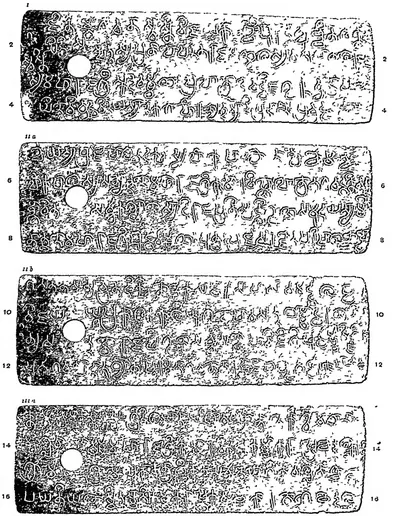 "Chendalur plates of Kumaravishnu II", plates i, ii a, ii b and iii a (Epigraphia Indica VIII, plate with No. 23 (PDF p. 295))Inscription rubbing · 1906
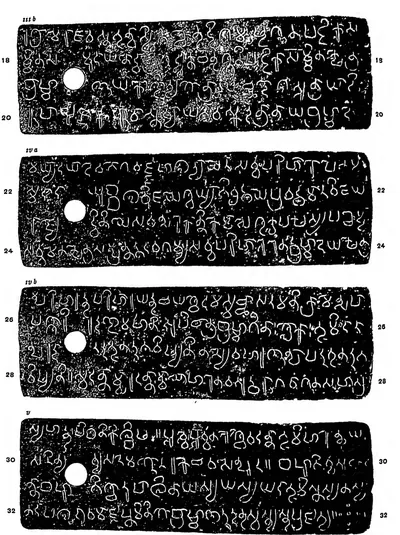 "Chendalur plates of Kumaravishnu II", plates iii b, iv a, iv b and v (Epigraphia Indica VIII, plate with No. 23 (PDF p. 296))Inscription rubbing · 1906
References
Notes (0)
Sources (5)
Spotted an error on this page? Tell us
Last updated: