Chikkulla plates of Vikramendravarman II
A Vishnukundin copper-plate grant, issued from Lendulura in the king's 10th regnal year, giving the village of Regonram near the Krishna to a Shiva temple. It was found in a tank at Chikkulla near Tuni, and F. Kielhorn edited it in 1897. Its date depends on the disputed Vishnukundin chronology.
The Chikkulla plates are a copper-plate charter of the Vishnukundin king Vikramendravarman II, recording the gift of a village to a temple of Shiva.1 They give the fullest early family tree of the Vishnukundin kings.1 When their editor F. Kielhorn published them, he knew of no other inscription that mentioned the Vishnukundins by name.1
Discovery
J. Ramayya, Treasury Deputy Collector of Vizagapatam, wrote a note on the find.21 According to it, Pindi Nammayya had found the plates about ten years earlier, while digging earth at the Atikavani tank.21 The tank was in the Chikkulla agrahara (village granted to Brahmins) of the Tuni division of Godavari district.21 Nammayya lived at Upperagudem, a hamlet of Amalapuram in the Golgonda taluk of Visakhapatnam (then Vizagapatam) district.21
His wife offered the plates for sale early in 1895.21 The village accountant (karanam) secured them and sent them to the Collector, who passed them to E. Hultzsch.21 Kielhorn edited them in Epigraphia Indica IV.21
Physical description
There are five oblong copper plates, each a little over 7 inches wide.1 The first and last are inscribed on one side only.1 They hang on a copper ring about 3 inches across.1 Its ends are soldered into a round seal bearing, in relief, a lion standing with its right fore-paw raised and its mouth open.1 The letters are deeply cut and well preserved.1
Language and script
The characters belong to the southern group of alphabets derived from Brahmi.13 They are close to those of the Godavari plates of Raja Prithivimula.13 The language is Sanskrit prose ending in three verses.13 But it is in places very incorrect, and mixed with Prakrit words such as gihma for grishma, “summer”.13
Kielhorn took the Telugu-style plural samvassarambul, “years”, in the date line as proof that the writer’s own language was Telugu.13 The date is written with numerical symbols for 5, 8 and 10.13
Content
The king issues his order from “victorious Lendulura”.435 He describes himself as one who meditates on the feet of the lord of Sriparvata.435 The family tree runs as follows:435
- Maharaja Madhavavarman, who performed eleven horse sacrifices (ashvamedha) and thousands of others, among them the purushamedha, vajapeya and rajasuya435
- his son Vikramendravarman I, “whose birth was embellished by the two families of the Vishnukundins and Vakatas”435
- his son Indrabhattarakavarman, praised for victories won with his elephants435
- the donor, Indrabhattarakavarman’s eldest son Vikramendravarman II, who “in childhood already embellished with all the virtues of a king, has duly taken upon himself the whole burden of government”435
The grant gives the village of Regonram to the temple of Somagirishvaranatha, a form of Tryambaka (Shiva).15 Regonram lay south-east of the village of Ravireva, on the bank of the Krishnabenna (Krishna) in the Natripati district.15 The grant is dated on the 5th day of the 8th fortnight of summer in the 10th year of the reign.15
Kielhorn identified Lendulura with Dendaluru, near the ruins of Vengi north-east of Eluru (then Ellore), following Ramayya.6 He identified Sriparvata with Srisailam in Kurnool district.6 He also suggested that the dynasty’s name survived in Vinukonda in the Krishna (then Kistna) district, and that Vinukonda had been the Vishnukundin capital.6
A second grant, the Ramatirtham plates of Indravarman, was published by Hultzsch in 1914.7 It gives a short family tree that identifies its donor with the Indrabhattarakavarman of the Chikkulla plates.7
Date
The plates carry no era date, only the regnal year,5 and opinions about their age have changed greatly:
- Kielhorn (1897) argued from the seasonal dating and the numerical symbols.6 He thought the grant not later than about the end of the 8th century, and probably not much earlier.6 He assumed the Vakataka family flourished in the late 7th and 8th centuries.6 The later authorities below place the dynasty two centuries or more earlier.
- Sewell and Aiyangar (1932) followed a tentative scheme of K. V. Lakshman Rao.8 They placed the Vishnukundins between the mid-4th century and about 610, with Vikramendravarman II reigning around the turn of the 5th and 6th centuries.8 They listed his grant of land on the Krishna near Ravireva (modern Ravirela) among the records of about the 6th century.9
- V. V. Mirashi (1947–48, published 1956) placed the great Madhavavarman, great-grandfather of Vikramendravarman II, at about 510–560.10 This scheme puts the grant correspondingly later.10
The scheme of dates followed on the Vishnukundins page sets out these positions. The plates themselves can only be dated relative to the dynasty’s pedigree.5
Edition
- F. Kielhorn, “Chikkulla Plates of Vikramendravarman II”, Epigraphia Indica IV (1896–97), No. 25, pp. 193–198, with plates.2
Footnotes
-
Kielhorn, “Chikkulla Plates” (1897), p. 194 (archive.org (opens in a new tab)). ↩ ↩2 ↩3 ↩4 ↩5 ↩6 ↩7 ↩8 ↩9 ↩10 ↩11 ↩12 ↩13 ↩14 ↩15 ↩16 ↩17 ↩18 ↩19 ↩20 ↩21 ↩22 ↩23 ↩24
-
F. Kielhorn, “Chikkulla Plates of Vikramendravarman II”, Epigraphia Indica IV (1897), p. 193 (archive.org (opens in a new tab)). ↩ ↩2 ↩3 ↩4 ↩5 ↩6 ↩7 ↩8
-
Kielhorn, “Chikkulla Plates” (1897), p. 197 (archive.org (opens in a new tab)). ↩ ↩2 ↩3 ↩4 ↩5 ↩6 ↩7 ↩8 ↩9 ↩10 ↩11 ↩12 ↩13
-
Kielhorn, “Chikkulla Plates” (1897), p. 196 (archive.org (opens in a new tab)). ↩ ↩2 ↩3 ↩4 ↩5 ↩6 ↩7
-
Kielhorn, “Chikkulla Plates” (1897), p. 198 (archive.org (opens in a new tab)). ↩ ↩2 ↩3 ↩4 ↩5 ↩6 ↩7 ↩8 ↩9 ↩10 ↩11 ↩12
-
Kielhorn, “Chikkulla Plates” (1897), p. 195 (archive.org (opens in a new tab)). ↩ ↩2 ↩3 ↩4 ↩5 ↩6
-
E. Hultzsch, “Ramatirtham Plates of Indravarman”, Epigraphia Indica XII (1914), pp. 133–134 (archive.org (opens in a new tab)). ↩ ↩2
-
Sewell and Aiyangar, Historical Inscriptions of Southern India (1932), p. 404 (archive.org (opens in a new tab)). ↩ ↩2
-
Robert Sewell and S. Krishnaswami Aiyangar, The Historical Inscriptions of Southern India (1932), p. 21 (archive.org (opens in a new tab)). ↩
-
V. V. Mirashi and Y. R. Gupte, “Khanapur Plates of Madhavavarman”, Epigraphia Indica XXVII (1956), pp. 314–315 (archive.org (opens in a new tab)). ↩ ↩2
Photos
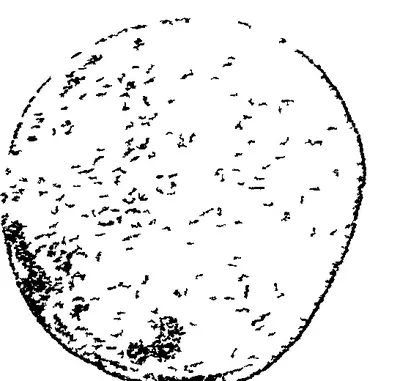 "Chikkulla Plates of Vikramendravarman II, Ep Ind Vol IV No 25" (Epigraphia Indica IV, plate (PDF p. 297), fig. 3)Book plate · 1897
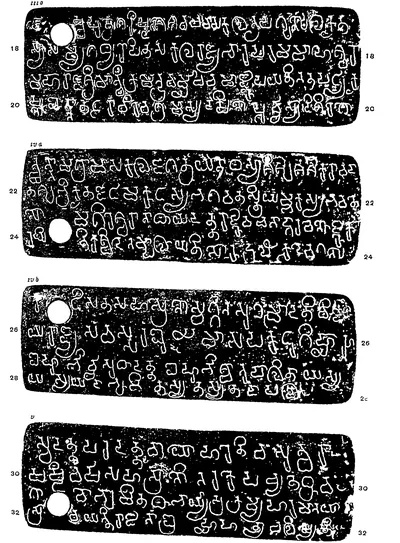 "Chikkulla Plates of Vikramendravarman II", second page of the plate: plates iii b, iv a, iv b and v, lines 17-32 (Epigraphia Indica IV, plate (PDF p. 242))Inscription rubbing · 1897
References
Notes (0)
Sources (4)
Spotted an error on this page? Tell us
Last updated: