Kumaravishnu II (Pallava)
Pallava king of Kanchi known from the Chendalur plates. He issued them from Kanchipura in the second year of his reign, granting land in the village of Chendalura in Karmarashtra, in the present Prakasam district. Where he belongs in the Pallava line is disputed: before Simhavarman, according to Jouveau-Dubreuil, or between Simhavarman and Simhavishnu, according to Hultzsch.
Kumaravishnu II is known from one grant, the Chendalur plates.12 Unlike the kings of the other Sanskrit charters found in the Guntur and Nellore country, he issued his grant from Kanchipura, the Pallava capital.12 Yet the land it gives lay at Chendalur, in the Ongole country.12
Family
The Chendalur plates name four generations.12 They are the Maharaja Skandavarman, his son the Maharaja Kumaravishnu I, his son the Maharaja Buddhavarman, and his son the donor, Kumaravishnu II.12 Kumaravishnu II was the son of Buddhavarman.3 Buddhavarman was the son of Kumaravishnu I.3 Kumaravishnu I was the son of Skandavarman.3
E. Hultzsch found no way to connect this line with the kings of the Pikira, Mangalur and Uruvupalli grants.2 Only the name Skandavarman occurs in both.2
The Velurpalayam plates, a family record of the 9th century, name a Kumaravishnu “who conquered Kanchi”.4 They also name his son Buddhavarman, “a submarine fire to the ocean-like army of the Cholas”.4 H. Krishna Sastri identified these two with Kumaravishnu I and Buddhavarman of the Chendalur plates.4 D. C. Sircar thought the identification very probable.5
The grant
The Maharaja Kumaravishnu, “the fervent Bhagavata, the Bharadvaja”, issued the grant from “the victorious Kanchipura” in the second year of his reign.3 He told the villagers of Chendalura in Karmmanka-rashtra and his officers of a gift.3 A field of 432 pattikas, out of 800 pattikas of the king’s land in the village, had been given to the Brahman Bhavaskandatrata.3 Hultzsch noted that the wording is very close to that of the Uruvupalli grant.2
Date and place in the line
- Hultzsch thought the letters of the Chendalur plates more modern than those of the Pikira, Mangalur and Uruvupalli grants.2 He concluded that the four kings of the Chendalur plates ruled “in the interval between Simhavarman and Simhavishnu”.2
- G. Jouveau-Dubreuil suggested in 1917 that the plates were a copy of a document of the early 4th century.6 In 1920 he called that theory “entirely untenable” and dated the grant to about 450.789 He argued that Kumaravishnu II reigned at Kanchi at the same time as Skandavarman II of Tambrapa, and just before the Simhavarman of the Uruvupalli grant.789 His family table gives him 425–450.789
- R. Gopalan rejected the view that the Chendalur plates were the oldest of the Sanskrit charters.1011 He placed Kumaravishnu II, as the king who captured Kanchi, after Simhavarman and before Simhavishnu.12
- Sircar placed the Chendalur kings after Vishnugopa, the enemy of Samudragupta.1314 He placed them before the kings of the Udayendiram plates, whose Simhavarman he dated from 436.1314
- Sewell’s chronology of 1932 dated the grant about 426, following Jouveau-Dubreuil.15
Footnotes
-
E. Hultzsch, “Chendalur Plates of Kumaravishnu II”, Epigraphia Indica VIII (1905–06), p. 233 (archive.org (opens in a new tab)). ↩ ↩2 ↩3 ↩4 ↩5
-
Hultzsch, “Chendalur Plates of Kumaravishnu II” (1906), p. 234 (archive.org (opens in a new tab)). ↩ ↩2 ↩3 ↩4 ↩5 ↩6 ↩7 ↩8 ↩9 ↩10
-
Hultzsch, “Chendalur Plates of Kumaravishnu II” (1906), p. 236, translation (archive.org (opens in a new tab)). ↩ ↩2 ↩3 ↩4 ↩5 ↩6
-
H. Krishna Sastri, “Two Pallava Copper-plate Grants”, Epigraphia Indica XV (1919–20), p. 249 (archive.org (opens in a new tab)). ↩ ↩2 ↩3
-
D. C. Sircar, The Successors of the Satavahanas in Lower Deccan (1939), p. 160 (archive.org (opens in a new tab)). ↩
-
G. Jouveau-Dubreuil, The Pallavas (1917), p. 22 (archive.org (opens in a new tab)). ↩
-
G. Jouveau-Dubreuil, Ancient History of the Deccan (1920), p. 65 (archive.org (opens in a new tab)). ↩ ↩2 ↩3
-
Jouveau-Dubreuil, Ancient History of the Deccan (1920), pp. 66–67 (archive.org (opens in a new tab)). ↩ ↩2 ↩3
-
Jouveau-Dubreuil, Ancient History of the Deccan (1920), p. 68 (archive.org (opens in a new tab)). ↩ ↩2 ↩3
-
R. Gopalan, History of the Pallavas of Kanchi (1928), p. 55 (archive.org (opens in a new tab)). ↩
-
Gopalan, History of the Pallavas of Kanchi (1928), p. 56 (archive.org (opens in a new tab)). ↩
-
Gopalan, History of the Pallavas (1928), p. 69 (archive.org (opens in a new tab)). ↩
-
Sircar, Successors of the Satavahanas (1939), p. 180 (archive.org (opens in a new tab)). ↩ ↩2
-
Sircar, Successors of the Satavahanas (1939), p. 182 (archive.org (opens in a new tab)). ↩ ↩2
-
Robert Sewell and S. Krishnaswami Aiyangar, The Historical Inscriptions of Southern India (1932), p. 18 (archive.org (opens in a new tab)). ↩
Photos
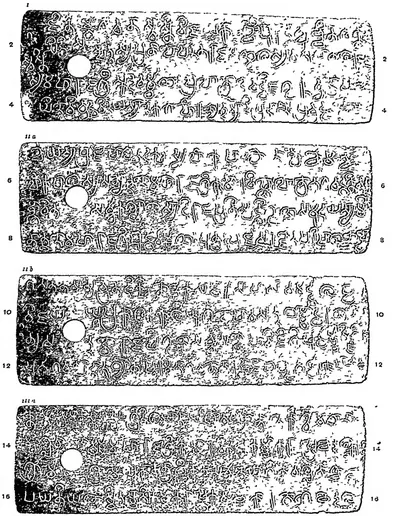 "Chendalur plates of Kumaravishnu II", plates i, ii a, ii b and iii a (Epigraphia Indica VIII, plate with No. 23 (PDF p. 295))Inscription rubbing · 1906
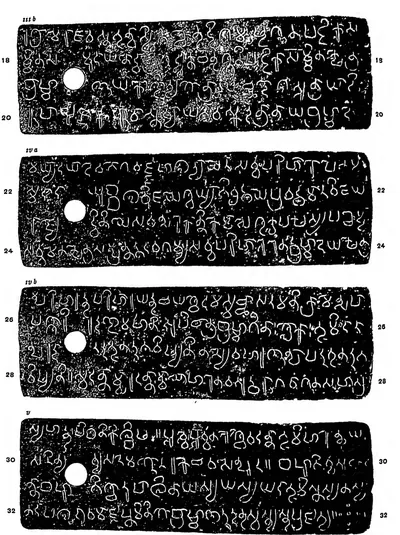 "Chendalur plates of Kumaravishnu II", plates iii b, iv a, iv b and v (Epigraphia Indica VIII, plate with No. 23 (PDF p. 296))Inscription rubbing · 1906
Related
Dynasties

References
Notes (0)
Sources (7)
Spotted an error on this page? Tell us
Last updated: