Dharmasagar inscription of the minister Malla
An undated Sanskrit and Telugu pillar inscription of Ganapatideva's reign at Dharmasagar near Hanamkonda. It records land given by the minister Malla to the god Prasanna-Vishveshvara of Elakurki. It also records how the land was shared among temple musicians, dancers and priests.
The pillar
The inscription is cut on the four sides of a stone pillar at Dharmasagar in the Warangal taluk.1 When Sreenivasachar recorded it, the pillar stood very near the boys’ school.1 P. Sreenivasachar placed it first in Part II of his Corpus of Inscriptions in the Telingana Districts (1940).1 The opening verses are in Sanskrit, and the details of the gift are in Telugu prose. Parts of the pillar are damaged.234
The king and the minister
After an opening prayer, the verses say that Brahma created the Kakatiya family of kings.4 In this family there was a king named Ganapa (Ganapatideva), whose courage and fame they praise.4 Under him served the minister Bhaskara.4 The family line then runs from father to son:45
- Bhaskara’s son was Chenna Ganna.45
- Chenna Ganna’s son was Ganadhipa.45
- Ganadhipa’s son was the minister Malla, a devotee of Shiva who carried the burden of the state.45
Sreenivasachar’s list gives the minister’s full name as Galanta Mallaya.1 No date survives.1
The gift
The verses on the third side give the boundaries of the land given, and say that it was divided into three parts.5 Two parts went to the god, and Mallaya kept the third for his own use.5
The god’s share was divided again among the temple’s people.5 Land went to ten dancing women.5 Set shares went to players of the mridanga drum, to pipers, to players of the kahala horn and of the jalaja-karanda, and to the cowherds.5
The Telugu summary at the end calls the estate the Vishveshvara-samudra with its outlying land, and the god Prasanna-Vishveshvara of Elakurki.35 It gives land to eighteen dancing women, and half a share each for a cattle trough and a water-shed.5 It gives a share to the two sons of a Panditaradhya.45
The rest went to the temple itself, at Goraga-kunta, Renu-kunta and Kesama-reddi-kunta.45 The damaged last lines mention the traders in connection with the gift.45
Significance
The record is one of the few Kakatiya inscriptions that set out in detail how a temple endowment supported musicians and dancers. In his introduction Sreenivasachar cited it, with records at Pillalamarri and Panugallu.6 He took them as evidence that the temple was the main support of the fine arts in this period.6 For the king, see Ganapatideva.
Editions
The text and translation are in Sreenivasachar’s Corpus, Part II (1940), pp. 1–4, with the list entry on p. 183.21
Footnotes
-
P. Sreenivasachar (ed.), A Corpus of Inscriptions in the Telingana Districts, Part II (1940), p. 183, list of inscriptions, No. 1 (archive.org (opens in a new tab)). Paraphrased. ↩ ↩2 ↩3 ↩4 ↩5 ↩6
-
Sreenivasachar, Corpus, Part II (1940), p. 1, text, sides I–II (archive.org (opens in a new tab)). ↩ ↩2
-
Sreenivasachar, Corpus, Part II (1940), p. 2, text, sides III–IV (archive.org (opens in a new tab)). The names are quoted from the text. ↩ ↩2
-
Sreenivasachar, Corpus, Part II (1940), p. 3, text lines 69–76 and translation, verses 1–7 (archive.org (opens in a new tab)). Paraphrased. ↩ ↩2 ↩3 ↩4 ↩5 ↩6 ↩7 ↩8 ↩9 ↩10 ↩11
-
Sreenivasachar, Corpus, Part II (1940), p. 4, translation, verses 8–19 and lines 63–76 (archive.org (opens in a new tab)). Paraphrased. ↩ ↩2 ↩3 ↩4 ↩5 ↩6 ↩7 ↩8 ↩9 ↩10 ↩11 ↩12 ↩13 ↩14
-
P. Sreenivasachar (ed.), A Corpus of Inscriptions in the Telingana Districts, Part I: Introduction (1942), p. 33 (archive.org (opens in a new tab)). Paraphrased. ↩ ↩2
Photos
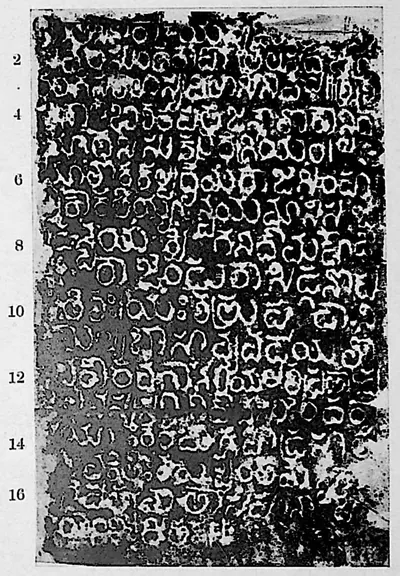 "Dharmasāgar inscription", face I (Sreenivasachar, Corpus of Inscriptions in the Telingana Districts II, Plate 1 (PDF p. 222))Inscription rubbing · 1940
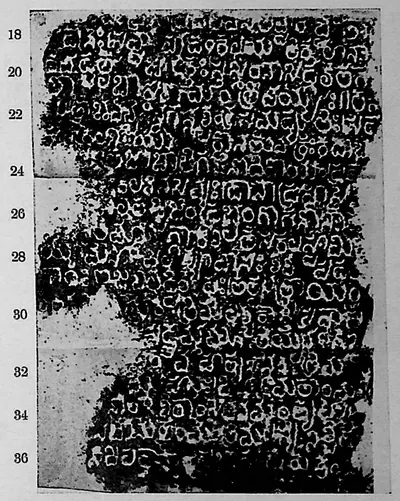 "Dharmasāgar inscription", face II (Sreenivasachar, Corpus of Inscriptions in the Telingana Districts II, Plate 1 (PDF p. 222))Inscription rubbing · 1940
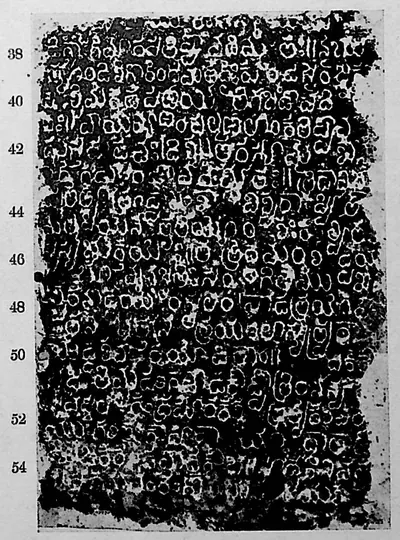 "Dharmasāgar inscription", face III (Sreenivasachar, Corpus of Inscriptions in the Telingana Districts II, Plate 1 (PDF p. 222))Inscription rubbing · 1940
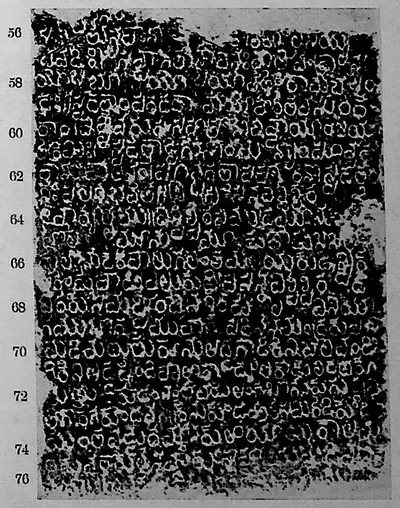 "Dharmasāgar inscription", face IV (Sreenivasachar, Corpus of Inscriptions in the Telingana Districts II, Plate 1 (PDF p. 222))Inscription rubbing · 1940
References
Notes (0)
Sources (2)
Spotted an error on this page? Tell us
Last updated: