Darsi plate of a Pallava grant
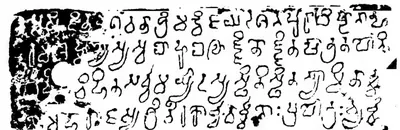
Single copper plate, the first of a lost Sanskrit grant of a Pallava king, found in a tobacco field at Darsi in the Nellore district and now in the Madras Museum. A great-grandson of the Maharaja Virakorchavarman issued it 'from the prosperous and victorious residence of Dasanapura'. E. Hultzsch edited it in 1892. Later scholars identified Virakorchavarman with Viravarman of the Nellore–Guntur line and Dasanapura with Darsi itself.
Only the first plate of this grant survives, and with it the name of the king who issued it is lost.12 What remains links it to the Pallava line of the Nellore–Guntur country.12 It also links it to Dasanapura, one of the places from which those kings issued their grants.12
Discovery and description
E. Hultzsch reported in 1892 that the plate “was found lying in a tobacco field at the village of Darsi in the Nellur district”, and that it was then in the Madras Museum.1 It carries the beginning of a Sanskrit inscription on one side of a copper plate.1 A hole on the left of the inscribed side once held the ring, which must have borne the royal seal, and the other plates have not been found.1 See Darsi.
Content
Hultzsch translated the four lines.2 The grant opens: “Hail! Victorious is Bhagavat! From the prosperous and victorious residence of Dasanapura.”2 It then names “The great-grandson of the maharaja Sri-Vira-Korchavarman”.2 It praises this Virakorchavarman as “very pious”.2 He “acquired by the power of his arm a mighty treasure of such penance as becomes the warrior-caste”.2 He “ordained all laws according to the sacred scriptures”, was “constant in virtue”, and his mind “was immeasurable”.2
Hultzsch noted that these epithets (words of praise) agree word for word with those given to the Pallava kings Skandavarman I and Skandavarman II.12 They appear in two published copper-plate grants, one of them the Uruvupalli grant.12 The plate ends with the opening of the next king’s description, in the same words as those grants.12 With its archaic (very old) alphabet, this left him in no doubt about the plate.12 It belonged to one of the early Pallava kings whose grants are dated from Palakkada, Dasanapura and Kanchipura.12
Who was Virakorchavarman?
Hultzsch noted that the correct Sanskrit form Vira-Kurchavarman occurs in a Pallava grant from Kasakudi.1 H. Krishna Sastri identified Virakorchavarman with Viravarman, the grandfather of the crown prince Vishnugopa.34 He also identified him with the Virakurcha of the Velurpalayam plates.34 R. Gopalan and G. Jouveau-Dubreuil both took the plate as proof that a king called Virakurcha existed.56
D. C. Sircar thought the form of the name, influenced by Prakrit, placed the grant soon after the Prakrit charters.78 He suggested that its issuer was a predecessor of Skandavarman II.78 He also suggested that Virakorchavarman was a predecessor of Kumaravishnu, the first king of the first Omgodu grant.78
Dasanapura and Darsi
V. Venkayya suggested that Dasanapura was the ancient name of Darsi, which is called Darsi and Darisi in 14th-century inscriptions.9 The Nellore gazetteer of 1942 reported that Fleet and others identified Dasanapura with Darsi.10 Jouveau-Dubreuil, in 1917, noted only that the plate was found at Darsi and was issued at Dasanapura.11
Footnotes
-
E. Hultzsch, “A Plate of a Pallava Copper-plate Grant”, Epigraphia Indica I (1892), p. 397 (archive.org (opens in a new tab)). ↩ ↩2 ↩3 ↩4 ↩5 ↩6 ↩7 ↩8 ↩9 ↩10 ↩11 ↩12
-
Hultzsch, “A Plate of a Pallava Copper-plate Grant” (1892), p. 398, text and translation (archive.org (opens in a new tab)). ↩ ↩2 ↩3 ↩4 ↩5 ↩6 ↩7 ↩8 ↩9 ↩10 ↩11 ↩12 ↩13 ↩14
-
H. Krishna Sastri, “Two Pallava Copper-plate Grants”, Epigraphia Indica XV (1919–20), p. 249 (archive.org (opens in a new tab)). ↩ ↩2
-
Krishna Sastri, “Two Pallava Copper-plate Grants” (1920), p. 251 (archive.org (opens in a new tab)). ↩ ↩2
-
R. Gopalan, History of the Pallavas of Kanchi (1928), p. 61 (archive.org (opens in a new tab)). ↩
-
Jouveau-Dubreuil, The Pallavas (1917), p. 22 (archive.org (opens in a new tab)). ↩
-
D. C. Sircar, The Successors of the Satavahanas in Lower Deccan (1939), p. 171 (archive.org (opens in a new tab)). ↩ ↩2 ↩3
-
Sircar, Successors of the Satavahanas (1939), p. 172 (archive.org (opens in a new tab)). ↩ ↩2 ↩3
-
Gopalan, History of the Pallavas of Kanchi (1928), p. 62 (archive.org (opens in a new tab)). ↩
-
Gazetteer of the Nellore District, brought up to 1938, Vol. A (1942), p. 30 (archive.org (opens in a new tab)). ↩
-
G. Jouveau-Dubreuil, The Pallavas (1917), p. 16 (archive.org (opens in a new tab)). ↩
Photos
References
Notes (0)
Sources (6)
Spotted an error on this page? Tell us
Last updated: