Gudimallam plates of the Bana king Vikramaditya II
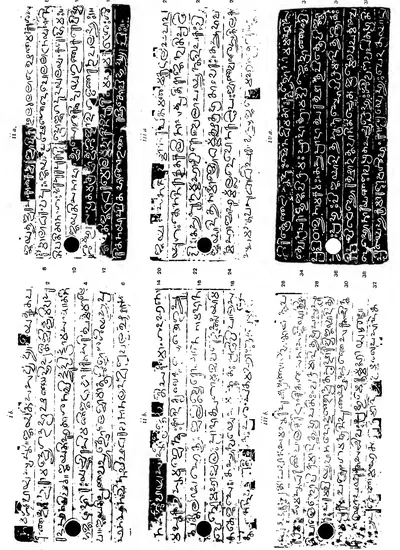
Five copper plates with a bull seal, found at Gudimallam in the Kalahasti zamindari and acquired for the Government Museum, Madras. In Sanskrit verse and prose with a short Tamil postscript, they record that the Bana prince Vikramaditya, son of Vijayaditya Prabhumeru, confirmed an old grant of the village Viprapitha (Gudimallam) to its Brahmins. Published by E. Hultzsch in 1924, they gave a fuller family tree of the Banas and showed that their friend 'Krishna-Raja' was the Rashtrakuta Krishna III.
By these copper plates, the Bana prince Vikramaditya confirmed an old grant of the village of Viprapitha to its Brahmins.1 Viprapitha was the Sanskrit name of Gudimallam, where the plates were found.21 They give the fullest family tree of the Bana kings of the 9th century.13
The plates
The plates were found at Gudimallam in the Kalahasti zamindari (landholder’s estate).2 K. Raghaviah of Kalahasti sent them to H. Krishna Sastri, and they were bought for the Government Museum, Madras.2 There are five plates, with writing on nine faces.2 They hang on a copper ring fixed in a round seal.2 The seal shows a bull lying down, with what looks like a lamp-stand and a crescent above it.2
Most of the text is in Sanskrit, in the Grantha script.2 It ends with a short postscript in Tamil.2 E. Hultzsch, who edited the plates in 1924, could not give a fully satisfactory translation of the eight opening verses to Siva.2 He found the rest clear, though not always correct in wording.2
What they say
After the verses to Siva, the plates tell the legend of the demon king Bali, son of Virochana.1 One of Bali’s descendants was King Nandivarman.1 The line then runs through Vijayaditya, Malladeva “of the Bana race”, Jayameru (also called Vikramaditya), and Vijayaditya (also called Prabhumeru).1 The donor was Vikramaditya, son of Prabhumeru.1
A verse says that a king, perhaps the Nandivarman of the opening, had once given the village of Viprapitha to Brahmins.1 With his father’s consent, Vikramaditya confirmed that gift.1 He did so because the god of the Parasuramesvara temple had granted him a favour.1 The Tamil postscript gives the village’s revenue assessment as 500 of paddy and ten kalanju (a gold weight) of gold.1
What they settled
Before these plates, the only Bana family tree came from the Udayendiram plates.1 The new plates showed that Prabhumeru of the Udayendiram plates was also called Vijayaditya.1 They also showed that his father, called Banavidyadhara there, had the names Vikramaditya and Jayameru.1
This let Hultzsch place other Bana records.13 Stone records at Gudimallam dated Saka 820 (Saka is an Indian way of counting years) and 827, and another of Saka 831, belong to Vijayaditya Prabhumeru.3 So he ruled about 900.3 The Udayendiram plates call his great-grandson Vikramaditya-Vijayabahu a friend of a king named Krishna.3 Scholars had taken this to be the Rashtrakuta Krishna II, about 900.3 Hultzsch argued that he must instead be Krishna III, about 950, who made wide conquests in the south.3
Where the sources disagree
Hultzsch’s dating also changed the place of the Ganga prince Prithivipati II Hastimalla.3 The Chola king Parantaka I gave him the title Banadhiraja (overlord of the Banas), and his records are dated in 915 and 921.3 Hultzsch concluded that Prithivipati was only a temporary usurper.3 In his view he was the Chola candidate, while the true Bana heir was protected by the Rashtrakutas.3
Footnotes
-
Hultzsch, “Gudimallam Plates” (1924), p. 2 (archive.org (opens in a new tab)). ↩ ↩2 ↩3 ↩4 ↩5 ↩6 ↩7 ↩8 ↩9 ↩10 ↩11 ↩12 ↩13 ↩14 ↩15
-
E. Hultzsch, “Gudimallam Plates of the Bana King Vikramaditya II”, Epigraphia Indica XVII (1923–24), p. 1 (archive.org (opens in a new tab)). ↩ ↩2 ↩3 ↩4 ↩5 ↩6 ↩7 ↩8 ↩9 ↩10
-
Hultzsch, “Gudimallam Plates” (1924), p. 3 (archive.org (opens in a new tab)). ↩ ↩2 ↩3 ↩4 ↩5 ↩6 ↩7 ↩8 ↩9 ↩10 ↩11
Photos
References
Notes (0)
Sources (1)
Spotted an error on this page? Tell us
Last updated: