Bezwada pillar inscription of Yuddhamalla
A Telugu verse inscription on a stone pillar in the Mallesvara temple at Bezwada (Vijayawada). It records that a Chalukya king Yuddhamalla built a temple and a monastery for Kumarasvamin (Karttikeya). It also records that a Yuddhamalla later added a front tower to a temple built by his grandfather Mallapa-raju. Its editor J. Ramayya Pantulu (1920) dated it to about 890–930 and called it the earliest Telugu poetry then known. Its date, its division into one or two records and the meaning of its fourth verse were disputed.
When J. Ramayya Pantulu published this inscription from Bezwada (Vijayawada) in 1920, it was “the earliest specimen of Telugu poetry yet discovered”.1 It is a short Telugu poem in a Dravidian metre, recording a Chalukya king’s temple and monastery for the god Kumarasvamin. It also showed scholars that early Telugu had a Dravidian consonant, ḻ.23 Until then this sound was known only from Tamil, Malayalam and old Kannada.23
The pillar
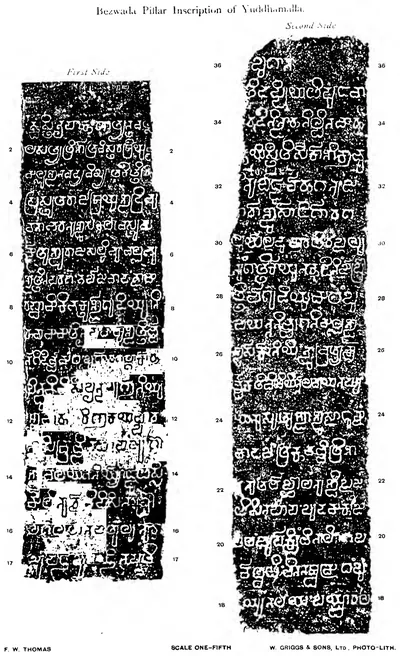
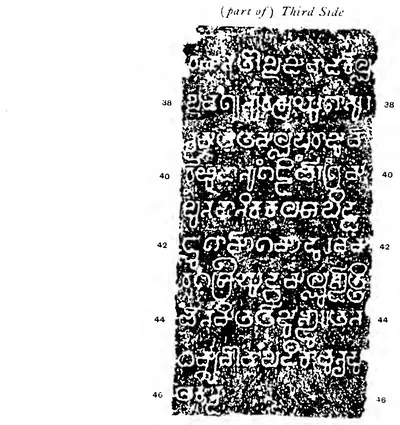
The inscription is No. 323 of the Government Epigraphist’s collection for 1892.4 Ramayya Pantulu described it as “engraved on two sides and partly on the third side of a quadrangular stone pillar”.4 The pillar was then “built into the platform of a verandah in front of the temple kitchen—in the temple of Mallesvara-Svamin at Bezwada”.4 By 1920 it had been moved to a room in the temple compound.4 He edited the inscription from an estampage (ink copy) supplied by H. Krishna Sastri, and also inspected the stone himself.4
A later Telugu inscription is cut below it on the right-hand side.4 On the back is a Tamil inscription of the 41st year of the Chola king Kulottunga I.4 That record gives a perpetual lamp to the temple of “Mallisvaram-udaiya-Mahadeva at Vijaiavadai, surnamed Rajendra-Sola-puram”.4
The record is well preserved except for the first syllables of a few lines on the second face.5 The letters are about an inch square.5 Unusually, the lines on the second face are read from the bottom upwards.5 Ramayya Pantulu thought this imitated palm-leaf manuscripts.5
Script and language
The letters are of the Eastern Chalukya type.5 Ramayya Pantulu found that they closely resembled those of the copper-plate grants of Chalukya-Bhima I, including the Bezwada plates.5 He discussed the forms of each letter in detail.5
He noted that the anusvara (nasal sign) is often written where the metre shows it was not pronounced, as in mathambu for mathamu.6 He called this “the first instance I have come across of mbu standing for mu”.6 He also called it “a sign of the antiquity of the inscription”.6
The poem is in Telugu verse in the madhyakkara metre.63 The exception is a prose passage in lines 29–36 that he could not fully read.63 He explained that this “non-Sanskritic” metre corresponds to the Kannada dore-akkara.63
He concluded that “even at this remote period the grammar and prosody of the Telugu language had attained a high state of development and were nearly standardized”.7 So, he wrote, Telugu as a literary language “must be accorded a greater antiquity than is generally allowed”.7
K. V. Lakshmana Rao added that the inscription “takes the history of the Telugu literature at least two centuries back”.2 He pointed out that three of its words use the letter for the Dravidian sound ḻ.2 Ramayya Pantulu had first read it as ḍ when he published the poem in the Journal of the Telugu Academy in 1916.2 In the Epigraphia Indica text it was given its proper value, a correction made in proof by the editor.2
What it records
The first verse praises king Yuddhamalla as “the lord of the imperial Salki country” and “an elephant goad to kings”.87 Salki is the Telugu form of Chalukya.87 In Ramayya Pantulu’s translation, the king “built with pleasure in Bejavada a temple to Komara-svami, being (his) devotee, and erected a matha” (monastery).83
Anyone “not being Saiva mendicants” who occupies the building incurs the sin of killing “in the (celebrated) Baranasi”.83 The temple authorities and the king are to expel those who disobey.3 Ramayya Pantulu thought this prohibition was aimed at the Jains, who were still numerous in the country.7 He judged so “considering the vehemence with which it is propounded”.7
The fourth verse, in his translation, speaks of the son of the three-eyed god Siva.9 It says that, “having come from the celebrated (town of) Chebrolu to (attend) a jatra at Bejavada”, the god “manifested himself in this place”.9 Finding this out, “Malla erected with pleasure a temple and a matha to Karttikeya”.9
The fifth verse, on the right-hand face, speaks of a temple built by Yuddhamalla’s grandfather Mallapa-raju “as an ornament and protection to the whole of Bejavada”.9 Then “the glorious Yuddhamalla in course of time erected a front tower to the same (temple)”.9 The tower “looks like a kalasa crowning the temple”.9 An unfinished line follows, addressed “to kings who recognize and maintain the charity”.9
One record or two, and which Yuddhamalla?
Ramayya Pantulu argued that the pillar carries two inscriptions.31 In his view, the first four verses and the prose passage record the temple and monastery for Karttikeya.31 The fifth verse and the fragment record the tower added by a Yuddhamalla to his grandfather’s temple.31 He thought “Mallapa-raja” a colloquial short form of Yuddhamalla, which would give two Yuddhamallas, grandfather and grandson.31
He identified them with Yuddhamalla I and his grandson Yuddhamalla II.1 Yuddhamalla I was a younger brother of Gunaga-Vijayaditya III who took part in the government without being king in name.1 Yuddhamalla II, son of Tada, reigned seven years.1 So Ramayya Pantulu dated the first record to about 890, and the second about forty years later.1
As an alternative, he gave Yuddhamalla II and a grandson, but he preferred the first view.1 He wrote: “In either case the first cannot be referred to a period later than the middle of the 10th century”.1 See Gunaga Vijayaditya III.
H. Krishna Sastri, in a note to the edition, thought instead that the first three verses refer to one temple, and the fourth to a different temple.3 C. R. Krishnamachari agreed that verse 5 and what follows form a separate record.1011 But he read verse 5 differently.1011 In his reading, Yuddhamalla himself first built the temple “in the name of his grandfather Mallaparaju”, and later added the tower.1011
K. V. Lakshmana Rao, writing on another set of plates in 1928, referred to the pillar simply as an inscription of Yuddhamalla II.12
Who came from Chebrolu?
Ramayya Pantulu took the fourth verse to mean that the god came from Chebrolu, famous for its temple of Shanmukha.37 On this view, the Vijayawada (then Bezwada) image was a replica said to be “inhabited by the spirit” of the god at Chebrolu.37
Krishna Sastri suggested instead that it was the king, Malla, who went from Chebrolu to the festival at Bejavada.3 Ramayya Pantulu called this “a very far-fetched construction”.3
Krishnamachari re-read the verse to support Krishna Sastri.10 He argued that Malla came from Chebrolu and ruled it.10 His reason was that the prose passage, as he restored it, entrusts the charity to “those same (people) that rule over Chebrolu”.10
Lakshmana Rao read the prose passage as calling on “the rulers of Chebrolu, the rulers of the sea-coast and the Saiva mendicants of other places” to maintain the institution.13
In 1928 Ramayya Pantulu rejected most of Krishnamachari’s readings.14 He allowed that the king’s journey was “literally possible”, though his own reading was “the more probable one”.14 He also observed that “Chebrolu does not appear to have ever been a Chalukyan capital”.14
Its date and Nannaya
The date mattered because Nannaya’s Mahabharata was the oldest Telugu work extant.1 Nannaya dedicated it to Rajaraja Narendra, who was crowned in 1022.1
Critics in the Telugu press argued that the inscription could not be older than Nannaya.115 They argued that he first brought the akkara metres into Telugu from Kannada.115 Others identified the two Yuddhamallas with two Mallapas of the Pithapuram branch of the Chalukyas, the second crowned in 1202.115
Ramayya Pantulu rejected both views on the evidence of the letters.15 He set the inscription beside the Nandamapundi grant, whose older first part he thought had been engraved under Saktivarman.15 He found the pillar’s writing “more archaic”.15 He also noted that the caesura (the pause in a verse line) falls at the start of the fifth foot, as in Nannaya but not in Errapreggada’s later verse.15
Krishna Sastri added in a note that the unpublished Guntur plates of Yuddhamalla II’s sons, Badapa and Tala II, have a closely similar alphabet.15
K. V. Lakshmana Rao published the Addanki inscription of Pandaranga in 1928.1617 He wrote that “the Bezwada pillar inscription of Yuddhamalla took it”, meaning the beginning of Telugu poetry, “a century back” from Nannaya.1617 He added that the Addanki record “takes it a century further still”.1617 He found its orthography (spelling) like that of the Bezwada pillar, and credited the Bezwada inscription with first revealing the sound ḻ in early Telugu.1617
Footnotes
-
Ramayya Pantulu, “The Bezwada Pillar Inscription” (1920), p. 154 (archive.org (opens in a new tab)). ↩ ↩2 ↩3 ↩4 ↩5 ↩6 ↩7 ↩8 ↩9 ↩10 ↩11 ↩12 ↩13 ↩14 ↩15 ↩16
-
K. V. Lakshmana Rao, “A Note on the Bezwada Pillar Inscription of Yuddhamalla”, Epigraphia Indica XV (1919–20), p. 366 (archive.org (opens in a new tab)). ↩ ↩2 ↩3 ↩4 ↩5 ↩6
-
Ramayya Pantulu, “The Bezwada Pillar Inscription” (1920), p. 153, with H. Krishna Sastri’s notes (archive.org (opens in a new tab)). ↩ ↩2 ↩3 ↩4 ↩5 ↩6 ↩7 ↩8 ↩9 ↩10 ↩11 ↩12 ↩13 ↩14 ↩15 ↩16 ↩17
-
J. Ramayya Pantulu, “The Bezwada Pillar Inscription of Yuddhamalla”, Epigraphia Indica XV (1919–20), p. 150 (archive.org (opens in a new tab)). ↩ ↩2 ↩3 ↩4 ↩5 ↩6 ↩7 ↩8
-
Ramayya Pantulu, “The Bezwada Pillar Inscription” (1920), p. 151 (archive.org (opens in a new tab)). ↩ ↩2 ↩3 ↩4 ↩5 ↩6 ↩7
-
Ramayya Pantulu, “The Bezwada Pillar Inscription” (1920), p. 152 (archive.org (opens in a new tab)). ↩ ↩2 ↩3 ↩4 ↩5 ↩6
-
Ramayya Pantulu, “The Bezwada Pillar Inscription” (1920), p. 156 (archive.org (opens in a new tab)). ↩ ↩2 ↩3 ↩4 ↩5 ↩6 ↩7 ↩8
-
Ramayya Pantulu, “The Bezwada Pillar Inscription” (1920), p. 158, translation (archive.org (opens in a new tab)). ↩ ↩2 ↩3 ↩4
-
Ramayya Pantulu, “The Bezwada Pillar Inscription” (1920), p. 159, translation (archive.org (opens in a new tab)). ↩ ↩2 ↩3 ↩4 ↩5 ↩6 ↩7
-
C. R. Krishnamachari, “A Note on the Bezwada Pillar Inscription of Yuddhamalla”, Epigraphia Indica XV (1919–20), p. 365 (archive.org (opens in a new tab)). ↩ ↩2 ↩3 ↩4 ↩5 ↩6
-
Krishnamachari, “A Note on the Bezwada Pillar Inscription” (1920), p. 366 (archive.org (opens in a new tab)). ↩ ↩2 ↩3
-
K. V. Lakshmana Rao, “Two Copper-plate Inscriptions of Eastern Chalukya Princes”, Epigraphia Indica XIX (1927–28), p. 139 (archive.org (opens in a new tab)). ↩
-
Lakshmana Rao, “A Note on the Bezwada Pillar Inscription” (1920), p. 367 (archive.org (opens in a new tab)). ↩
-
J. Ramayya Pantulu, “A Further Note on the Bezwada Pillar Inscription of Yuddhamalla”, Epigraphia Indica XIX (1927–28), p. 88 (archive.org (opens in a new tab)). ↩ ↩2 ↩3
-
Ramayya Pantulu, “The Bezwada Pillar Inscription” (1920), p. 155, with H. Krishna Sastri’s note (archive.org (opens in a new tab)). ↩ ↩2 ↩3 ↩4 ↩5 ↩6 ↩7 ↩8
-
K. V. Lakshmana Rao, “The Addanki Stone Inscription of Pandaranga”, Epigraphia Indica XIX (1927–28), p. 272 (archive.org (opens in a new tab)). ↩ ↩2 ↩3 ↩4
-
Lakshmana Rao, “The Addanki Stone Inscription of Pandaranga” (1928), p. 273 (archive.org (opens in a new tab)). ↩ ↩2 ↩3 ↩4
Photos
References
Notes (0)
Sources (3)
Spotted an error on this page? Tell us
Last updated: