Chevuru plates of Amma I
Three undated copper plates of the Eastern Chalukya king Amma I (reigned about 918–925). They were dug up about 1928 in a ruined mud house at Chevuru in the Kaikalur taluk of Kistna district, and B. Ch. Chhabra edited them. They were issued at the first-feeding ceremony of the infant prince Vijayaditya (Beta-Vijayaditya V). They make the warrior Vemaraja headman of the village of Umikili for a fixed tribute of eight gold gadyanakas. Their boundaries are in Telugu.
These three plates are the fourth known charter of Amma I, the Eastern Chalukya king who reigned for seven years.1 In J. F. Fleet’s chronology he reigned from September 918 to August 925.1 B. Ch. Chhabra, who edited the plates, noted that other scholars had since arrived at slightly different dates.1
Unlike Amma’s other grants, these plates do not reward a Brahmin.23 They make a soldier, Vemaraja, the headman of a village.23 They were issued at the first-feeding ceremony of the king’s infant son.23
Discovery
Chhabra found the plates in the possession of a peasant, Pulovarapa Ankayya, son of Venkata Reddi, of Chevuru village in the Kaikalur taluk of Krishna (then Kistna) district.4 He heard of them by chance from a resident of the neighbouring village of Singarayapalem, while touring the area in November 1938.4 He borrowed them with the help of the revenue inspector of Vadali and the village accountant (karanam) of Chevuru.4
He was shown the spot where the peasant’s spade had turned them up.4 It was a heap of debris from a ruined mud house, whose old earth was being dug for manure.4 That had happened about ten years before his visit, and the plates had lain unnoticed with their finder ever since.4 See Chevuru.
Description
There are three plates, each about 8½ inches broad and 4¼ inches high.4 They are strung on an uncut copper ring about 4½ inches across.4 The ring’s ends are fixed under a round seal about 2¾ inches across.4
The second plate is written on both sides, and the first and third on the inner side only.4 Raised rims have kept the writing well preserved from start to finish.4
The seal, slightly damaged at the bottom, carries the legend Sri-Tribhuvanankusa across the centre.42 Above it is a running boar facing right, with an elephant-goad in front of it and a crescent with a star above.42 Below it is an open lotus.42 Chhabra noted that some scholars take the dot within the crescent for the sun.2
Script and language
Chhabra placed the letters in the southern class of alphabets, regular for the period and place.2 He described them as forerunners of the modern Telugu characters.2 They include the letters ḷ and ṟ, peculiar to Telugu and other southern languages.2
The language is Sanskrit, except that lines 26 to 30 are mostly in Telugu.2 The text is in prose apart from three closing verses, the last of which names the composer.2
Content
The order is addressed to the householders of the Gudravara district (vishaya), headed by the village headmen.315 Amma I bears here the full imperial titles Maharajadhiraja, Paramesvara and Paramabhattaraka.315 He also has the epithet Gandaraganda and the surnames Raja-Mahendra and Vishnuvardhana.315 He is called a devout worshipper of Shiva (paramamahesvara), which Chhabra noted was new for this king.315
The preamble does not list the reigns of all the earlier kings, as Amma I’s other grants do.31 It names only his father Vijayaditya (IV), praised for his liberality, and his grandfather Chalukya-Bhima (I), praised for his victories.31 Amma himself is praised for subduing his kinsmen.31
The beneficiary was a warrior named Vemaraja, son of Manohitarya, who was the younger brother of a Rajaditya.26 Vemaraja was the grandson of Chandeyaraja of the Kona family.26 Chandeyaraja had been headman of the same village of Umikili.26 He had received the honour of riding an elephant from king Vijayaditya alias Gunakkenalla, whom Chhabra took to be Gunaga Vijayaditya III.26
The grant calls Vemaraja the Sudraka of the Kali age, after a legendary hero.36 It says that he had served Amma’s father Vijayaditya loyally and obediently.36
Pleased with this service, Amma made him headman (gramani) of Umikili.26 He was exempt from every tax except the fixed tribute of eight gadyanakas (gold coins) that had long been customary.26 Chhabra took the gadyanaka to be a gold coin.26 He understood the arrangement as, in effect, a grant of the village.26
The boundaries that follow, in Telugu, describe two fields called Ervvoka, one south and one north of the village.56 One adjoins Dadrupaka, a royal demesne (royal land) and a plot belonging to the Chandalas.56 The other adjoins a stream called Vannegu.56 The passage ends with dues to be received in grain.56
C. R. Krishnamacharlu, in a note to the edition, suggested from these boundaries that the gift may have consisted only of the two fields.3
The executor (samajnapti) was the Katakesvara, whom the grant praises as able to guard the Vengi country.16 Chhabra noted that his personal name is not given, and rendered the title as governor of the royal camp.16 The composer was Bhatta Mahakala, son of Bhatta Niravadya.16 Chhabra thought him a different man from the general Mahakala who received Amma I’s Masulipatam grant.1
The infant prince
The occasion of the gift was the annaprasana, the first feeding with solid food, of prince Vijayaditya, Amma I’s son.31 This prince reigned for a fortnight as Vijayaditya V and was also called Beta.31 Since that ceremony is usually held in the child’s sixth month, Chhabra inferred that the prince was then about six months old.31
He also argued that the grant is the latest of Amma I’s four known charters.1 His reason was that only here does the king use the imperial titles, which he took to show that Amma had by then subdued his opponents.1 If so, Beta-Vijayaditya V must have been a baby when he succeeded his father in 925.1
In a footnote Chhabra cited an earlier parallel.3 A remote ancestor of Amma I, Mangi-yuvaraja (672–696), had given land at Eluru, the modern Ellore, to a Brahmin.3 He did so on the first-feeding ceremony of his son Vishnuvardhana III.3 See Amma I and the succession wars of 925–945.
Grants to soldiers
Chhabra pointed out that none of the four known charters of Amma I records a gift to a Brahmin.3 These are the charters from Machilipatnam (then Masulipatam), Ederu, Tenali and Chevuru.3 Each honours a man of military rank, even on an occasion like a prince’s first feeding, when a Brahmin’s claim might have been expected.3 He suggested that a king almost always at war with his kinsmen or with the Rashtrakutas may have deliberately favoured soldiers to keep them loyal.3
Fleet, in 1891, had known only the Machilipatnam and Idara (Ederu) grants.78 The first gives a village to Mahakala, who had been a general of Bhima I.78 The second gives one to Bhandanaditya, otherwise called Kuntaditya, of the Pattavardhini family.78 See the Ederu plates of Amma I.
Places named
The Gudravara district appears in many Eastern Chalukya inscriptions, under several spellings.9 It had been identified both with Guduru near Machilipatnam and with Gudivada.9 Chhabra thought Gudivada more likely.9
He identified the village of Umikili with Unikili, and the boundary village of Dadrupaka with Rudrapaka, both in the Kaikalur taluk.9 The taluk map, he noted, shows Rudrapaka about a mile and a half south of Unikili, as the inscription says.9 He added that the Kaikalur taluk had formerly been part of the Gudivada taluk, so that Chevuru and its neighbours once lay in the latter.9
Footnotes
-
Chhabra, “Chevuru Plates” (1956), p. 44 and notes (archive.org (opens in a new tab)). ↩ ↩2 ↩3 ↩4 ↩5 ↩6 ↩7 ↩8 ↩9 ↩10 ↩11 ↩12 ↩13 ↩14 ↩15 ↩16 ↩17 ↩18 ↩19 ↩20
-
Chhabra, “Chevuru Plates of Eastern Chalukya Amma I” (1956), p. 42 and notes (archive.org (opens in a new tab)). ↩ ↩2 ↩3 ↩4 ↩5 ↩6 ↩7 ↩8 ↩9 ↩10 ↩11 ↩12 ↩13 ↩14 ↩15 ↩16 ↩17 ↩18 ↩19 ↩20
-
Chhabra, “Chevuru Plates” (1956), p. 43 and notes (archive.org (opens in a new tab)). ↩ ↩2 ↩3 ↩4 ↩5 ↩6 ↩7 ↩8 ↩9 ↩10 ↩11 ↩12 ↩13 ↩14 ↩15 ↩16 ↩17 ↩18 ↩19 ↩20 ↩21 ↩22 ↩23
-
B. Ch. Chhabra, “Chevuru Plates of Eastern Chalukya Amma I”, Epigraphia Indica XXVII (1947–48, publ. 1956), p. 41 (archive.org (opens in a new tab)). ↩ ↩2 ↩3 ↩4 ↩5 ↩6 ↩7 ↩8 ↩9 ↩10 ↩11 ↩12 ↩13 ↩14
-
Chhabra, “Chevuru Plates” (1956), p. 46, text (archive.org (opens in a new tab)). ↩ ↩2 ↩3 ↩4 ↩5 ↩6 ↩7 ↩8
-
Chhabra, “Chevuru Plates” (1956), p. 47, translation (archive.org (opens in a new tab)). ↩ ↩2 ↩3 ↩4 ↩5 ↩6 ↩7 ↩8 ↩9 ↩10 ↩11 ↩12 ↩13 ↩14 ↩15 ↩16 ↩17
-
J. F. Fleet, “The Chronology of the Eastern Chalukya Kings”, Indian Antiquary XX (1891), p. 266 (archive.org (opens in a new tab)). ↩ ↩2 ↩3
-
Fleet, “The Chronology of the Eastern Chalukya Kings” (1891), p. 267 (archive.org (opens in a new tab)). ↩ ↩2 ↩3
-
Chhabra, “Chevuru Plates” (1956), p. 45 and notes (archive.org (opens in a new tab)). ↩ ↩2 ↩3 ↩4 ↩5 ↩6
Photos
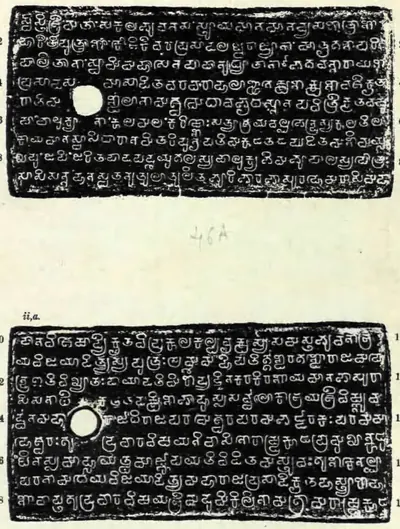 "Chevuru Plates of Eastern Chalukya Amma I", plates i and ii a (Epigraphia Indica XXVII, plate between pp. 46 and 47 (PDF p. 86))Inscription rubbing · 1956
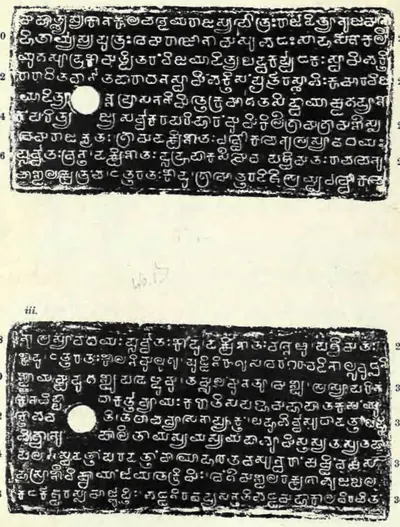 "Chevuru Plates of Eastern Chalukya Amma I", plates ii b and iii (Epigraphia Indica XXVII, plate between pp. 46 and 47 (PDF p. 87))Inscription rubbing · 1956
References
Notes (0)
Sources (2)
Spotted an error on this page? Tell us
Last updated: