Thousand Pillar Temple inscription of Rudradeva
A Telugu and Sanskrit inscription of January 1163 CE at the Thousand Pillar Temple in Hanamkonda. It records that Rudradeva consecrated the temple's three gods. It also tells of the wars by which he and his father Prola II made the Kakatiyas masters of Telangana.
What it is
The inscription stands at the temple of Rudra in the eastern part of Hanamkonda.1 J. F. Fleet described the place in 1882 as lying a short distance north of Warangal.1 The inscription is a sasana, a formal record cut in stone, issued in the reign of the Kakatiya ruler Rudradeva.1 It was issued at his capital, which it calls Anmakundapura, Anmakondapattana or Anumakondanagari.1
Its stated purpose is to record that Rudradeva set up images of Rudra (Shiva), Vasudeva (Vishnu) and Surya (the Sun).12 It also records that he granted the large village of Mattichéruvala for their worship.12 The opening Telugu lines say that he installed the Shiva image as Rudreshvara, in his own name.3 These three gods are the deities of the three shrines of the Thousand Pillar Temple.4
The stone
The text is engraved on all four faces of a stone about 8 feet high, 2 feet 2 inches broad and 1 foot 2 inches thick.1 Fleet thought the stone might be a dhvajastambha (flag pillar).1 The lines are spread over the four faces like this:1
- lines 1 to 41 on the front face1
- 42 to 89 on the right1
- 90 to 150 on the back, where a sculpture interrupts lines 90 to 1041
- the last lines, 151 to 166, on the left1
Fleet called the letters “well executed and well preserved Old-Canarese characters” (Old Kannada).1
Date
The record is dated in Saka 1084 (Saka is an Indian way of counting years), the Chitrabhanu year, on the thirteenth day of the bright half of Magha.13 Fleet gave the year as 1162–63 CE.1 P. V. Parabrahma Sastry dates it to 19 January 1163.5 Robert Sewell’s chronology takes 19 January 1163 as the day of Rudradeva’s coronation, and dates the inscription to the following day.6
Earlier readings were badly wrong.1 The first published version read the year as Saka 1054, and Bhau Daji read Saka 1064.1 Rice assigned the record to the ninth century.1
Contents
The first eight lines are in Old Telugu prose, and the rest is Sanskrit verse.1 P. Sreenivasachar pointed out that this order is unusual.7 Here the Telugu opening carries the practical details of the gift, and the Sanskrit that follows is a show-piece by a court poet.7
The poet was the ascetic Achintendra, a disciple of Advayamrita.89 His father, Rameshvara Dikshita, had been spiritual preceptor to Rudradeva’s father Prola.89
The family tree names Tribhuvanamalla, his son Prola, Prola’s queen Muppama, and their son Rudradeva.10 Prola is said to have:10
- captured the Chalukya prince Tailapadeva in battle and let him go10
- captured Govindaraja and given his kingdom to Udaya10
- shaved the head of Gunda, lord of Mantrakuta, and branded him with a boar10
- made Jagaddeva lift his siege of Anumakonda10
Rudradeva is credited with defeating Domma and Mailigideva, and with taking the wealth of Polavasa.1011 He is also credited with driving into the forest a king named Bhima, who had seized power after Tailapa’s death.1011 He then burned the city of Chododaya and built a new city around a great lake on the site of the forest.11
The poem ends with praise of Anumakonda and of Rudradeva’s cavalry.12 It sets the kingdom’s limits at the sea in the east, Srisailam in the south and Malyavanta in the north.12
Interpretation
Fleet identified Tailapadeva with the Western Chalukya king Taila III.2 He noted that Rudradeva calls himself only mahamandaleshvara, a feudatory’s title.2 But he judged that Rudradeva was in fact independent.2
Parabrahma Sastry used inscriptions found in Telangana after 1964.1314 He argued instead that this Tailapa was Kumara Tailapa, a Chalukya prince who governed part of Telangana in the 1130s.1314 On this reading the record does not describe a revolt against the Chalukyas.1314 In his reading, Prola and Rudradeva put down rival local chiefs, and Rudradeva declared sovereignty only after Chalukya rule at Kalyana had collapsed.1314
Parabrahma Sastry also called the claim that the kingdom reached the eastern sea an exaggeration.15
Editions
Versions were published in the Journal of the Asiatic Society of Bengal and the Journal of the Bombay Branch of the Royal Asiatic Society before Fleet’s revised edition of 1882.1 Fleet made his edition from an ink impression, and published it with lithographs and a full translation.1 Sreenivasachar’s Corpus of Inscriptions in the Telingana Districts (1942) includes it as No. 3.7 The Imperial Gazetteer of 1909 noted inscriptions in Old Telugu and Sanskrit on three pillars of the temple.16
Footnotes
-
J. F. Fleet, Sanskrit and Old-Canarese Inscriptions, No. CXVIII, Indian Antiquary XI (1882), p. 9 (archive.org (opens in a new tab)). ↩ ↩2 ↩3 ↩4 ↩5 ↩6 ↩7 ↩8 ↩9 ↩10 ↩11 ↩12 ↩13 ↩14 ↩15 ↩16 ↩17 ↩18 ↩19 ↩20 ↩21 ↩22
-
Fleet, Sanskrit and Old-Canarese Inscriptions, No. CXVIII (1882), p. 10 (archive.org (opens in a new tab)). ↩ ↩2 ↩3 ↩4 ↩5
-
Fleet, Sanskrit and Old-Canarese Inscriptions, No. CXVIII (1882), p. 12, text lines 4–7 (archive.org (opens in a new tab)). ↩ ↩2
-
P. V. Parabrahma Sastry, The Kakatiyas of Warangal (1978), p. 300. ↩
-
Parabrahma Sastry, The Kakatiyas of Warangal (1978), p. 74. ↩
-
Robert Sewell, The Historical Inscriptions of Southern India (1932), pp. 113–114 (archive.org (opens in a new tab)). ↩
-
P. Sreenivasachar, A Corpus of Inscriptions in the Telingana Districts, Part I (1942), p. 8 (archive.org (opens in a new tab)). ↩ ↩2 ↩3
-
Sreenivasachar, Corpus, Part I (1942), p. 11 (archive.org (opens in a new tab)). ↩ ↩2
-
Parabrahma Sastry, The Kakatiyas of Warangal (1978), p. 293. ↩ ↩2
-
Fleet, Sanskrit and Old-Canarese Inscriptions, No. CXVIII (1882), p. 17 (archive.org (opens in a new tab)). ↩ ↩2 ↩3 ↩4 ↩5 ↩6 ↩7 ↩8
-
Fleet, Sanskrit and Old-Canarese Inscriptions, No. CXVIII (1882), p. 18 (archive.org (opens in a new tab)). ↩ ↩2 ↩3
-
Fleet, Sanskrit and Old-Canarese Inscriptions, No. CXVIII (1882), p. 20 (archive.org (opens in a new tab)). ↩ ↩2
-
Parabrahma Sastry, The Kakatiyas of Warangal (1978), pp. 81–84. ↩ ↩2 ↩3 ↩4
-
Parabrahma Sastry, The Kakatiyas of Warangal (1978), pp. 89–90, 97. ↩ ↩2 ↩3 ↩4
-
Parabrahma Sastry, The Kakatiyas of Warangal (1978), p. 96. ↩
-
Imperial Gazetteer of India, Provincial Series: Hyderabad State (1909), p. 164 (archive.org (opens in a new tab)). ↩
Photos
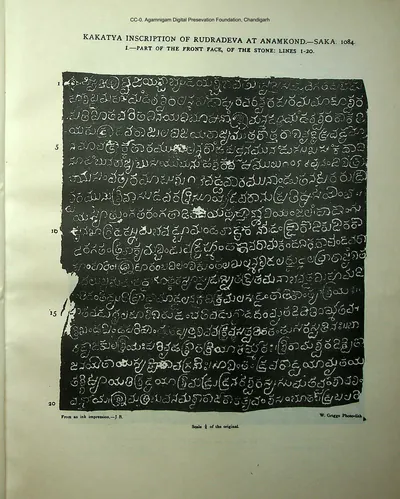 "Kakatya inscription of Rudradeva at Anamkond, Saka 1084. I: Part of the front face of the stone, lines 1-20" (Indian Antiquary XI, Plate I (PDF p. 26))Inscription rubbing · 1882
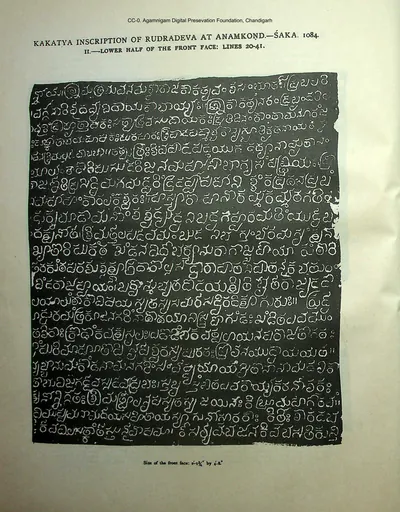 "Kakatya inscription of Rudradeva at Anamkond, Saka 1084. II: Lower half of the front face, lines 20-41" (Indian Antiquary XI, Plate II (PDF p. 27))Inscription rubbing · 1882
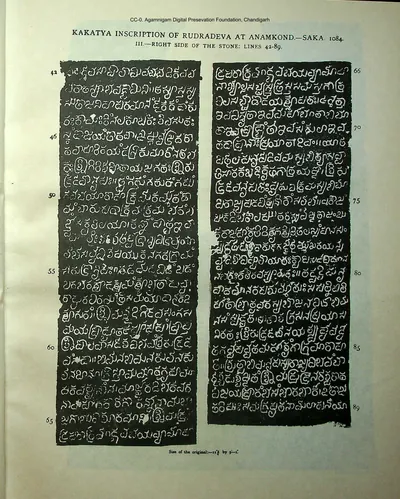 "Kakatya inscription of Rudradeva at Anamkond, Saka 1084. III: Right side of the stone, lines 42-89" (Indian Antiquary XI, Plate III (PDF p. 30))Inscription rubbing · 1882
 Line 1 of the Thousand Pillar Temple inscription of Rudradeva, Hanamkonda, 1163: "Om Svasti Srir=vvijayas=ch=abhyudayas=cha bhavatu" (Indian Antiquary XI, Plate I, detail)Inscription rubbing · 1882
 Line 6 of the Hanamkonda inscription, with the year "Saka-varshamulu 1084" in Telugu-Kannada figures (Indian Antiquary XI, Plate I, detail)Inscription rubbing · 1882
References
Notes (0)
Sources (6)
Spotted an error on this page? Tell us
Last updated: