Karimnagar inscription of Gangadhara
Telugu verse inscription of January 1171 on a pillar at Karimnagar. In it Gangadhara, a Brahmin from the Vengi country who served the Kakatiya chiefs Prola II and Rudradeva, lists the agrahara (Brahmin village), temples, tanks and gardens he founded. Among them are temples at Anumakonda and an image of Vishnu as the Buddha.
The pillar
The inscription is cut on a stone pillar.1 When P. Sreenivasachar recorded it, the pillar stood in the compound of the Talukdar’s bungalow at Karimnagar.1 He published it in 1940 as No. 56, the last record in Part II of his Corpus of Inscriptions in the Telingana Districts, with a translation and two plates.1
Apart from a short prose passage at the end (lines 161–171), the whole text is in Telugu verse.23 Sreenivasachar praised the verses as beautiful.23 In his introduction he set their plain style against the ornate Sanskrit of later records, such as those at Bothpur and Kondaparti.23
The minister and his family
The speaker is Gangadhara.42 He traces his family to the town of Velleki in the Vengi country, home of men of the Atreya gotra (clan).42 His line runs from Komman-arya through Narayana and his wife Aytamambika, and Govinda and his wife Turukamamba, to Gangadhara himself.42
Gangadhara says that his parents educated him with care.4 King Vrola, that is, Prola, sent for him as a man of upright character and skill.4 In the following verses he describes how Rudra, lord of the city of Anmakunda (Anumakonda), made him a minister.5 Rudra gave him vrittis (endowments), a sword, a white umbrella and other insignia (signs of rank).5
Foundations
By the king’s favour Gangadhara gave a large agrahara (village for Brahmins) called Dendondu to learned Brahmins.51 He held sacrifices there.51 He also built a triple shrine of Shiva, a lake and gardens of flowers and fruit trees.51
At Anumakonda, in the middle of the town, he set up an image of Prasanna-Keshava beside the god Rudreshvara.5 He built a large temple near the temple of Punneshvara and installed the three gods (Tri-purushas).5
Other verses list a shrine of Vishnu near the Gangachi tank.61 They also list, in a hall, an image of the Buddha, explained as the form Vishnu took to deceive the chief of the demons.61 He also built a temple and tank for Shiva as Samvartakeshvara.61
Near the temple of Rudreshvara he built a temple for Shiva.6 He set up an image of Vishnu with a festival in the tank.6 In the city of Mantrakuta he founded a temple of Shiva.6 He set up Achyuta with flagstaffs, gateways and the twenty-four images.6 A verse on the seven ways of leaving a lasting name closes the poem.6 Among these ways are an agrahara, a garden, a tank and a temple.6
Date and the final passage
The closing prose is dated Saka 1092 (Saka is an Indian way of counting years), the year Vikriti, on the fifth day of the bright half of Magha, a Wednesday.7 It is dated under the mahamandaleshvara (great feudal lord) Kakatiya Rudradeva.7 Sreenivasachar gave the date as Wednesday, 13 January 1171.1
The rest of this passage is damaged.72 It seems to record an order of Rudradeva.72 It names a village, Nagaruru, and the district of Sabbi-nadu.72
Parabrahma Sastry’s reading
P. V. Parabrahma Sastry used the record for Gangadhara’s career.89 On his reading Prola II, pleased with the young man’s character, put him in charge of the town administration of Anumakonda.89 Gangadhara then rose under Rudradeva in the wars against Medaraja and Dommaraja.89 Rudradeva made him governor of the Sabbi-mandala, with Nagunuru near Karimnagar as its capital.89
Parabrahma Sastry took Gangadhara’s temples of Samvartakeshvara and the others to stand in his capital Nagunuru.1011 He drew attention to the image of the Buddha installed in a hall as an incarnation of Vishnu.1011 His book gives the date of the record in three ways: 1170, 1171 and 1172.8911
Significance
The record shows a Brahmin family from the Vengi country in the service of two Kakatiya chiefs of Anumakonda, Prola II and Rudradeva.45 It also names the god Rudreshvara at Anumakonda.512 The Thousand Pillar Temple inscription of 1163 says Rudradeva installed this god in his own name.512 Gangadhara’s career is also recorded in his Sanskrit inscription at Hanamkonda; see the Hanamkonda inscription of Gangadhara.
Editions
The text, translation and plates are in Sreenivasachar’s Corpus, Part II (1940), pp. 169–177, with the list entry on pp. 198–199.12
Footnotes
-
P. Sreenivasachar (ed.), A Corpus of Inscriptions in the Telingana Districts, Part II (1940), p. 198, list of inscriptions, No. 56 (archive.org (opens in a new tab)). Paraphrased. ↩ ↩2 ↩3 ↩4 ↩5 ↩6 ↩7 ↩8 ↩9 ↩10 ↩11
-
Sreenivasachar, Corpus, Part II (1940), p. 199, list of inscriptions, No. 56 (archive.org (opens in a new tab)). Paraphrased. ↩ ↩2 ↩3 ↩4 ↩5 ↩6 ↩7 ↩8 ↩9 ↩10
-
P. Sreenivasachar (ed.), A Corpus of Inscriptions in the Telingana Districts, Part I: Introduction (1942), p. 8 (archive.org (opens in a new tab)). Paraphrased. ↩ ↩2 ↩3
-
Sreenivasachar, Corpus, Part II (1940), p. 174, verses 2–9 (archive.org (opens in a new tab)). Paraphrased. ↩ ↩2 ↩3 ↩4 ↩5 ↩6
-
Sreenivasachar, Corpus, Part II (1940), p. 175, verses 10–20 (archive.org (opens in a new tab)). Paraphrased. ↩ ↩2 ↩3 ↩4 ↩5 ↩6 ↩7 ↩8 ↩9 ↩10
-
Sreenivasachar, Corpus, Part II (1940), p. 176, verses 21–32 (archive.org (opens in a new tab)). Paraphrased. ↩ ↩2 ↩3 ↩4 ↩5 ↩6 ↩7 ↩8 ↩9
-
Sreenivasachar, Corpus, Part II (1940), p. 177, lines 161–172 (archive.org (opens in a new tab)). Paraphrased. ↩ ↩2 ↩3 ↩4 ↩5
-
P. V. Parabrahma Sastry, The Kakatiyas of Warangal (1978), p. 101. ↩ ↩2 ↩3 ↩4 ↩5
-
Parabrahma Sastry, The Kakatiyas of Warangal (1978), p. 167. ↩ ↩2 ↩3 ↩4 ↩5
-
Parabrahma Sastry, The Kakatiyas of Warangal (1978), p. 102. ↩ ↩2
-
Parabrahma Sastry, The Kakatiyas of Warangal (1978), p. 271. ↩ ↩2 ↩3
-
J. F. Fleet, Sanskrit and Old-Canarese Inscriptions, No. CXVIII, Indian Antiquary XI (1882), p. 12, text lines 4–7 (archive.org (opens in a new tab)). ↩ ↩2
Photos
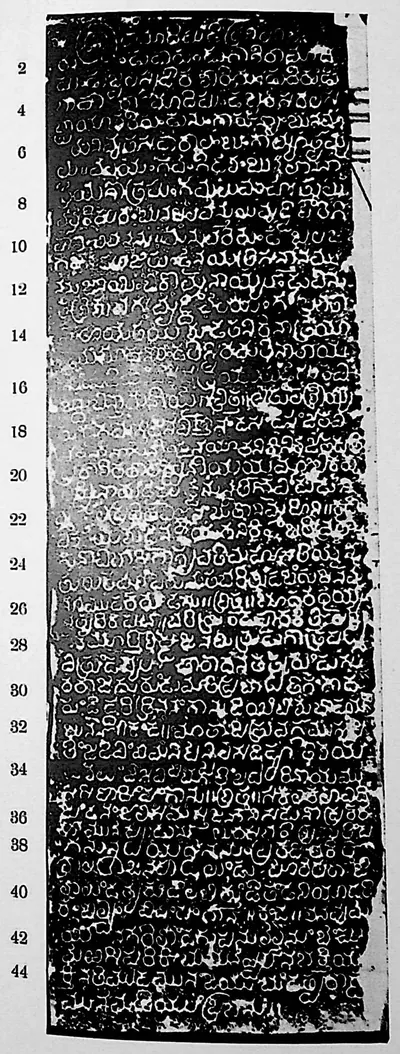 "Karimnagar inscription of Gaṅgādhara", face I (Sreenivasachar, Corpus of Inscriptions in the Telingana Districts II, Plate 53 (PDF p. 326))Inscription rubbing · 1940
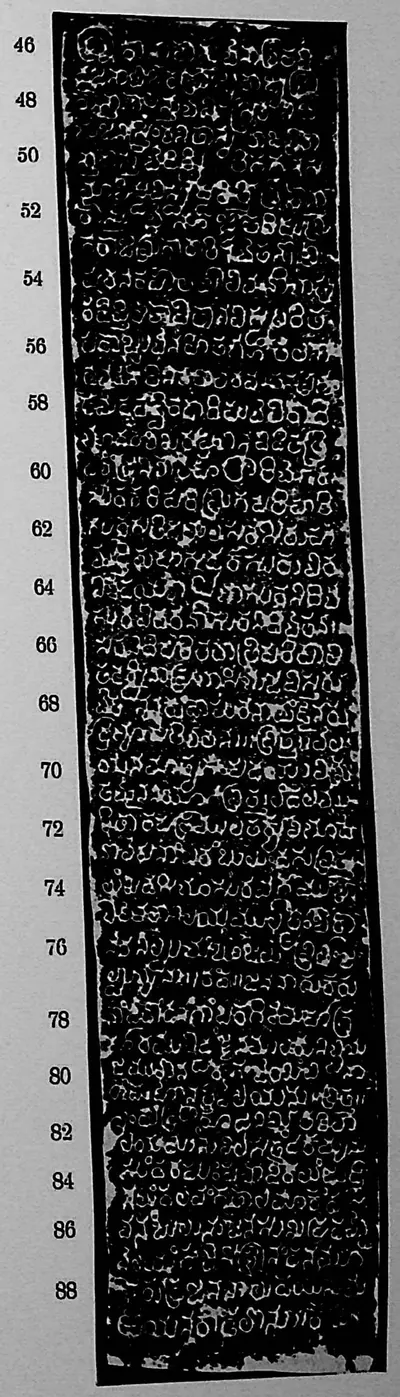 "Karimnagar inscription of Gaṅgādhara", face II (Sreenivasachar, Corpus of Inscriptions in the Telingana Districts II, Plate 53 (PDF p. 326))Inscription rubbing · 1940
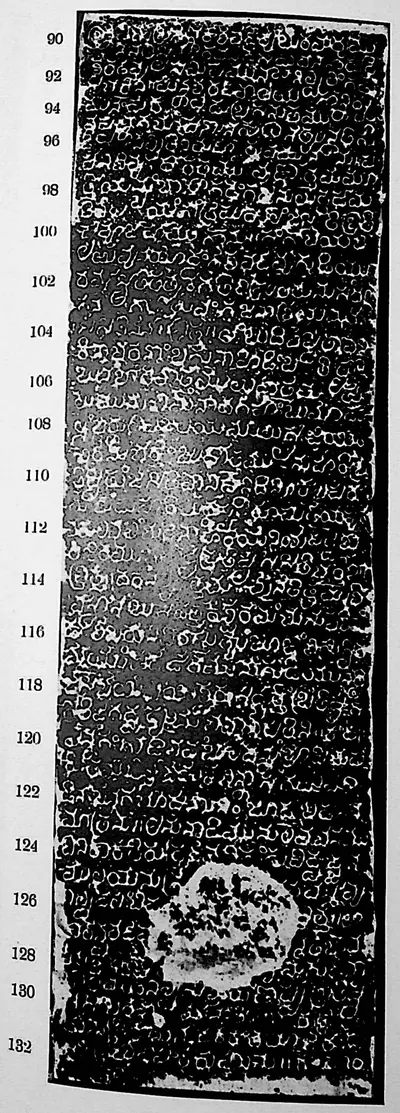 "Karimnagar inscription of Gaṅgādhara", face III (Sreenivasachar, Corpus of Inscriptions in the Telingana Districts II, Plate 54 (PDF p. 328))Inscription rubbing · 1940
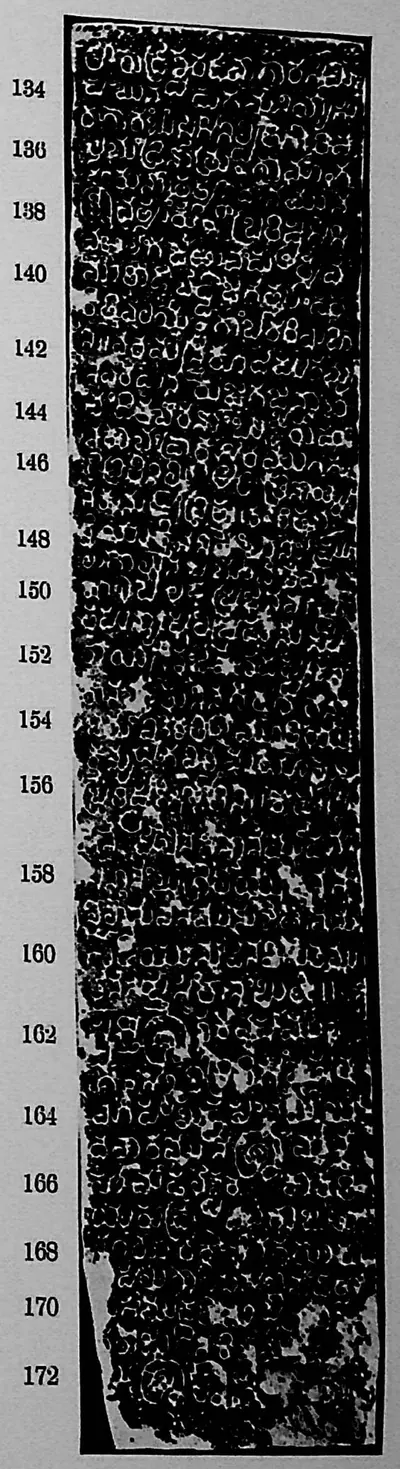 "Karimnagar inscription of Gaṅgādhara", face IV (Sreenivasachar, Corpus of Inscriptions in the Telingana Districts II, Plate 54 (PDF p. 328))Inscription rubbing · 1940
References
Notes (0)
Sources (4)
Spotted an error on this page? Tell us
Last updated: