Ahobilam inscription of Sriranga I (1584)
A Telugu inscription on a slab at the Narasimha temple in Lower Ahobilam, Kurnool district. It is dated Saka 1506 (1584), in the reign of Sriranga I, 'ruling at Penugonda'. V. Rangacharya summarised it in 1919. It grants rights in the temple to the chief Venkataraja, because his grandfather had driven out 'Vibhuramu', the Golconda king Ibrahim. Ibrahim had occupied the temple for seven years, in alliance with the Hande chiefs. A companion slab of 1585, of Venkatapati, records the same chief's gift to the temple.
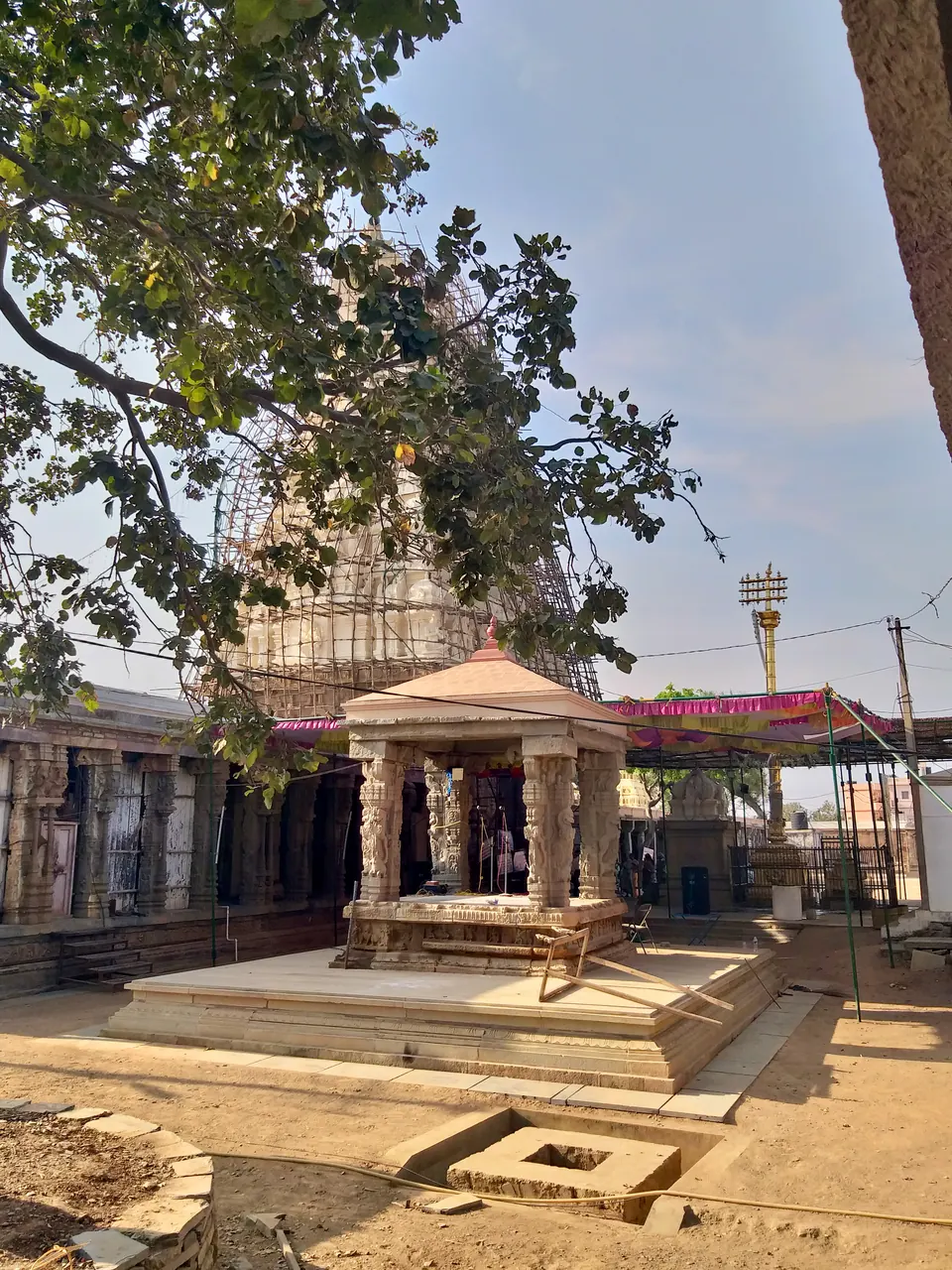
The record
The Government Epigraphist copied the temple inscriptions of Lower Ahobilam in 1915.12 V. Rangacharya summarised No. 70 of 1915, which is “on the south slab set in the same place”.12 It is dated in the reign of the Vijayanagara king “Virapratapa Vira-Rangarayadeva-Maharaya (1578–87) ‘ruling at Penugonda,’”.12 The date is “S. 1506, Tarana, Vaisakha, su. di. 14”.12 Saka 1506 (Saka is an Indian way of counting years) is 1584.12
The record says that “Venkatrajadeva Choda-maharaja, son of Timmana of the solar race and the Kasyapagotra, came to receive certain privileges in the temple.”12 It gives the reason.12 His grandfather, Kondaraja-Venkatraja-Timmaraja, had acted “under orders of the king and at the request of Van Sathagopa-Jiyyangaru”.12
The grandfather “had expelled the Muhammadan chief Vibhuramu (Ibrahim II of Golconda)”.12 Vibhuramu “had occupied the temple of Ahobalam for seven years in alliance with the Handevaru (chiefs)”.12 In Rangacharya’s words, “It was for thus restoring the temple to its original state that the family was granted the privileges mentioned above.”12 See Ahobilam and Vijayanagara.
Rangacharya added a note on the chief.12 The chief’s titles had led the Government Epigraphist to guess that he belonged to the Matla family.12 Rangacharya also wrote that “the Hande chiefs of Anantapur were ardent Saivites”.12 So they “co-operated with Ibrahim Qutb Shah in the spoiling of Ahobalam, and Venkatraja defeated the vandals and restored the prosperity of the place”.12 He noted that the Van Sathagopa of the record was the seventh of the Ahobilam svamis (heads of the religious house).12
The next slab, No. 71 of 1915, is a record of “Vira-Venkata-patirayadeva-Maharaya … ‘ruling at Penukonda’”.2 It is dated Saka 1507 (1585).2 By it the same chief gave the temple the 80 varahas (gold coins) due to him every year from the temple villages.2 This was his fee for protection (kavali).2 See Venkatapati II and Penukonda.
The Kurnool manual’s account
The Kurnool manual of 1886 tells the story from local records.3 It gives different dates and a different villain.3 In its account, Muhammad Quli Qutb Shah of Golconda crossed the Krishna about 1590 and left garrisons in the district.3 After that, “Hande Devappa of Anantapur, a grandson of Hande Hanumanna, … attacked the famous temple of Ahobilam and plundered it of the jewels belonging to the idol.”3
The manual goes on: “Sathagopa Jeyyangar, who was in charge of the temple, sent a deputation to Venkatapati Raja, then ruling at Penukonda”.3 He “complained of the sacrilege committed by the Hande people and Muhammadans.”3 Then “Venkatapati sent a detachment of troops under the command of Venkata Raju, who restored the temple to the Jeyyangar”.3
Rangacharya’s summary of the inscription differs from the manual on these points.12 It names Ibrahim, not Muhammad Quli, as the occupier.12 It gives the credit to Venkataraja’s grandfather.12 It is dated 1584, in the reign of Sriranga I.12
Other records at Ahobilam from the same century include grants of the reigns of Achyuta Raya (1531 and 1536) and Sadasiva (1547 to 1563).42
Footnotes
-
Rangacharya, Topographical List, Vol. II (1919), p. 972, Kurnool No. 584 (archive.org (opens in a new tab)). ↩ ↩2 ↩3 ↩4 ↩5 ↩6 ↩7 ↩8 ↩9 ↩10 ↩11 ↩12 ↩13 ↩14 ↩15 ↩16 ↩17 ↩18 ↩19 ↩20
-
Rangacharya, Topographical List, Vol. II (1919), p. 973, Kurnool Nos. 584–589 (archive.org (opens in a new tab)). ↩ ↩2 ↩3 ↩4 ↩5 ↩6 ↩7 ↩8 ↩9 ↩10 ↩11 ↩12 ↩13 ↩14 ↩15 ↩16 ↩17 ↩18 ↩19 ↩20 ↩21 ↩22 ↩23 ↩24 ↩25
-
Narahari Gopalakristnamah Chetty, A Manual of the Kurnool District in the Presidency of Madras (1886), p. 28 (archive.org (opens in a new tab)). ↩ ↩2 ↩3 ↩4 ↩5 ↩6 ↩7
-
V. Rangacharya, A Topographical List of the Inscriptions of the Madras Presidency, Vol. II (1919), p. 969, Kurnool Nos. 569–572 (archive.org (opens in a new tab)). ↩
Photos
References
Notes (0)
Sources (2)
Spotted an error on this page? Tell us
Last updated: