Jami Masjid, Hyderabad
Congregational (Friday) mosque of Muhammad Quli Qutb Shah, a short way north-east of the Charminar, built under the minister Aminu-l-Mulk. The chronogram over its door gives AH 1006 (1597). The Imperial Gazetteer dates it to 1596, and Campbell and Rocco to 1598. It is a double hall of seven arches on a paved courtyard. It once had a school, a monastery and a Turkish bath attached, and by 1898 houses and shops crowded round it.
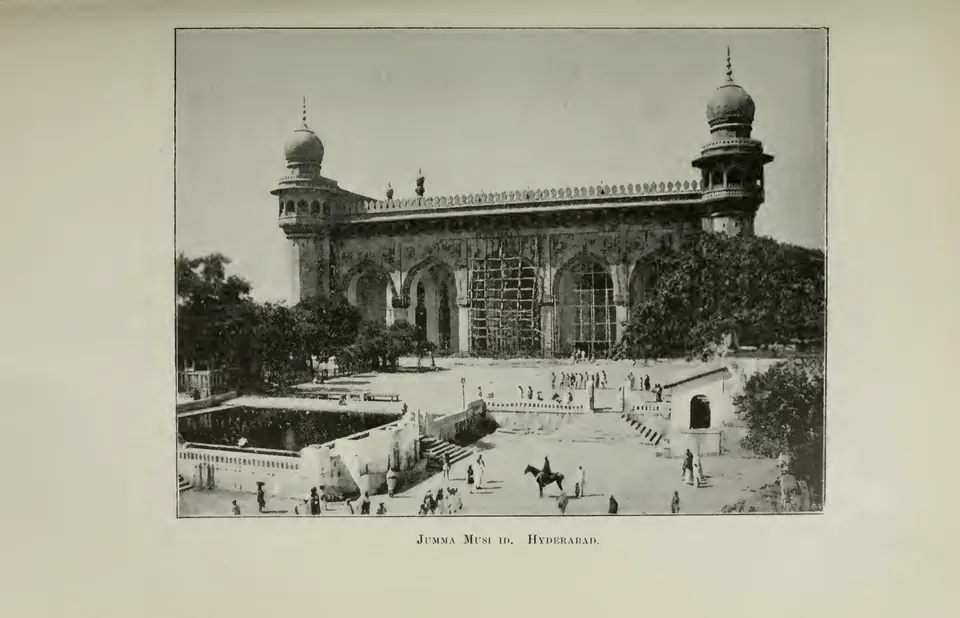
The Jami Masjid (“congregational mosque”) of Hyderabad stands close to the Charminar.12 A narrow lane leads to it from the main road.12 The Golconda chronicle translated by John Briggs names it among the first works of Muhammad Quli Qutb Shah in his new city.3 It calls it an “elegant musjid” (mosque), built together with the Charminar.3
G. Yazdani surveyed the Qutb Shahi buildings of the city in 1918–19.4 He wrote that Firishta refers to the mosque together with the Charminar.4 He added: “According to an inscription fixed over the doorway of the mosque it was built by Muhammad Quli Qutb Shah”.4
Date
The verse inscription over the door gives the year by a chronogram, in which the number values of letters add up to the year.5678 Yazdani and Syed Ali Asgar Bilgrami both read it as AH 1006 (AH is the Islamic way of counting years), that is 1597.5678 The inscription in the prayer niche gives the same year.5678
The Imperial Gazetteer of 1909 dates the mosque to 1596.9 A. Claude Campbell (1898) and Sha Rocco (1929) date it to 1598.110 The text of the inscriptions, and the differences between their editors, are given on the page of the Jami Masjid inscription.
In his edition of the inscriptions, Yazdani says that the door inscription leaves out the name of the king.5 It names the minister who supervised the work, Malik Aminu-l-Mulk.56 Yazdani says he held the office of Mir Jumla (chief minister) before Mir Muhammad Amin of Astarabad.5 In the middle of Muhammad Quli’s reign he “distinguished himself in quelling the rebellions of petty Hindu Rajas”.5
Bilgrami calls him “his Vazier and Mir Jumla, Malik Aminul Mulk, Alaf Khan Bahadur whose Amin Bagh is still famous”.8 He says Aminu-l-Mulk is buried at Patancheru.8
The building
Yazdani described the plan:511
- a double hall, 72 ft 6 in by 32 ft 6 in, opening by seven arches onto a paved courtyard511
- the courtyard, 74 by 70 feet, with a cistern at its north-eastern end511
- two lofty minarets at the north-east and south-east corners of the hall511
- a colonnade of nine openings in the pillar-and-lintel style, along the north side of the court511
He found the interior “still imposing”.411 But he regretted that “a thick growth of houses and shops envelopes the exterior”.411 These spoiled the mosque’s original setting beside the Charminar square, the Char Kaman and the royal palaces.411
Campbell was less impressed.1 He wrote that the mosque, “which is of moderate size, has no pretension to architectural merit”.1 He called it “the oldest musjid in Hyderabad”.1 He noted in its courtyard “the ruins of an old Turkish bath”, which the gazetteer also mentions.19
Bilgrami calls it “one of the earliest of the Deccan mosques next to the famous Bahmani mosque of Gulburga”.8 He says it was built “at a cost of Rs. 2 Lacs”.8 “A school, a monastry and a bath” were attached to it, and all of them were ruined by his day.812
Under Asaf Jah III the mosque was extensively repaired.12 Mir Abbas Ali Khan, who died in AH 1230, fixed wooden railings in it.12 Later the scholar Hafiz Mir Shujauddin taught Arabic in it.12 Bilgrami credits him with spreading the custom of learning the Quran by heart in the city.12
The calligraphy
Yazdani called the door inscription, written by Baba Khan, “the finest example of the Nasta’liq script in the Deccan”.136 He noted that the prayer-niche inscription of the same year was copied, seventy-one years later, in the great mosque at the Qutb Shahi Tombs.136 Bilgrami published photographic rubbings of both.27
Where the sources disagree
Yazdani describes the door inscription in two ways.45 In the Archaeological Department’s report for 1918–19, he wrote that according to it the mosque “was built by Muhammad Quli Qutb Shah”.4 In his edition of the inscription in Epigraphia Indo-Moslemica, he says that “the name of the king is omitted in the inscription”.5 There it names only the minister, Malik Aminu-l-Mulk.56
Footnotes
-
A. Claude Campbell, Glimpses of the Nizam’s Dominions (1898), p. 168 (archive.org (opens in a new tab)). ↩ ↩2 ↩3 ↩4 ↩5 ↩6 ↩7
-
Syed Ali Asgar Bilgrami, Landmarks of the Deccan (1927), p. 26 and plate (archive.org (opens in a new tab)). ↩ ↩2 ↩3
-
Golconda chronicle, in Muhammad Qasim Ferishta, tr. John Briggs, History of the Rise of the Mahomedan Power in India, Vol. III (1829), p. 452 (archive.org (opens in a new tab)). ↩ ↩2
-
Annual Report of the Archaeological Department of H.E.H. the Nizam’s Dominions, 1328 F. (1918–19) (1920), p. 4 (archive.org (opens in a new tab)). ↩ ↩2 ↩3 ↩4 ↩5 ↩6 ↩7 ↩8
-
Yazdani, Epigraphia Indo-Moslemica 1917–18 (1921), p. 44 and notes (archive.org (opens in a new tab)). ↩ ↩2 ↩3 ↩4 ↩5 ↩6 ↩7 ↩8 ↩9 ↩10 ↩11 ↩12 ↩13 ↩14 ↩15
-
Yazdani, Epigraphia Indo-Moslemica 1917–18 (1921), p. 45 (archive.org (opens in a new tab)). ↩ ↩2 ↩3 ↩4 ↩5 ↩6 ↩7
-
Bilgrami, Landmarks of the Deccan (1927), p. 27 and plate (archive.org (opens in a new tab)). ↩ ↩2 ↩3 ↩4
-
Bilgrami, Landmarks of the Deccan (1927), p. 28 and notes (archive.org (opens in a new tab)). ↩ ↩2 ↩3 ↩4 ↩5 ↩6 ↩7 ↩8
-
Imperial Gazetteer of India: Hyderabad State (1909), p. 116 (archive.org (opens in a new tab)). ↩ ↩2
-
Sha Rocco, Golconda and the Qutb Shahs (1929), p. 14 (archive.org (opens in a new tab)). ↩
-
Annual Report of the Archaeological Department, 1918–19 (1920), p. 5 (archive.org (opens in a new tab)). ↩ ↩2 ↩3 ↩4 ↩5 ↩6 ↩7 ↩8
-
Bilgrami, Landmarks of the Deccan (1927), p. 29 (archive.org (opens in a new tab)). ↩ ↩2 ↩3 ↩4 ↩5
-
G. Yazdani, “Inscriptions of the Qutb Shahi Kings in Hyderabad City and Suburbs”, Epigraphia Indo-Moslemica 1917–18 (1921), p. 43 (archive.org (opens in a new tab)). ↩ ↩2
Photos
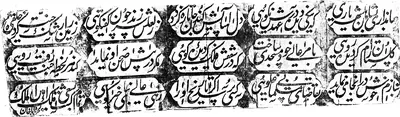 "Inscription over the doorway of the Jami' Masjid, Hyderabad City" (Epigraphia Indo-Moslemica 1917-18, Pl. XVII (a) (PDF p. 75))Inscription rubbing · 1921
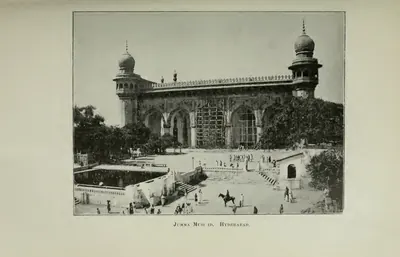 "Jumma Musjid, Hyderabad" (Gribble 1896, PDF p. 237)Historic photograph · 1896
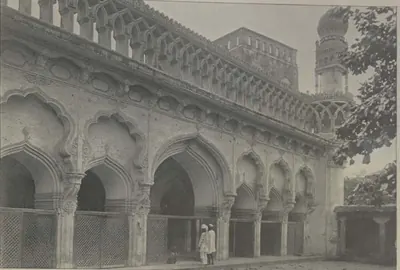 Hyderabad: "The Juma Musjid, Hyderabad" (Campbell 1898, p. 169)Historic photograph · 1898
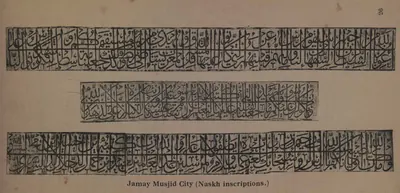 Naskh inscription, Jamay Masjid, City (Hyderabad) (Bilgrami 1927, p. 26)Inscription rubbing · 1927
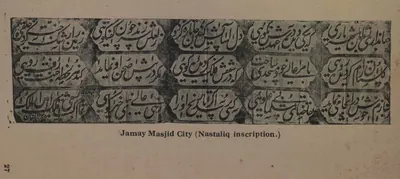 Nastaliq inscription, Jamay Masjid, City (Hyderabad) (Bilgrami 1927, p. 27)Inscription rubbing · 1927
References
Notes (0)
Sources (7)
Spotted an error on this page? Tell us
Last updated: