Khanapur plates of Madhavavarman
An incomplete Sanskrit copper-plate grant of a Maharaja Madhavavarman, found in 1927 at Khanapur in Satara district, Maharashtra. It gives a village on the Krishna near Karad to two Brahmins. Its first plate, which would have named the dynasty, is lost. V. V. Mirashi and Y. R. Gupte, who edited it in 1956, gave it to the Vishnukundin Madhavavarman I because of the sacrifices and the imperial title it claims. They took it as proof of a Vishnukundin empire reaching into Maharashtra.
The Khanapur plates are the only grant attributed to the Vishnukundins that was found outside the Telugu country.12 Because their first plate is lost, the attribution rests entirely on the argument of their editors.12
Discovery and edition
The plates were found in 1927 in the possession of Dadasaheb Mane at Khanapur, the chief town of the Khanapur taluka of Satara district. Y. R. Gupte noticed them briefly that year in a Marathi quarterly and again in 1928.1 By the time V. V. Mirashi and Gupte edited them in Epigraphia Indica XXVII (published 1956), the plates could no longer be traced.31 They worked from Gupte’s photographs and impressions, made twenty-two years earlier.31
Description
The grant seems to have had three plates on a ring.1 But the first plate, the ring and any seal had long been lost.1 The second plate, written on both sides, is broken at top and bottom.1 It was too brittle to yield an ink impression, so it was photographed.1 The third, written on the inner side only, was well preserved.1 The plates appear to have been about 10.9 by 5.5 inches.1
The editors judged the letters to be of the southern alphabet, boldly but carelessly cut.1 They thought the writer might have come from the Andhra country, where similar letters are found, and compared them with the Chikkulla plates.1 The language is Sanskrit, in prose except for the closing verses, and full of mistakes.1
Content
The surviving text refers to the reign of the Maharaja Madhavavarman.12 He performed the Pundarika, Bahusuvarna and eleven other sacrifices whose names are not given.12 It says he took the title of sarvabhauma (emperor).12
He granted the village of Retturaka, with three fording-places on the river and three hamlets, south-east of the river Krishnavega (the Krishna).12 The donees were two Brahmins, Bolasvamin of the Salankayana gotra (clan) and Keshavasvamin of the Bharadvaja gotra.2 The occasion was the full moon of Vaishakha, and no year of any era or reign is given.2 The charter was written by Sripala, described as a devout kayastha.2
Why Madhavavarman I?
Mirashi and Gupte dated the letters to the 6th century.2 They argued that the only king of that period who fitted the description was the Vishnukundin Madhavavarman I.2 His own grants and his descendants’ credit him with a thousand agnishtomas, eleven horse sacrifices and other rites, including the Bahusuvarna and Pundarika.2 They thought the “eleven” unnamed sacrifices of the Khanapur plates were probably horse sacrifices.4 So they concluded that the two kings must be the same.4
On that basis they argued that Maharashtra had been part of Madhavavarman I’s empire.45 His grandson Madhavavarman II, in the second Ipur plates, claimed to be lord of the Trikuta and Malaya mountains.45 E. Hultzsch had treated this as an empty boast, but to them it now seemed to rest on fact.45 They thought the western part of the empire passed to Madhavavarman II and was soon lost to the Rashtrakutas of Kuntala.6 Their reason was that no other Vishnukundin record has been found in Maharashtra.6
Places
The editors identified Retturaka with Retare Budrukh in Karad taluka, on the south-east bank of the Krishna.6 They placed several boundary villages and hamlets close by:6
- Machhadarya (Rajmachi)6
- Kolika (Koli)6
- Belavatika (Belvade)6
- Kolikavatika (Kolavade)6
- Vattarika (Vathar)6
- Mallakhetaka (Malkhet)6
Notes on the text
Mirashi and Gupte called the grant the earliest mention in an inscription of Sanatanadharma, the “eternal religion”.2 They also thought it perhaps the earliest mention of the Kayastha caste.2 An editorial note doubted that kayastha here meant the caste.2 Citing D. C. Sircar, it pointed to earlier Gupta-period records in which the word seems to mean a writer or official.2
Edition
- V. V. Mirashi and Y. R. Gupte, “Khanapur Plates of Madhavavarman”, Epigraphia Indica XXVII (1947–48, published 1956), No. 49, pp. 312–318.3
Footnotes
-
Mirashi and Gupte, “Khanapur Plates” (1956), p. 313 (archive.org (opens in a new tab)). ↩ ↩2 ↩3 ↩4 ↩5 ↩6 ↩7 ↩8 ↩9 ↩10 ↩11 ↩12 ↩13 ↩14 ↩15 ↩16 ↩17 ↩18
-
Mirashi and Gupte, “Khanapur Plates” (1956), p. 314 and notes (archive.org (opens in a new tab)). ↩ ↩2 ↩3 ↩4 ↩5 ↩6 ↩7 ↩8 ↩9 ↩10 ↩11 ↩12 ↩13 ↩14 ↩15 ↩16
-
V. V. Mirashi and Y. R. Gupte, “Khanapur Plates of Madhavavarman”, Epigraphia Indica XXVII (1956), p. 312 (archive.org (opens in a new tab)). ↩ ↩2 ↩3
-
Mirashi and Gupte, “Khanapur Plates” (1956), p. 315 (archive.org (opens in a new tab)). ↩ ↩2 ↩3 ↩4 ↩5
-
E. Hultzsch, “Ipur Plates of Madhavavarman II”, Epigraphia Indica XVII (1924), p. 338 (archive.org (opens in a new tab)). ↩ ↩2 ↩3
-
Mirashi and Gupte, “Khanapur Plates” (1956), p. 316 (archive.org (opens in a new tab)). ↩ ↩2 ↩3 ↩4 ↩5 ↩6 ↩7 ↩8 ↩9 ↩10
Photos
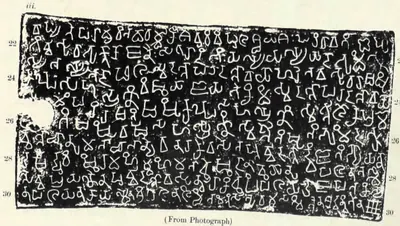 "Khanapur Plates of Madhavavarman": plate iii, lines 22-30 (Epigraphia Indica XXVII, plate between pp. 316 and 317 (PDF p. 421, printed sideways))Book plate · 1956
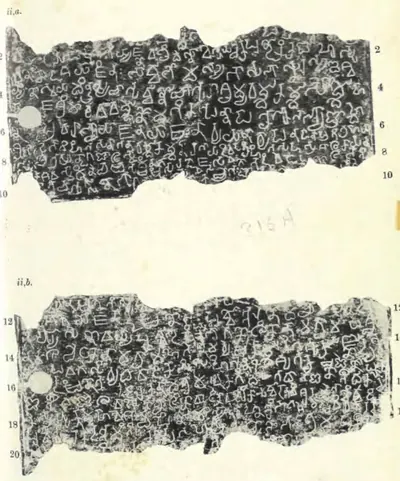 "Khanapur Plates of Madhavavarman": plates ii a and ii b, lines 1-20 (Epigraphia Indica XXVII, plate between pp. 316 and 317 (PDF p. 420))Book plate · 1956
References
Notes (0)
Sources (2)
Spotted an error on this page? Tell us
Last updated: