Vishnukundins
Dynasty of the Krishna–Godavari country that ruled after the Salankayanas and before the Eastern Chalukyas. It is known from a handful of Sanskrit copper-plate grants and one stone inscription. Its kings worshipped the lord of Sriparvata, claimed eleven horse sacrifices for their greatest ruler, Madhavavarman, and married into the Vakataka royal family. Their capital in the later grants was Lendulura (Denduluru near Vengi). Scholars have dated them anywhere from the 4th to the 8th century. Most later reconstructions put the main line in the 6th century and end it with the Chalukya conquest of the early 7th, though D. C. Sircar continued it to about 670.
Swipe sideways to see the whole chart; tap a bar for details.
Each bar is a ruling power in its region; time runs left to right. Dashed = approximate dates. Select a bar for details.
Show as a list
Ikshvakus, Vishnukundins & early kingdoms 225–624 CE
- Telangana
- Vakatakas (c. 300–500 CE) · Vishnukundins (c. 375–612 CE)
- Coastal Andhra
- Pallavas (c. 250–630 CE) · Salankayanas of Vengi (c. 300–470 CE) · Vishnukundins (c. 500–630 CE) · Eastern Gangas of Kalinga (c. 537–1434 CE) · Eastern Chalukyas of Vengi (c. 615–973 CE) · Chalukyas of Badami (c. 615–642 CE)
- Rayalaseema
- Pallavas (c. 300–900 CE) · Telugu Cholas of Renadu (c. 550–800 CE)
Eastern Chalukyas & the Deccan powers 624–1163 CE
- Telangana
- Chalukyas of Badami (c. 655–753 CE)
- Coastal Andhra
- Pallavas (c. 250–630 CE) · Chalukyas of Badami (c. 655–680 CE) · Vishnukundins (c. 500–630 CE) · Eastern Gangas of Kalinga (c. 537–1434 CE) · Eastern Chalukyas of Vengi (c. 615–973 CE)
- Rayalaseema
- Pallavas (c. 300–900 CE) · Telugu Cholas of Renadu (c. 550–800 CE) · Chalukyas of Badami (c. 654–753 CE) · Banas (c. 700–915 CE)
Kingdoms and empires
Vakatakas
Open page- Telangana: c. 300–500 CE (c. 200 years)
Partial: the Adilabad, Nizamabad and Karimnagar country north of the Godavari, as part of the Vakataka lands of central India and the northern Deccan. Goel et al. (2022) place the Vakataka lands from the findspots of their 37 inscriptions and name only these three Telangana districts. Jouveau-Dubreuil (1920) claimed much more: almost the whole of the Hyderabad State, and up to Kurnool. A Vakataka princess married the Vishnukundin Madhavavarman (Chikkulla plates). No Vakataka inscription from Telangana is listed in Epigraphia Telanganica I; this span rests on modern histories. Dates follow the Sewell table (Vindhyasakti c. 275-300 to Harishena c. 465-500).
Rulers (8)
- Vindhyasakti (c. 275–300 CE)
- Pravarasena I (c. 300–330 CE)
- Rudrasena I (c. 330–340 CE)
- Prithvisena I (c. 340–390 CE)
- Rudrasena II (c. 390–395 CE)
- Pravarasena II (c. 395–420 CE)
… and 2 more
- Devasena (c. 445–465 CE)
- Harishena (c. 465–500 CE)
Sources (5)
Kingdoms and empires
Chalukyas of Badami
Open page- Coastal Andhra: c. 615–642 CE (c. 27 years)
Pulakesin II took Pishtapura (Pithapuram) and the Kolleru lake country (Aihole inscription) about 615 and left his brother Vishnuvardhana to govern Vengi, which was an independent kingdom by 632 (Fleet); his Kopparam plates grant land in Karmarashtra (Guntur) in 631, and Hultzsch read them as showing Vishnuvardhana still his subordinate then. The Vizagapatam gazetteer adds that the Badami Chalukyas had already conquered Kalinga in the 6th century.
- Rayalaseema: c. 654–753 CE (c. 99 years)
Copper-plate grants of Vikramaditya I in Kurnool (654-55, 657-58, 663); his grant names the Nalavadi district (near Madakasira, Anantapur); grants of 680 in Anantapur and Bellary; grants of Vinayaditya in the Kurnool district (Nandyal, 689-90); the Telugu Cholas of Renadu were their vassals. Fleet guessed that Kirtivarman I's enemies the Nalas lived towards Bellary and Kurnool.
- Telangana: c. 655–753 CE (c. 98 years)
Partial: the Alampur-Gadwal country. Amudalapadu plates of Vikramaditya I (Alampur taluk, 660), Gadval plates (674), Pallepadu plates of Vinayaditya (682, issued at Pangal), and inscriptions in the Alampur temples of a queen of Vikramaditya I, of Vinayaditya's reign and of Vijayaditya (704, 713). IG Hyderabad: displaced by the Rashtrakutas (Dantidurga, 753).
- Coastal Andhra: c. 655–680 CE (c. 25 years)
Partial: Nellore. Talamanchi plates of Vikramaditya I (found near Nellore, 13 July 660), a grant to his preceptor Meghacharya.
Rulers (9)
- Pulakesin I (c. 550–566 CE)
- Kirtivarman I (c. 566–597 CE)
- Mangalesa (c. 597–609 CE)
- Pulakesin II (c. 609–642 CE)
- Vikramaditya I (Chalukya of Badami) (c. 655–680 CE)
- Vinayaditya (c. 680–696 CE)
… and 3 more
- Vijayaditya (c. 696–733 CE)
- Vikramaditya II (c. 733–746 CE)
- Kirtivarman II (c. 746–757 CE)
Capitals
Monuments
Inscriptions
Sources (12)
Kingdoms and empires
Vishnukundins
Open page- Telangana: c. 375–612 CE (c. 237 years)
Partial: the early kingdom north of Srisailam (Nalgonda and Mahabubnagar), with its capital at Keesaragutta near Hyderabad or at Indrapura (Indrapala Gutta near Tummalagudem, Nalgonda); the capital later moved to Trivaranagara (Tiruvuru). The Tummalagudem plates of Govindavarman (37th year) and Vikramendravarman II (Saka 488, 566-67) were found in Nalgonda. The early dates (Indravarman c. 375-400) and the end in 612 follow Goel et al.
- Coastal Andhra: c. 500–630 CE (c. 130 years)
Krishna-Godavari country; later capital Lendulura (Denduluru near Vengi); grants from the Godavari delta, Tenali taluk and the Vizianagaram region, and a pillar at Velpuru south of the Krishna. Dates disputed: K. V. Lakshman Rao (in Sewell 1932) about 357-610; Panchamukhi (1936) about 500 to the Chalukya conquest of 621-631; Mirashi puts Madhavavarman I about 510-568; Sircar (1939) about 500-670 and an end later still
Rulers (7)
- Vikramahendra (c. 500–520 CE)
- Govindavarman (c. 520–535 CE)
- Madhavavarman (Vishnukundin) (c. 535–585 CE)
- Madhavavarman II (Vishnukundin) (c. 585–615 CE)
- Vikramendravarman I (c. 615–625 CE)
- Indravarman (Vishnukundin) (c. 625–655 CE)
Capitals
Inscriptions (7)
- Chikkulla plates of Vikramendravarman II
- Ipur plates (set I) of Govindavarman's son Madhavavarman
- Ipur plates (set II) of Madhavavarman II
- Khanapur plates of Madhavavarman
- Polamuru plates of Madhavavarman Janashraya
- Ramatirtham plates of Indravarman
… and 1 more
Sources (8)
Kingdoms and empires
Pallavas
Open page- Coastal Andhra: c. 250–630 CE (c. 380 years)
Krishna-Guntur, Ongole and Nellore. Prakrit grant of the crown prince Sivaskandavarman to his officer at Dhanyakataka (Amaravati), dated from about 234 (Sewell) or 250-275 (Jouveau-Dubreuil) to the first half of the 4th century (Sircar); Sanskrit grants of a Nellore-Guntur line (Omgodu, Uruvupalli, Pikira, Mangalur, Vilavatti, Chura) in the 5th and 6th centuries. Karmarashtra (Ongole-Bapatla) was Chalukya by about 630 (Kopparam plates of Pulakesin II). The Godavari gazetteer calls 200-615 a Pallava age, and IG Madras calls Vengi originally a Pallava province; Sircar found no evidence that the Pallavas held Vengi itself.
- Rayalaseema: c. 300–900 CE (c. 600 years)
Partial. Pallava frontier guards at Sriparvata (Kurnool) in the 4th century (Talagunda inscription; Sircar); Ganga kings of the Penukonda plates installed by Pallava kings (5th century); inscription of Paramesvaravarman II at Ulchala near Kurnool (728-29); Bana vassals in the Chittoor country under Nripatunga (9th century). The Cuddapah gazetteer has the Pallavas hold the eastern Cuddapah taluks for four centuries until the Chola Aditya I crippled them at the end of the 9th century. The Cuddapah gazetteer says the Pallavas of Kanchi pushed up the Penner from Nellore into north Cuddapah for a time and then ruled the eastern Cuddapah taluks for four centuries, until the Chola Aditya I crippled them at the end of the 9th century; Sewell gives a Pallava regnal-year record in Chittoor (864-65), with the Banas as Pallava vassals.
- Coastal Andhra: c. 670–750 CE (c. 80 years)
Southern Nellore only: grants of Paramesvaravarman I (Podili-Kandukur country, 687) and Narasimhavarman II (Revuru, Atmakur taluk, about 700-711), and a Tamil record of the 15th year of Nandipottarasar at Mallam (Gudur taluk), read as Pallava supremacy (Nellore gazetteer, 1942) or as Pallava rule under the Western Chalukyas (Butterworth and Venugopaul Chetty, 1905).
Rulers (18)
- Bappa (c. 225–250 CE)
- Sivaskandavarman (Pallava) (c. 250–275 CE)
- Vishnugopa of Kanchi (c. 325–350 CE)
- Kumaravishnu II (Pallava) (c. 425–450 CE)
- Skandavarman II (Pallava) (c. 450–475 CE)
- Simhavarman II (Pallava) (c. 500–525 CE)
… and 12 more
- Vishnugopavarman (c. 525–550 CE)
- Simhavishnu (c. 575–600 CE)
- Mahendravarman I (c. 600–630 CE)
- Narasimhavarman I (c. 630–668 CE)
- Mahendravarman II (c. 668–670 CE)
- Paramesvaravarman I (c. 670–690 CE)
- Narasimhavarman II (c. 690–715 CE)
- Nandivarman II Pallavamalla (c. 717–779 CE)
- Dantivarman (c. 779–830 CE)
- Nandivarman III (c. 830–854 CE)
- Nripatunga (c. 854–880 CE)
- Aparajita (c. 880–900 CE)
Capitals
Inscriptions (14)
Sources (19)
Kingdoms and empires
Salankayanas of Vengi
Open page- Coastal Andhra: c. 300–470 CE (c. 170 years)
Vengi (Pedavegi near Eluru), between the Krishna and the Godavari. Dates debated: D. C. Sircar (1939) about 320-470, from Devavarman to Skandavarman; B. V. Krishna Rao puts Nandivarman I at the close of the 3rd century, Sircar (1960) the Ellore and Kanukollu grants in the mid-4th; Subramanian about 275-450; Subba Rao has the Vishnukundins take Vengi about 450. Older works call these rulers Pallavas
Rulers
Capitals
Inscriptions
Sources (5)
Kingdoms and empires
Eastern Gangas of Kalinga
Open page- Coastal Andhra: c. 537–1434 CE (c. 897 years)
Partial: only the far north coast (the old Ganjam and Vizagapatam districts, now Srikakulam-Vizianagaram- Visakhapatnam), capital Kalinganagara (Mukhalingam). Earliest dated grant: Jirjingi, near Tekkali, Ganga year 39 (c. 537 on Mirashi's epoch of 498; Fleet put the early grants in the 7th century and Sewell used an epoch of 877-78; the Imperial Gazetteer, the 7th century). Later line in power from the end of the 9th century (Vizagapatam gazetteer): Vajrahasta III crowned 1038; Anantavarman Chodaganga 1078-1146, with records at Mukhalingam, Srikurmam, Simhachalam and Visakhapatnam. South of the Godavari only records and raids (Draksharama 1128-1274; Bendapudi). Ended 1434, when the minister Kapilesvara founded the Gajapati line
Rulers (15)
- Vajrahasta III (Eastern Ganga) (1038–1070 CE)
- Rajaraja I (Eastern Ganga) (1070–1078 CE)
- Anantavarman Chodaganga (c. 1078–1146 CE)
- Madhu-Kamarnava (c. 1146–1152 CE)
- Raghava (c. 1152–1166 CE)
- Rajaraja II (c. 1166–1192 CE)
… and 9 more
- Aniyanka-Bhima (c. 1192–1202 CE)
- Anangabhima III (c. 1219–1253 CE)
- Narasimha I (Eastern Ganga) (c. 1253–1256 CE)
- Bhanudeva I (c. 1256–1275 CE)
- Narasimha II (c. 1275–1306 CE)
- Bhanudeva II (c. 1306–1323 CE)
- Narasimha III (c. 1323–1346 CE)
- Bhanudeva III (c. 1346–1378 CE)
- Narasimha IV (c. 1378–1397 CE)
Capitals
Monuments
Inscriptions (8)
Sources (10)
Kingdoms and empires
Eastern Chalukyas of Vengi
Open page- Coastal Andhra: c. 615–973 CE (c. 358 years)
Vengi, between the Godavari and the Krishna, with the Vizagapatam country to the north (Chipurupalle grant of 632) and Karmarashtra, the Ongole-Guntur country, to the south (grants of 664 and 673). Kubja Vishnuvardhana was installed as yuvaraja in 615 (Fleet) and was independent by 632; others date the start about 605 (Hultzsch 1890, Mackenzie), after 631 (Kopparam plates, Hultzsch 1926) or in 624-25 (Rama Rao 1964). The line of kings from the grants ends with Danarnava (970-973).
- Telangana: c. 935–973 CE (c. 38 years)
Partial: the Chalukya chiefs of Mudigonda and Koravi (Khammam and Warangal) owed allegiance to Vengi rather than to the Rashtrakutas, in Parabrahma Sastry's account; ended after the death of Danarnava in 973.
- Coastal Andhra: c. 999–1077 CE (c. 78 years)
After an interval that the grants call twenty-seven years without a ruler, Saktivarman I was restored about 999 with the help of the Chola Rajaraja I, "as king (or perhaps feudatory)" in the Godavari gazetteer's words. His successors married Chola princesses; Rajendra II, heir to Vengi in 1063, became the Chola emperor Kulottunga I in 1070. His uncle Vijayaditya VII governed Vengi until he died in 1077 (1076 in Sewell's table), after which Vengi was ruled for the Cholas by viceroys.
Rulers (29)
- Kubja Vishnuvardhana (c. 615–633 CE)
- Jayasimha I (c. 633–663 CE)
- Indra-Bhattaraka (c. 663 CE)
- Vishnuvardhana II (Eastern Chalukya) (c. 663–672 CE)
- Mangi-yuvaraja (c. 672–696 CE)
- Jayasimha II (Eastern Chalukya) (c. 696–709 CE)
… and 23 more
- Kokkili (c. 709 CE)
- Vishnuvardhana III (Eastern Chalukya) (c. 709–746 CE)
- Vijayaditya I (c. 746–764 CE)
- Vishnuvardhana IV (Eastern Chalukya) (c. 764–799 CE)
- Vijayaditya II Narendra-mrigaraja (c. 799–843 CE)
- Kali-Vishnuvardhana V (c. 843–844 CE)
- Gunaga Vijayaditya III (c. 844–888 CE)
- Chalukya-Bhima I (c. 888–918 CE)
- Vijayaditya IV (Kollabhiganda) (c. 918 CE)
- Amma I (c. 918–925 CE)
- Beta-Vijayaditya V (c. 925 CE)
- Tadapa (c. 925 CE)
- Vikramaditya II (c. 926 CE)
- Bhima III (c. 926–927 CE)
- Yuddhamalla II (c. 927–934 CE)
- Chalukya-Bhima II (c. 934–945 CE)
- Amma II (945–970 CE)
- Danarnava (970–973 CE)
- Saktivarman I (c. 999–1011 CE)
- Vimaladitya (1011–1022 CE)
- Rajaraja Narendra (1022–1063 CE)
- Kulottunga I (c. 1063–1070 CE)
- Vijayaditya VII (c. 1063–1076 CE)
Capitals
Monuments
Inscriptions (36)
- Satara grant of Vishnuvardhana I
- Timmapuram plates of Vishnuvardhana I
- Chipurupalle plates of Vishnuvardhana I
- Pedda-Vegi plates of Jayasimha I
- Niduparu grant of Jayasimha I
- Pulibumra plates of Jayasimha I
… and 30 more
- Gudivada plates of Jayasimha I (three grants)
- Chendalur plates of Sarvalokasraya (Mangi-yuvaraja)
- Penukaparu grant of Jayasimha II
- Ipur plates of Vishnuvardhana III
- Ederu plates of Vijayaditya II
- Addanki inscription of Pandaranga
- Masulipatam (?) plates of Vijayaditya III
- Bezwada plates of Chalukya-Bhima I
- Bezwada pillar inscription of Yuddhamalla
- Chevuru plates of Amma I
- Ederu plates of Amma I
- Diggubarru grant of Chalukya-Bhima II
- Gundugolanu plates of Amma II
- Kaluchumbarru grant of Amma II
- Maliyapundi grant of Amma II
- Masulipatam plates of Amma II
- Padamkaluru grant of Amma II
- Vandram plates of Amma II
- Vemalurpadu plates of Amma II
- Yelavarru plates of Amma II
- Arumbaka plates of Badapa
- Mangallu grant of Amma II
- Sripundi plates of Tala II
- Tandikonda grant of Amma II
- Ranastipundi grant of Vimaladitya
- Kalidindi grant of Rajaraja I
- Korumelli plates of Rajaraja I
- Nandamapundi grant of Rajaraja Narendra
- Teki plates of Rajaraja-Chodaganga
- Chellur plates of Vira-Choda
Sources (10)
Kingdoms and empires
Telugu Cholas of Renadu
Open page- Rayalaseema: c. 550–800 CE (c. 250 years)
Renandu, the country between the Chitravati and the Cheyyeru (most of Cuddapah, parts of Kolar and Chittoor; Sewell: Cuddapah and Kurnool), with capitals at Chippili and Malepadu. Undated records placed by EI XXVII between the later 6th and the end of the 8th century (Nandivarman c. 550, Punyakumara c. 625); Krishna Sastri (1912) and Narasimhaswami (1956) put Punyakumara near 800 and about 740. A collateral line at Budili lasted to Srikantha, c. 850.
Rulers (9)
- Nandivarman (c. 550–575 CE)
- Dhananjaya (Telugu Chola) (c. 575–600 CE)
- Mahendravikrama (Telugu Chola) (c. 600–625 CE)
- Punyakumara (c. 625–650 CE)
- Vikramaditya I (c. 650–675 CE)
- Saktikumara (c. 675–700 CE)
… and 3 more
- Vikramaditya II (Telugu Chola) (c. 700–725 CE)
- Uttamaditya (c. 725–750 CE)
- Vijayaditya Chola (Telugu Chola) (c. 750–775 CE)
Capitals
Inscriptions (7)
- Kalamalla inscription of Erikal Muturaju Dhananjaya
- Erragudipadu inscription of Erikal-Mutturaju
- Malepadu plates of Punyakumara
- Tippaluru inscription of Punyakumara
- Malepadu stone inscription of Satyaditya
- Dommara-Nandyala plates of Punyakumara
… and 1 more
Sources (4)
Kingdoms and empires
Banas
Open page- Rayalaseema: c. 700–915 CE (c. 215 years)
Partial (the Chittoor hills between Kolar and Kalahasti, with Punganur and Kalahasti among their chief towns; north Cuddapah in the late 9th century). Brackenbury says the Bana kingdom was set up early in the 8th century and was acknowledged in north Cuddapah by 884, before the Banas became feudatories of the Chola Parantaka I (907-940). Five Bana records at Gudimallam (Venkayya 1912) show them as subordinates of the Pallava kings of Kanchi. Sewell and Sircar trace the Banas of North Arcot and Chittoor back to the 4th century. The Nolamba Mahendra attacked their country of Pulinadu, round Punganur, in the later 9th century.
Rulers
- Vijayaditya (under Dantivarman) (c. 820–830 CE)
- Vikramaditya I (Banavidyadhara, Jayameru) (c. 850–880 CE)
- Vijayaditya II Prabhumeru (Bana) (c. 880–910 CE)
- Vikramaditya II (c. 910–921 CE)
Inscriptions
Sources (6)
Reigns
Each bar is one ruler’s reign; time runs left to right. c. = approximate date.
- Vikramahendrac. 500–520 CE · c. 20 yrs
- Govindavarmanc. 520–535 CE · c. 15 yrs
- Madhavavarman (Vishnukundin)c. 535–585 CE · c. 50 yrs
- Madhavavarman II (Vishnukundin)c. 585–615 CE · c. 30 yrs
- Vikramendravarman Ic. 615–625 CE · c. 10 yrs
- Indravarman (Vishnukundin)c. 625–655 CE · c. 30 yrs
- Vikramendravarman II (Vishnukundin)c. 655–670 CE · c. 15 yrs
Approximate reign years after D. C. Sircar (1939), who made the Polamuru king the great Madhavavarman I and so put Vikramahendra and Govindavarman at the head of the line. Other schemes differ by up to two centuries. K. V. Lakshman Rao (printed by Sewell, 1932) runs from Madhava I about 357 to Madhava III Janashraya, defeated about 610. R. S. Panchamukhi (1936) has Madhavavarman I about 500 and the Chalukya conquest between 621 and 631. V. V. Mirashi puts Madhavavarman I about 525–568 (1938) or 510–560 (1956).
Family tree
The rulers and the relatives who explain the succession. Every line rests on a cited statement on a person page; the sources are listed below the tree. Select a card to open that page.
- parent and child
- marriage
- adoption
- the sources disagree (see below)
- order of succession
Generation 1
- 1Vikramahendrac. 500–520 CEGrandfather of Madhavavarman in the Polamuru plates
Generation 2
- 2Govindavarmanc. 520–535 CEWorshipper of the lord of Sriparvata; father of Madhavavarman (Ipur I, Polamuru)Son of Vikramahendra
Generation 3
- A Vakataka princessMother of Vikramendravarman I; name unknownWife of Madhavavarman I
- 3Madhavavarman Ic. 535–585 CEHusband of A Vakataka princess
Generation 4
- 5Vikramendravarman Ic. 615–625 CEBorn of the Vishnukundin and Vakataka familiesSon of Madhavavarman I and A Vakataka princess
- DevavarmanSon of Madhavavarman I; no royal titleSon of Madhavavarman I
- Manchyanna-bhattarakaPrince; executor of the first Ipur grantSon of Madhavavarman I
Generation 5
- 6Indravarman (Indrabhattarakavarman)c. 625–655 CESon of Vikramendravarman I
- 4Madhavavarman IIc. 585–615 CESon of Devavarman
Generation 6
- 7Vikramendravarman IIc. 655–670 CESon of Indravarman (Indrabhattarakavarman)
Where the sources disagree
Was the great Madhavavarman the son of Govindavarman?
Yes: Govindavarman's son was Madhavavarman I, the great sacrificer (Sircar, 1939; Mirashi)
- Sircar concluded that the great Madhavavarman was the son of Govindavarman and the grandson of Vikramahendra. →
- Sircar, Successors of the Satavahanas (1939), pp. 103–104 (archive.org (opens in a new tab)).
No: Govindavarman's son was a later king, Madhavavarman III Janashraya (epigraphical reports; Lakshman Rao; Panchamukhi)
- Others made Govindavarman's son a later king, Madhavavarman III, as described above. →
- Robert Sewell and S. Krishnaswami Aiyangar, The Historical Inscriptions of Southern India (1932), p. 404 (archive.org (opens in a new tab)).
- R. S. Panchamukhi, "Tandivada Grant of Prithivi-Maharaja: 46th Year", Epigraphia Indica XXIII (1936), pp. 91–92 and editor's note (archive.org (opens in a new tab)).
Sources for every line of the tree
- Vikramahendra → Govindavarman (parent and child)
- Govindavarman was the son of Vikramahendra, according to the Polamuru plates. →
- Annual Report on Epigraphy, Madras, for 1913–14 (1914), Part II, para. 35, p. 102 (archive.org (opens in a new tab)).
- Sircar, Successors of the Satavahanas (1939), pp. 100–101 (archive.org (opens in a new tab)).
- Govindavarman was the son of Vikramahendra, according to the Polamuru plates. →
- Govindavarman → Madhavavarman I (parent and child) · sources disagree
- Sircar concluded that the great Madhavavarman was the son of Govindavarman and the grandson of Vikramahendra. →
- Sircar, Successors of the Satavahanas (1939), pp. 103–104 (archive.org (opens in a new tab)).
- Sircar concluded that the great Madhavavarman was the son of Govindavarman and the grandson of Vikramahendra. →
- Madhavavarman I · A Vakataka princess (marriage)
- Madhavavarman married a princess of the Vakataka family, according to the usual reading of the Chikkulla plates. →
- F. Kielhorn, "Chikkulla Plates of Vikramendravarman II", Epigraphia Indica IV (1897), p. 197 (archive.org (opens in a new tab)).
- E. Hultzsch, "Ramatirtham Plates of Indravarman", Epigraphia Indica XII (1914), p. 134 (archive.org (opens in a new tab)).
- Madhavavarman married a princess of the Vakataka family, according to the usual reading of the Chikkulla plates. →
- Madhavavarman I and A Vakataka princess → Vikramendravarman I (parent and child)
- Vikramendravarman I was the son of Madhavavarman, and the Chikkulla plates say that his birth was "embellished by the two families of the Vishnukundins and Vakatas". →
- F. Kielhorn, "Chikkulla Plates of Vikramendravarman II", Epigraphia Indica IV (1897), p. 197 (archive.org (opens in a new tab)).
- Vikramendravarman I was the son of Madhavavarman, and the Chikkulla plates say that his birth was "embellished by the two families of the Vishnukundins and Vakatas". →
- Madhavavarman I → Devavarman and Manchyanna-bhattaraka (parent and child)
- Devavarman was a son of Madhavavarman I, according to the same grant. →
- E. Hultzsch, "Ipur Plates of Madhavavarman II", Epigraphia Indica XVII (1924), p. 338 (archive.org (opens in a new tab)).
- Hultzsch, "Ipur Plates of Madhavavarman II" (1924), p. 339, translation (archive.org (opens in a new tab)).
- Sircar listed three sons of Madhavavarman: Devavarman, Manchyanna-bhattaraka and Vikramendravarman I. →
- Sircar, Successors of the Satavahanas (1939), p. 105 (archive.org (opens in a new tab)).
- Devavarman was a son of Madhavavarman I, according to the same grant. →
- Devavarman → Madhavavarman II (parent and child)
- Madhavavarman II was the son of Devavarman, "who displayed matchless, well-known valour in attacking warriors". →
- Hultzsch, "Ipur Plates of Madhavavarman II" (1924), p. 339, translation (archive.org (opens in a new tab)).
- Madhavavarman II was the son of Devavarman, "who displayed matchless, well-known valour in attacking warriors". →
- Vikramendravarman I → Indravarman (Indrabhattarakavarman) (parent and child)
- Indravarman was the son of Vikramendravarman I and the grandson of the Maharaja Madhavavarman, "an ornament of the ever rising family of the Vishnukundin kings". →
- E. Hultzsch, "Ramatirtham Plates of Indravarman", Epigraphia Indica XII (1914), p. 133 (archive.org (opens in a new tab)).
- Hultzsch, "Ramatirtham Plates" (1914), p. 136, translation (archive.org (opens in a new tab)).
- Indravarman was the son of Vikramendravarman I and the grandson of the Maharaja Madhavavarman, "an ornament of the ever rising family of the Vishnukundin kings". →
- Indravarman (Indrabhattarakavarman) → Vikramendravarman II (parent and child)
- Vikramendravarman II was the eldest son of Indravarman, the Indrabhattarakavarman of the Chikkulla plates. →
- Kielhorn, "Chikkulla Plates" (1897), p. 194 (archive.org (opens in a new tab)).
- Kielhorn, "Chikkulla Plates" (1897), p. 197, translation (archive.org (opens in a new tab)).
- Vikramendravarman II was the eldest son of Indravarman, the Indrabhattarakavarman of the Chikkulla plates. →
A line from one parent only means that the cited sources name no other parent.
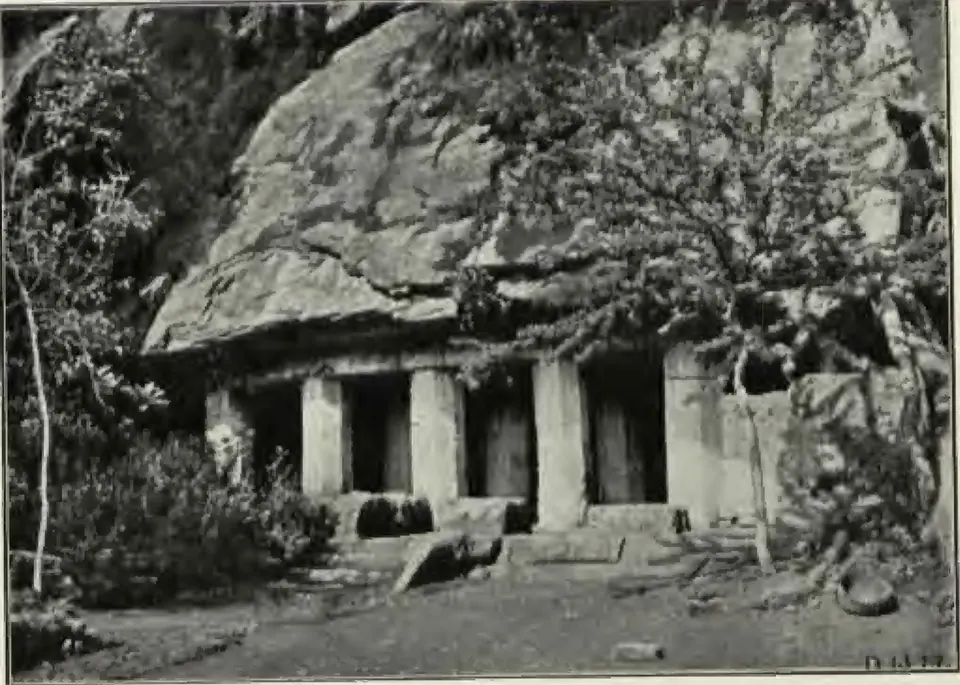
The Vishnukundins were a royal family of the lower Krishna and Godavari valleys, the country later called Vengi. They came after the Salankayanas and before the Eastern Chalukyas.12
Almost all that is known of them comes from five copper-plate charters in Sanskrit, a sixth from Maharashtra attributed to them, and one damaged stone inscription.34567 The charters record gifts of villages to Brahmins and to a temple and trace the kings’ descent.34567 None of them is dated in an era, and modern dates for the dynasty differ by two centuries or more.891
How the dynasty was found
The name first appeared in 1897, when F. Kielhorn published the Chikkulla plates of Vikramendravarman II.103 The plates had been found in a tank in the Tuni division of Godavari district.103 Kielhorn knew of no other record that named the family.103
H. Krishna Sastri described a second grant in 1909, the Ramatirtham plates of Indravarman, kept by a family of pandits near Vizianagaram.11 E. Hultzsch edited them in 1914.4 In 1914 the epigraphy office examined the Polamuru plates of a Madhavavarman Janashraya, found in Godavari district.12 Two more sets came to light in 1919–20 at Ipur in Tenali taluk, and Hultzsch edited both in 1924.135
In 1925 the only stone inscription of the family was noticed on a marble pillar at Velpuru in Guntur district.7 The Khanapur plates from Satara district, found in 1927, were attributed to the Vishnukundins by V. V. Mirashi and Y. R. Gupte in their edition of 1956.614 D. C. Sircar drew the evidence together in 1939.15
Origins and name
The grants use Vishnukundin as a family name. The Chikkulla plates call Vikramendravarman I’s birth “embellished by the two families of the Vishnukundins and Vakatas”.16 Where the family came from is disputed:
- Vinukonda. Kielhorn noted that the writer’s own language was Telugu, and that the kings worshipped the lord of Sriparvata.17 He took Sriparvata to be Srisailam in Kurnool district.17 He suggested that the family name survived in Vinukonda, a hill fort and town in Krishna (then Kistna) district about 60 miles east of Srisailam.17 He thought Vinukonda had been the Vishnukundin capital.17 Jouveau-Dubreuil called Vinukonda the probable cradle of the family.18 K. R. Subramanian reported the connection without endorsing it. He noted that Vishnukundin is not found in the lists of Brahmin gotras (clans).19
- The Srisailam region. Sircar took Sriparvatasvamin, the god named in every Vishnukundin grant, to be the family deity. He concluded that the family’s original home was not far from Srisailam.20 Subramanian likewise traced their earliest associations to Srisailam. He thought they began as rulers of that region under the Vakatakas and moved into the coastal plain about 460.1921
- A northern family. Krishna Sastri argued in 1909 that the Vishnukundins, kinsmen of the Vakatakas of the north, must have been “distinctly a northern family”.11 He placed their early home in Visakhapatnam (then Vizagapatam) district, where he looked for Sriparvata.11 The epigraphical report for 1919–20 found support for this in the Trikuta-Malaya and Trivaranagara of the Ipur plates.22 It placed these north of the Godavari.22
- No link with the Satakarnis. Sircar was tempted to connect the name with the Vinhukada Chutukulananda Satakarnis of earlier inscriptions and coins, but rejected the idea. Those kings used metronymics and named their gotra, which the Vishnukundins never do.9
Sircar also reported traditions about a Madhavavarman of Vijayawada (then Bezwada), collected by K. V. Lakshman Rao. A 13th-century inscription at Vijayawada tells of a king Madhavavarman who put his own son to death for killing a poor woman’s son. A poem of about 1540 says that a Madhavavarman led four Rajput tribes into Telingana.23 The Razu caste and the Maharajas of Vizianagaram claimed descent from him.23 Subramanian too noted traditions linking a Madhavavarman with Vijayawada.24 Neither writer connects these stories with the Vishnukundin grants by more than the name.2324
Territory and capitals
The grants name several royal seats, but most cannot be placed with confidence:
- Lendulura, the residence from which Vikramendravarman II issued the Chikkulla plates, was identified by J. Ramayya with Dendaluru (Denduluru), a village on the ruins of Vengi about five miles north-east of Eluru (then Ellore).17 Sewell and Aiyangar called Dendalur the family’s seat.25 Sircar took the identification as proof that the Vishnukundins held Vengi after the Salankayanas.2
- [Ama]rapura, from which Madhavavarman II issued the second Ipur grant, was identified by Sircar, with “probably”, as Amaravati on the Krishna.2627 Subramanian placed it near Srisailam.21
- Trivaranagara, named in the first Ipur grant as a city whose young women the king delighted, is the most disputed. Hultzsch could not identify it.28 The report for 1919–20 thought it was Tripuri.22 Mirashi and R. S. Panchamukhi took it for the city of Tivaradeva, king of Mahakosala (Chhattisgarh).2930
- Puranisangama (Ramatirtham plates) and Kudavada (first Ipur grant, a camp of victory) have not been identified. Sircar took Puranisangama to mean a camp at the confluence of a river Purani.43132
The villages granted give a better idea of the kingdom’s reach. Vikramendravarman II gave land on the Krishna near Ravireva, which Robert Sewell identified with Ravirela.833 Madhavavarman Janashraya’s Polamuru grant concerns the Guddavadi district of the Godavari delta.12 Indravarman’s Ramatirtham grant gives a village in the Plaki district, which Krishna Sastri and Sircar placed in Visakhapatnam district or the Vizianagaram region.1134
The Velpuru pillar, near Amaravati, lies south of the Krishna.7 Panchamukhi described the Vishnukundin dominions as reaching from the borders of Kalinga to Guntur district.35 Subramanian thought their hold south of the Krishna was brief, because of Pallava power there.21 Mirashi argued for a far wider empire under Madhavavarman I, taking in Maharashtra, as the Khanapur plates show, and Dakshina Kosala.36
In Telangana
Two sets of copper plates found at Tummalagudem, in the Ramannapeta taluk of the Nalgonda district, carry the Vishnukundins into Telangana. Both grant villages to a Buddhist monastery. The first is dated in the thirty-seventh year of Govindavarman, son of Madhavavarman and grandson of Indravarman. The second is dated in the eleventh year of Vikramendravarman II and Saka 488 (566–67; Saka is an Indian way of counting years). The editor noted that this dated set helps to settle the disputed Vishnukundin chronology.373839
Its editor identified the city of Indrapura, where Govindavarman’s queen built the monastery, with the Indrapala Gutta near the findspot.40 The second set also says that Vikramendra I was born of a Vakataka princess.41
A modern history of Telangana places the early kingdom north of Srisailam, in the Nalgonda and Mahabubnagar country.4243 It puts the first capital at Keesaragutta near Hyderabad or at Indrapura.4243 It says the capital was later moved east to Trivaranagara.4243 A short Brahmi inscription of about the fifth century on a boulder at Chaitanyapuri in Hyderabad names a Govinda Vihara.44 The published notice does not connect it with Govindavarman.44
Kings
The grants give the following pedigrees, each running from father to son:
- Chikkulla plates: Madhavavarman, Vikramendravarman I, Indrabhattarakavarman, Vikramendravarman II.16
- Ramatirtham plates: Madhavavarman, Vikramendra, Indravarman.45
- Ipur plates (set I): Govindavarman, Madhavavarman, with Madhavavarman’s son Manchyanna-bhattaraka as executor.31
- Ipur plates (set II): Madhavavarman, Devavarman, Madhavavarman.46
- Polamuru plates: Vikramahendra, Govindavarman, Madhavavarman Janashraya.12
Hultzsch showed that Indravarman of the Ramatirtham plates was the Indrabhattarakavarman of Chikkulla.4 Two questions decide every reconstruction. First, was Govindavarman’s son Madhavavarman, who claims the same eleven horse sacrifices as the head of the Chikkulla line, the same king? Second, was Vikramahendra of the Polamuru plates the Vikramendravarman II of Chikkulla?474830 See Madhavavarman, Madhavavarman II, Indravarman and Vikramendravarman II.
| Source | Order of kings |
|---|---|
| Epigraphical report, 1919–2022 | Three separate groups: Madhavavarman I, Devavarman, Madhavavarman II; Govindavarman, Madhavavarman III; then the Chikkulla line followed by Vikramahendra, Govindavarman and Madhavavarman Janashraya. It thought Madhavavarman III and the Chikkulla Madhavavarman might be the same king |
| Jouveau-Dubreuil (1920)4933 | Madhavavarman I, Vikramendravarman I, Indrabhattarakavarman, Vikramendravarman II (= Vikramahendra), Govindavarman, Madhavavarman II Janashraya |
| K. V. Lakshman Rao, in Sewell (1932)1 | Madhava I, Devavarma, Madhava II, Vikramendra I, Indrabhattaraka, Vikramendra II, Govinda, Madhava III Janashraya, Manchanna-bhattaraka (?) |
| Subramanian (1932)50 | Madhavavarman I, Devavarman, Madhavavarman II; Govindavarman I, Madhavavarman III; Vikramendravarman I, Indrabhattaraka, Vikramendravarman II, Govindavarman II, Madhavavarman IV Janashraya |
| Panchamukhi (1936)51 | Madhavavarman I; his sons Vikramendra I and Devavarman (whose son Madhavavarman II ruled a collateral branch); Indrabhattaraka, Vikramendra II, Govindavarman Vikramashraya, Madhavavarman III Janashraya, Prince Manchanna-bhattaraka |
| Sircar (1939)529 | Vikramahendra, Govindavarman, Madhavavarman I Janashraya; his sons Devavarman, Manchyanna and Vikramendravarman I; Madhavavarman II (son of Devavarman), Vikramendravarman I, Indravarman, Vikramendravarman II |
| Mirashi (1938, 1956)2953 | Follows Sircar’s pedigree; Madhavavarman II ruled the west and Indravarman the east |
The reign chart and family tree on this page follow Sircar’s scheme.9
Marriages
The Chikkulla plates say that Vikramendravarman I’s birth was embellished by the two families of the Vishnukundins and the Vakatas. The Ramatirtham plates call him an ornament of both families. Krishna Sastri and Hultzsch took this to mean that his mother, the wife of Madhavavarman, was a Vakataka princess.161154
Her identity is unknown, and Jouveau-Dubreuil thought she was a daughter or granddaughter of Prabhavati, the Gupta princess who married the Vakataka Rudrasena II.5556 He linked this with a story that a daughter of Chandragupta worshipped the god of Srisailam.5556
Vincent Smith, as reported by Sewell and Aiyangar, made her a daughter of the Vakataka king Harishena.25 Panchamukhi and Mirashi also thought Harishena the likeliest.5758 Several writers thought the Vakatakas had placed Madhavavarman on the throne of Vengi.565960 Sircar rejected this, since Madhavavarman was not the first king of his line.60
Jouveau-Dubreuil also proposed a Pallava marriage. He suggested that the Pallava Simhavishnu married a daughter of the Vishnukundin Vikramahendra and named his son Mahendravikrama (Mahendravarman I) after her father. No grant records such a marriage.61
Wars
- Kalinga and the Eastern Gangas. The Godavari plates of Raja Prithivimula record an alliance of chiefs against Indrabhattaraka. Kielhorn and most later writers identified him with the Vishnukundin Indravarman.1762 The victory is claimed for his enemy Indradhiraja, often taken to be a Ganga king.636465 Jouveau-Dubreuil and Subramanian thought the Vishnukundin really won.636465 Madhavavarman Janashraya’s Polamuru grant was made while he was crossing the Godavari to conquer the east.12 Sewell and Aiyangar took this for an attack on Kalinga.59 Panchamukhi thought it an attempt to win back the Plaki district from the Gangas.66
- The Pallavas. Sewell and Aiyangar thought the Pallavas held the Vengi country about 500, so that the Vishnukundins could only have been minor chiefs.25 Subramanian thought the Pallavas checked the family’s first advance south of the Krishna.21 Panchamukhi noted that the Kopparam plates of Pulakeshin II, about 631, show Kammarashtra in Chalukya hands.66 Kammarashtra had once been held by the Pallavas and the Vishnukundins.66
- Northern powers. Sircar identified Madhavavarman I with the lord of the Andhras whom the Maukhari king Ishanavarman claims to have defeated in the Haraha inscription.6760 Mirashi read the Trivaranagara phrase as a boast of victory over Tivaradeva of Mahakosala.2968
The end of the dynasty
The sources agree that the Chalukyas of Badami ended Vishnukundin rule, but not on how or when:
- Sewell and Aiyangar (1932), following Lakshman Rao, have Madhava III defeated about 610 by the Chalukya kings Mangalesha, Kubja Vishnuvardhana and Pulakeshin II. Kubja Vishnuvardhana then became ruler of Vengi about 615.169 Somasekhara Sarma reports Lakshman Rao’s view that Madhava III and his son Manchanna-bhattaraka were defeated by Pulakeshin II or his brother.70
- Jouveau-Dubreuil (1920) placed Janashraya’s eastern campaign shortly before the invasion of Pulakeshin II, which ended the dynasty.33
- Panchamukhi (1936) put the Chalukya conquest of the Vishnukundins between 621 and 631, perhaps in the same campaign in which Pulakeshin II took southern Kalinga.6651
- Mirashi (1938) thought Vikramendravarman II, the last known king of the line, was dethroned by Pulakeshin II.68
- Sircar (1939) argued that there was no proof that Pulakeshin II took Vengi at once. He thought the battle at the “water of Kunala” (the Kolleru lake) named in the Aihole inscription was fought against a Vishnukundin king. In his view the Vishnukundins, though weakened, held their capital for some time alongside the Eastern Chalukyas.27172 They lost their last lands only at the end of the 7th century or later.27172
The village of Polamuru shows the change of rulers. Madhavavarman Janashraya granted it to a Brahmin, Shivasharman, and the Eastern Chalukya Jayasimha I granted it again to Shivasharman’s son Rudrasharman.127374 See the Kubja Vishnuvardhana page for the founding of the Eastern Chalukya kingdom.
The Godavari district gazetteer of 1907 did not mention the Vishnukundins at all. It treated the period before the Chalukya conquest simply as a Pallava age (about 200–615).7576 Yet the Chikkulla plates had been published ten years earlier.7576
Administration
The grants are royal orders and show something of how the kingdom was run. Kings issued them from a residence (vasaka) or a camp of victory (vijaya-skandhavara).1631 The orders were addressed to the villagers of the place granted, to the “ryots assembled” there, or to the village heads (mahattaras) and royal officials.453177
Each grant names its executor (ajna).314578 For the first Ipur grant it was a prince, and for Ramatirtham the king himself.314578 For Polamuru there were two officers styled Hastikosha and Virakosha.314578 Sircar took these titles to mean military officers, perhaps of the elephant corps and the infantry. He noted that officers of the same names appear in the Godavari plates of Prithivimula and in the Eastern Chalukya grant of Polamuru.79
The kingdom was divided into districts called vishaya or rashtra: Guddadi or Guddavadi, Plaki and Natripati.31458 Granted villages were freed from all taxes and burdens. The Ramatirtham grant orders the ryots (peasants) to give the donee “the customary produce” and to do their customary duties, such as carrying messages.45 Sircar read a phrase of the Polamuru grant as evidence of trial by ordeal in Vishnukundin courts.80
Religion
Every Vishnukundin grant names the holy lord of Sriparvata. Kielhorn, Hultzsch and Sircar took him to be the Shiva of Srisailam.172820 Krishna Sastri looked for Sriparvata in Visakhapatnam district instead.11 Indravarman and Vikramendravarman II call themselves devout worshippers of Maheshvara (Shiva). The Chikkulla grant endowed a temple of Somagirishvaranatha, a form of Tryambaka.16845
The kings also patronised Vedic sacrifice. The grants credit Madhavavarman I with eleven horse sacrifices and a thousand agnishtomas. The Chikkulla plates add the purushamedha, which Kielhorn noted is a human sacrifice, the vajapeya, the rajasuya and others.163
Sircar observed that no other Vishnukundin king is credited with any sacrifice.81 Jouveau-Dubreuil noted that the praise of Madhavavarman resembles that of the Vakataka Pravarasena I.63 Most donees were Brahmins learned in the Vedas.458231 They included the Taittiriya scholars Nagnasarman of the Ramatirtham plates and Shivasharman of the Polamuru plates.4582 At Ipur the donee was Agnisharman of the Vatsa gotra.31
No source in the library records a Vishnukundin gift to a Buddhist community. The temple at Velpuru that holds the Vishnukundin pillar stands on a mound.783 The epigraphists thought the mound might cover a stupa (relic mound), and old bricks and apsidal (round-ended) foundations there suggested Buddhist ruins.783 Subramanian, by contrast, saw the Vishnukundins as leaders of a Brahmanical revival.84
Monuments attributed to the Vishnukundins
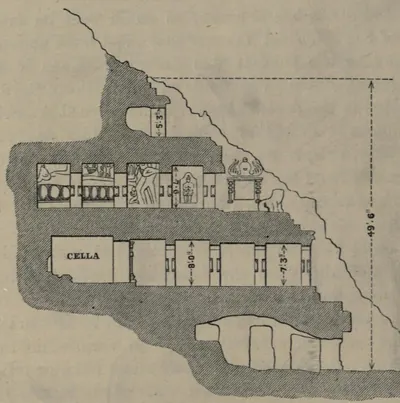
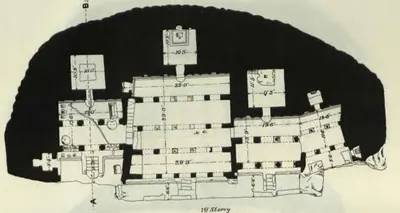
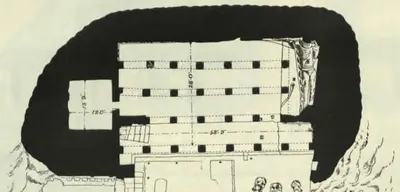
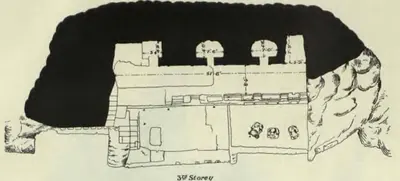
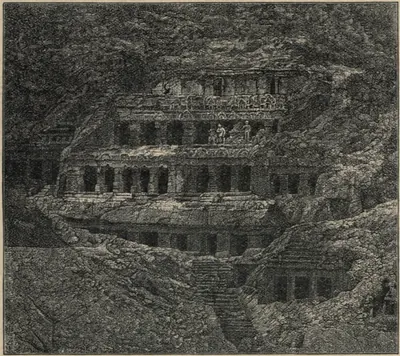
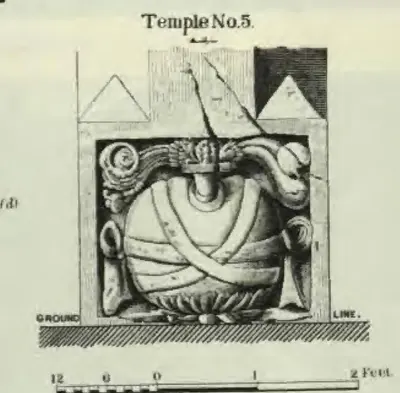
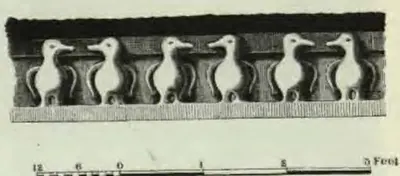
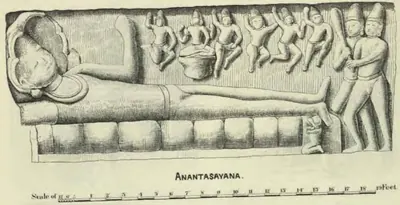
No building is dated by a Vishnukundin inscription. G. Jouveau-Dubreuil attributed the rock-cut cave temples at Vijayawada, Mogalrajapuram, Undavalli and Sitanagaram to the Vishnukundins in 1917, and repeated the attribution in 1920. He pointed to the lions carved on pillars at Undavalli, like the lion on the Vishnukundin seals, and to vases carved at Undavalli and Mogalrajapuram.186133
A. H. Longhurst saw no proof of this and, on architectural grounds, treated the caves as Pallava work of the early 7th century.85 Subramanian reported both views.84 Longhurst also described the cave temples at Bhairavakonda in Nellore district as Pallava; no source in the library attributes them to the Vishnukundins.86
Coins
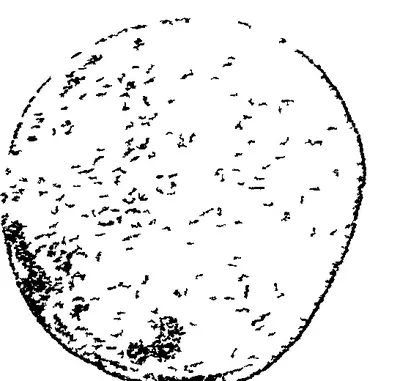
Krishna Sastri noted in 1909 that many old coins found in Visakhapatnam district bear a lion.11 He connected that symbol with the lion on the Vishnukundin seals.11 Coins with a lion on one side and a vase on the other have been found on the Godavari and the Krishna.8733 They had been attributed to the Pallavas, but Jouveau-Dubreuil, in 1917 and 1920, attributed them to the Vishnukundins.8733 Subramanian also listed lion-and-vase coins from Visakhapatnam district as attributed to the dynasty.84 No coin bearing a Vishnukundin king’s name is described in the library sources.
Seals, script and language
The seals of the Chikkulla and Ramatirtham plates show an advancing lion with one fore-paw raised and the tail looped over its back. Jouveau-Dubreuil took the lion to be the family crest.31133 The seals of the two Ipur sets carry the legend Sri-Madhavavarma.526 The symbol above it on the first set is a figure of Lakshmi or a svastika.526
All the grants are in Sanskrit, but with Prakrit forms.3 The Chikkulla plates use the Telugu-style plural samvassarambul (“years”), which Kielhorn took as proof that the writer’s own language was Telugu.3 Three of the grants are dated by fortnights of the seasons, an old style of dating.30
Panchamukhi connected a prosody text named Janashrayi Chhandovichiti, which quotes the poet Bharavi, with the surname Janashraya of the Polamuru king.88 The editor of Epigraphia Indica thought the link uncertain.88
Chronology
| Source | Dates proposed |
|---|---|
| Kielhorn (1897)17 | Chikkulla plates not later than about the end of the 8th century |
| Epigraphical report for 1919–201389 | Second Ipur set not later than the 5th century; first set about the 6th |
| Jouveau-Dubreuil (1920)9091 | Conquest of Vengi in the 5th century with Vakataka help; Indrabhattaraka about the beginning of the 6th |
| Lakshman Rao, in Sewell (1932)1 | Madhava I about 357–382 to Madhava III, about 546–610 |
| Subramanian (1932)1950 | About 350–610; entry into Vengi about 460 |
| Panchamukhi (1936)8851 | Madhavavarman I about 500; end between 621 and 631 |
| Mirashi (1938, 1956)6814 | Madhavavarman I about 525–568, later 510–560 |
| Sircar (1939)9 | Vikramahendra about 500 to Vikramendravarman II about 670; end possibly late 7th or 8th century |
These schemes cannot all be right. The 1932 and 1956 positions differ by more than a century for the king who married into the Vakataka family.136 The reign chart follows Sircar. The dates given for the dynasty as a whole (about 500–630) follow most of the later reconstructions.51689 These end it with the Chalukya conquest of the early 7th century.51689 Sircar’s chart runs on to about 670.9
The dynasties before and after them
The Vishnukundins followed the Salankayanas of Vengi, a dynasty whose capital was Vengipura and whose seals carried a bull.92 Jouveau-Dubreuil and Sewell and Aiyangar thought the Vakatakas installed the first Vishnukundin at Vengi in place of the Salankayanas.9159 Subramanian thought the Pallavas had overthrown the Salankayanas first.19 Their successors, the Eastern Chalukyas, kept some of their districts. The Plaki district of Indravarman’s grant appears again in the records of Vishnuvardhana I.4 The village of Polamuru passed from a Vishnukundin grant to an Eastern Chalukya one.73
Footnotes
-
Sewell and Aiyangar, Historical Inscriptions of Southern India (1932), p. 404 (archive.org (opens in a new tab)). ↩ ↩2 ↩3 ↩4 ↩5 ↩6
-
Sircar, Successors of the Satavahanas (1939), p. 115 (archive.org (opens in a new tab)). ↩ ↩2 ↩3 ↩4
-
Kielhorn, “Chikkulla Plates” (1897), p. 194 (archive.org (opens in a new tab)). ↩ ↩2 ↩3 ↩4 ↩5 ↩6 ↩7 ↩8 ↩9
-
E. Hultzsch, “Ramatirtham Plates of Indravarman”, Epigraphia Indica XII (1914), p. 133 (archive.org (opens in a new tab)). ↩ ↩2 ↩3 ↩4 ↩5 ↩6
-
E. Hultzsch, “Ipur Plates of Govindavarman’s Son Madhavavarman”, Epigraphia Indica XVII (1924), p. 334 (archive.org (opens in a new tab)). ↩ ↩2 ↩3 ↩4 ↩5
-
V. V. Mirashi and Y. R. Gupte, “Khanapur Plates of Madhavavarman”, Epigraphia Indica XXVII (1956), p. 313 (archive.org (opens in a new tab)). ↩ ↩2 ↩3
-
Annual Report on South-Indian Epigraphy for 1925–26 (1927), Part I, para. 7, p. 8 (archive.org (opens in a new tab)). ↩ ↩2 ↩3 ↩4 ↩5 ↩6
-
Kielhorn, “Chikkulla Plates” (1897), p. 198, translation (archive.org (opens in a new tab)). ↩ ↩2 ↩3 ↩4
-
Sircar, Successors of the Satavahanas (1939), p. 112, chronological table and notes (archive.org (opens in a new tab)). ↩ ↩2 ↩3 ↩4 ↩5 ↩6 ↩7 ↩8
-
F. Kielhorn, “Chikkulla Plates of Vikramendravarman II”, Epigraphia Indica IV (1897), p. 193 (archive.org (opens in a new tab)). ↩ ↩2 ↩3
-
H. Krishna Sastri, Annual Report on Epigraphy, Southern Circle, for 1908–09 (1909), Part II, para. 62, p. 109 (archive.org (opens in a new tab)). ↩ ↩2 ↩3 ↩4 ↩5 ↩6 ↩7 ↩8 ↩9
-
Annual Report on Epigraphy, Madras, for 1913–14 (1914), Part II, para. 35, p. 102 (archive.org (opens in a new tab)). ↩ ↩2 ↩3 ↩4 ↩5
-
Annual Report on Epigraphy, Madras, for 1919–20 (1920), Part II, paras. 6–7, p. 97 (archive.org (opens in a new tab)). ↩ ↩2
-
Mirashi and Gupte, “Khanapur Plates” (1956), p. 314 (archive.org (opens in a new tab)). ↩ ↩2
-
D. C. Sircar, The Successors of the Satavahanas in Lower Deccan (1939), p. 97 (archive.org (opens in a new tab)). ↩
-
Kielhorn, “Chikkulla Plates” (1897), p. 197, translation (archive.org (opens in a new tab)). ↩ ↩2 ↩3 ↩4 ↩5 ↩6
-
Kielhorn, “Chikkulla Plates” (1897), p. 195 and notes (archive.org (opens in a new tab)). ↩ ↩2 ↩3 ↩4 ↩5 ↩6 ↩7 ↩8
-
G. Jouveau-Dubreuil, The Pallavas (1917), p. 33 (archive.org (opens in a new tab)). ↩ ↩2
-
K. R. Subramanian, Buddhist Remains in Andhra and the History of Andhra between 225 and 610 A.D. (1932), p. 111 and notes (archive.org (opens in a new tab)). ↩ ↩2 ↩3 ↩4
-
Sircar, Successors of the Satavahanas (1939), p. 123 (archive.org (opens in a new tab)). ↩ ↩2
-
Subramanian, Buddhist Remains in Andhra (1932), p. 112 (archive.org (opens in a new tab)). ↩ ↩2 ↩3 ↩4
-
Annual Report on Epigraphy, Madras, for 1919–20 (1920), Part II, para. 10, pp. 98–99 (archive.org (opens in a new tab)). ↩ ↩2 ↩3 ↩4
-
Sircar, Successors of the Satavahanas (1939), p. 124, note 1 (archive.org (opens in a new tab)). ↩ ↩2 ↩3
-
Subramanian, Buddhist Remains in Andhra (1932), p. 113 and notes (archive.org (opens in a new tab)). ↩ ↩2
-
Robert Sewell and S. Krishnaswami Aiyangar, The Historical Inscriptions of Southern India (1932), p. 20 (archive.org (opens in a new tab)). ↩ ↩2 ↩3
-
E. Hultzsch, “Ipur Plates of Madhavavarman II”, Epigraphia Indica XVII (1924), p. 338 (archive.org (opens in a new tab)). ↩ ↩2 ↩3
-
Sircar, Successors of the Satavahanas (1939), p. 133 (archive.org (opens in a new tab)). ↩
-
Hultzsch, “Ipur Plates of Govindavarman’s Son Madhavavarman” (1924), p. 335 (archive.org (opens in a new tab)). ↩ ↩2
-
V. V. Mirashi, “Thakurdiya Plates of Maha-Pravararaja”, Epigraphia Indica XXII (1938), p. 19 (archive.org (opens in a new tab)). ↩ ↩2 ↩3
-
R. S. Panchamukhi, “Tandivada Grant of Prithivi-Maharaja: 46th Year”, Epigraphia Indica XXIII (1936), p. 91 (archive.org (opens in a new tab)). ↩ ↩2 ↩3
-
Hultzsch, “Ipur Plates of Govindavarman’s Son Madhavavarman” (1924), p. 337, translation (archive.org (opens in a new tab)). ↩ ↩2 ↩3 ↩4 ↩5 ↩6 ↩7 ↩8 ↩9 ↩10
-
Sircar, Successors of the Satavahanas (1939), p. 137 (archive.org (opens in a new tab)). ↩
-
Jouveau-Dubreuil, Ancient History of the Deccan (1920), p. 92 (archive.org (opens in a new tab)). ↩ ↩2 ↩3 ↩4 ↩5 ↩6 ↩7
-
Sircar, Successors of the Satavahanas (1939), p. 138 (archive.org (opens in a new tab)). ↩
-
Panchamukhi, “Tandivada Grant” (1936), p. 96 (archive.org (opens in a new tab)). ↩
-
Mirashi and Gupte, “Khanapur Plates” (1956), p. 315 (archive.org (opens in a new tab)). ↩ ↩2
-
Gajjala Vasanta Lakshmi (ed.), Epigraphia Telanganica I (2023), p. 16, reprinting S. Sankaranarayanan, “Two Vishnukundi Charters from Tummalagudem”, Epigraphia Andhrica II (1974), pp. 4–20. Cite-only; paraphrased. ↩
-
Epigraphia Telanganica I (2023), pp. 17–18. Cite-only; paraphrased. ↩
-
Epigraphia Telanganica I (2023), p. 19. Cite-only; paraphrased. ↩
-
Epigraphia Telanganica I (2023), p. 21. Cite-only; paraphrased. ↩
-
Epigraphia Telanganica I (2023), p. 23, translation of Set II, lines 9–10. Cite-only; paraphrased. ↩
-
A. K. Goel, D. Satyanarayana, Rekha Pande and Ravulapati Madhavi, History of Telangana – Land and People, vol. 1 (2022), p. 251. Cite-only; paraphrased. ↩ ↩2 ↩3
-
Goel et al., History of Telangana – Land and People, vol. 1 (2022), p. 252. Cite-only; paraphrased. ↩ ↩2 ↩3
-
Epigraphia Telanganica I (2023), p. 386, Indeterminate inscriptions No. 3, from Indian Archaeology 1986–87: A Review, p. 105. Cite-only; paraphrased. ↩ ↩2
-
Hultzsch, “Ramatirtham Plates” (1914), p. 136, translation (archive.org (opens in a new tab)). ↩ ↩2 ↩3 ↩4 ↩5 ↩6 ↩7 ↩8 ↩9 ↩10
-
Hultzsch, “Ipur Plates of Madhavavarman II” (1924), p. 339, translation (archive.org (opens in a new tab)). ↩
-
Sircar, Successors of the Satavahanas (1939), p. 100 (archive.org (opens in a new tab)). ↩
-
Sircar, Successors of the Satavahanas (1939), p. 103 (archive.org (opens in a new tab)). ↩
-
Jouveau-Dubreuil, Ancient History of the Deccan (1920), p. 90 (archive.org (opens in a new tab)). ↩
-
Subramanian, Buddhist Remains in Andhra (1932), pp. 114–115 (archive.org (opens in a new tab)). ↩ ↩2
-
Panchamukhi, “Tandivada Grant” (1936), p. 95, genealogical table (archive.org (opens in a new tab)). ↩ ↩2 ↩3 ↩4 ↩5
-
Sircar, Successors of the Satavahanas (1939), p. 104, genealogical table (archive.org (opens in a new tab)). ↩
-
Mirashi and Gupte, “Khanapur Plates” (1956), p. 316 (archive.org (opens in a new tab)). ↩
-
Hultzsch, “Ramatirtham Plates” (1914), p. 134 (archive.org (opens in a new tab)). ↩
-
G. Jouveau-Dubreuil, Ancient History of the Deccan (1920), p. 73 (archive.org (opens in a new tab)). ↩ ↩2
-
Jouveau-Dubreuil, Ancient History of the Deccan (1920), p. 74 (archive.org (opens in a new tab)). ↩ ↩2 ↩3
-
Panchamukhi, “Tandivada Grant” (1936), p. 92 (archive.org (opens in a new tab)). ↩
-
Mirashi, “Epoch of the Ganga Era” (1942), p. 336 (archive.org (opens in a new tab)). ↩
-
Sewell and Aiyangar, Historical Inscriptions of Southern India (1932), p. 21 (archive.org (opens in a new tab)). ↩ ↩2 ↩3
-
Sircar, Successors of the Satavahanas (1939), p. 126 (archive.org (opens in a new tab)). ↩ ↩2 ↩3
-
Jouveau-Dubreuil, The Pallavas (1917), p. 35 (archive.org (opens in a new tab)). ↩ ↩2
-
V. V. Mirashi, “Epoch of the Ganga Era”, Epigraphia Indica XXVI (1942), p. 334 (archive.org (opens in a new tab)). ↩
-
Jouveau-Dubreuil, Ancient History of the Deccan (1920), p. 91 (archive.org (opens in a new tab)). ↩ ↩2 ↩3
-
Jouveau-Dubreuil, Ancient History of the Deccan (1920), p. 94 (archive.org (opens in a new tab)). ↩ ↩2
-
Subramanian, Buddhist Remains in Andhra (1932), p. 123 (archive.org (opens in a new tab)). ↩ ↩2
-
Panchamukhi, “Tandivada Grant” (1936), p. 94 (archive.org (opens in a new tab)). ↩ ↩2 ↩3 ↩4
-
Sircar, Successors of the Satavahanas (1939), p. 111 (archive.org (opens in a new tab)). ↩
-
Mirashi, “Thakurdiya Plates” (1938), pp. 20–21 (archive.org (opens in a new tab)). ↩ ↩2 ↩3 ↩4 ↩5
-
Sewell and Aiyangar, Historical Inscriptions of Southern India (1932), p. 22 (archive.org (opens in a new tab)). ↩
-
M. Somasekhara Sarma, “Indrabhattaraka and the Ganga Era”, Journal of the Andhra Historical Research Society V, pt. 3 (1930–31), p. 184 (archive.org (opens in a new tab)). ↩
-
Sircar, Successors of the Satavahanas (1939), pp. 116–117 (archive.org (opens in a new tab)). ↩ ↩2
-
Sircar, Successors of the Satavahanas (1939), p. 120 (archive.org (opens in a new tab)). ↩ ↩2
-
V. Rangacharya, “The Pulibumra Plates of the Eastern Chalukya King Jayasimha I”, Epigraphia Indica XIX (1928), p. 255 (archive.org (opens in a new tab)). ↩ ↩2
-
Sircar, Successors of the Satavahanas (1939), p. 108 (archive.org (opens in a new tab)). ↩
-
F. R. Hemingway, Madras District Gazetteers: Godavari (1907), p. 18 (archive.org (opens in a new tab)). ↩ ↩2
-
Hemingway, Godavari (1907), p. 19 (archive.org (opens in a new tab)). ↩ ↩2
-
Sircar, Successors of the Satavahanas (1939), p. 131 (archive.org (opens in a new tab)). ↩
-
Sircar, Successors of the Satavahanas (1939), p. 132 (archive.org (opens in a new tab)). ↩ ↩2 ↩3
-
Sircar, Successors of the Satavahanas (1939), p. 110, note 2 (archive.org (opens in a new tab)). ↩
-
Sircar, Successors of the Satavahanas (1939), p. 127 (archive.org (opens in a new tab)). ↩
-
Sircar, Successors of the Satavahanas (1939), pp. 99–100 (archive.org (opens in a new tab)). ↩
-
Sircar, Successors of the Satavahanas (1939), p. 107 (archive.org (opens in a new tab)). ↩ ↩2
-
Annual Reports on South Indian Epigraphy for 1939–40 to 1942–43 (1952), Part II, para. 4, p. 229 (archive.org (opens in a new tab)). ↩ ↩2
-
Subramanian, Buddhist Remains in Andhra (1932), p. 118 and notes (archive.org (opens in a new tab)). ↩ ↩2 ↩3
-
A. H. Longhurst, Pallava Architecture, Part I (Memoirs of the Archaeological Survey of India No. 17, 1924), p. 5 (archive.org (opens in a new tab)). ↩
-
Longhurst, Pallava Architecture, Part I (1924), p. 30 (archive.org (opens in a new tab)). ↩
-
Jouveau-Dubreuil, The Pallavas (1917), p. 34 (archive.org (opens in a new tab)). ↩ ↩2
-
Panchamukhi, “Tandivada Grant” (1936), p. 93 and editor’s notes (archive.org (opens in a new tab)). ↩ ↩2 ↩3
-
Annual Report on Epigraphy, Madras, for 1919–20 (1920), Part II, para. 8, p. 98 (archive.org (opens in a new tab)). ↩
-
Jouveau-Dubreuil, Ancient History of the Deccan (1920), p. 76 (archive.org (opens in a new tab)). ↩
-
Jouveau-Dubreuil, Ancient History of the Deccan (1920), p. 89 (archive.org (opens in a new tab)). ↩ ↩2
-
B. V. Krishna Rao, “Two Salankayana Charters from Kanukollu”, Epigraphia Indica XXXI (1960), p. 1 (archive.org (opens in a new tab)). ↩
Photos
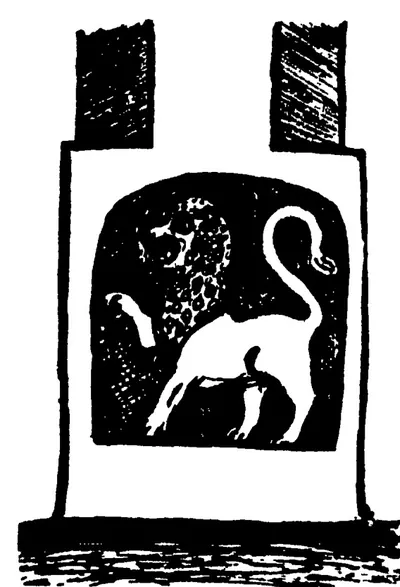 "A lion (simha) at Undavalli" (Jouveau-Dubreuil, The Pallavas, 1917, Fig. 1, p. 33)Drawing · 1917
 "Akkanna Madanna temple at Bezwada" (Longhurst, Pallava Architecture I, 1924, Plate V (d) (PDF p. 62))Historic photograph · 1924
 "Chikkulla Plates of Vikramendravarman II, Ep Ind Vol IV No 25" (Epigraphia Indica IV, plate (PDF p. 297), fig. 3)Book plate · 1897
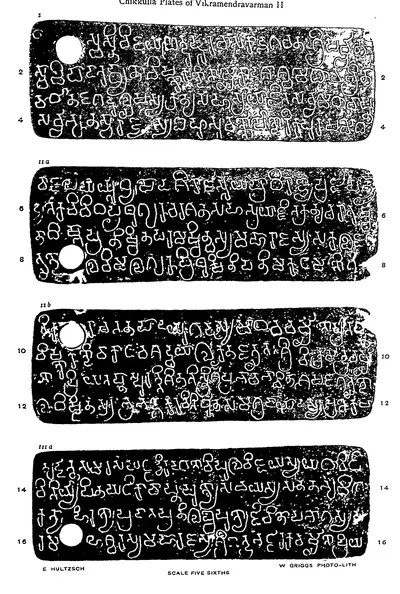 "Chikkulla Plates of Vikramendravarman II" (Epigraphia Indica IV, plate (PDF p. 241))Inscription rubbing · 1897
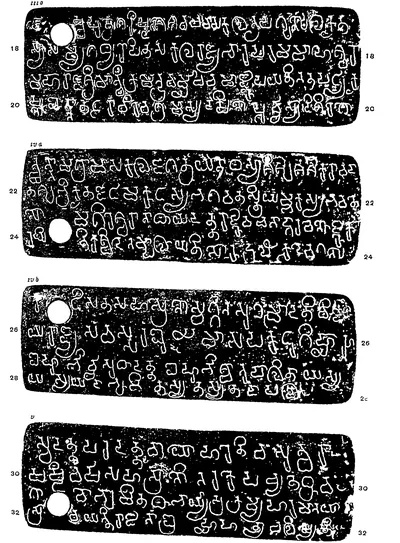 "Chikkulla Plates of Vikramendravarman II", second page of the plate: plates iii b, iv a, iv b and v, lines 17-32 (Epigraphia Indica IV, plate (PDF p. 242))Inscription rubbing · 1897
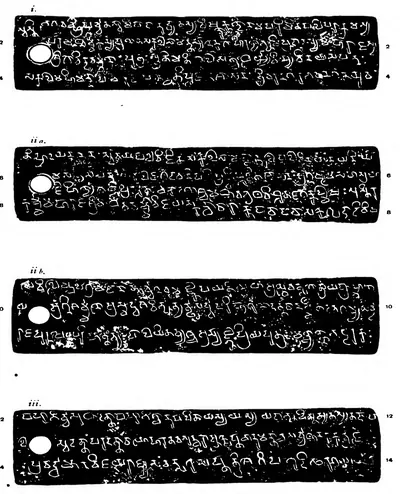 "Ipur Plates of Govindavarman's Son Madhavavarman": plates i, ii a, ii b and iii, lines 1-14 (Epigraphia Indica XVII, plate between pp. 334 and 335 (PDF p. 388 of scan in.ernet.dli.2015.180697))Inscription rubbing · 1924
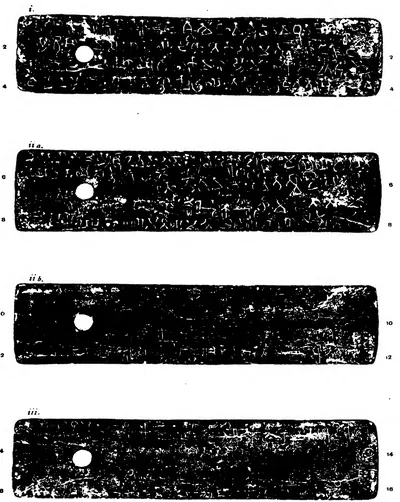 "Ipur Plates of Madhavavarman II": plates i, ii a, ii b and iii, lines 1-16 (Epigraphia Indica XVII, plate between pp. 338 and 339 (PDF p. 394 of scan in.ernet.dli.2015.180697))Inscription rubbing · 1924
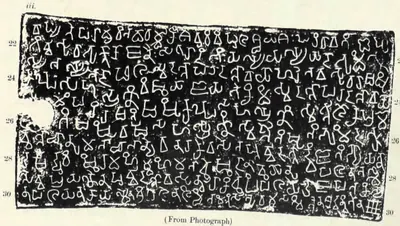 "Khanapur Plates of Madhavavarman": plate iii, lines 22-30 (Epigraphia Indica XXVII, plate between pp. 316 and 317 (PDF p. 421, printed sideways))Book plate · 1956
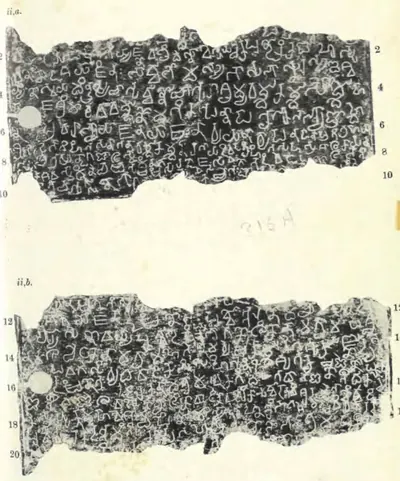 "Khanapur Plates of Madhavavarman": plates ii a and ii b, lines 1-20 (Epigraphia Indica XXVII, plate between pp. 316 and 317 (PDF p. 420))Book plate · 1956
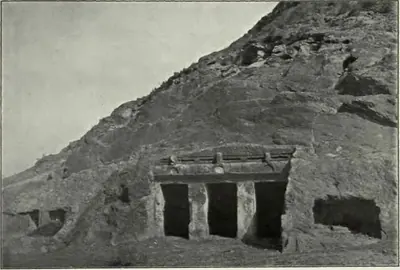 "Mogalrajapuram: Temple No. III" (Longhurst, Pallava Architecture I, 1924, Plate VIII (a) (PDF p. 68))Historic photograph · 1924
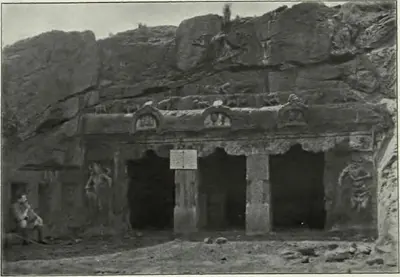 "Mogalrajapuram: Temple No. IV" (Longhurst, Pallava Architecture I, 1924, Plate VIII (b) (PDF p. 68))Historic photograph · 1924
 "Section of the Undavilla Cave, from a Drawing by Mr. Peters. Scale 20 feet to 1 inch" (Fergusson and Burgess, The Cave Temples of India, 1880, woodcut No. 24, p. 100)Drawing · 1880
Show all (30)
 "Undavalli temple, Guntur District.—Plans": 1st Storey (Longhurst, Pallava Architecture I, 1924, Plate IX (PDF p. 70))Plan · 1924
 "Undavalli temple, Guntur District.—Plans": 2nd Storey (Longhurst, Pallava Architecture I, 1924, Plate X (PDF p. 72))Plan · 1924
 "Undavalli temple, Guntur District.—Plans": 3rd Storey (Longhurst, Pallava Architecture I, 1924, Plate X (PDF p. 72))Plan · 1924
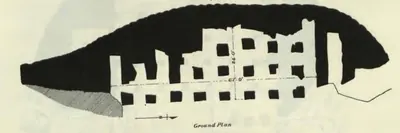 "Undavalli temple, Guntur District.—Plans": Ground Plan (Longhurst, Pallava Architecture I, 1924, Plate IX (PDF p. 70))Plan · 1924
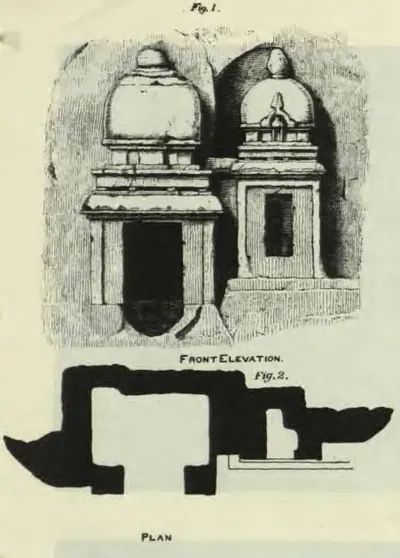 "Undavalli temple, Guntur District.—Rock-cut memorial shrines on the hill", Figs. 1-2 (Longhurst, Pallava Architecture I, 1924, Plate XIII (PDF p. 78))Drawing · 1924
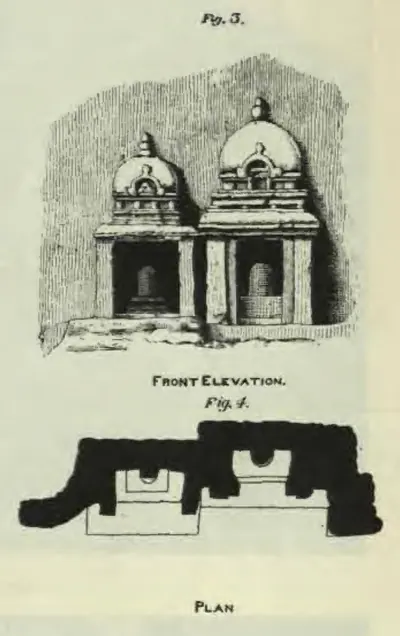 "Undavalli temple, Guntur District.—Rock-cut memorial shrines on the hill", Figs. 3-4 (Longhurst, Pallava Architecture I, 1924, Plate XIII (PDF p. 78))Drawing · 1924
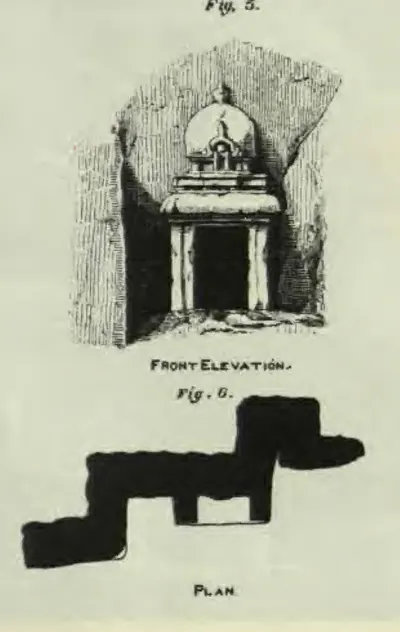 "Undavalli temple, Guntur District.—Rock-cut memorial shrines on the hill", Figs. 5-6 (Longhurst, Pallava Architecture I, 1924, Plate XIII (PDF p. 78))Drawing · 1924
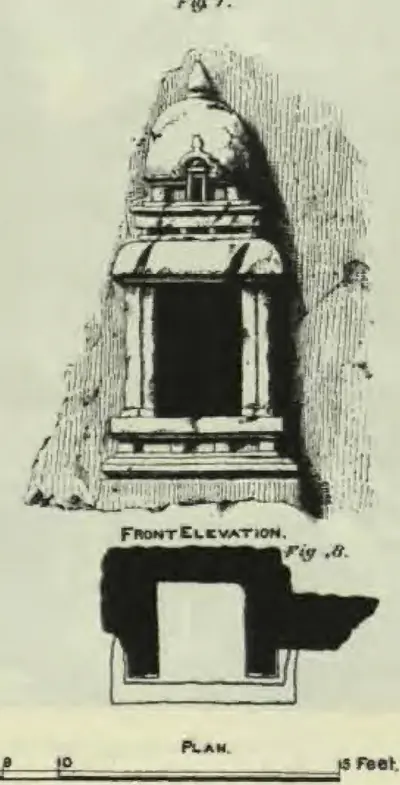 "Undavalli temple, Guntur District.—Rock-cut memorial shrines on the hill", Figs. 7-8 (Longhurst, Pallava Architecture I, 1924, Plate XIII (PDF p. 78))Drawing · 1924
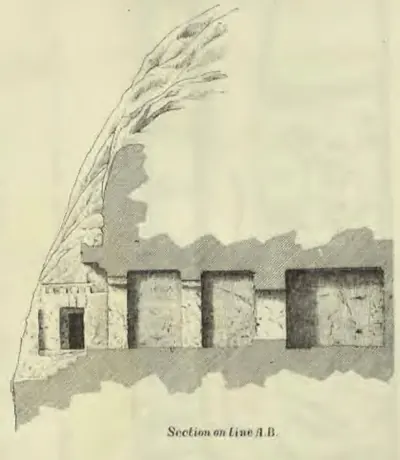 "Undavalli temple, Guntur District.—Sections": "Section on Line A.B." (Longhurst, Pallava Architecture I, 1924, Plate XI (PDF p. 74))Plan · 1924
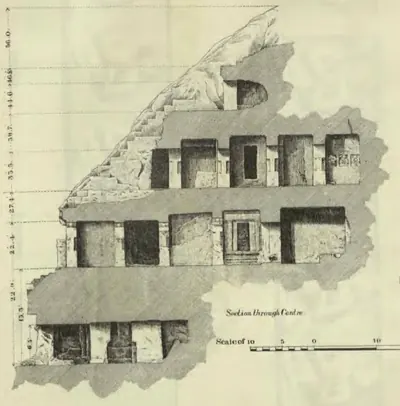 "Undavalli temple, Guntur District.—Sections": "Section through Centre" (Longhurst, Pallava Architecture I, 1924, Plate XI (PDF p. 74))Plan · 1924
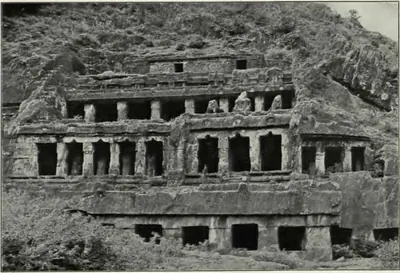 "Undavalli: Rock-cut temple" (Longhurst, Pallava Architecture I, 1924, Plate XIV (a) (PDF p. 80))Historic photograph · 1924
 "View of the Undavilli Cave, from a Photograph" (Fergusson and Burgess, The Cave Temples of India, 1880, woodcut No. 23, p. 97)Drawing · 1880
 Line 1 of the Chikkulla plates of Vikramendravarman II: "Om svasti Vijaya-Lendulura-vasakad=bhagavatah Sriparvvata-" (Epigraphia Indica IV, plate, detail)Inscription rubbing · 1897
 Line 26 of the Chikkulla plates, with the old numeral symbols for 10, 8 and 5 in the date (Epigraphia Indica IV, plate, detail)Inscription rubbing · 1897
 Mogalrajapuram "Temple No. 5", detail A (Longhurst, Pallava Architecture I, 1924, Plate VII (d) (PDF p. 66))Drawing · 1924
 Mogalrajapuram temple No. V, detail B: frieze of geese (Longhurst, Pallava Architecture I, 1924, Plate VII (e) (PDF p. 66))Drawing · 1924
 Undavalli temple: "Anantasayana" (Longhurst, Pallava Architecture I, 1924, Plate XII (PDF p. 76))Drawing · 1924
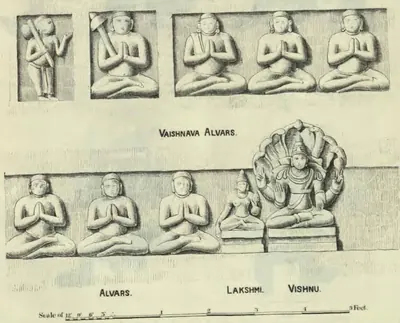 Undavalli temple: "Vaishnava Alvars" and "Alvars, Lakshmi, Vishnu" (Longhurst, Pallava Architecture I, 1924, Plate XII (PDF p. 76))Drawing · 1924
Related
People
Madhavavarman (Vishnukundin)
c. 535–585 CE
The most famous Vishnukundin king. His own and his descendants' grants credit him with eleven horse sacrifices and a thousand agnishtoma rites. He married into the Vakataka royal family. Whether he was also Madhavavarman Janashraya, the son of Govindavarman and donor of the first Ipur and the Polamuru plates, is disputed: D. C. Sircar and V. V. Mirashi thought so, while other scholars made Janashraya a later king, Madhavavarman III. His date is also disputed: Sircar placed him about 535–585, Mirashi about 510–560.
Madhavavarman II (Vishnukundin)
c. 585–615 CE
Vishnukundin king, son of Devavarman and grandson of the great Madhavavarman. He is known from the second set of Ipur plates, issued from [Ama]rapura. The grant calls him lord of the Trikuta and Malaya mountains. Scholars have read this claim as an empty boast, as evidence of a western Vishnukundin realm, or as the name of a local hill. His place in the line and his date are disputed.
Indravarman (Vishnukundin)
c. 625–655 CE
Vishnukundin king, called Indrabhattarakavarman in his son's Chikkulla plates, who issued the Ramatirtham plates near Vizianagaram in his 27th year. His grants praise his victories with war elephants. Most scholars identify him with the Indrabhattaraka against whom a group of kings fought, according to the Godavari plates of Prithivimula. His date depends on the disputed Vishnukundin chronology: about 469–496, 535, 570–600 and 625–655 have all been proposed.
Vikramendravarman II (Vishnukundin)
c. 655–670 CE
Vishnukundin king, eldest son of Indravarman, who issued the Chikkulla plates from Lendulura (Denduluru near Vengi) in his 10th year, giving a village on the Krishna to a Shiva temple. The plates say he took up the government as a child. Some scholars identify him with the Vikramahendra of the Polamuru plates, the grandfather of the last known Vishnukundin king; D. C. Sircar did not. Sircar dated him about 655–670, and the scheme printed by Sewell in 1932 about 496–521.
Inscriptions
Chikkulla plates of Vikramendravarman II
A Vishnukundin copper-plate grant, issued from Lendulura in the king's 10th regnal year, giving the village of Regonram near the Krishna to a Shiva temple. It was found in a tank at Chikkulla near Tuni, and F. Kielhorn edited it in 1897. Its date depends on the disputed Vishnukundin chronology.
Ipur plates (set I) of Govindavarman's son Madhavavarman
Sanskrit copper-plate grant of the Vishnukundin king Madhavavarman, son of Govindavarman. He issued it from his camp at Kudavada in his 37th year, giving the village of Vilembali in the Guddadi district to a Brahmin. It is one of two Vishnukundin sets found at Ipur in Tenali taluk, and E. Hultzsch edited it in 1924. Whether its king is the great Madhavavarman I or a later Madhavavarman III is disputed.
Ipur plates (set II) of Madhavavarman II
A damaged Sanskrit copper-plate grant of the Vishnukundin king Madhavavarman II, son of Devavarman and grandson of Madhavavarman I, issued from [Ama]rapura. It calls the king lord of the Trikuta and Malaya mountains. It was found at Ipur in Tenali taluk, and E. Hultzsch edited it in 1924. It is in the most archaic script of all the Vishnukundin grants, and its regnal year has been read as 47, 37 and 17.
Khanapur plates of Madhavavarman
An incomplete Sanskrit copper-plate grant of a Maharaja Madhavavarman, found in 1927 at Khanapur in Satara district, Maharashtra. It gives a village on the Krishna near Karad to two Brahmins. Its first plate, which would have named the dynasty, is lost. V. V. Mirashi and Y. R. Gupte, who edited it in 1956, gave it to the Vishnukundin Madhavavarman I because of the sacrifices and the imperial title it claims. They took it as proof of a Vishnukundin empire reaching into Maharashtra.
Polamuru plates of Madhavavarman Janashraya
A Sanskrit copper-plate grant of the Vishnukundin king Madhavavarman Janashraya, son of Govindavarman and grandson of Vikramahendra. He made it while crossing the Godavari to conquer the east. It gave the village of Polamuru to a Brahmin whose son received the same village again from the Eastern Chalukya king Jayasimha I. Noticed in 1914 and edited in Telugu-country journals, it is the key to the Vishnukundin chronology. But its regnal year, its date and even its king are disputed.
Ramatirtham plates of Indravarman
Sanskrit copper-plate grant of the Vishnukundin king Indravarman (Indrabhattarakavarman), issued from Puranisangama in his 27th year. It gives the village of Peruvataka in the Plaki district to a Brahmin. A family of pandits at Ramatirtham near Vizianagaram held it. It was noticed in 1909, and E. Hultzsch edited it in 1914. Its short family line confirmed the line of the Chikkulla plates and the Vishnukundin marriage with the Vakatakas.
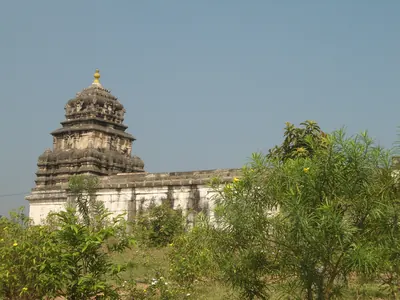
Velpuru pillar inscription of Madhavavarman
A Sanskrit inscription on a white marble pillar in the Ramalingasvamin temple at Velpuru, in the former Sattenapalle taluk of Guntur district. It names a Vishnukundin king Madhavavarman. Noticed in 1925, it is the only known stone inscription of the dynasty. Only the exposed part has been copied, because the pillar could not be removed from the temple.
References
Notes (0)
Sources (24)
Spotted an error on this page? Tell us
Last updated: