Kanukollu plates of Skandavarman
A Sanskrit copper-plate grant of the first year of the Salankayana king Skandavarman, issued from Vengi. It was found at Kanukollu with a Prakrit grant of Nandivarman I. Its four-generation family line, published in 1960, showed that Skandavarman was a great-grandson of Hastivarman I through a second son of Nandivarman I.
This grant of the Salankayana king Skandavarman was found at Kanukollu together with the Prakrit grant of Nandivarman I. Villagers melted down its ring and seal to test the metal, but the plates survived. B. V. Krishna Rao published both grants in 1960.1
Description
There are four plates, about 7⅚ by 2½ inches, weighing about 78 tolas.2 The first and fourth are written on the inside only.2 The six written faces are numbered like the pages of a book.2 The almost square hole for the ring was cut after the plates were engraved.2 The letters are very like those of the Kanteru plates of Skandavarman and other Salankayana charters.2 The language is Sanskrit.2
Content
The grant is issued from the victorious city of Vengi by the Salankayana Maharaja Skandavarman. He is described as meditating on the feet of the god Chitrarathasvamin and devoted to the feet of his royal father.34 It traces his descent through three earlier generations:34
- his father, the Maharaja Hastivarman, whose fame reached the four oceans34
- his grandfather, the Maharaja Nandivarman, who had overcome his enemies by his own courage34
- his great-grandfather, the Maharaja Hastivarman, famed for deeds in many battles34
The king informs the villagers of Kompara, in the district of Kudrahara, of the grant. He has given the village as a brahmadeya (gift to Brahmins), free of all taxes, to a Brahmin learned in the four Vedas who lived at Rathakara. The officials are told to leave the village alone. The grant is dated on the first day of the bright fortnight of Karttika, in the first year of the reign.34
The places
Krishna Rao could not identify Kompara with certainty.35 He thought it might be Komarru, an old village about ten miles east of Kanukollu in the Gudivada taluk.35 He knew no village called Rathakara.35 He took Kudrahara and Gudrahara to be early forms of the name of Gudivada.5 He kept this district apart from Kudura, the capital of the Brihatphalayanas.5 Sircar, as editor, suggested that the donee might have descended from the Rathakara Brahmin of the earlier Prakrit grant.3
Significance
The family line allowed Krishna Rao to compare the Kanukollu plates with the Peddavegi plates of Nandivarman II, which also list four generations.3 Both begin with Hastivarman I and his son Nandivarman I.3 The two lines then run on as follows:3
- the Kanukollu line, through Hastivarman II to Skandavarman3
- the Peddavegi line, through Chandavarman to Nandivarman II3
Krishna Rao concluded that Nandivarman I had two sons who both reigned.3 He suggested that Hastivarman II, named after his grandfather, was the elder.3 He also thought it possible that this Skandavarman was the issuer of the Kanteru plates.3 See the family tree and the Kanteru plates.
In this grant the king is a Salankayana and a worshipper of Chitrarathasvamin. Krishna Rao took the family to have been Brahmins in origin.3 He thought the couchant (lying) bull on their seals showed that they worshipped Shiva.3 To him Chitrarathasvamin appeared to be the sun god.3
Footnotes
-
B. V. Krishna Rao, “Two Salankayana Charters from Kanukollu”, Epigraphia Indica XXXI (1955–56, publ. 1960), p. 1 (archive.org (opens in a new tab)). ↩
-
Krishna Rao, “Two Salankayana Charters from Kanukollu” (1960), p. 7 (archive.org (opens in a new tab)). ↩ ↩2 ↩3 ↩4 ↩5 ↩6
-
Krishna Rao, “Two Salankayana Charters from Kanukollu” (1960), p. 8 and notes (archive.org (opens in a new tab)). ↩ ↩2 ↩3 ↩4 ↩5 ↩6 ↩7 ↩8 ↩9 ↩10 ↩11 ↩12 ↩13 ↩14 ↩15 ↩16 ↩17 ↩18 ↩19 ↩20 ↩21
-
Krishna Rao, “Two Salankayana Charters from Kanukollu” (1960), p. 10, translation (archive.org (opens in a new tab)). ↩ ↩2 ↩3 ↩4 ↩5 ↩6
-
Krishna Rao, “Two Salankayana Charters from Kanukollu” (1960), p. 9 (archive.org (opens in a new tab)). ↩ ↩2 ↩3 ↩4 ↩5
Photos
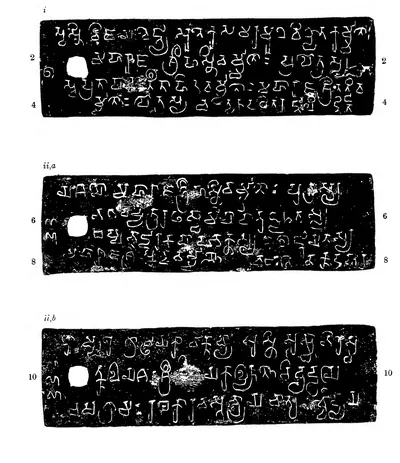 "Two Salankayana Charters from Kanukollu-Plate III. B.-Plates of Skandavarman, Year 1": plates i to ii b (Epigraphia Indica XXXI, Plate III, left half, between pp. 8 and 9 (PDF p. 32))Inscription rubbing · 1960
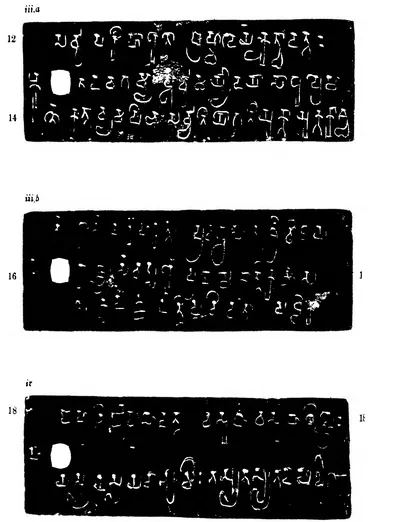 "Two Salankayana Charters from Kanukollu-Plate III. B.-Plates of Skandavarman, Year 1": plates iii a to iv (Epigraphia Indica XXXI, Plate III, right half, between pp. 8 and 9 (PDF p. 33))Inscription rubbing · 1960
References
Notes (0)
Sources (1)
Spotted an error on this page? Tell us
Last updated: