Pillalamarri inscription of Recherla Nami-reddi
A Sanskrit and Telugu pillar inscription of March 1202 at Pillalamarri near Suryapet, in the reign of Ganapatideva. It records the Nameshvara temple and the tanks and lands that the general Nami-reddi of the Recherla family gave to it. It also gives the family tree of the Pillalamarri branch of the Recherla generals.
The pillar
The inscription is cut on a stone pillar in the courtyard of the Komareshvara temple, inside the village of Pillalamarri.1 The village was then in the Suryapet taluk of the Nalgonda district.1 P. Sreenivasachar edited it in 1940 as No. 41 of his Corpus of Inscriptions in the Telingana Districts, with three plates.1 The main record is in Sanskrit verse, and the details of the gift follow in Telugu prose.23
The family
The verses trace the donor’s family to Bamma.4 Bamma was a warrior said to have carried off the gate of Kanchi and so humbled the Choda king.4 His descendants were Mucca and Mucca’s son Kata.4 Kata’s son Kama married Kacha.5
Sreenivasachar’s list of inscriptions gives the line from the verses as Bamma, Mucca, Kata and Kama, followed by Kama’s son Nama (Nami-reddi).1 Nama’s wife was Aitama, and their son was Vishvanatha.1 Nama’s sister’s son was Prola.1
The record does not say that Nama belonged to the same family as Recherla Rudra, the general who built the Ramappa temple.1 P. V. Parabrahma Sastry, however, used an inscription at Yadlapalli to make Rudra’s father Kata a son of the same Kama by another wife.6 On that view, Nama was Rudra’s uncle.6
What it records
The verses place the gift in the reign of king Ganapati.2 They praise him for his victories and for bringing back the golden age.2 By his master’s favour, Nama installed a linga (stone emblem of Shiva) called Nameshvara.2
The Telugu prose names him as Recheruvula Nami-reddi, son of Kachambika.3 It dates the consecration at Pillalamarri to Saka 1124 (Saka is an Indian way of counting years), the year Dundubhi.3 The day was the fourteenth of the bright half of Chaitra, a Saturday.3 The Sanskrit verse in Sreenivasachar’s translation gives the eleventh day.23 He worked the date out as Saturday, 9 March 1202.7
Nama gave the god two tanks, the Gudla-cheruvu and the Katyake-cheruvu, with their fields.3 His wife Aitama, his son Vishvanatha and his nephew Prola each installed a Shiva and gave it an endowment.3
The prose adds more gifts of tanks and land to the gods Aiteshvara and Vishvanatheshvara.3 It also records a gift by Nama’s sister Vallasani to a god named after her son Prolaya.3 Land behind the Kudu-kudiya-Gaura-samudra was given to the same gods.31 The record gives Nama the usual Recherla titles, among them lord of the city of Amanikanti and sun of the Manuma family.38
Other records at Pillalamarri
Pillalamarri has several other Recherla records in the Corpus:
- No. 38 is dated in the reign of Rudradeva on Sunday, 23 April 1195.9 It records three lingas that Nama, son of Kama and Kacha, installed in the names of his father, his mother and himself, with gifts of land behind several tanks.9
- No. 37 records that Recheruvula Nami-reddi gave nineteen houses in the fort of Pillalamarri to the musicians, dancers and priests of the Nameshvara temple.9
- No. 42, of 1208–1216, records temples built by Eraka-sani of the same family.1
Parabrahma Sastry described the Pillalamarri and Nagulapadu chiefs as a branch of the Recherla family who served Prola II, Rudradeva and Ganapatideva. He wrote that Nami-reddi built some of the Pillalamarri temples in 1195, which were perhaps finished under Ganapatideva.610 He also wrote that the Nameshvara temple, with its two tanks and lands, was Nami-reddi’s foundation of 1202.610 He noted that this branch stayed at the rank of maha-samanta (great vassal), while the branch of Recherla Rudra rose to mandalika (provincial lord) status.10
Editions
The record is edited, with a translation, in Sreenivasachar’s Corpus, Part II (1940), pp. 114–122. The date is worked out on p. 181 and the list entry is on p. 194.17
Footnotes
-
P. Sreenivasachar (ed.), A Corpus of Inscriptions in the Telingana Districts, Part II (1940), p. 194, list of inscriptions, Nos. 41–42 (archive.org (opens in a new tab)). Paraphrased. ↩ ↩2 ↩3 ↩4 ↩5 ↩6 ↩7 ↩8 ↩9 ↩10
-
Sreenivasachar, Corpus, Part II (1940), p. 121, verses 23–28 (archive.org (opens in a new tab)). Paraphrased. ↩ ↩2 ↩3 ↩4 ↩5
-
Sreenivasachar, Corpus, Part II (1940), p. 122, verses 29–33 and lines 100–118 (archive.org (opens in a new tab)). Paraphrased. ↩ ↩2 ↩3 ↩4 ↩5 ↩6 ↩7 ↩8 ↩9 ↩10 ↩11
-
Sreenivasachar, Corpus, Part II (1940), p. 119, verses 4–8 (archive.org (opens in a new tab)). Paraphrased. ↩ ↩2 ↩3
-
Sreenivasachar, Corpus, Part II (1940), p. 120, verses 10–12 (archive.org (opens in a new tab)). Paraphrased. ↩
-
P. V. Parabrahma Sastry, The Kakatiyas of Warangal (1978), p. 144. ↩ ↩2 ↩3 ↩4
-
Sreenivasachar, Corpus, Part II (1940), p. 181, appendix of dates, No. 30 (archive.org (opens in a new tab)). Paraphrased. ↩ ↩2
-
Sreenivasachar, Corpus, Part II (1940), p. 118, text lines 100–105 (archive.org (opens in a new tab)). The titles are quoted from the text. ↩
-
Sreenivasachar, Corpus, Part II (1940), p. 193, list of inscriptions, Nos. 37–38 (archive.org (opens in a new tab)). Paraphrased. ↩ ↩2 ↩3
-
Parabrahma Sastry, The Kakatiyas of Warangal (1978), p. 145. ↩ ↩2 ↩3
Photos
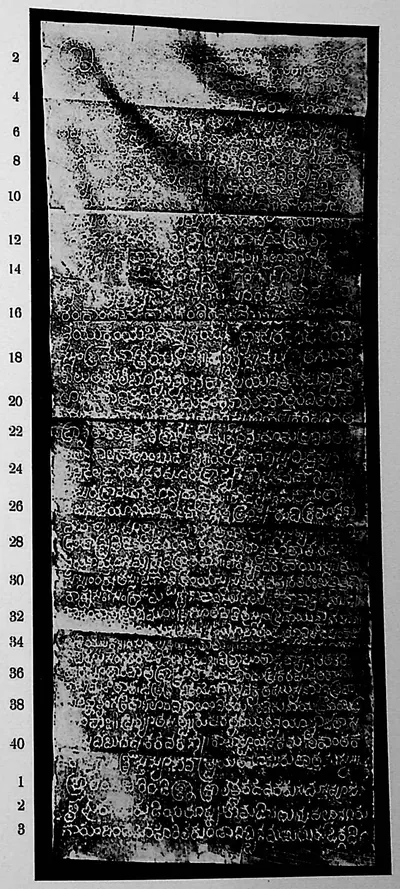 "Pillalamaṟṟi inscription of Nāmi-Reḍḍi (dated Saka 1124)", face I (Sreenivasachar, Corpus of Inscriptions in the Telingana Districts II, Plate 38 (PDF p. 296))Inscription rubbing · 1940
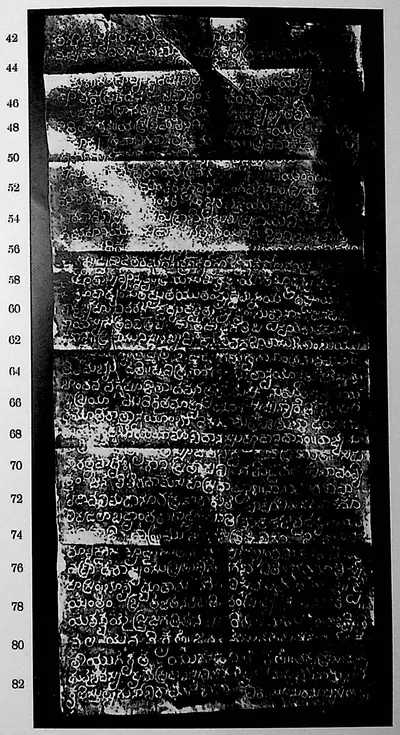 "Pillalamaṟṟi inscription of Nāmi-Reḍḍi (dated Saka 1124)", face II (Sreenivasachar, Corpus of Inscriptions in the Telingana Districts II, Plate 39 (PDF p. 298))Inscription rubbing · 1940
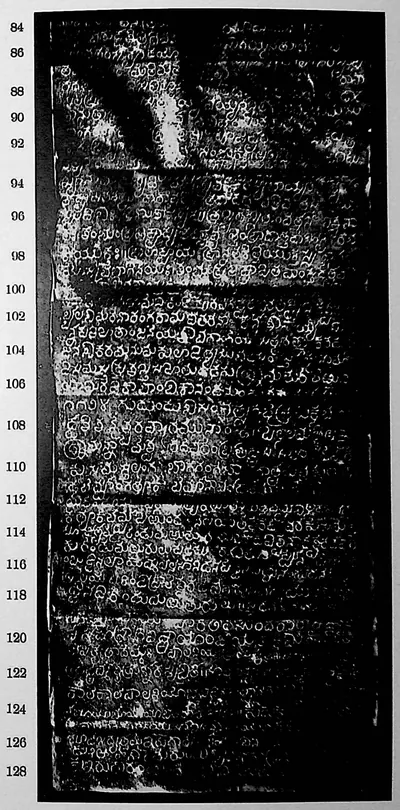 "Pillalamaṟṟi inscription of Nāmi-Reḍḍi (dated Saka 1124)", face III (Sreenivasachar, Corpus of Inscriptions in the Telingana Districts II, Plate 40 (PDF p. 300))Inscription rubbing · 1940
References
Notes (0)
Sources (2)
Spotted an error on this page? Tell us
Last updated: