Kondaparti inscription of Malyala Chaunda
A Sanskrit inscription of April 1203 on a pillar at Kondaparti near Warangal. It records the temple of Chaundeshvara and the gift of a village by Malyala Chaunda, commander-in-chief of the young Kakatiya king Ganapatideva. It gives the family line of the Malyala generals. P. V. Parabrahma Sastry read it as the record of the Kakatiya conquest of the Divi island.
The pillar
The inscription is cut on a stone pillar lying in the Venugopalasvami temple at Kondaparti, in the old Warangal taluk.1 P. Sreenivasachar edited it in 1940 as No. 8 of his Corpus of Inscriptions in the Telingana Districts, with two plates.1 The record is in ornate Sanskrit verse throughout. In his introduction Sreenivasachar counted it among the most valuable of the Sanskrit records in the collection.12 He thought, though, that its style showed a taste for show of words over clear expression.12
The Malyala family
The verses trace the donor’s family to the line of Durjaya.1 Its first named member is Danna or Dannapa, chief of Malyala.1 His son Sabba, lord of Samkisa, married Achama, and their son Kataya married Bollama.31 Kataya bore the title Kota-gelvata, and king Rudradeva made him his minister.34 Kataya’s sons were Pota and Chaunda.41 Chaunda, commander-in-chief of king Ganapati, married Mailama.451
What it records
The verses describe the temple that Chaunda built at Kondaparti, its golden finial, its sculpted figures and its enclosure wall.56 The chief minister Chaunda consecrated Shiva in the temple under the name Chaundeshvara.6 This was in Saka 1125 (Saka is an Indian way of counting years), the year Rudhirodgari, on the fifth day of the bright half of Vaishakha.6 He gave the god the whole village of Narukurki for its festivals and worship.6
An earlier verse says that he had founded an agrahara (Brahmin village) called Chaundapura for Brahmins.5 He built there a large tank, the Chaunda-samudra.5 Sreenivasachar dated the consecration probably to Thursday, 17 April 1203.1
The conquest of Divi
The last verses praise Chaunda’s campaigns in the usual terms. Enemy kings flee to islands in the sea, and Chaunda fills Ganapati’s treasury with gems taken from the treasuries of other kings.7 Sreenivasachar singled out one of Chaunda’s titles, Dvipi-lumtaka, as interesting.1
P. V. Parabrahma Sastry read the record as an account of the capture of Divi, the island near the mouth of the Krishna, from the forces of the Velanati chief Prithvishvara. In his reading, Chaunda plundered the island and filled Ganapatideva’s treasury with Prithvishvara’s diamonds.89 He received the title Dvipi-lumtaka, plunderer of the island.89 Parabrahma Sastry placed the campaign between 1203 and 1206. He noted that other generals also claimed victories over Prithvishvara.9 But the Kondaparti record alone calls Chaunda commander-in-chief.9 On his account the temple of Chaundesha was built to mark the victory.9
Chaunda and Ganapatideva
Parabrahma Sastry counted Malyala Chaunda, with Recherla Rudra, among the men without whom Ganapatideva might not have come to the throne.10 This was after the troubles that followed the death of Mahadeva.10 He identified Chaunda’s wife Mailama with Mailama, daughter of Annaya of the Viriyala family, known from an inscription at Katakuru.1112 He also traced the family’s rise to Chaunda’s father Kata. Kata won the title Kota-gelpata, conqueror of the Kotas, in Rudradeva’s campaign in coastal Andhra, and was later made minister.129
The second Kondaparti inscription
A second pillar lies in the Trikuta temple at Kondaparti.1 It records the temples of Shiva, Keshava and Proleshvara built by Kata of the same Malyala family, and the land he gave them.1 Sreenivasachar dated it to Saturday, 23 February 1241.113 It gives Kata the titles Kota-gelpata and Pedamuttu-ganda.113 Parabrahma Sastry wrote that Chaunda and his son Kata led the conquest of the Divi and Velanadu regions.14
Editions
Both records are edited, with translations, in Sreenivasachar’s Corpus, Part II (1940): No. 8 on pp. 31–41 and No. 9 from p. 42. The second date is worked out on p. 179, and both appear in the list of inscriptions on p. 186.113
Footnotes
-
P. Sreenivasachar (ed.), A Corpus of Inscriptions in the Telingana Districts, Part II (1940), p. 186, list of inscriptions, Nos. 8–9 (archive.org (opens in a new tab)). Paraphrased. ↩ ↩2 ↩3 ↩4 ↩5 ↩6 ↩7 ↩8 ↩9 ↩10 ↩11 ↩12 ↩13 ↩14 ↩15 ↩16
-
P. Sreenivasachar (ed.), A Corpus of Inscriptions in the Telingana Districts, Part I: Introduction (1942), p. 8 (archive.org (opens in a new tab)). Paraphrased. ↩ ↩2
-
Sreenivasachar, Corpus, Part II (1940), p. 37, verses 5–14 (archive.org (opens in a new tab)). Paraphrased. ↩ ↩2
-
Sreenivasachar, Corpus, Part II (1940), p. 38, verses 14–23 (archive.org (opens in a new tab)). Paraphrased. ↩ ↩2 ↩3
-
Sreenivasachar, Corpus, Part II (1940), p. 39, verses 24–32 (archive.org (opens in a new tab)). Paraphrased. ↩ ↩2 ↩3 ↩4
-
Sreenivasachar, Corpus, Part II (1940), p. 40, verses 32–39 (archive.org (opens in a new tab)). Paraphrased. ↩ ↩2 ↩3 ↩4
-
Sreenivasachar, Corpus, Part II (1940), p. 41, verses 52–54 (archive.org (opens in a new tab)). Paraphrased. ↩
-
P. V. Parabrahma Sastry, The Kakatiyas of Warangal (1978), p. 107. ↩ ↩2
-
Parabrahma Sastry, The Kakatiyas of Warangal (1978), p. 150. ↩ ↩2 ↩3 ↩4 ↩5 ↩6
-
Parabrahma Sastry, The Kakatiyas of Warangal (1978), p. 144. ↩ ↩2
-
Parabrahma Sastry, The Kakatiyas of Warangal (1978), p. 147. ↩
-
Parabrahma Sastry, The Kakatiyas of Warangal (1978), p. 149. ↩ ↩2
-
Sreenivasachar, Corpus, Part II (1940), p. 179, appendix of dates, No. 8 (archive.org (opens in a new tab)). Paraphrased. ↩ ↩2 ↩3
-
Parabrahma Sastry, The Kakatiyas of Warangal (1978), p. 116. ↩
Photos
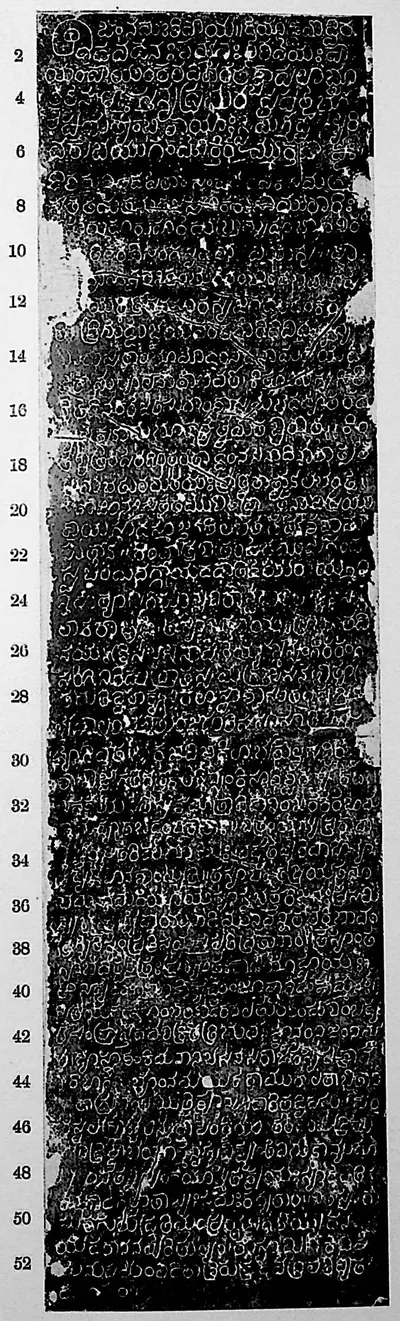 "Koṇḍiparti inscription of Cauṇḍa", face I (Sreenivasachar, Corpus of Inscriptions in the Telingana Districts II, Plate 11 (PDF p. 242))Inscription rubbing · 1940
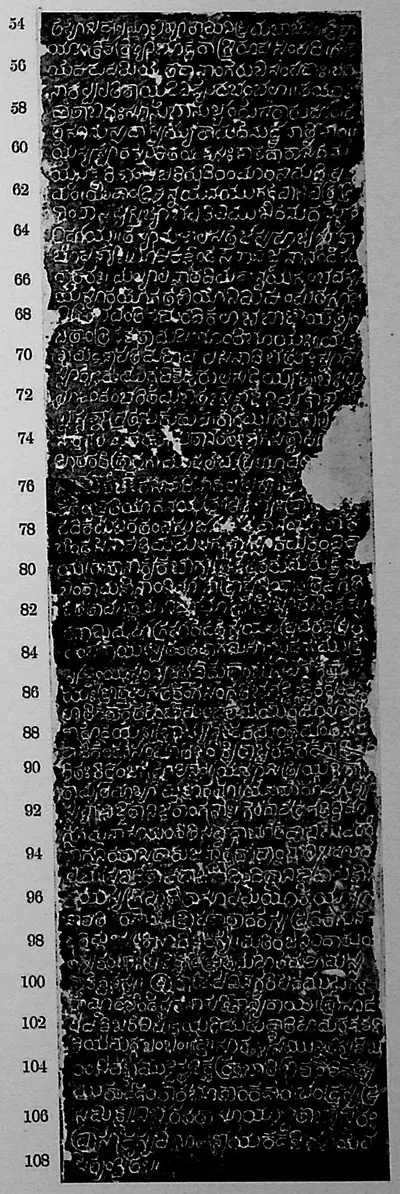 "Koṇḍiparti inscription of Cauṇḍa", face II (Sreenivasachar, Corpus of Inscriptions in the Telingana Districts II, Plate 11 (PDF p. 242))Inscription rubbing · 1940
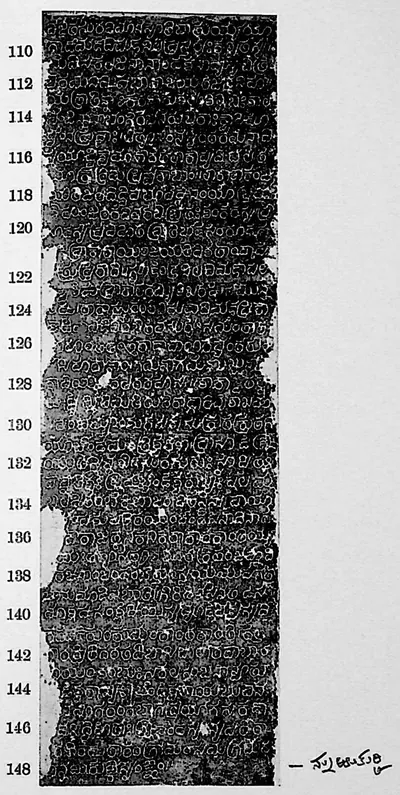 "Koṇḍiparti inscription of Cauṇḍa", face III (Sreenivasachar, Corpus of Inscriptions in the Telingana Districts II, Plate 12 (PDF p. 244))Inscription rubbing · 1940
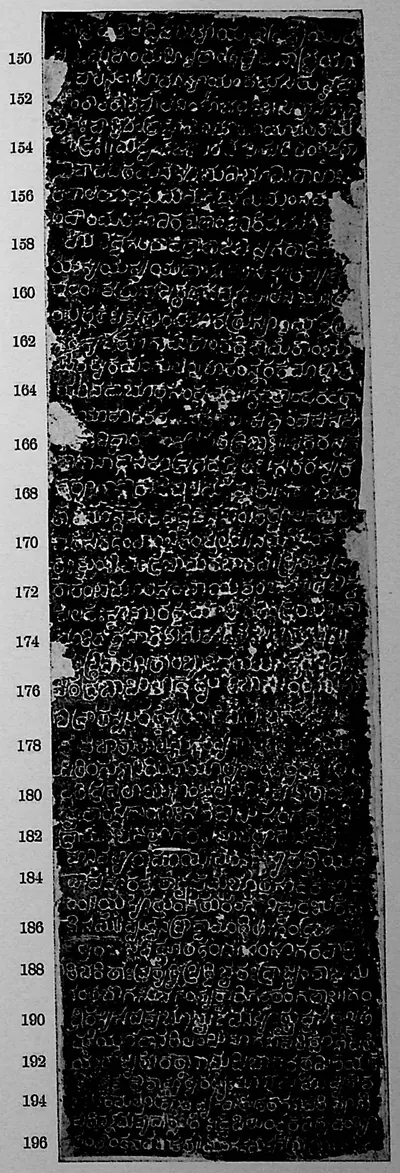 "Koṇḍiparti inscription of Cauṇḍa", face IV (Sreenivasachar, Corpus of Inscriptions in the Telingana Districts II, Plate 12 (PDF p. 244))Inscription rubbing · 1940
References
Notes (0)
Sources (3)
Spotted an error on this page? Tell us
Last updated: