Puvvada grant of Prolaya Vema (1346)
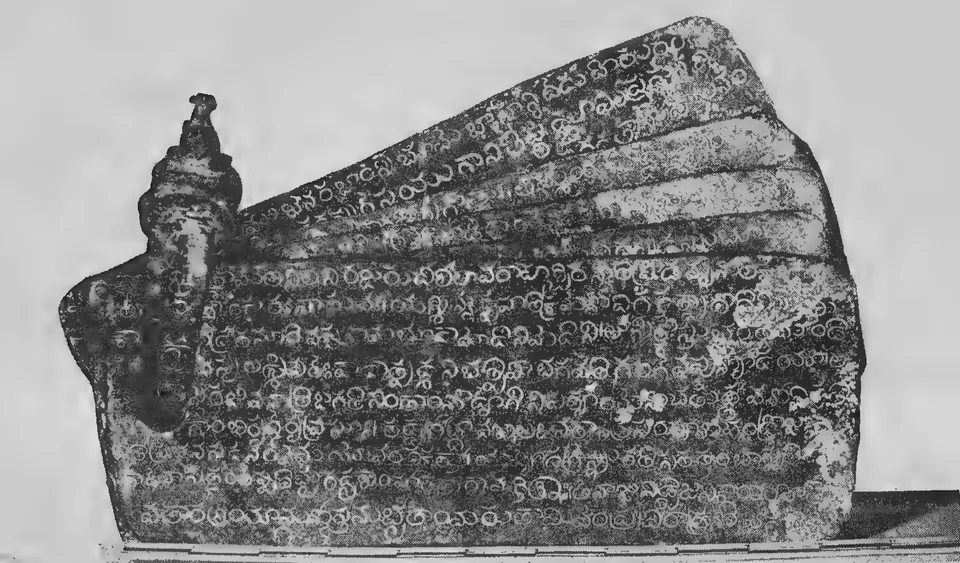
Five copper plates of 1346, found in an old well in the Tenali taluk and now in the Andhra Pradesh State Museum, Hyderabad. They record Prolaya Vema's gift of the village of Puvvada to Brahmans in sixty-four shares. The village lay between the forts of Addanki and Vinukonda and was renamed Vemapuri. The ring carries a Nandi seal and the sign-manual (royal signature) Sri Pallava Trinetra.
What it is
The Puvvada grant is a charter of Prolaya Vema, founder of the Reddi kingdom.1 He issued it in 1346, a year after his Madras Museum plates.1 N. Ramesan published it in 1962.1
Discovery and the plates
The plates were found in an old well in the Tenali taluk of the Guntur district.1 N. Bhagwandas, then Collector of Guntur, recovered them.1 Ramesan noticed them in his private collection, and Bhagwandas gave them to the Andhra Pradesh Government Museum at Hyderabad.1
There are five plates, each about 26.8 cm by 10.8 cm.1 They are held on a ring sealed with a Nandi, the usual emblem of the Kondavidu kings.1 The plates weigh 2,925 g and the ring 632 g.1 Only the first and last plates have raised rims, so some of the writing is worn.1
The 82 lines are in medieval Telugu characters.1 They are in Sanskrit, except for the boundaries of the village.1 The seal is inscribed Sri Pallava Trinetra, the sign-manual (royal signature) of the Kondavidu kings.1
Contents
The grant opens with an invocation of the boar incarnation of Vishnu and of the fourth caste born from his feet.12 It then names Vema as the founder of the line, and his son Komati Prola.12 It names Prola’s wife Annamamba and their five sons, Macha, Vema, Dodda, Anna and Malla.12 It likens the five sons to the five Pandavas.12
The second son, Vema, came to the throne.2 He restored the old agraharas (villages granted to Brahmans) and made new ones.2 He also built a flight of steps down to the Patalaganga river at Srisailam.2
He is compared to Agastya before the ocean of the Mlechchhas, the Muslims.3 A vigorous verse likens his sword to Siva dancing on the battlefield.3 He ruled the Andhra country east of Srisailam and next to the Gundlakamma from his capital Addanki.3 He is called a bee at the feet of his guru Ghoderaya-Ganga.3
On the tenth day of Ashadha in Saka 1268 (Saka is an Indian way of counting years), the cyclic year Vyaya, the king gave the village of Puvvada to learned Brahmans in sixty-four shares.34 He made the gift in the presence of the god of Srisailam.34 The grant says that from then on the village was called Vemapuri.34 It lay between the two forts of Addanki and Vinukonda.34
A list of the donees and their shares closes the text, with the usual imprecatory verses (curses on anyone who harms the gift).45
Date and place
The year is written in words as well as figures, and the words as engraved give 1262.5 Ramesan argued that a syllable has dropped out of the chronogram (the year in words), which should read 1268.5 That year agrees with both the figures and the cyclic year Vyaya.5 This gives the date as 17 or 31 July 1346.5
Ramesan identified the village with Puvvada in the Guntur district, between Addanki and Vinukonda.5 See Addanki.
Importance
Ramesan used the grant to discuss the family’s titles. Of the legend that the family’s wealth came from a stolen philosopher’s stone, he noted only two things.4 The names Vema and Komati recur in the family, and another grant credits Prolaya Vema with knowledge of alchemy.4
Ramesan reported a suggestion of M. Somasekhara Sarma: Ghoderaya-Ganga was the minister of the Kakatiya feudatory Ambadeva.6 He explained the title Pallava Trinetra by marriages with Pallava chiefs of Nellore, or by the family’s origin in the Panta country.6 He did not explain it by Pallava descent.6
Footnotes
-
N. Ramesan, Copper Plate Inscriptions of Andhra Pradesh Government Museum, Hyderabad, Vol. I (1962), pp. 173–174 (archive.org (opens in a new tab)). ↩ ↩2 ↩3 ↩4 ↩5 ↩6 ↩7 ↩8 ↩9 ↩10 ↩11 ↩12 ↩13 ↩14 ↩15 ↩16 ↩17
-
Ramesan, Copper Plate Inscriptions, Vol. I (1962), p. 174 (archive.org (opens in a new tab)). ↩ ↩2 ↩3 ↩4 ↩5 ↩6 ↩7
-
Ramesan, Copper Plate Inscriptions, Vol. I (1962), p. 175 (archive.org (opens in a new tab)). ↩ ↩2 ↩3 ↩4 ↩5 ↩6 ↩7 ↩8
-
Ramesan, Copper Plate Inscriptions, Vol. I (1962), p. 176 (archive.org (opens in a new tab)). ↩ ↩2 ↩3 ↩4 ↩5 ↩6 ↩7
-
Ramesan, Copper Plate Inscriptions, Vol. I (1962), p. 178 (archive.org (opens in a new tab)). ↩ ↩2 ↩3 ↩4 ↩5 ↩6
-
Ramesan, Copper Plate Inscriptions, Vol. I (1962), pp. 177–178 (archive.org (opens in a new tab)). ↩ ↩2 ↩3
Photos
 Puvvada grant of Prolaya Vema, Saka 1268 (A.D. 1346): general view of the five plates on their ring with the seal (Ramesan 1962, Plate XI (d), PDF p. 231)Photograph · 1962
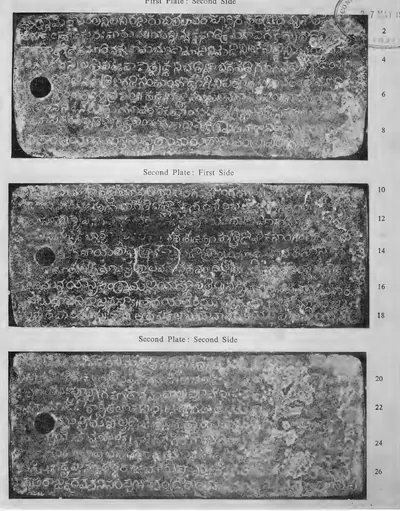 Puvvada grant of Prolaya Vema, Saka 1268 (A.D. 1346): photographs of the plates, first plate second side, second plate both sides (lines 1-27) (Ramesan 1962, Plate XI (a), PDF p. 226)Photograph · 1962
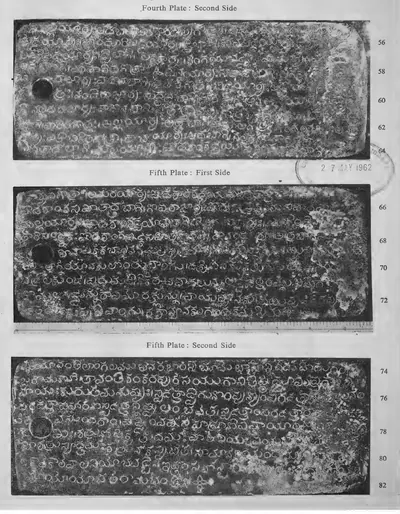 Puvvada grant of Prolaya Vema, Saka 1268 (A.D. 1346): photographs of the plates, fourth plate second side, fifth plate both sides (lines 55-82) (Ramesan 1962, Plate XI (c), PDF p. 230)Photograph · 1962
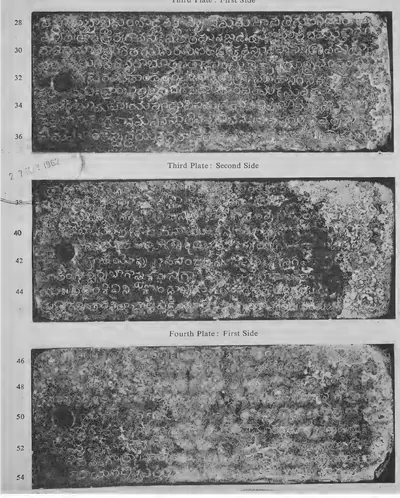 Puvvada grant of Prolaya Vema, Saka 1268 (A.D. 1346): photographs of the plates, third plate both sides, fourth plate first side (lines 28-54) (Ramesan 1962, Plate XI (b), PDF p. 227)Photograph · 1962
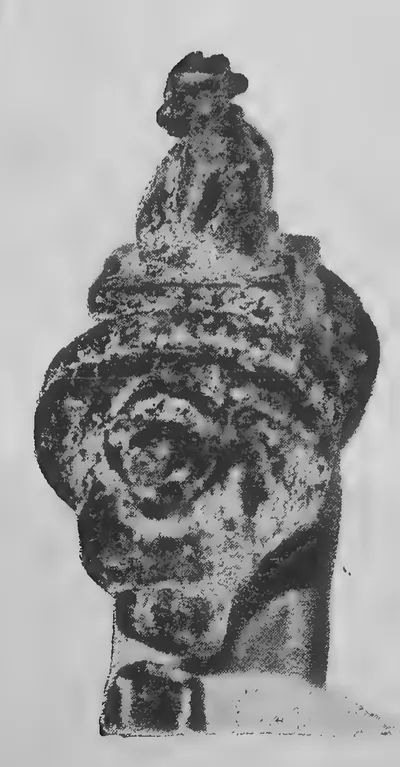 Puvvada grant of Prolaya Vema, Saka 1268 (A.D. 1346): the Nandi seal on the ring (Ramesan 1962, Plate XI (d), PDF p. 231)Photograph · 1962
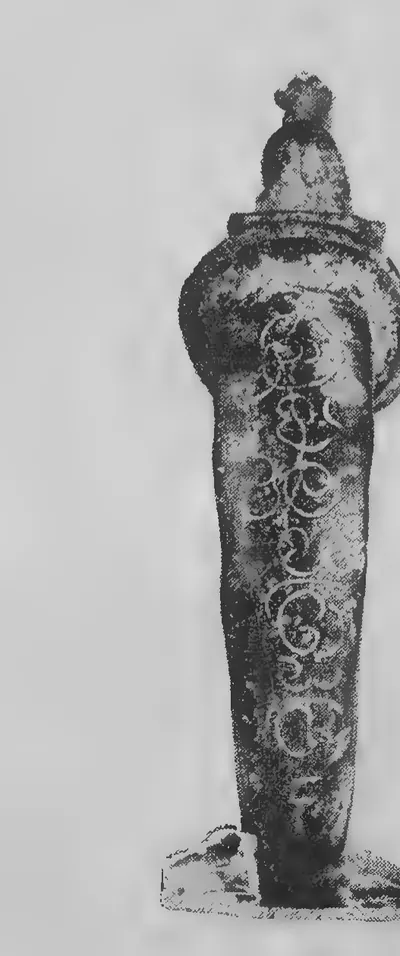 Puvvada grant of Prolaya Vema, Saka 1268 (A.D. 1346): the ring, inscribed "Sri Pallava Trinetra" (Ramesan 1962, Plate XI (d), PDF p. 231)Photograph · 1962
References
Notes (0)
Sources (1)
Spotted an error on this page? Tell us
Last updated: