Reddis of Kondaveedu
Telugu dynasty of the Panta Reddi family. It rose on the coast after the fall of the Kakatiyas and ruled for about a hundred years, from about 1325 to the 1420s, first from Addanki and then from the hill fortress of Kondavidu. Its six kings, from Prolaya Vema to Racha Vema, held the country between Srisailam and the sea and at times the Godavari delta. They built the flights of steps at Srisailam and Ahobilam, fought the Recherla Velamas, Vijayanagara and the Bahmanis, and kept a court where Errapragada and Srinatha wrote. Under Kumaragiri the eastern half of the kingdom became a separate state at Rajahmundry.
Swipe sideways to see the whole chart; tap a bar for details.
Each bar is a ruling power in its region; time runs left to right. Dashed = approximate dates. Select a bar for details.
Show as a list
Kakatiyas 1163–1323 CE
- Telangana
- Kakatiyas (c. 1163–1323 CE)
- Coastal Andhra
- Eastern Gangas of Kalinga (c. 537–1434 CE) · Haihayas of Kona and Palnadu (c. 1073–1364 CE) · Kotas of Dharanikota (c. 1100–1276 CE) · Telugu Chodas of Pottapi and Nellore (c. 1106–1316 CE) · Cholas of Tanjore (c. 1135–1264 CE) · Kakatiyas (c. 1185–1323 CE) · Pandyas (c. 1260–1264 CE)
- Rayalaseema
- Cholas of Tanjore (c. 985–1268 CE) · Pandyas (1285–1293 CE) · Telugu Chodas of Pottapi and Nellore (c. 1120–1268 CE) · Hoysalas (c. 1178–1342 CE) · Kakatiyas (c. 1250–1323 CE)
Nayakas, Reddis & Bahmanis 1323–1518 CE
- Telangana
- Musunuri Nayakas (c. 1336–1368 CE) · Gajapatis of Orissa (c. 1459–1461 CE) · Adil Shahis of Bijapur (c. 1489–1686 CE) · Delhi Sultanate (Tughluqs) (c. 1323–1336 CE) · Bahmani Sultanate (c. 1347–1518 CE) · Recherla Velamas (Padmanayakas) (c. 1361–1475 CE)
- Coastal Andhra
- Eastern Gangas of Kalinga (c. 537–1434 CE) · Gajapatis of Orissa (c. 1446–1571 CE) · Haihayas of Kona and Palnadu (c. 1073–1364 CE) · Reddis of Rajahmundry (c. 1386–1448 CE) · Bahmani Sultanate (c. 1471–1489 CE) · Delhi Sultanate (Tughluqs) (c. 1323–1326 CE) · Vijayanagara Empire (c. 1350–1579 CE) · Reddis of Kondaveedu (c. 1325–1424 CE) · Musunuri Nayakas (c. 1325–1346 CE)
- Rayalaseema
- Vijayanagara Empire (c. 1336–1646 CE) · Reddis of Kondaveedu (c. 1346–1386 CE) · Hoysalas (c. 1178–1342 CE)
Vijayanagara & the Qutb Shahis 1336–1687 CE
- Telangana
- Musunuri Nayakas (c. 1336–1368 CE) · Gajapatis of Orissa (c. 1459–1461 CE) · Adil Shahis of Bijapur (c. 1489–1686 CE) · Bahmani Sultanate (c. 1347–1518 CE) · Recherla Velamas (Padmanayakas) (c. 1361–1475 CE)
- Coastal Andhra
- Eastern Gangas of Kalinga (c. 537–1434 CE) · Gajapatis of Orissa (c. 1446–1571 CE) · Haihayas of Kona and Palnadu (c. 1073–1364 CE) · Reddis of Rajahmundry (c. 1386–1448 CE) · Bahmani Sultanate (c. 1471–1489 CE) · Vijayanagara Empire (c. 1350–1579 CE) · Reddis of Kondaveedu (c. 1325–1424 CE) · Musunuri Nayakas (c. 1325–1346 CE)
- Rayalaseema
- Vijayanagara Empire (c. 1336–1646 CE) · Reddis of Kondaveedu (c. 1346–1386 CE) · Hoysalas (c. 1178–1342 CE)
Kingdoms and empires
Kakatiyas
Open page- Telangana: c. 1052–1162 CE (c. 110 years)
Partial: feudatory chiefs of Anumakonda (Hanamkonda) under the Chalukyas of Kalyani. Prola I received the Anumakonda district as a permanent fief from Someshvara I (record of 1053); Prola II's last record as a subordinate is of 1149; Rudradeva subdued the other Telangana chiefs c. 1157–62 (Parabrahma Sastry). Earlier members served the Rashtrakutas (Mangallu grant, c. 956) according to Parabrahma Sastry, a link rejected by Venkataramanayya and Somasekhara Sarma (1960).
- Telangana: c. 1163–1323 CE (c. 160 years)
Sovereign from Rudradeva's Anumakonda inscription of January 1163; capital moved to Orugallu (Warangal) under Ganapatideva. Warangal taken by Ulugh Khan in 1323 (Parabrahma Sastry, after Isami); Barani and the Imperial Gazetteer give 1321.
- Coastal Andhra: c. 1185–1323 CE (c. 138 years)
Rudradeva subdued the Kotas of Dharanikota and the Kondapadumatis (Tripurantakam grant 1185); Ganapatideva annexed Divi (1203) and Velanadu (records from 1209; Jaya governor 1213) and held the coast from the Godavari to the Penna; Kakatiya records at Draksharama from 1212, but the Eastern Gangas held the region north of the Godavari c. 1230–33 and again c. 1262–78; the Telugu Chodas of Nellore were allies; Nellore was lost to the Pandyas c. 1263 and recovered under Prataparudra.
- Rayalaseema: c. 1250–1323 CE (c. 73 years)
Through the Kayastha chiefs (Gangaya Sahini, bahattara-niyogadhipati c. 1250, capital Valluru in Cuddapah); Ambadeva independent c. 1272–1291, until Prataparudra's armies retook Tripurantakam (between 13 June and 11 August 1291) and the Kayastha lands within about eight years.
Rulers (11)
Capitals
Monuments (16)
Inscriptions (36)
- Kazipet Dargah pillar inscription
- Matedu inscription of Vemabola Malle-nayaka
- Gudur pillar inscriptions of the Viriyala family
- Thousand Pillar Temple inscription of Rudradeva
- Karimnagar inscription of Gangadhara
- Warangal fort inscription of Rudradeva
… and 30 more
- Pillalamarri inscription of Recherla Nami-reddi
- Kondaparti inscription of Malyala Chaunda
- Inugurti pillar inscription of Natavadi Rudra
- Bayyaram tank inscription of Mailama
- Chebrolu inscription of Jaya
- Palampet pillar inscription of Recherla Rudra
- Ganapavaram inscription of Devapala
- Warangal toll inscription of Ganapatideva
- Ganapesvaram inscription of Jaya
- Upparapalli pillar inscription of Kataya
- Motupalli pillar inscription of Ganapatideva
- Pakhal lake inscription of Jagadala Mummadi
- Rayaparti fragment of Saka 1169
- Ekamranatha temple inscription of Ganapati
- Nayanapalle inscription of Ganapatideva
- Durgi inscription of Gangaya-sahini
- Sarngapuram plates of Sarngadhara
- Bothpur tank inscription of Malyala Gunda
- Garavapadu plates of Ganapatideva
- Malkapuram pillar inscription of Rudramadevi
- Kotagiri plates of Viryala Sura
- Kolanupaka inscription of Rudramadevi's reign
- Chandupatla inscription
- Panugallu inscription of Immadi Mallikarjuna-nayaka
- Tripurantakam inscription of Ambadeva
- Raichur fort inscription of Gona Vithala
- Mellacheruvu inscription of Prataparudra's reign
- Srirangam inscription of Prataparudra
- Dharmasagar inscription of the minister Malla
- Hanamkonda inscription of Gangadhara
Sources (7)
Kingdoms and empires
Musunuri Nayakas
Open page- Coastal Andhra: c. 1325–1346 CE (c. 21 years)
Prolaya Nayaka recovered the coast from Delhi in 1325-26 and ruled from Rekapalli on the Godavari (Vilasa grant, about 1330); latest dated Musunuri records on the coast are Kapaya's Guraja grant (February 1346) and his Ganapesvaram inscription (1346-47). Partial: the Reddis of Addanki and the Korukonda chiefs held parts of the coast as Kapaya's kinsmen and subordinates
- Telangana: c. 1336–1368 CE (c. 32 years)
Kapaya Nayaka took Warangal about 1336-37 (Ferishta: 1343-44) and ruled as "lord of the Andhra country" (Pillalamarri inscription, 1357); ceded Kaulas and then Golconda (1364-65) to the Bahmanis; overthrown by the Recherla chief Anapota about 1368 (Kapaya named in the Akkalapundi grant of 1368; Anapota ruling Orugallu in July 1369)
Rulers
Capitals
Inscriptions
Sources (9)
Kingdoms and empires
Gajapatis of Orissa
Open page- Coastal Andhra: c. 1446–1571 CE (c. 125 years)
Kapilendra (Kapilesvara, r. 1434-35 to 1469-70) took the Reddi kingdom of Rajahmundry between 1444 and 1448 and held Kondavidu by 1454 through his kinsman Ganadeva; the Bahmanis took Rajahmundry and Kondapalli or Kondavidu in 1470-71 and Purushottama had recovered the Godavari-Krishna country and the Ongole taluk by 1489; the country south of the Krishna passed to Saluva Narasimha after 1470 and, with Udayagiri, Kondavidu and Kondapalli, to Krishnadeva Raya in 1513-16; Golconda took the Godavari-Krishna doab from about 1522 and Rajahmundry in 1571-72. The northern coast (Srikurmam, Simhachalam) stayed Gajapati throughout.
- Telangana: c. 1459–1461 CE (c. 2 years)
Brief: Orissan troops relieved Devarakonda from the Bahmanis in 1459, and Kapilendra's son Hamvira and nephew Raghudeva took Warangal on 2 February 1460 (two gateway inscriptions); in 1461-62 the Orissan army and the zemindars of Telangana marched on Bidar. How long Warangal was held is not recorded
- Telangana: c. 1497–1516 CE (c. 19 years)
Partial: the uplands of Khammam and the Kondapalli-Nelakondapalli country, held by Prataparudra until Krishnadeva Raya's campaigns (Banerji; Nizam's Archaeological Department)
Rulers
- Kapilendra (Kapilesvara) (c. 1434–1470 CE)
- Purushottama (Gajapati) (c. 1470–1497 CE)
- Prataparudra (Gajapati) (c. 1497–1540 CE)
- Kalua Deva (c. 1540–1541 CE)
- Kakharua Deva (c. 1541 CE)
Inscriptions (8)
Sources (10)
Sultanates
Adil Shahis of Bijapur
Open page- Telangana: c. 1489–1686 CE (c. 197 years)
After the Bahmani break-up part of Mahbubnagar district went to Bijapur (the rest to Golconda) and stayed with it until Aurangzeb annexed Bijapur in 1686; the Raichur district article likewise passes Raichur (which then included the Alampur taluk and Gadwal) from the Bahmanis to the Adil Shahis.
- Rayalaseema: c. 1568–1686 CE (c. 118 years)
Partial, the western uplands only. Adoni taken by Ali Adil Shah's general Ankus Khan in 1568 after a failed siege in 1535-37; Penukonda besieged in the 1570s (dates disputed) and taken in 1652 (Mackenzie MS); Kurnool taken from Gopala Raja early in the 17th century and governed by Abdul Wahab (d. 1618) and later deputies, Siddi Jauhar holding it as his jagir about 1660; the Bellary and Anantapur uplands held through governors and tributary poligars; Bijapur's rights there passed to Shivaji in 1677-80 (Francis); Bijapur fell to Aurangzeb on 12 September 1686, but Siddi Masud held Adoni until 1688 (Sarkar) or 1687 (Bellary gazetteer)
Rulers (9)
Capitals
Monuments
Sources (11)
Sultanates
Delhi Sultanate (Tughluqs)
Open page- Telangana: c. 1323–1336 CE (c. 13 years)
Province of Tilang after Ulugh Khan (Muhammad bin Tughluq) took Warangal and renamed it Sultanpur (1321 by Barani's date for the campaign, 1323 in Haig and the editors of the Vilasa grant). Earlier Khalji campaigns (1303, 1309-10, 1318) ended in failure or tribute and are not drawn. Lost to a Hindu rising under Kanya Naik (Kapaya Nayaka) soon after the cholera of 1335 (Barani), about 1336-37 (modern historians) or in 1343-44 (Ferishta)
- Coastal Andhra: c. 1323–1326 CE (c. 3 years)
Brief hold on the Godavari delta and the coast: mosque at Rajahmundry built in 1324 by Ulugh Khan's servant Salar Ulwi; the coast retaken by Prolaya Nayaka and his allies between 1325 and 1326
Rulers
- Ala-ud-din Khalji (1296–1316 CE)
- Qutb-ud-din Mubarak Shah (1316–1320 CE)
- Ghiyas-ud-din Tughluq (1320–1325 CE)
- Muhammad bin Tughluq (1325–1351 CE)
Sources (7)
Sultanates
Bahmani Sultanate
Open page- Telangana: c. 1347–1518 CE (c. 171 years)
Western Telangana from 1347 (Kaulas taken or ceded; Bhongir taken late in Bahman Shah's reign, the province of Bidar reaching east to Bhongir); Golconda ceded under Muhammad Shah I (1362 Bilgrami; 1364-65 Haig, IG); Warangal taken in AH 828 (end of 1424 per Haig, 1422 per IG, 1425 per the Kistna Manual) and the rayas of Devarakonda and Rachakonda made tributary. Partial afterwards (Telugu chiefs regained districts under Ahmad I; Devarakonda relieved by Orissa 1459; Warangal held by the Gajapatis 1460 and by Shitab Khan from 1504). Governed for Mahmud Shah by Sultan Quli from 1495-96 until his independence (1512 per Haig; 1518 per Bilgrami, from the Golconda mosque inscription of AH 924)
- Coastal Andhra: c. 1471–1489 CE (c. 18 years)
Rajahmundry and Kondapalli (Ferishta) or Kondavidu (Haig, Burhan-i Ma'asir) taken by Malik Hasan Bahri in AH 876 (1471-72), on the invitation of a claimant to the Orissan throne (the Godavari gazetteer says Purushottama ceded the two districts); Muhammad Shah III at Rajahmundry for nearly three years after his Orissa campaign of 1478, and raided Masulipatam and Kanchi in 1481; Telingana split into the provinces of Rajahmundry and Warangal; Rajahmundry still Bahmani in 1486; the Godavari-Krishna country recovered by the Gajapati Purushottama by 1489
Rulers (18)
- Ala-ud-din Hasan Bahman Shah (1347–1358 CE)
- Muhammad Shah I (1358–1375 CE)
- Mujahid Shah (1375–1378 CE)
- Daud Shah (1378 CE)
- Muhammad Shah II (1378–1397 CE)
- Ghiyas-ud-din (1397 CE)
… and 12 more
- Shams-ud-din Daud (1397 CE)
- Firuz Shah (1397–1422 CE)
- Ahmad Shah I (1422–1435 CE)
- Ala-ud-din Ahmad Shah II (1435–1458 CE)
- Humayun Shah (1458–1461 CE)
- Nizam Shah (1461–1463 CE)
- Muhammad Shah III (1463–1482 CE)
- Mahmud Shah Bahmani (1482–1518 CE)
- Ahmad Shah (c. 1518–1521 CE)
- Ala-ud-din (c. 1521–1523 CE)
- Wali-ullah Shah (c. 1523–1525 CE)
- Kalim-ullah Shah (c. 1525–1527 CE)
Inscriptions
Sources (12)
Kingdoms and empires
Recherla Velamas (Padmanayakas)
Open page- Telangana: c. 1361–1475 CE (c. 114 years)
Anapota at Rachakonda (Rajukonda) and Mada at Devarakonda after their victories of 1361 (family chronicle); Rachakonda fortified in August 1365; Warangal, Bhongir and Rachakonda ruled by July 1369 (Inavolu inscription). The rayas of Devarakonda and Rachakonda paid tribute to Ahmad Shah Bahmani after his capture of Warangal (end of 1424); Devarakonda routed a Bahmani army with Orissan help in 1459; last dated record of the Rachakonda line 1464. End about 1475 per the list of rulers in Epigraphia Telanganica; no source dates the annexation
Rulers (7)
- Singama Nayaka (Recherla) (c. 1336–1361 CE)
- Anapota Nayaka (Recherla) (c. 1361–1384 CE)
- Mada Nayaka (Recherla) (c. 1361–1384 CE)
- Singabhupala (Recherla) (c. 1384–1399 CE)
- Peda Vedagiri (Recherla) (c. 1384–1410 CE)
- Lingama Nayaka (Recherla) (c. 1427–1475 CE)
… and 1 more
- Singama Nayaka, 'Sarvajna' (Rachakonda) (c. 1430–1475 CE)
Capitals
Monuments
Inscriptions
Sources (7)
Kingdoms and empires
Eastern Gangas of Kalinga
Open page- Coastal Andhra: c. 537–1434 CE (c. 897 years)
Partial: only the far north coast (the old Ganjam and Vizagapatam districts, now Srikakulam-Vizianagaram- Visakhapatnam), capital Kalinganagara (Mukhalingam). Earliest dated grant: Jirjingi, near Tekkali, Ganga year 39 (c. 537 on Mirashi's epoch of 498; Fleet put the early grants in the 7th century and Sewell used an epoch of 877-78; the Imperial Gazetteer, the 7th century). Later line in power from the end of the 9th century (Vizagapatam gazetteer): Vajrahasta III crowned 1038; Anantavarman Chodaganga 1078-1146, with records at Mukhalingam, Srikurmam, Simhachalam and Visakhapatnam. South of the Godavari only records and raids (Draksharama 1128-1274; Bendapudi). Ended 1434, when the minister Kapilesvara founded the Gajapati line
Rulers (15)
- Vajrahasta III (Eastern Ganga) (1038–1070 CE)
- Rajaraja I (Eastern Ganga) (1070–1078 CE)
- Anantavarman Chodaganga (c. 1078–1146 CE)
- Madhu-Kamarnava (c. 1146–1152 CE)
- Raghava (c. 1152–1166 CE)
- Rajaraja II (c. 1166–1192 CE)
… and 9 more
- Aniyanka-Bhima (c. 1192–1202 CE)
- Anangabhima III (c. 1219–1253 CE)
- Narasimha I (Eastern Ganga) (c. 1253–1256 CE)
- Bhanudeva I (c. 1256–1275 CE)
- Narasimha II (c. 1275–1306 CE)
- Bhanudeva II (c. 1306–1323 CE)
- Narasimha III (c. 1323–1346 CE)
- Bhanudeva III (c. 1346–1378 CE)
- Narasimha IV (c. 1378–1397 CE)
Capitals
Monuments
Inscriptions (8)
Sources (10)
Kingdoms and empires
Haihayas of Kona and Palnadu
Open page- Coastal Andhra: c. 1073–1364 CE (c. 291 years)
Partial. Kona chiefs of Konamandala (the Godavari delta, Amalapuram taluk), with records at Draksharama and Palakol from Saka 995 (1073) to 1364–65, dependent on the Chola–Chalukya kings and the Velanati Chodas, later on the Kakatiyas; Haihaya chiefs of the Chagi family in the Palnadu (Macherla 1111, Gurazala 1129) as feudatories of the Chalukyas of Kalyani; the Palnadu war of the ballads is undated (proposals 1080–1386).
Rulers
- Rajendra Choda I of Kona (1128 CE)
- Mummadi-Bhima II and Satya I (1135 CE)
- Bhima III (c. 1153–1168 CE)
- Mallideva of Kona (c. 1155–1207 CE)
- Ganapatideva of Kona (c. 1262–1300 CE)
- Bhima-Vallabha (1318 CE)
Inscriptions
Sources (5)
Kingdoms and empires
Reddis of Rajahmundry
Open page- Coastal Andhra: c. 1386–1448 CE (c. 62 years)
Partial: the Godavari delta and the coast north to Simhachalam, capital Rajahmundry. Kataya Vema, minister of Kumaragiri, received "the eastern country" by 1386 (Ramayya; Sewell c. 1380); after his death (c. 1414-16) Allada Reddi, then Allada's sons Allaya Vema and Virabhadra (records 1423-1437, a record of 1444). Godavari gazetteer: family in the Draksharama inscriptions until 1447; a Gajapati record of 1448 at Penugonda marks the end (Somasekhara Sarma); Kapilesvara's minister ruling at Rajahmundry in 1458
Rulers
- Kataya Vema (c. 1386–1415 CE)
- Allada Reddi (c. 1416–1420 CE)
- Allaya Vema and Virabhadra (c. 1423–1448 CE)
Capitals
Inscriptions
Sources (6)
Kingdoms and empires
Kotas of Dharanikota
Open page- Coastal Andhra: c. 1100–1276 CE (c. 176 years)
Partial (the Six-thousand country, Konnatavadi, south of the Krishna about Amaravati–Dharanikota and the Sattenapalle taluk). Line from Bhima I (c. 1100, Sewell); Keta II from about 1182; subdued by the Kakatiya Rudradeva about 1185 and thereafter Kakatiya subordinates and relatives by marriage (Ganapamba, widow of Kota Beta, ruled in the 1250s); last record of a Kota Rudra 1275–76.
Rulers
- Kota Keta II (c. 1182–1209 CE)
- Manma-Keta (Keta III) (c. 1234–1240 CE)
- Kota Beta (c. 1250–1251 CE)
- Ganapamba (c. 1251–1257 CE)
- Bhima IV (1265 CE)
Capitals
Inscriptions
Sources (5)
Kingdoms and empires
Vijayanagara Empire
Open page- Rayalaseema: c. 1336–1646 CE (c. 310 years)
Founded c. 1335-36; Bukka I held Penukonda and Gooty (records of 1352 and a Gooty rock inscription) and his minister built the Bukkarayasamudram tank near Anantapur in 1364; Cuddapah in the 14th century; Kurnool wholly annexed under Krishnadeva Raya. After Talikota (1565) the kings ruled from Penukonda, which held out against Bijapur in 1577 and Golconda in 1589; the country north of Penukonda was lost after Sriranga I's capture (c. 1579-80); Venkatapati II moved to Chandragiri c. 1592; Golconda held the Cuddapah district and took Chandragiri (Chittoor) in 1646. Bijapur and Golconda took most of the region piecemeal after 1565
- Coastal Andhra: c. 1350–1579 CE (c. 229 years)
Vijayanagara officers kept Guntur (Kondavidu, Vinukonda, Bellamkonda) and the governor of Udayagiri kept Nellore after Talikota; Golconda took Kondavidu in April 1579 (Kistna Manual) or 1580 (a Guntur record of 1592 cited by Sewell), though Sewell thinks Guntur was already under Muslim rule by 1576 and the Nellore Manual says the Muslims held Nellore from 1565.
- Telangana: c. 1563–1565 CE (c. 2 years)
To end the confederate invasion of Golconda, Ibrahim Qutb Shah let Rama Raja keep the forts of Ghanpur and Panagal (Mahbubnagar) until Talikota; Ferishta places this after the Kalyani campaign of the early 1560s, the Kistna Manual dates it to 1557.
Rulers (24)
- Harihara I (Vijayanagara) (c. 1336–1355 CE)
- Bukka I (Vijayanagara) (1355–1377 CE)
- Harihara II (1377–1404 CE)
- Bukka II (1404–1406 CE)
- Deva Raya I (1406–1422 CE)
- Vijaya (Bukka III) (1422 CE)
… and 18 more
- Deva Raya II (Vijayanagara) (1422–1446 CE)
- Mallikarjuna (1446–1465 CE)
- Virupaksha (1465–1485 CE)
- Saluva Narasimha (1485–1492 CE)
- Immadi Narasimha (1492–1505 CE)
- Narasa Nayaka (c. 1505 CE)
- Vira Narasimha (1505–1509 CE)
- Krishnadeva Raya (1509–1529 CE)
- Achyuta Raya (1529–1542 CE)
- Venkata I (1542 CE)
- Sadasiva (c. 1542–1569 CE)
- Tirumala (Aravidu) (c. 1569–1572 CE)
- Sriranga I (1572–1586 CE)
- Venkatapati II (Vijayanagara) (1586–1614 CE)
- Sriranga II (1614 CE)
- Rama Deva (1614–1630 CE)
- Pedda Venkata (1630–1642 CE)
- Sriranga III (c. 1642–1670 CE)
Monuments (7)
- Penukonda fort and Gagan Mahal
- Kalahastisvara temple, Srikalahasti
- Virabhadra temple, Lepakshi
- Chandragiri fort and Raja Mahal
- Gooty fort
- Narasimha temples, Ahobilam
… and 1 more
Inscriptions (14)
- Penukonda fort inscription (1354)
- Gooty rock inscription of Bukka I
- Bitragunta grant of Sangama II (1356)
- Bukkarayasamudram tank inscription (1364)
- Tirumala inscriptions of Krishnadeva Raya and his queens (1513–1514)
- Amaravati inscription of Krishnadeva Raya (1515)
… and 8 more
- Mangalagiri and Kaza pillar inscriptions (1515–1518)
- Simhachalam inscriptions of Krishnadeva Raya (1516–1519)
- Srikalahasti inscription of Krishnadeva Raya (1516)
- Kondavidu pillar inscription of Nadindla Gopa (1520)
- Lepakshi temple inscriptions of Achyuta Raya's reign (1533–1538)
- Kanuma grant of Sadasiva (1548)
- Penukonda inscription of Channappa Nayudu (1577)
- Ahobilam inscription of Sriranga I (1584)
Sources (20)
Kingdoms and empires
Telugu Chodas of Pottapi and Nellore
Open page- Coastal Andhra: c. 1106–1316 CE (c. 210 years)
Konidena branch in the Guntur country from 1106 to about 1150; the main line at Nellore (Vikramasimhapura) from Tammusiddhi's anointment in 1205-06, under the Cholas and then the Kakatiyas, who restored Manumasiddhi II; held Kanchi under Tikka I (1209/1223-1248/1250) and Manmasiddhi III. Last date 1316 (Sewell); the Nellore gazetteer finds no Telugu Choda record in Nellore after 1305.
- Rayalaseema: c. 1120–1268 CE (c. 148 years)
Pottapinadu (Pullampet country of Cuddapah), seat of the Madhurantaka Pottapi-Cholas under the Chola emperors: Betta 1120-21, Vimaladitya c. 1125; Pottapi remained their seat until Tikka I moved to Nellore; Manumasiddhi II recorded at Pottapi 1258-59; the country passed to the Kayastha Ambadeva after 1268.
Rulers
- Tammusiddhi (c. 1205–1209 CE)
- Tikka I (Telugu Choda of Nellore) (c. 1209–1248 CE)
- Manumasiddhi II (c. 1248–1290 CE)
- Manmasiddhi III (c. 1290–1316 CE)
Capitals
Inscriptions
Sources (5)
Kingdoms and empires
Reddis of Kondaveedu
Open page- Coastal Andhra: c. 1325–1424 CE (c. 99 years)
Capital Addanki, then (from Anavema, after 1361) Kondavidu. Coast south of the Krishna and at times the Godavari delta (Anavema's grants at Vanapalli, Nadupuru, Palivela, Draksharama 1374-81). Start: Mallavaram record of 1325 (Somasekhara Sarma); the Kistna manual says 1328, the Godavari gazetteer has the earliest record in 1344. End disputed: Vijayanagara conquest by 1424 (Somasekhara Sarma), Racha Vema killed 1428 (Kistna manual), overthrown 1427 (Sewell 1884), a Gajapati conquest c. 1420 (village chronicles). From c. 1386 the Godavari country belonged to the separate Rajahmundry kingdom
- Rayalaseema: c. 1346–1386 CE (c. 40 years)
Partial: the Srisailam plateau and the Markapur taluk (records at Tripurantakam, 1346 and 1347; Anavema's Viramantapa at Srisailam, 1378); Prolaya Vema's steps at Srisailam and Ahobilam
Rulers
Capitals
Monuments
Inscriptions (8)
Sources (8)
Kingdoms and empires
Cholas of Tanjore
Open page- Rayalaseema: c. 985–1268 CE (c. 283 years)
Rajaraja I (from 982/985) claims Nulambapadi and had the Vaidumbas of Cuddapah as feudatories. Chola inscriptions in Kurnool are dated 1108 and 1123. The east of Cuddapah (Pottapi-nadu) stayed under Chola suzerainty through the Telugu Chodas until Rajendra III's death in 1268. IG Madras has Cuddapah Chola from the 11th to the 13th century.
- Coastal Andhra: c. 999–1135 CE (c. 136 years)
Overlords of the Eastern Chalukya kings from 999; Kulottunga I's sons ruled Vengi as viceroys 1077-1118; Vengi was lost to the Western Chalukyas after Vikrama-Chola left in 1118, and his records reappear at Chebrolu (1127) and Nidubrolu (1135). Nellore stayed under Chola suzerainty into the 13th century (IG Madras)
- Coastal Andhra: c. 1135–1264 CE (c. 129 years)
Partial (Nellore). After Vengi was lost, Nellore stayed under the Cholas until their 13th-century decline: Rajaraja III is recognised there in 1237 and Rajendra III in 1253, with the Telugu Choda chiefs ruling locally as their vassals. A Tamil record at Punjulurupadu, in the Gudur country, is still dated in the 20th year of Rajendra III, Saka 1185 (1263-64).
Rulers (14)
- Rajaraja I (Chola) (985–1016 CE)
- Rajendra I (Chola) (1012–1043 CE)
- Rajadhiraja I (Chola) (1018–1052 CE)
- Rajendradeva (1052–1063 CE)
- Virarajendra (Chola) (1063–1070 CE)
- Adhirajendra (1070 CE)
… and 8 more
- Kulottunga I (1070–1118 CE)
- Vikrama-Chola (1118–1133 CE)
- Kulottunga II (Chola) (1133–1146 CE)
- Rajaraja II (Chola) (1146–1163 CE)
- Rajadhiraja II (1163–1178 CE)
- Kulottunga III (Chola) (1178–1216 CE)
- Rajaraja III (1216–1246 CE)
- Rajendra III (Chola) (1246–1267 CE)
Capitals
Inscriptions (10)
Sources (9)
Kingdoms and empires
Pandyas
Open page- Coastal Andhra: c. 1260–1264 CE (c. 4 years)
Partial (Nellore). Jatavarman Sundara Pandya I beat the Telugus at Mudugur, drove them to the Krishna and was crowned at Nellore (Aiyangar, from his records); Sewell dates the march to 1260, Parabrahma Sastry the battle to 1263. Aiyangar says the conquest was not permanent and the Nellore gazetteer says Ganapati recovered Nellore almost at once, so the span is short. A later Jatavarman Sundara Pandya, crowned at Nellore after 1276 (Nellore gazetteer), endowed a hall in the Ranganayaka temple there; no source gives the length of this second hold, so it has no span.
- Rayalaseema: 1285–1293 CE (8 years)
Partial (Nandalur, east Cuddapah). Jatavarman Sundara Pandya II has dated records at Nandalur in 1285, 1286 and 1293, six in all from 1286-1293, as Pandya power spread north after the Chola collapse.
Rulers
- Jatavarman Sundara Pandya I (c. 1251–1268 CE)
- Maravarman Kulasekhara I (1268–1311 CE)
- Jatavarman Sundara Pandya (crowned at Nellore) (c. 1276–1293 CE)
Inscriptions
Sources (5)
Kingdoms and empires
Hoysalas
Open page- Rayalaseema: c. 1178–1342 CE (c. 164 years)
Partial (south and west Anantapur: Hemavati, Madakasira, Penukonda, Gooty claim; Rayachoti taluk in the later 13th century). A record at Parigi (Hindupur taluk) of Saka 1100 (1178) shows Ballala II ruling at Dorasamudra; he took Nolambavadi, and his inscription of 1205-06 is at Hemavati. A record at Kodigepalle of 1328 shows Ballala III's minister ruling at Penugonda. Ballala III's inscriptions in Anantapur district run from 1317 through 1320 and 1323 to 1340. He was killed fighting the Sultan of Madurai on 8 September 1342.
Rulers
- Ballala II (Hoysala) (1173–1220 CE)
- Narasimha II (1220–1235 CE)
- Somesvara (1233–1254 CE)
- Narasimha III (1254–1291 CE)
- Ballala III (Hoysala) (1291–1342 CE)
- Ballala IV (Virupaksha) (1342–1343 CE)
Capitals
Sources (6)
Reigns
Each bar is one ruler’s reign; time runs left to right. c. = approximate date.
- Prolaya Vema Reddic. 1325–1353 CE · c. 28 yrs
- Anavota Reddic. 1353–1364 CE · c. 11 yrs
- Anavema Reddic. 1364–1386 CE · c. 22 yrs
- Kumaragiri Reddic. 1386–1402 CE · c. 16 yrs
- Peda Komati Vemac. 1402–1420 CE · c. 18 yrs
- Racha Vema Reddic. 1420–1424 CE · c. 4 yrs
Reign years as adopted by N. Ramesan (1962) from M. Somasekhara Sarma's study of the dated records. Older lists differ: J. Ramayya (1906) gave Prolaya Vema 1320–1349, Anavota 1350–1361, Anavema 1362–1377, Kumaragiri 1378–1398, Peda Komati Vema 1399–1415 and Racha Vema 1416–1419; the Kistna manual (1883) has the six kings from 1328, 1340, 1370, 1382, 1396 and 1424. Racha Vema has left no records of his own.
Family tree
The rulers and the relatives who explain the succession. Every line rests on a cited statement on a person page; the sources are listed below the tree. Select a card to open that page.
- parent and child
- marriage
- adoption
- the sources disagree (see below)
- order of succession
Generation 1
- AnnamambaDaughter of DoddaWife of Komati Prola
- Komati ProlaSon of Vemaya, the founder of the familyHusband of Annamamba
Generation 2
- Macha ReddiElder brother of Prolaya VemaSon of Komati Prola and Annamamba
- 1Prolaya Vema Reddic. 1325–1353 CESon of Komati Prola and Annamamba
- Malla ReddiYoungest brother of Prolaya Vema; ancestor of the Kandukur lineSon of Komati Prola and Annamamba
Generation 3
- Peda KomatiSon of Macha ReddiSon of Macha Reddi
- 2Anavota Reddic. 1353–1364 CESon of Prolaya Vema Reddi
- 3Anavema Reddic. 1364–1386 CESon of Prolaya Vema Reddi
- Kata IISon of Mara, of the family later ruling at RajahmundryHusband of Doddambika
- DoddambikaDaughter of Prolaya VemaDaughter of Prolaya Vema ReddiWife of Kata II
- NallanunkaHusband of VemasaniHusband of Vemasani
- VemasaniDaughter of Prolaya VemaDaughter of Prolaya Vema ReddiWife of Nallanunka
Generation 4
- SuramambaDaughter of Ganna of DhanyavatiWife of Peda Komati Vema
- 5Peda Komati Vemac. 1402–1420 CESon of Peda KomatiHusband of Suramamba
- 4Kumaragiri Reddic. 1386–1402 CESon of Anavota Reddi
- MallambikaDaughter of Anavota; her name is given as Doddambika by some scholarsDaughter of Anavota ReddiWife of Kataya Vema
- Kataya VemaSon of Kata II and DoddambikaHusband of Mallambika
- HemambikaQueen of Deva Raya I of VijayanagaraDaughter of Nallanunka and Vemasani
Generation 5
- 6Racha Vema Reddic. 1420–1424 CESon of Peda Komati Vema and Suramamba
Sources for every line of the tree
- Komati Prola · Annamamba (marriage)
- His grant of 1345 traces the family to a man named Vemaya, "the founder of a family". →
- J. Ramayya, Madras Museum Plates of Vema, A.D. 1345, Epigraphia Indica VIII (1905–06), p. 9 (archive.org (opens in a new tab)).
- Vemaya's son Komati Prola married Annemamba (Annamamba). →
- J. Ramayya, Madras Museum Plates of Vema, A.D. 1345, Epigraphia Indica VIII (1905–06), p. 9 (archive.org (opens in a new tab)).
- His grant of 1345 traces the family to a man named Vemaya, "the founder of a family". →
- Komati Prola and Annamamba → Macha Reddi, Prolaya Vema Reddi and Malla Reddi (parent and child)
- Komati Prola and his wife Annamamba had five sons: Macha, Vema, Doddaya, Annaya and Mallaya. →
- J. Ramayya, Madras Museum Plates of Vema, A.D. 1345, Epigraphia Indica VIII (1905–06), p. 9 (archive.org (opens in a new tab)).
- Ramesan, Copper Plate Inscriptions, Vol. I (1962), p. 174 (archive.org (opens in a new tab)).
- Komati Prola and his wife Annamamba had five sons: Macha, Vema, Doddaya, Annaya and Mallaya. →
- Prolaya Vema Reddi → Anavota Reddi, Anavema Reddi, Doddambika and Vemasani (parent and child)
- Vema had two sons, Anavota and Anavema, who ruled after him one after the other. →
- E. Hultzsch, Nadupuru Grant of Anna-Vema, Saka-Samvat 1296, Epigraphia Indica III (1894–95), p. 286 (archive.org (opens in a new tab)).
- Ramesan, Copper Plate Inscriptions, Vol. I (1962), p. 189 (archive.org (opens in a new tab)).
- His daughter Doddambika married Kata II, of the family that later ruled at Rajahmundry. →
- Ramayya, Tottaramudi Plates of Kataya-Vema (1896–97), p. 321 (archive.org (opens in a new tab)).
- Vema had two sons, Anavota and Anavema, who ruled after him one after the other. →
- Kata II · Doddambika (marriage)
- Kataya Vema was the son of Kata II and of Doddambika, a daughter of Prolaya Vema of Kondavidu. →
- Ramayya, Tottaramudi Plates of Kataya-Vema (1896–97), p. 321 (archive.org (opens in a new tab)).
- Kataya Vema was the son of Kata II and of Doddambika, a daughter of Prolaya Vema of Kondavidu. →
- Kata II and Doddambika → Kataya Vema (parent and child)
- Kataya Vema was the son of Kata II and of Doddambika, a daughter of Prolaya Vema of Kondavidu. →
- Ramayya, Tottaramudi Plates of Kataya-Vema (1896–97), p. 321 (archive.org (opens in a new tab)).
- Kataya Vema was the son of Kata II and of Doddambika, a daughter of Prolaya Vema of Kondavidu. →
- Nallanunka · Vemasani (marriage)
- Another daughter, Vemasani, married a chief named Nallanunka. →
- Hultzsch, Nadupuru Grant of Anna-Vema (1894–95), p. 287 (archive.org (opens in a new tab)).
- Another daughter, Vemasani, married a chief named Nallanunka. →
- Nallanunka and Vemasani → Hemambika (parent and child)
- Robert Sewell's pedigree says that Vemasani and Nallanunka had a daughter, Hemambika, who married Deva Raya I of Vijayanagara. →
- Sewell, Historical Inscriptions (1932), p. 385 (archive.org (opens in a new tab)).
- Robert Sewell's pedigree says that Vemasani and Nallanunka had a daughter, Hemambika, who married Deva Raya I of Vijayanagara. →
- Anavota Reddi → Kumaragiri Reddi and Mallambika (parent and child)
- Anavota's son was Kumaragiri, who later ruled at Kondavidu, and his daughter Mallambika married Kataya Vema. →
- J. Ramayya, Tottaramudi Plates of Kataya-Vema, Saka-Samvat 1333, Epigraphia Indica IV (1896–97), p. 319 (archive.org (opens in a new tab)).
- Ramayya, Tottaramudi Plates of Kataya-Vema (1896–97), p. 321 (archive.org (opens in a new tab)).
- Kataya Vema's Tottaramudi plates say that Kumaragiri was the son of Anavota, the eldest son of the founder Prolaya Vema. →
- J. Ramayya, Tottaramudi Plates of Kataya-Vema, Saka-Samvat 1333, Epigraphia Indica IV (1896–97), p. 319 (archive.org (opens in a new tab)).
- Anavota's son was Kumaragiri, who later ruled at Kondavidu, and his daughter Mallambika married Kataya Vema. →
- Kataya Vema · Mallambika (marriage)
- He married his cousin Mallambika, a daughter of Anavota, the elder brother of Anavema. →
- Ramayya, Tottaramudi Plates of Kataya-Vema (1896–97), p. 321 (archive.org (opens in a new tab)).
- He married his cousin Mallambika, a daughter of Anavota, the elder brother of Anavema. →
- Macha Reddi → Peda Komati (parent and child)
- Peda Komati Vema was the son of Peda Komati, one of the three sons of Macha, the elder brother of Prolaya Vema. →
- J. Ramayya, Three Inscriptions of the Reddis of Kondavidu, Epigraphia Indica XI (1911–12), p. 314 (archive.org (opens in a new tab)).
- J. Ramayya, Madras Museum Plates of Vema, A.D. 1345, Epigraphia Indica VIII (1905–06), p. 12 (archive.org (opens in a new tab)).
- Peda Komati Vema was the son of Peda Komati, one of the three sons of Macha, the elder brother of Prolaya Vema. →
- Peda Komati → Peda Komati Vema (parent and child)
- Peda Komati Vema was the son of Peda Komati, one of the three sons of Macha, the elder brother of Prolaya Vema. →
- J. Ramayya, Three Inscriptions of the Reddis of Kondavidu, Epigraphia Indica XI (1911–12), p. 314 (archive.org (opens in a new tab)).
- J. Ramayya, Madras Museum Plates of Vema, A.D. 1345, Epigraphia Indica VIII (1905–06), p. 12 (archive.org (opens in a new tab)).
- Peda Komati Vema was the son of Peda Komati, one of the three sons of Macha, the elder brother of Prolaya Vema. →
- Peda Komati Vema · Suramamba (marriage)
- His queen was Suramamba, a daughter of Ganna of Dhanyavati (Dharanikota). →
- J. Ramayya, Three Inscriptions of the Reddis of Kondavidu, Epigraphia Indica XI (1911–12), p. 314 (archive.org (opens in a new tab)).
- Ramayya, Three Inscriptions of the Reddis of Kondavidu (1911–12), p. 315 (archive.org (opens in a new tab)).
- His queen was Suramamba, a daughter of Ganna of Dhanyavati (Dharanikota). →
- Peda Komati Vema and Suramamba → Racha Vema Reddi (parent and child)
- An inscription of 1415 at Aminabad shows that his son Racha Vema dug a channel to feed the tank that his mother had built. →
- Ramayya, Madras Museum Plates of Vema (1905–06), p. 13 (archive.org (opens in a new tab)).
- Rangacharya, Topographical List, Vol. II (1919), p. 835, Guntur No. 766 (archive.org (opens in a new tab)).
- An inscription of 1415 at Aminabad shows that his son Racha Vema dug a channel to feed the tank that his mother had built. →
A line from one parent only means that the cited sources name no other parent.
The Reddis of Kondavidu ruled the coastal Telugu country south of the Krishna for about a hundred years after the fall of the Kakatiyas.12 Their first capital was Addanki on the Gundlakamma.12 Their later one was the hill fortress of Kondavidu near Guntur.12
The Godavari district gazetteer describes the time after the influence of the Warangal kings disappeared from the coast.3 Then, it says, Vengi “was ruled by the Reddi chiefs of Korukonda, Kondavid and Rajahmundry”.3 Six kings followed one another, from Prolaya Vema to Racha Vema.45 Under the fourth, Kumaragiri, the eastern half of the kingdom passed to his minister Kataya Vema.45 The Reddis of Rajahmundry outlived the parent line by about a quarter of a century.45
The dynasty in brief
The Kistna district manual of 1883 summed up the older view.6 It says the Reddis were “great patrons of Telugu literature”.6 The poet Srinidha (Srinatha) “with his brother-in-law Bommara Pota raja flourished at their Court and sang their praises”.6 On their extinction “the Gajapati kings of Orissa extended their power over this District”.6
Robert Sewell, in 1884, wrote that “the Kondavidu chiefs were, for a century, so important that their government rises to the dignity of a kingdom, and their family to that of a dynasty”.7 The Imperial Gazetteer of 1908 describes them as “a line of cultivators who rose to considerable power and are known to history as the Reddi kings”.8 Their fortresses at Kondavid, Bellamkonda and Kondapalli could still be seen.8
Most of what is now known comes from the family’s copper-plate grants and temple inscriptions, edited in Epigraphia Indica from 1894 onwards.19 Much also comes from the prefaces of the Telugu and Sanskrit books written at their courts.19 The traditional accounts in the Mackenzie manuscripts, above all the Kondavidu Dandakavili, tell how the kingdom was founded.210 They also give a list of reigns that the inscriptions only partly confirm.210
M. Somasekhara Sarma’s history of the Reddi kingdoms (1948) collected the dated records and fixed the reigns now generally used.11 N. Ramesan adopted his chronology in 1962.5
Origins
The Reddi grants place the family in the fourth caste, the Shudras, said to be born from the feet of Vishnu.124 They name its branch the Panta family.124 The Madras Museum plates of 1345 begin the line with a Vemaya, “the founder of a family”.13 His son Komati Prola married Annemamba.13
Ramesan noted that a later grant calls the family the Panta Reddi community.1415 After Somasekhara Sarma, he suggested that the name came from a Panta country around Gudur in the Nellore district.1415
The local chronicles explain the family’s sudden wealth with a legend.2 J. Ramayya summarised its version from the Dandakavili in 1906.2 In it, Donti Allada Reddi robbed a guest of the Komati (merchant) caste of a philosopher’s stone (a stone said to turn metal into gold).2 The dying Komati asked that his name be kept in the Reddi family and the wealth spent on charity.2 With the money Prolaya Vema raised troops, seized Dharanikota from Prataparudra’s officers and settled at Kondavidu.2
Ramayya thought the story might have grown from the fact that Komati was a family name.2 He pointed instead to Srinatha’s Haravilasam.2 It says that a Komati merchant of Nellore, Avachi Devaya, was Vema’s chief support.2
The Kistna manual tells a shorter version.16 In it the founder, “a cultivator of Anumakonda”, grew rich “by discovering the alchymists’ secret”.16 Sewell recorded a third tradition at Kondavidu.7 In it Prolaya Vema was not of Donti Alla Reddi’s family at all but “a guest in his house”.7
The kings signed their grants Pallava-Trinetra.17 Hultzsch noted that the name was borrowed from a mythical king of the Telugu country.17 The Eastern Chalukya grants remember this king as Trilochana-Pallava.17 The family’s spiritual guide was a teacher named Ghoderaya-Ganga, whom Ramayya found also in Srinatha’s works.13
Ramesan reported Somasekhara Sarma’s suggestion that this teacher was the minister of the Kakatiya feudatory (subject chief) Ambadeva.18 By the same suggestion, the family first rose in Ambadeva’s service.18 Ramesan did not think the evidence enough to make the Reddis Pallavas by descent.18
Prolaya Vema and the founding at Addanki
The Delhi sultanate took Warangal in 1323. A group of Telugu chiefs then drove out the sultan’s officers. They were led by the Musunuri Prolaya Nayaka and then by his cousin Kapaya Nayaka. Ramesan, following Somasekhara Sarma, described Prolaya Vema as one of the chiefs of this movement.1920 He cited the Kaluvacheru grant of 1423 for the statement that Vema had been one of Kapaya’s seventy-five subordinate chiefs before ruling in his own right.1920
The Madras Museum plates say that Vema restored all the agraharas (villages granted to Brahmans) “which had been taken away by the wicked Mlechchha kings from (the time of) king Vira-Rudra of the Kakati-vamsa”.132 Ramayya called this “the only epigraphical reference as yet discovered to the Muhammadan conquest of Warangal”.132 He noted that it shows the Reddis as the political successors of the Kakatiyas.132
The same plates give Vema’s capital as “the city of Addanki in the country of Pungi, which extended from the eastern slopes of Srigiri to the eastern sea on both sides of the river Kundi”.1 The river Kundi is the Gundlakamma.1
When his rule began is disputed.612122 The sources give these dates:63123242122
- the Kistna manual says he made himself independent in the hill fort of Kondavidu in 13286
- the Godavari gazetteer put the earliest Reddi record in 13443
- Ramayya, in 1906, knew none earlier than the Madras Museum plates of 18 March 13451
- the editors of a single plate from Chimakurti, published in 1933, read its date as 1336 but thought the plate a later copy23
- H. K. Narasimhaswami gave Saka 1254 (1332–33; Saka is an Indian way of counting years) as the earliest date known for Vema24
- Somasekhara Sarma and Ramesan begin the reign in 1325, with an inscription at Mallavaram in the Ongole taluk2122
Vema’s younger brother Malla is credited with the conquest of the port of Motupalli.2526 Later records of the Reddis of Kandukur trace their descent from him.2526
The Puvvada grant of 1346 calls Vema an Agastya to “the ocean of the Mlechchhas”.2027 A Mackenzie manuscript tells of his victories over Turushka (Turkish) armies led by “Alavadin”.2027 Ramesan read this as a fight with the first Bahmani sultan.2027 The Godavari gazetteer adds that he “boasts that he conquered Raichur”.28 See Prolaya Vema Reddi, the Madras Museum plates and the Puvvada grant.
Anavota and the wars with the Velamas
Vema’s elder son Anavota was already crown prince and commander of the army in his father’s lifetime.2429 This comes from Errapragada’s Harivamsa, as cited by Narasimhaswami and Somasekhara Sarma.2429 Somasekhara Sarma placed his accession in 1353.29
His only known copper-plate grant comes from Koduru in the Gudivada taluk.3031 It gave a village to sixty-one Brahmans in January 1358.3031 In the same year, at Motupalli, he renewed a charter of the Kakatiya king Ganapatideva.32 In it Ganapatideva had promised sea merchants that only the usual customs duties would be taken from their ships and cargoes.32 See the Koduru grant and the Motupalli inscription of 1244.
In 1361 Anavota’s minister Vema, son of Mallinatha, reconsecrated the Amaresvara temple at Amaravati.33 The chronicle of the Velugoti family says that the same year the Recherla brothers Anapota and Mada, sons of Singa, defeated “Anapota-Reddi at Dharanikota”.34
Sewell took the battle to mean that Anavota was driven out and succeeded by his brother.35 Narasimhaswami left open whether his reign ended with it.36 Ramesan, following Somasekhara Sarma, adds that Anavota lost land in the west and south to Vijayanagara.37 The Vijayanagara kings had made Udayagiri in the Nellore country their base.37
Anavema and the move to Kondavidu
The Amaravati inscription of 1361 still names Addanki as the capital.23438 The Vanapalli plates of 1380 seat Anavema “on the lion-throne in (his) capital, the prosperous city of Kontoviti”.23438 Ramayya therefore presumed that Kondavidu became the capital only under Anavema.23438
Anavema’s grants reach the Godavari delta:3940
- the Vanapalli plates of 1380 gave a village on the Gautami in the Amalapuram taluk3940
- the Nadupuru grant, dated in Saka 1296 (1374–75), was made in the temple of Vijayesvara on the Godavari for a village in Konasthala, the delta country3940
- a gift of land by his servant at Palivela is dated 13783940
An inscription of 1381 at Draksharama records buildings put up by an Ana-Vema.41 Rangacharya calls him the Kondavidu king, but Hultzsch thought it uncertain that he was the same man.4041 Ramesan described an eastern campaign in which Anavema took Nidadavolu and Rajahmundry and reached Simhachalam.3742 He also described a western one in which Anavema won land north of the Krishna from the Recherla chiefs.3742 For this he cited an inscription at Wazirabad in the Nalgonda district.3742
At Srisailam, an inscription of January 1378 records that Anavema built the Viramantapa (heroes’ hall) for the merit of his uncle Annaya.43 It adds that “in this mantapa many heroes voluntarily cut off their heads and tongues”.43
Hultzsch explained two of his surnames.3944 Kshurika-Kali-Vetala likened him to a Vetala, a battlefield demon, fighting with a dagger.3944 Karpura-Vasantaraya referred to his part in the spring festival, when camphor was scattered about.3944
His sister Vemasani married a chief named Nallanunka.40 Sewell’s pedigree makes their daughter Hemambika a queen of Deva Raya I of Vijayanagara.45 See the Vanapalli plates, the Nadupuru grant, the Pedapalakaluru plates and the Pachchanitandiparru grant.
Kumaragiri and the division of the kingdom
On Anavema’s death the crown passed to Anavota’s son Kumaragiri.34 According to the Dandakavili, he “was an unpopular and wicked prince”.34 Somasekhara Sarma dated his accession to about 1386.4642 He described a quarrel over the succession in which Kumaragiri’s brother-in-law and minister Kataya Vema fought for him.4642
Kataya Vema’s Tottaramudi plates say that he “rendered great help to Komaragiri in obtaining possession of and governing his ancestral territory, even as Krishna did to Yudhishthira”.4 In return he received “the eastern country, of which Rajamahendranagari (the modern Rajahmundry) was the capital”.4 Ramayya dated the division not later than Saka 1308 (1386–87).34 Sewell placed it about 1380.47 See the Tottaramudi plates.
Kumaragiri’s court is known mainly from books. Ramayya summarised Srinatha’s Haravilasam.34 It makes Kumaragiri a contemporary of Harihara II of Vijayanagara and of the Bahmani sultan Firuz Shah.34 It says that the merchant Tippa held the sole right to supply perfumes and spices for “the great annual spring-festival (vasantotsava) which Kumaragiri seems to have instituted”.34
Rangacharya calls Kumaragiri the author of the Vasantarajiyam.33 Kataya Vema named his commentary on Kalidasa’s plays the Kumaragirirajiyam after him.48
Ramesan, following Somasekhara Sarma, says that a Vijayanagara army under Harihara II took Tripurantakam and reached Vinukonda.42 He says that Kataya Vema drove it back.42 The peace that followed was sealed by the marriage of Harihara’s daughter to Kataya Vema.42 See Kumaragiri Reddi.
The end of the reign was troubled. Somasekhara Sarma placed Kumaragiri’s last record in 1402.464950 He held that the throne was then seized by force by Peda Komati Vema, a grandson of Prolaya Vema’s elder brother Macha, with the help of some nobles.464950 Kataya Vema, fighting for Kumaragiri, was defeated, and Kumaragiri ended his days at Rajahmundry.464950
Ramayya, writing in 1906 from fewer records, saw no seizure of the throne.34 He thought Kumaragiri “the last of Vema’s branch of the family”.34 After his death, Ramayya thought, the crown passed to Peda Komati Vema.34
Peda Komati Vema, the scholar-king
Ramayya wrote that Peda Komati Vema was “both a scholar and a patron of scholars”.51 He was the reputed author of the Sringaradipika, a commentary on the Amarusataka.51 His court “was the resort of poets among whom was the great Sanskrit poet Vamanabhatta Bana”.51
He signed as Viranarayana, and Srinatha held under him the office of vidyadhikarin (officer of learning).525153 Srinatha composed his grants and inscriptions.525153 Among them is the pillar inscription of 1410 at Phirangipuram, which records a tank built by his queen Suramamba.525153 See the Phirangipuram inscription.
His reign was spent at war with his neighbours. Somasekhara Sarma held that he never won the obedience of Kataya Vema at Rajahmundry.505455 In his account Peda Komati Vema supported the Telugu Choda chief Annadeva against Kataya Vema.505455 Kataya Vema in turn sought help from Deva Raya I of Vijayanagara.505455 Deva Raya’s inscription of 1412 at Inkollu in the Bapatla taluk marks an invasion of the Reddi coast.505455
After Kataya Vema’s death the war went on against Allada Reddi of Rajahmundry.5657 In his son’s Vemavaram grant, Allada claimed to have “defeated Komati Vema at Ramesvaram”.5657 Somasekhara Sarma connected Peda Komati Vema with the Bahmani sultan Firuz Shah’s march towards Rajahmundry in 1417.5859 Inscriptions of the sultan’s officers from this march remain at Vedadri in the Krishna (then Kistna) district.5859
The Recherla Velamas were also enemies. Ramayya read their chronicle.10 It says that Racha, son of Komati, was killed by Pina Vedagiri, “great-grandson of Madanidu who had fought with Anapota-Reddi at Dharanikota”.10 Racha’s elder brother Vema killed Vedagiri and was himself killed by Vedagiri’s younger brother Linga.10 Ramayya used this account to show that when Peda Komati Vema died “he had, therefore, no brother to succeed him”.10
Somasekhara Sarma placed the chronicle’s account of Peda Komati Vema’s capture and death in battle among these wars.6061 But he warned that no other evidence supports it.6061 See Lingama Nayaka.
Racha Vema and the end of the Kondavidu line
Peda Komati Vema’s last known grant, from Rudravaram, is dated 1419.6263 Ramayya showed that his successor Racha Vema was his son, not his brother as the Dandakavili had it.1064 His proof was an inscription of 1415 at Aminabad, composed by Srinatha.1064 It says that Racha Vema, son of Vema, dug a channel to feed the tank Santana-sagara that his mother Suramba had built.1064 This is the same tank recorded at Phirangipuram two miles away.1064
The Kistna manual says that Racha Vema, “after an evil reign of four years was assassinated by a peon named Choudari Yellappa in 1428”.6 No records of his own have been found.65
How the kingdom fell is disputed. Sewell, in 1884, wrote that “the dynasty was overthrown by the Muhammadans in A.D. 1427”, and Rangacharya repeated the date.76667 But the Kondavidu chronicle that Sewell summarised in the same book makes a Langala Gajapati of Orissa succeed Racha Vema in 1420.76667 In this chronicle two kings of the Vijayanagara family followed, from 1431 to 1454.76667
Sewell’s later work is no more settled.6845 One passage has the family disappear about 1420, with Kondavidu passing to the Gajapati king.68 His pedigree has the dynasty overthrown by the Bahmani Ahmad I about 1427.45 The Imperial Gazetteer gives the Reddi dynasty at Kondavid “from 1328 to 1482”.69
Somasekhara Sarma argued that Vijayanagara had conquered the kingdom by 1424.7065 He based this on inscriptions of Deva Raya II at Pottur near Kondavidu (1420) and Paidipadu (1424).7065 He found no inscription to confirm the Gajapati conquest told by the village histories.7065 The Godavari gazetteer says that by 1454 the Gajapati Kapilesvara “was recognized as suzerain as far south as Kondavid”.28 See the Gajapatis and Vijayanagara.
Territory, forts and branches
The Reddi kings, Ramesan wrote, regarded themselves as masters of the land from Srisailam to the eastern sea.20 Ramayya concluded that Vema’s rule reached at least the north bank of the Krishna.2 By the evidence of an Amaravati inscription, he thought, it also reached the banks of the Godavari.2 The Pedapalakaluru plates credit Vema with gifts of villages on the Tungabhadra, the Krishna and the Godavari.71
The Kistna manual credits the founder with the hill forts of Bellamkonda, Vinukonda and Nagarjunakonda in the Palnad.6 It credits Anuvema with extending the kingdom “to Rajahmundry on the north, Kanchi on the south and Srisailam on the west”.6 Sewell’s lists of antiquities of 1882 ascribe ruined forts and temples in the Krishna district to “the Reddi chiefs (A.D. 1328 to 1427)”.72 One of these is the ruined hill fort at Gudimetla on the Krishna.72
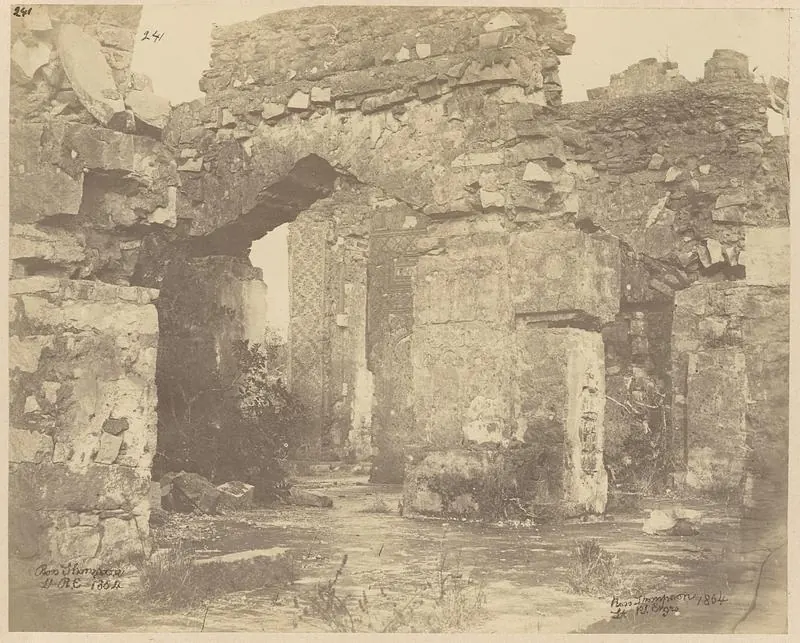
The Imperial Gazetteer says that Kondavidu itself had been fortified in the 12th century.69 Its walls ran along the crests of a small range of hills.69 According to the same gazetteer, Kondapalli, on the north bank of the Krishna, was “built about A.D. 1360 by the Reddi kings of Kondavid”.73 The Kistna manual says it was built in Anuvema’s reign.6
Somasekhara Sarma says that Peda Komati Vema gave the country north of the Krishna to his brother Macha.74 Macha fortified Kondapalli and made it his seat.74 See the Kondavidu fort and the Kondapalli fort.
A second line, descended from Prolaya Vema’s youngest brother Malla, ruled around Kandukur in the Nellore district.262575 Its records, at Kandukur and Chundi, run from the 1390s to the 1430s.262575 At Chundi in 1408 Malla Reddi, son of Srigiri, built a temple of Janardana.262575 He gave his soldiers’ payment of two pies each to its festivals.262575 In the Godavari delta, the Reddis of Rajahmundry descended from Kataya Vema and then from Allada Reddi.28
Government, trade and coins
The grants are mostly gifts of whole villages to Brahmans.17630 The villages were renamed after the donor: Atukuru became Vemapuram, Puvvada became Vemapuri, and Koduru became Annavotapuram.17630 The villages were divided into shares among many donees, sixty-four at Puvvada.7730 Their boundaries were written out in Telugu, “the language of the country”, after Sanskrit verses.7730
Ministers appear as donors and governors.278 Vema son of Malla governed Dharanikota under Anavota, and Mallinatha was Anavota’s minister.278
The coast’s sea trade continued. Anavota’s renewal of the Motupalli charter for sea merchants in 1358 was signed by his minister Somayamatya at Motupalli.32 Srinatha describes the merchant Tippa, who supplied Kumaragiri’s court with goods from many lands:34
- camphor from the Panjab34
- elephants from Ceylon34
- horses from “Hurumanji (Ormuz or Persia)”34
- civet (a perfume) from Goa34
- silk cloth from China34
Ramayya read this account as showing that the Telugu country then had “extensive trade relations”.34 An inscription of the Vijayanagara period at Kondavidu lists the tolls taken in the Kondavidu country at market towns, salt-pans and pilgrim roads.79
No coin bears a Reddi king’s name. In 1926 R. Srinivasa Raghava Iyengar listed among South Indian gold coins a group he called “Reddi fanams”.80 They have a couchant (lying) bull under the sun and moon on one side, and an elephant goad and coiled whip on the other.80 But he did not say why he attributed them to the Reddis.80 The bull is the emblem on the seals of the Reddi grants.1281
Religion and temples
The Reddi kings were Saivas (worshippers of Shiva).1234 Their seals bear the bull Nandi.1234 Almost every inscription of the family remembers Prolaya Vema for the flight of steps from the Patalaganga stream up to the shrine of Srisailam.1234 The Pedapalakaluru plates add a second flight of steps at Ahobilam, and call the two “permanent pillars of victory”.71
Later tradition gave the Srisailam steps to Anavema.8283 An inscription listed at Srisailam says so.82 The Kurnool district manual credits Anavema with “the causeway on Srisailam”.83 The Kistna manual found in the Brahmans’ chronicles that Pulayya Vema Reddi “dedicated 108 temples to the worship of Siva”.84
The family also gave to Vishnu temples. Kataya Vema gave the village Kaluvacheru, renamed Komaragiripuram, to the Narasimha temple at Ahobilam in 1410.85 Errapragada dedicated his Narasimha Purana to the god of Ahobilam.24
Their inscriptions stand at the great temples of the coast: Amaravati, Draksharama and, in the north, Simhachalam.86418788 At Simhachalam Kataya Vema gave gold in 1386, and Virabhadra of Rajahmundry gave a village and jewels.86418788
Literature at the Reddi courts
The Reddi period was a high point of Telugu and Sanskrit letters. Errapragada completed the Telugu Mahabharata left unfinished by Nannaya and Tikkana.8931 In the words of the History of Telugu Literature of 1928, he “was attached to Proliah Vema Reddy, the ruler of the district”.89 He dedicated his Harivamsa to him.8931
Court poets composed the grants.3139 Balasarasvati wrote Anavota’s Koduru grant and Anavema’s grants until 1377.31 Trilochanacharya wrote the Vanapalli plates of 1380.39 The same history calls Srinatha the poet who “overshadows all others of his age”.90 He served Peda Komati Vema and later the Rajahmundry Reddis.9051
The kings wrote too. Ramayya cited Peda Komati Vema’s Sringaradipika and the commentary that Kataya Vema wrote on Kalidasa’s three plays.5148 The 1928 history instead gives the Sringaradipika as “purporting to be the composition of Kumaragiri Reddi”.91 It adds that the work “is held by many to be by Srinatha”.91 Ramesan, following Somasekhara Sarma, also credits Peda Komati Vema with a work on poetics, the Sahitya Chintamani, and one on music, the Sangita Chintamani.92
Vemana: legend and record
The moralist poet Vemana, whose verses were the Telugu schoolbook for centuries, is sometimes connected with the Reddis. But no record of the period names him. Charles Philip Brown collected his verses in the 1820s.93 He heard some assert that “he belonged to the family of Ana Vema Reddi, a chief in the candanul (or Curnool) country”.93 But after enquiring in the places named he “gained no information whatever”.93 He reported the belief that Vemana “lived about the beginning of the seventeenth century”.93
The 1928 History of Telugu Literature reports claims for Kondavidu and for Katuru, where his tomb is shown, as his birthplace.94 It thought it probable that he lived at the beginning of the fifteenth century, though “nor can we fix his date, even approximately”.94 The connection with the Reddi kings therefore rests on tradition alone.9394
Evidence and disagreements
- The start of the kingdom. The Kistna manual dates the founding at Kondavidu to 1328.6 The Godavari gazetteer has the earliest record in 1344.3 Ramayya in 1906 knew nothing earlier than 1345.1 The editors of the Chimakurti plate read 1336.23 Narasimhaswami gave 1332–33.24 Somasekhara Sarma and Ramesan begin with a record of 1325.2122
- The order of the kings. The Kistna manual makes Anuvema, Aliya Vema and Komaragiri brothers of the founder, and the last two kings Komaragiri’s sons.6 The inscriptions make Anavota and Anavema the founder’s sons, Kumaragiri Anavota’s son, Peda Komati Vema a grandson of Macha, and Racha Vema Peda Komati Vema’s son.45210
- The Amaravati record of 1361. The Kistna manual says it names Anuvema.6 Rangacharya’s summary and Ramayya make it a record of Anavota’s minister.332
- Prolaya Vema’s wife. Ramayya read the Harivamsa as saying that Prola’s wife Annama was a daughter of Dodda.1 Sewell’s pedigree makes the daughter of Dodda the wife of Prolaya Vema.45
- The steps at Srisailam. The family’s inscriptions give them to Prolaya Vema.12 A later inscription at Srisailam and the Kurnool manual give them to Anavema.8283
- The Sringaradipika. Ramayya and Rangacharya give it to Peda Komati Vema.5195 The 1928 history of Telugu literature gives it to Kumaragiri, with many attributing it to Srinatha.91
- The end. The Kistna manual has Racha Vema assassinated in 1428.6 Sewell (1884) and Rangacharya have the dynasty overthrown by “the Muhammadans” in 1427.766 The Kondavidu chronicle and village histories have a Gajapati conquest in 1420.766 Sewell (1932) has an overthrow by Ahmad I Bahmani about 1427.45 Somasekhara Sarma has a Vijayanagara conquest by 1424.11 The Imperial Gazetteer gives 1482.69
Footnotes
-
Ramayya, Madras Museum Plates of Vema (1905–06), p. 10 (archive.org (opens in a new tab)). ↩ ↩2 ↩3 ↩4 ↩5 ↩6 ↩7 ↩8 ↩9 ↩10 ↩11 ↩12 ↩13 ↩14
-
Ramayya, Madras Museum Plates of Vema (1905–06), p. 11 (archive.org (opens in a new tab)). ↩ ↩2 ↩3 ↩4 ↩5 ↩6 ↩7 ↩8 ↩9 ↩10 ↩11 ↩12 ↩13 ↩14 ↩15 ↩16 ↩17 ↩18 ↩19 ↩20 ↩21 ↩22 ↩23 ↩24
-
F. R. Hemingway, Madras District Gazetteers: Godavari, Vol. I (1907), p. 25 (archive.org (opens in a new tab)). ↩ ↩2 ↩3 ↩4 ↩5
-
J. Ramayya, Tottaramudi Plates of Kataya-Vema, Saka-Samvat 1333, Epigraphia Indica IV (1896–97), p. 319 (archive.org (opens in a new tab)). ↩ ↩2 ↩3 ↩4 ↩5 ↩6 ↩7 ↩8
-
Ramesan, Copper Plate Inscriptions, Vol. I (1962), p. 165 (archive.org (opens in a new tab)). ↩ ↩2 ↩3 ↩4
-
Mackenzie, Kistna District (1883), p. 10 (archive.org (opens in a new tab)). ↩ ↩2 ↩3 ↩4 ↩5 ↩6 ↩7 ↩8 ↩9 ↩10 ↩11 ↩12 ↩13 ↩14 ↩15
-
Robert Sewell, Lists of Inscriptions, and Sketch of the Dynasties of Southern India (Lists of Antiquarian Remains, Vol. II, 1884), p. 187 (archive.org (opens in a new tab)). ↩ ↩2 ↩3 ↩4 ↩5 ↩6 ↩7 ↩8
-
Imperial Gazetteer of India: Madras, Vol. I (1908), p. 302 (archive.org (opens in a new tab)). ↩ ↩2
-
G. V. Ramamurti, Konkuduru Plates of Allaya-Dodda, Saka-Samvat 1352, Epigraphia Indica V (1898–99), p. 55 (archive.org (opens in a new tab)). ↩ ↩2
-
Ramayya, Madras Museum Plates of Vema (1905–06), p. 13 (archive.org (opens in a new tab)). ↩ ↩2 ↩3 ↩4 ↩5 ↩6 ↩7 ↩8 ↩9 ↩10 ↩11
-
Somasekhara Sarma, History of the Reddi Kingdoms (1948), p. 47 (archive.org (opens in a new tab)). ↩ ↩2
-
E. Hultzsch, Vanapalli Plates of Anna-Vema, Saka-Samvat 1300, Epigraphia Indica III (1894–95), p. 59 (archive.org (opens in a new tab)). ↩ ↩2 ↩3 ↩4 ↩5 ↩6 ↩7
-
J. Ramayya, Madras Museum Plates of Vema, A.D. 1345, Epigraphia Indica VIII (1905–06), p. 9 (archive.org (opens in a new tab)). ↩ ↩2 ↩3 ↩4 ↩5 ↩6
-
Ramesan, Copper Plate Inscriptions, Vol. I (1962), p. 188 (archive.org (opens in a new tab)). ↩ ↩2
-
Ramesan, Copper Plate Inscriptions, Vol. I (1962), p. 192 (archive.org (opens in a new tab)). ↩ ↩2
-
Gordon Mackenzie, A Manual of the Kistna District (1883), p. 9 (archive.org (opens in a new tab)). ↩ ↩2
-
E. Hultzsch, Nadupuru Grant of Anna-Vema, Saka-Samvat 1296, Epigraphia Indica III (1894–95), p. 286 (archive.org (opens in a new tab)). ↩ ↩2 ↩3
-
Ramesan, Copper Plate Inscriptions, Vol. I (1962), p. 177 (archive.org (opens in a new tab)). ↩ ↩2 ↩3
-
N. Ramesan, Copper Plate Inscriptions of Andhra Pradesh Government Museum, Hyderabad, Vol. I (1962), pp. 163–164 (archive.org (opens in a new tab)). ↩ ↩2
-
Ramesan, Copper Plate Inscriptions, Vol. I (1962), p. 166 (archive.org (opens in a new tab)). ↩ ↩2 ↩3 ↩4 ↩5 ↩6
-
Somasekhara Sarma, History of the Reddi Kingdoms (1948), p. 41 (archive.org (opens in a new tab)). ↩ ↩2 ↩3 ↩4
-
Ramesan, Copper Plate Inscriptions, Vol. I (1962), pp. 164–165 (archive.org (opens in a new tab)). ↩ ↩2 ↩3 ↩4
-
A. Rangaswami Saraswati and N. Lakshminarayan Rao, Three Copper-plate Inscriptions of the Reddis, Epigraphia Indica XXI (1931–32), p. 268 (archive.org (opens in a new tab)). ↩ ↩2 ↩3
-
Narasimhaswami, Koduru Grant of Ana-Vota-Reddi (1939–40), p. 139 (archive.org (opens in a new tab)). ↩ ↩2 ↩3 ↩4 ↩5 ↩6
-
Somasekhara Sarma, History of the Reddi Kingdoms (1948), p. 194 (archive.org (opens in a new tab)). ↩ ↩2 ↩3 ↩4 ↩5 ↩6
-
Rangacharya, Topographical List, Vol. II (1919), p. 1084, Nellore Nos. 289–292 (archive.org (opens in a new tab)). ↩ ↩2 ↩3 ↩4 ↩5 ↩6
-
Ramesan, Copper Plate Inscriptions, Vol. I (1962), p. 175 (archive.org (opens in a new tab)). ↩ ↩2 ↩3
-
Hemingway, Godavari (1907), p. 26 (archive.org (opens in a new tab)). ↩ ↩2 ↩3
-
Somasekhara Sarma, History of the Reddi Kingdoms (1948), p. 42 (archive.org (opens in a new tab)). ↩ ↩2 ↩3
-
H. K. Narasimhaswami, Koduru Grant of Ana-Vota-Reddi; Saka 1280, Epigraphia Indica XXV (1939–40), p. 137 (archive.org (opens in a new tab)). ↩ ↩2 ↩3 ↩4 ↩5 ↩6
-
Narasimhaswami, Koduru Grant of Ana-Vota-Reddi (1939–40), p. 138 (archive.org (opens in a new tab)). ↩ ↩2 ↩3 ↩4 ↩5 ↩6
-
Rangacharya, Topographical List, Vol. II (1919), p. 758, Guntur Nos. 102–103 (archive.org (opens in a new tab)). ↩ ↩2 ↩3
-
Rangacharya, Topographical List, Vol. II (1919), p. 824, Guntur Nos. 624–625 (archive.org (opens in a new tab)). ↩ ↩2 ↩3
-
Ramayya, Madras Museum Plates of Vema (1905–06), p. 12 (archive.org (opens in a new tab)). ↩ ↩2 ↩3 ↩4 ↩5 ↩6 ↩7 ↩8 ↩9 ↩10 ↩11 ↩12 ↩13 ↩14 ↩15 ↩16 ↩17 ↩18 ↩19 ↩20 ↩21 ↩22 ↩23
-
Robert Sewell, The Historical Inscriptions of Southern India (1932), p. 195 (archive.org (opens in a new tab)). ↩
-
Narasimhaswami, Koduru Grant of Ana-Vota-Reddi (1939–40), p. 140 (archive.org (opens in a new tab)). ↩
-
Ramesan, Copper Plate Inscriptions, Vol. I (1962), p. 167 (archive.org (opens in a new tab)). ↩ ↩2 ↩3 ↩4 ↩5
-
Hultzsch, Vanapalli Plates of Anna-Vema (1894–95), p. 64 (archive.org (opens in a new tab)). ↩ ↩2 ↩3
-
Hultzsch, Vanapalli Plates of Anna-Vema (1894–95), p. 60 (archive.org (opens in a new tab)). ↩ ↩2 ↩3 ↩4 ↩5 ↩6 ↩7 ↩8 ↩9
-
Hultzsch, Nadupuru Grant of Anna-Vema (1894–95), p. 287 (archive.org (opens in a new tab)). ↩ ↩2 ↩3 ↩4 ↩5 ↩6
-
V. Rangacharya, A Topographical List of the Inscriptions of the Madras Presidency, Vol. II (1919), p. 744, Godavari No. 352 (archive.org (opens in a new tab)). ↩ ↩2 ↩3 ↩4
-
Ramesan, Copper Plate Inscriptions, Vol. I (1962), p. 168 (archive.org (opens in a new tab)). ↩ ↩2 ↩3 ↩4 ↩5 ↩6 ↩7 ↩8
-
Rangacharya, Topographical List, Vol. II (1919), p. 954, Kurnool No. 456 (archive.org (opens in a new tab)). ↩ ↩2
-
Hultzsch, Vanapalli Plates of Anna-Vema (1894–95), p. 65 (archive.org (opens in a new tab)). ↩ ↩2 ↩3
-
Sewell, Historical Inscriptions (1932), p. 385 (archive.org (opens in a new tab)). ↩ ↩2 ↩3 ↩4 ↩5
-
Somasekhara Sarma, History of the Reddi Kingdoms (1948), p. 45 (archive.org (opens in a new tab)). ↩ ↩2 ↩3 ↩4 ↩5
-
Sewell, Historical Inscriptions (1932), p. 202 (archive.org (opens in a new tab)). ↩
-
Ramayya, Tottaramudi Plates of Kataya-Vema (1896–97), p. 320 (archive.org (opens in a new tab)). ↩ ↩2
-
Somasekhara Sarma, History of the Reddi Kingdoms (1948), p. 157 (archive.org (opens in a new tab)). ↩ ↩2 ↩3
-
Somasekhara Sarma, History of the Reddi Kingdoms (1948), p. 159 (archive.org (opens in a new tab)). ↩ ↩2 ↩3 ↩4 ↩5 ↩6 ↩7
-
Ramayya, Three Inscriptions of the Reddis of Kondavidu (1911–12), p. 315 (archive.org (opens in a new tab)). ↩ ↩2 ↩3 ↩4 ↩5 ↩6 ↩7 ↩8 ↩9
-
J. Ramayya, Three Inscriptions of the Reddis of Kondavidu, Epigraphia Indica XI (1911–12), p. 314 (archive.org (opens in a new tab)). ↩ ↩2 ↩3 ↩4
-
Rangacharya, Topographical List, Vol. II (1919), p. 838, Guntur No. 803 (archive.org (opens in a new tab)). ↩ ↩2 ↩3
-
Somasekhara Sarma, History of the Reddi Kingdoms (1948), p. 160 (archive.org (opens in a new tab)). ↩ ↩2 ↩3 ↩4
-
Somasekhara Sarma, History of the Reddi Kingdoms (1948), p. 161 (archive.org (opens in a new tab)). ↩ ↩2 ↩3 ↩4
-
L. D. Barnett, Vemavaram Grant of Allaya-Vema Reddi: Saka 1356, Epigraphia Indica XIII (1915–16), p. 238 (archive.org (opens in a new tab)). ↩ ↩2
-
Barnett, Vemavaram Grant of Allaya-Vema Reddi (1915–16), p. 239 (archive.org (opens in a new tab)). ↩ ↩2
-
Somasekhara Sarma, History of the Reddi Kingdoms (1948), p. 162 (archive.org (opens in a new tab)). ↩ ↩2
-
Somasekhara Sarma, History of the Reddi Kingdoms (1948), p. 163 (archive.org (opens in a new tab)). ↩ ↩2
-
Somasekhara Sarma, History of the Reddi Kingdoms (1948), p. 166 (archive.org (opens in a new tab)). ↩ ↩2
-
Somasekhara Sarma, History of the Reddi Kingdoms (1948), p. 167 (archive.org (opens in a new tab)). ↩ ↩2
-
Somasekhara Sarma, History of the Reddi Kingdoms (1948), p. 46 (archive.org (opens in a new tab)). ↩
-
Ramesan, Copper Plate Inscriptions, Vol. I (1962), p. 170 (archive.org (opens in a new tab)). ↩
-
Rangacharya, Topographical List, Vol. II (1919), p. 835, Guntur No. 766 (archive.org (opens in a new tab)). ↩ ↩2 ↩3 ↩4
-
Somasekhara Sarma, History of the Reddi Kingdoms (1948), p. 170 (archive.org (opens in a new tab)). ↩ ↩2 ↩3 ↩4
-
Sewell, Lists of Inscriptions (1884), p. 188 (archive.org (opens in a new tab)). ↩ ↩2 ↩3 ↩4 ↩5
-
Rangacharya, Topographical List, Vol. II (1919), p. 770 (archive.org (opens in a new tab)). ↩ ↩2 ↩3
-
Sewell, Historical Inscriptions (1932), p. 213 (archive.org (opens in a new tab)). ↩ ↩2
-
Imperial Gazetteer: Madras, Vol. I (1908), p. 336 (archive.org (opens in a new tab)). ↩ ↩2 ↩3 ↩4
-
M. Somasekhara Sarma, History of the Reddi Kingdoms (1948), pp. 40–41 (archive.org (opens in a new tab)). ↩ ↩2 ↩3
-
Ramesan, Copper Plate Inscriptions, Vol. I (1962), p. 189 (archive.org (opens in a new tab)). ↩ ↩2
-
Robert Sewell, Lists of the Antiquarian Remains in the Presidency of Madras, Vol. I (1882), p. 43 (archive.org (opens in a new tab)). ↩ ↩2
-
Imperial Gazetteer: Madras, Vol. I (1908), p. 323 (archive.org (opens in a new tab)). ↩
-
Somasekhara Sarma, History of the Reddi Kingdoms (1948), p. 158 (archive.org (opens in a new tab)). ↩ ↩2
-
Somasekhara Sarma, History of the Reddi Kingdoms (1948), p. 195 (archive.org (opens in a new tab)). ↩ ↩2 ↩3 ↩4
-
Ramesan, Copper Plate Inscriptions, Vol. I (1962), p. 176 (archive.org (opens in a new tab)). ↩ ↩2
-
Ramesan, Copper Plate Inscriptions, Vol. I (1962), p. 178 (archive.org (opens in a new tab)). ↩ ↩2
-
Rangacharya, Topographical List, Vol. II (1919), p. 795 (archive.org (opens in a new tab)). ↩ ↩2
-
Rangacharya, Topographical List, Vol. II (1919), p. 771, Guntur No. 208 (archive.org (opens in a new tab)). ↩
-
R. Srinivasa Raghava Iyengar, “Ancient South Indian Gold Coinage”, Journal of the Andhra Historical Research Society I (1926–27), p. 134 (archive.org (opens in a new tab)). ↩ ↩2 ↩3
-
Ramesan, Copper Plate Inscriptions, Vol. I (1962), p. 173 (archive.org (opens in a new tab)). ↩
-
Rangacharya, Topographical List, Vol. II (1919), p. 959, Kurnool No. 489-L (archive.org (opens in a new tab)). ↩ ↩2 ↩3
-
Narahari Gopalakristnamah Chetty, A Manual of the Kurnool District (1886), p. 24 (archive.org (opens in a new tab)). ↩ ↩2 ↩3
-
Mackenzie, Kistna District (1883), p. 11 (archive.org (opens in a new tab)). ↩
-
Rangacharya, Topographical List, Vol. II (1919), p. 975, Kurnool No. 598 (archive.org (opens in a new tab)). ↩
-
Rangacharya, Topographical List, Vol. II (1919), p. 825, Guntur No. 634 (archive.org (opens in a new tab)). ↩ ↩2
-
Rangacharya, Topographical List, Vol. III (1919), p. 1678, Vizagapatam No. 105 (archive.org (opens in a new tab)). ↩ ↩2
-
Rangacharya, Topographical List, Vol. III (1919), p. 1687 (archive.org (opens in a new tab)). ↩ ↩2
-
P. Chenchiah and Raja M. Bhujanga Rao, A History of Telugu Literature (1928), p. 48 (archive.org (opens in a new tab)). ↩ ↩2 ↩3
-
Chenchiah and Bhujanga Rao, History of Telugu Literature (1928), p. 59 (archive.org (opens in a new tab)). ↩ ↩2
-
Chenchiah and Bhujanga Rao, History of Telugu Literature (1928), p. 60 (archive.org (opens in a new tab)). ↩ ↩2 ↩3
-
Ramesan, Copper Plate Inscriptions, Vol. I (1962), p. 171 (archive.org (opens in a new tab)). ↩
-
Charles Philip Brown (tr.), The Verses of Vemana (1911 reprint of the 1829 edition), Preface (archive.org (opens in a new tab)). ↩ ↩2 ↩3 ↩4 ↩5
-
Chenchiah and Bhujanga Rao, History of Telugu Literature (1928), p. 99 (archive.org (opens in a new tab)). ↩ ↩2 ↩3
-
Rangacharya, Topographical List, Vol. II (1919), p. 772 (archive.org (opens in a new tab)). ↩
Photos
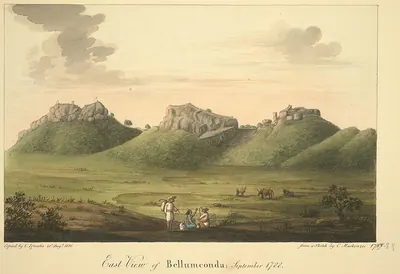 "East View of Bellumconda, September 1788": Bellamkonda hill fort, copy made by C. Ignatio in 1816 from a sketch by Colin MackenzieDrawing · 1816
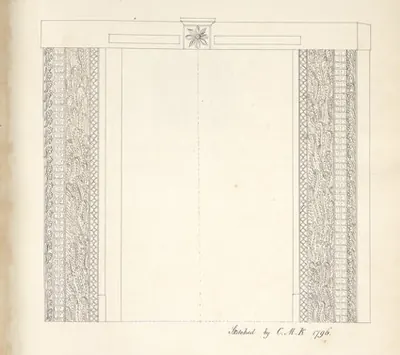 "Gateway at Kondavid Durg. Hindoo Architecture": a carved door frame in the lower fort of Kondavid, drawing signed "C.M.K. 1796" (Colin Mackenzie)Drawing · 1796
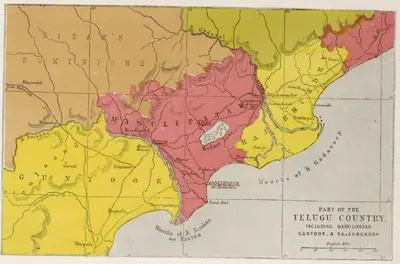 "Part of the Telugu Country, including Masulipatam, Guntoor, & Rajahmundry", map from the Church Missionary Atlas, 3rd edition, London, 1862 (cropped to the map)Map · 1862
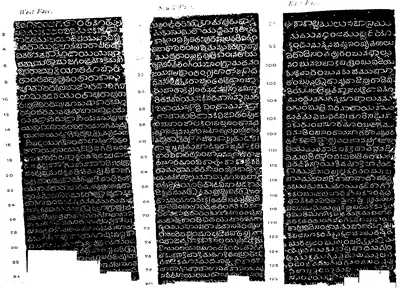 "Phirangipuram pillar inscription of Peda-Komati-Vema": west face (lines 1-34), south face (lines 50-80) and east face (lines 92-128) (Epigraphia Indica XI, plate between pp. 320 and 321, PDF p. 377)Inscription rubbing · 1912
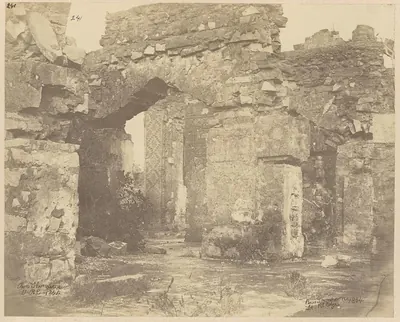 "Ruin of old palace [i.e. Kondapalli Fort], Condapilly hills, Kistnah District": albumen photograph signed "Ross Thompson, Lt. R.E., 1864"Photograph · 1864
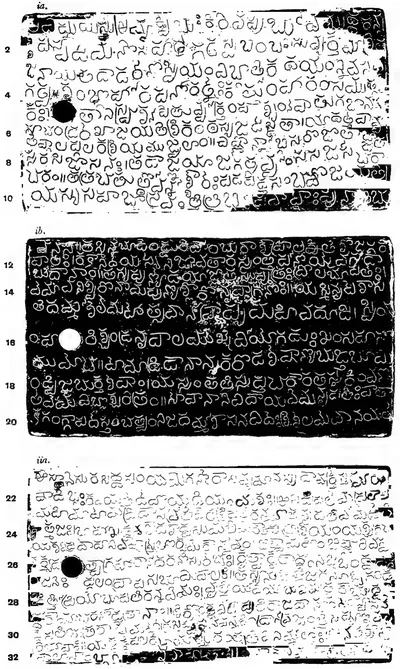 "Vanapalli Plates of Anna-Vema.—Saka-Samvat 1300", plates i a, i b and ii a (lines 1-32) (Epigraphia Indica III, plates between pp. 62 and 63, PDF p. 100)Inscription rubbing · 1895
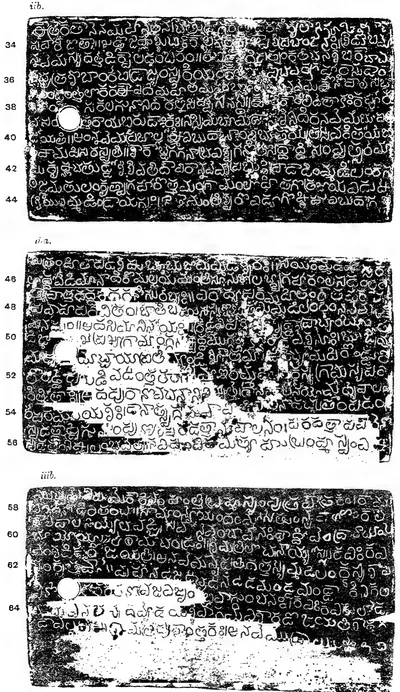 "Vanapalli Plates of Anna-Vema.—Saka-Samvat 1300", plates ii b, iii a and iii b (lines 33-65) (Epigraphia Indica III, plates between pp. 62 and 63, PDF p. 101)Inscription rubbing · 1895
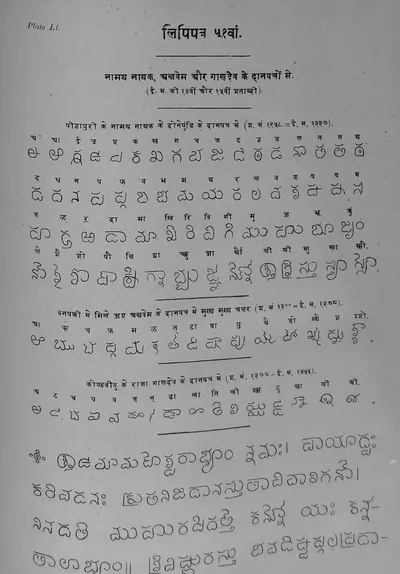 Alphabet table from the grants of Namaya Nayaka, Annavema and Ganadeva, 14th and 15th centuries CE (Donepundi grant, Saka 1259) (Ojha, Bharatiya Prachin Lipimala, 1918, Plate 51)Book plate · 1918
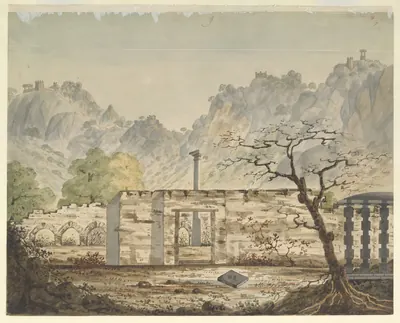 Kondavid-drug near Guntur, 19 February 1804 (drawing signed "W.R.")Drawing · 1804
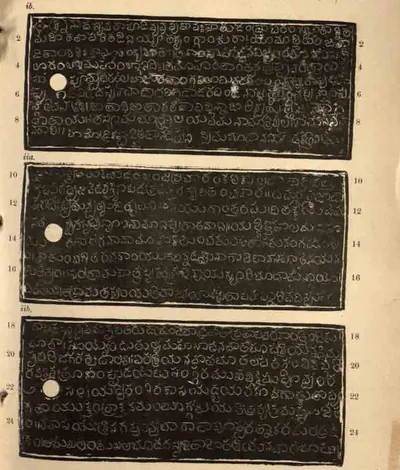 Pachchanitandiparru grant of Anna-Vema, Saka 1296 (A.D. 1374): ink impressions of plates i b, ii a and ii b (lines 1-25) (Epigraphia Indica XXI, No. 41 B, plates between pp. 274 and 275)Inscription rubbing · 1933
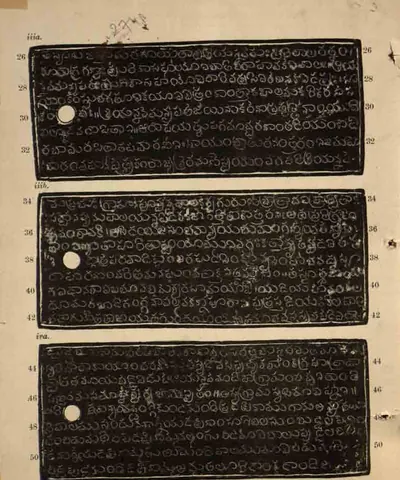 Pachchanitandiparru grant of Anna-Vema, Saka 1296 (A.D. 1374): ink impressions of plates iii a, iii b and iv a (lines 26-51) (Epigraphia Indica XXI, No. 41 B, plates between pp. 274 and 275)Inscription rubbing · 1933
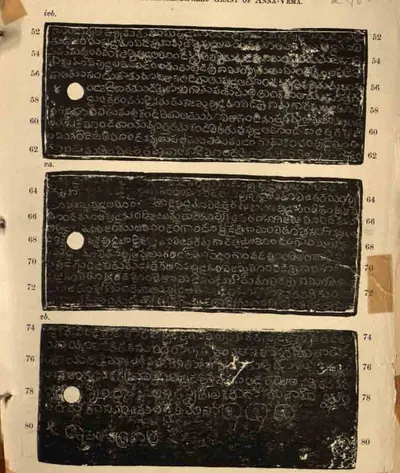 Pachchanitandiparru grant of Anna-Vema, Saka 1296 (A.D. 1374): ink impressions of plates iv b, v a and v b (lines 52-80) (Epigraphia Indica XXI, No. 41 B, plates between pp. 274 and 275)Inscription rubbing · 1933
Show all (27)
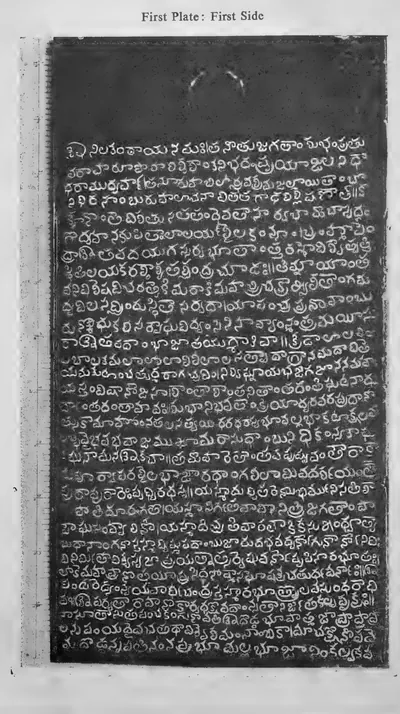 Pedapalakaluru plates of Anavema Reddi, Saka 1300 (A.D. 1378): photograph of the first plate, first side (lines 1-31) (Ramesan 1962, Plate XII (a), PDF p. 249)Photograph · 1962
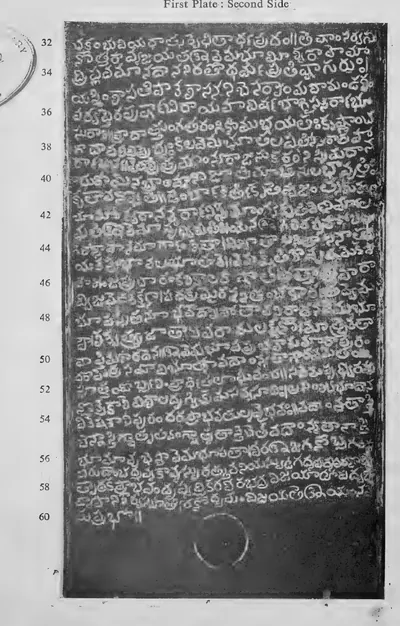 Pedapalakaluru plates of Anavema Reddi, Saka 1300 (A.D. 1378): photograph of the first plate, second side (lines 32-60) (Ramesan 1962, Plate XII (b), PDF p. 250)Photograph · 1962
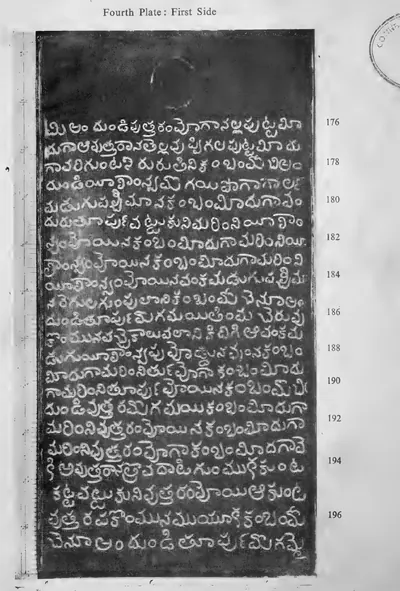 Pedapalakaluru plates of Anavema Reddi, Saka 1300 (A.D. 1378): photograph of the fourth plate, first side (lines 176-197) (Ramesan 1962, Plate XII (g), PDF p. 261)Photograph · 1962
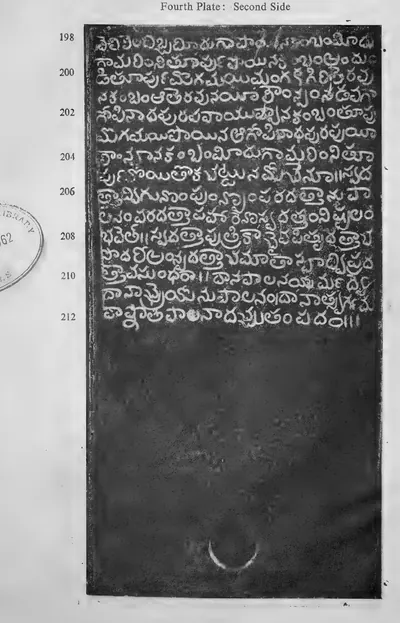 Pedapalakaluru plates of Anavema Reddi, Saka 1300 (A.D. 1378): photograph of the fourth plate, second side (lines 198-212) (Ramesan 1962, Plate XII (h), PDF p. 262)Photograph · 1962
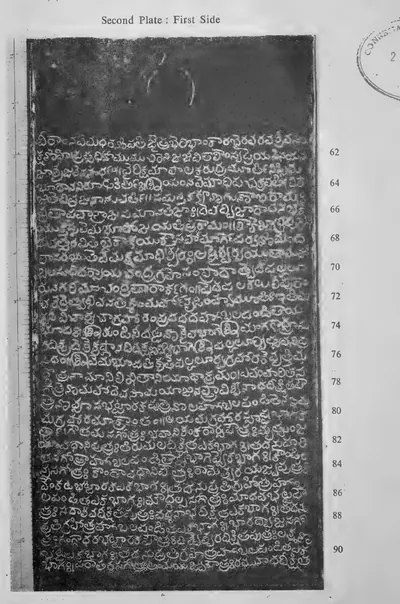 Pedapalakaluru plates of Anavema Reddi, Saka 1300 (A.D. 1378): photograph of the second plate, first side (lines 61-91) (Ramesan 1962, Plate XII (c), PDF p. 253)Photograph · 1962
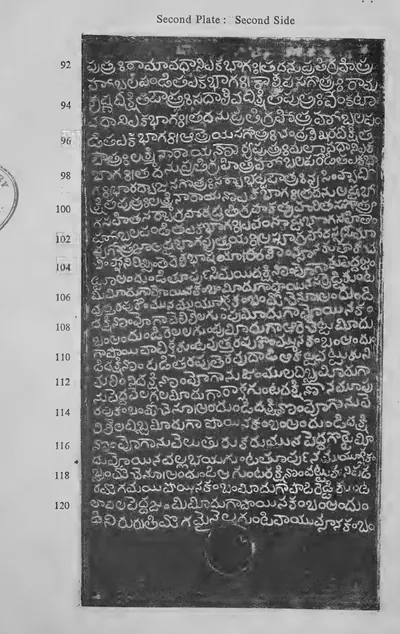 Pedapalakaluru plates of Anavema Reddi, Saka 1300 (A.D. 1378): photograph of the second plate, second side (lines 92-121) (Ramesan 1962, Plate XII (d), PDF p. 254)Photograph · 1962
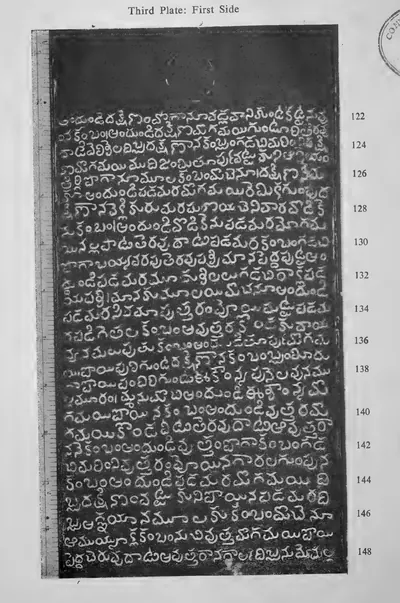 Pedapalakaluru plates of Anavema Reddi, Saka 1300 (A.D. 1378): photograph of the third plate, first side (lines 122-148) (Ramesan 1962, Plate XII (e), PDF p. 257)Photograph · 1962
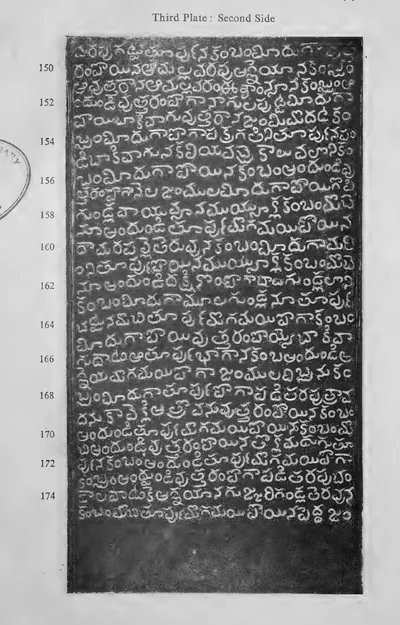 Pedapalakaluru plates of Anavema Reddi, Saka 1300 (A.D. 1378): photograph of the third plate, second side (lines 149-175) (Ramesan 1962, Plate XII (f), PDF p. 258)Photograph · 1962
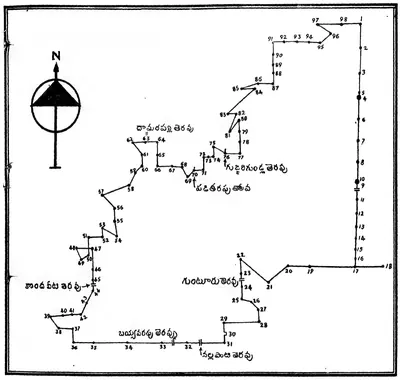 Plan of Pedapalakaluru village drawn by the editor from the boundaries given in the grant of Anavema Reddi (Ramesan 1962, Text Figure I, PDF p. 246)Map · 1962
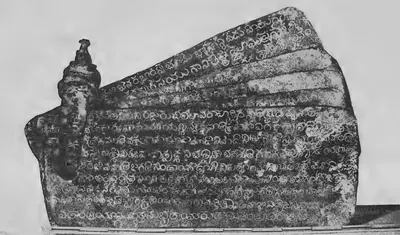 Puvvada grant of Prolaya Vema, Saka 1268 (A.D. 1346): general view of the five plates on their ring with the seal (Ramesan 1962, Plate XI (d), PDF p. 231)Photograph · 1962
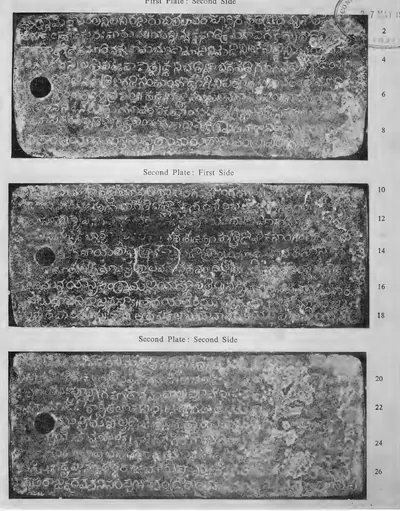 Puvvada grant of Prolaya Vema, Saka 1268 (A.D. 1346): photographs of the plates, first plate second side, second plate both sides (lines 1-27) (Ramesan 1962, Plate XI (a), PDF p. 226)Photograph · 1962
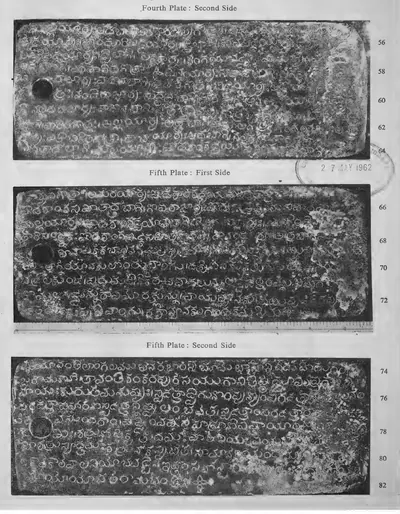 Puvvada grant of Prolaya Vema, Saka 1268 (A.D. 1346): photographs of the plates, fourth plate second side, fifth plate both sides (lines 55-82) (Ramesan 1962, Plate XI (c), PDF p. 230)Photograph · 1962
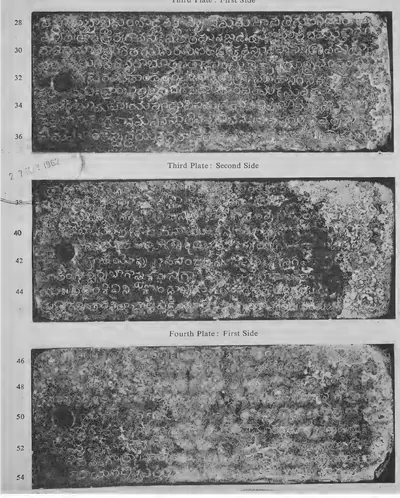 Puvvada grant of Prolaya Vema, Saka 1268 (A.D. 1346): photographs of the plates, third plate both sides, fourth plate first side (lines 28-54) (Ramesan 1962, Plate XI (b), PDF p. 227)Photograph · 1962
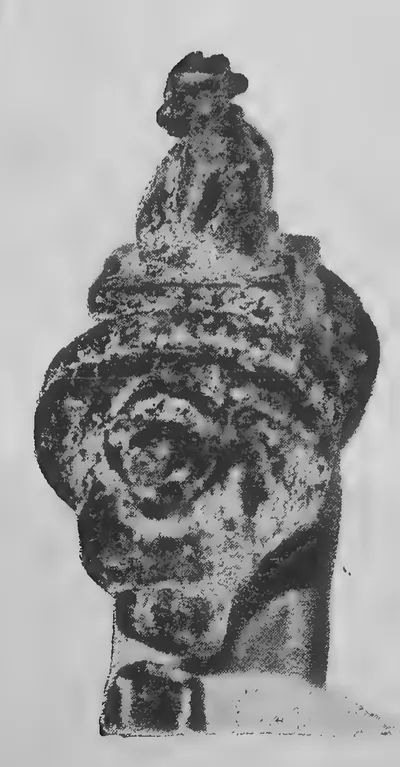 Puvvada grant of Prolaya Vema, Saka 1268 (A.D. 1346): the Nandi seal on the ring (Ramesan 1962, Plate XI (d), PDF p. 231)Photograph · 1962
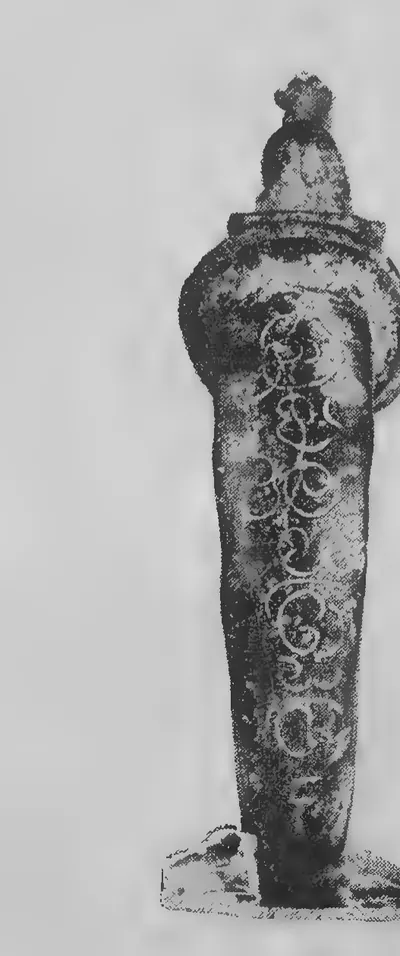 Puvvada grant of Prolaya Vema, Saka 1268 (A.D. 1346): the ring, inscribed "Sri Pallava Trinetra" (Ramesan 1962, Plate XI (d), PDF p. 231)Photograph · 1962
Related
People
Errapragada
c. 1280–1350 CE
Telugu poet of the 14th century, the third of the 'Kavitraya' who completed the Telugu Mahabharata. He finished the Aranya Parva that Nannaya had left incomplete. He was a Niyogi Brahman of Gudluru in the Nellore country and a devotee of Siva (Sambhudasa). He was attached to Prolaya Vema, the founder of the Reddi kingdom, and dedicated his Harivamsa to him. He also wrote a Ramayana and the Narasimha Purana for the god of Ahobilam.
Prolaya Vema Reddi
c. 1325–1353 CE
Founder of the Reddi kingdom of Addanki and Kondavidu (c. 1325–1353). He took over the country between Srisailam and the sea after the fall of the Kakatiyas. His grants of 1345 and 1346 say he restored the Brahman villages seized by the Muslim conquerors of Warangal. Later records remember him for the flights of steps at Srisailam and Ahobilam, and the poet Errapragada dedicated his Harivamsa to him.
Anavota Reddi
c. 1353–1364 CE
Second Reddi king of Addanki (c. 1353–1364), elder son of Prolaya Vema. His only known copper-plate grant, from Koduru (1358), and his renewal of the Kakatiya charter for sea merchants at Motupalli (1358) survive. A Velama chronicle claims a victory over him at Dharanikota in 1361. His son Kumaragiri and his son-in-law Kataya Vema later ruled at Kondavidu and Rajahmundry.
Anavema Reddi
c. 1364–1386 CE
Third Reddi king (c. 1364–1386), younger son of Prolaya Vema, who ruled from Kondavidu and carried the kingdom's grants into the Godavari delta. He is known from five copper-plate grants (Pachchanitandiparru 1374, Nadupuru, Pedapalakaluru 1378, Vanapalli 1380 and others) and from records at Srisailam and Draksharama. He was surnamed Vasantaraya for his spring festival. The poet Srinatha's connection with the Reddis probably began under him.
Srinatha
c. 1365–1440 CE
Telugu poet of the late 14th and early 15th centuries, often ranked with the three translators of the Mahabharata. He served Peda Komati Vema of Kondavidu as vidyadhikarin and composed his grants and inscriptions. He then wrote for the Reddis of Rajahmundry. His Sringaranaishadham, Bhimakhandam and Kasikhandam are dedicated to Reddi kings and ministers, and they are a main source for their history.
Kumaragiri Reddi
c. 1386–1402 CE
Reddi king of Kondavidu (c. 1386–1402), son of Anavota. He is remembered for his spring festival and his court's foreign trade, and as the patron after whom Kataya Vema named his commentary on Kalidasa. He gave the Godavari country around Rajahmundry to his minister and brother-in-law Kataya Vema. At the end of his reign he lost Kondavidu to his kinsman Peda Komati Vema.
Peda Komati Vema
c. 1402–1420 CE
Fifth Reddi king of Kondavidu (c. 1402–1420), a grandson of Prolaya Vema's elder brother Macha, known as a scholar-king. The Sringaradipika commentary on the Amarusataka and other works are ascribed to him, and the poet Srinatha served him as vidyadhikarin and composed his grants. His reign was spent in wars with the Rajahmundry Reddis, Vijayanagara and the Recherla Velamas.
Monuments
Kondavidu fort
c. 1150 CE
Hill fortress on a small range of hills west of Guntur. It was the capital of the Reddi kings from the time of Anavema (after 1361) to the 1420s. The Imperial Gazetteer dates the fortress to the 12th century, and local chronicles credit Prolaya Vema with rebuilding its inner fort. Its walls run for miles along the tops of the hills. Orissa, Vijayanagara and Golconda fought over it until 1579.
Kondapalli fort
c. 1360 CE
Hill fortress north-west of Vijayawada, said to have been built by the Reddi kings of Kondavidu about 1360. It has lines of fortifications with bastions, a lower fort guarding the main approach, and a palace on the hill. Muslim governors rebuilt the palace and called the place Mustafanagar.
Inscriptions
Madras Museum plates of Vema (1345)
1345 CE
A copper-plate grant of 18 March 1345, in which Vema (Prolaya Vema), founder of the Reddi kingdom, gave the village of Atukuru on the Krishna to Brahmans and renamed it Vemapuram. It names his capital as Addanki in the Pungi country and gives the earliest Reddi family tree. It says that he restored the Brahman villages seized by the Muslim conquerors of the Kakatiya kingdom.
Puvvada grant of Prolaya Vema (1346)
1346 CE
Five copper plates of 1346, found in an old well in the Tenali taluk and now in the Andhra Pradesh State Museum, Hyderabad. They record Prolaya Vema's gift of the village of Puvvada to Brahmans in sixty-four shares. The village lay between the forts of Addanki and Vinukonda and was renamed Vemapuri. The ring carries a Nandi seal and the sign-manual (royal signature) Sri Pallava Trinetra.
Koduru grant of Anavota Reddi (1358)
1358 CE
Five copper plates of January 1358, found at Koduru in the Gudivada taluk. They record the gift of Koduru, renamed Annavotapuram, to sixty-one Brahmans by Anavota, the second Reddi king. The court poet Balasarasvati composed the text, and it is the only known copper-plate grant of Anavota.
Nadupuru grant of Anavema
c. 1374 CE
Three copper plates, known from impressions (copies) made for Sir Walter Elliot. They record Anavema Reddi's gift of the village of Nadupuru in the Godavari delta to twenty Brahmans, for the merit of his sister Vemasani, queen of Nallanunka. The village was renamed Vemapura. The grant was made in the temple of Vijayesvara on the Godavari, and it is dated in Saka 1296 (1374–75).
Pachchanitandiparru grant of Anavema (1374)
1374 CE
Five copper plates of 22 August 1374 that record Anavema Reddi's gift of the village of Pachchani-Tandiparru to the astronomer Peddi. They were composed by the court poet Balasarasvati. They were published in Epigraphia Indica XXI (1931–32) with two other Reddi copper plates: a plate of Vema from Chimakurti, and the Pinapadu grant of Komati Vema written by Srinatha.
Pedapalakaluru plates of Anavema (1378)
1378 CE
Four copper plates of 4 December 1378, found at Pedapalakaluru near Guntur in 1954 and now in the Andhra Pradesh State Museum, Hyderabad. They record Anavema Reddi's gift of the village to the scholar Ahobala Pandita and eight other Brahmans. Half of the 212 lines describe the village boundaries in Telugu. The family history in the grant credits Prolaya Vema with flights of steps at Srisailam and Ahobilam.
Vanapalli plates of Anavema (1380)
1380 CE
Three copper plates of 6 February 1380, found at Vanapalli in the Amalapuram taluk of the Godavari district and now in the Madras Museum. They record Anavema Reddi's gift of the village of Immadilanka, renamed Anna-Vemapura, to his minister and preceptor (religious teacher) Immadi. They name Kondavidu as the king's capital and describe his court.
Phirangipuram pillar inscription of Peda Komati Vema (1410)
1410 CE
A verse inscription on a stone pillar in front of the Virabhadra temple at Phirangipuram near Guntur, composed by the poet Srinatha. It records the dedication in February 1410 of a tank, Santana-sagara, built by Suramamba, queen of the Reddi king Peda Komati Vema. Half of it is in Sanskrit and half in Telugu. It gives the king's descent from Macha, the elder brother of Prolaya Vema.
References
Notes (0)
Sources (22)
Spotted an error on this page? Tell us
Last updated: