Prolaya Vema Reddi
Founder of the Reddi kingdom of Addanki and Kondavidu (c. 1325–1353). He took over the country between Srisailam and the sea after the fall of the Kakatiyas. His grants of 1345 and 1346 say he restored the Brahman villages seized by the Muslim conquerors of Warangal. Later records remember him for the flights of steps at Srisailam and Ahobilam, and the poet Errapragada dedicated his Harivamsa to him.
Prolaya Vema was the first king of the Reddis of Kondavidu. He took power in the country south of the Krishna after the Delhi sultanate destroyed the Kakatiya kingdom.12 His capital was Addanki.12 Few events of his reign can be dated. Most of what is known comes from his own copper-plate grants of 1345 and 1346, and from the grants of his sons and later kinsmen.13
Family and names
His grant of 1345 traces the family to a man named Vemaya, “the founder of a family”.4 Vemaya’s son Komati Prola married Annemamba (Annamamba).4 Komati Prola and his wife Annamamba had five sons: Macha, Vema, Doddaya, Annaya and Mallaya.45 Of these, the grant says, Vema “ruled the earth”.4
Like the later Reddi grants, it places the family in the fourth caste, the Shudras, said to be born from the feet of Vishnu.46 J. Ramayya, who edited the grant in 1906, noted that the Telugu Harivamsa dedicated to Vema calls him Vema, Komati Vema, Prolaya Vema or Annama Vema.1 As Ramayya explained, the second and third names join his own name to his father’s, and the last to his mother’s.1
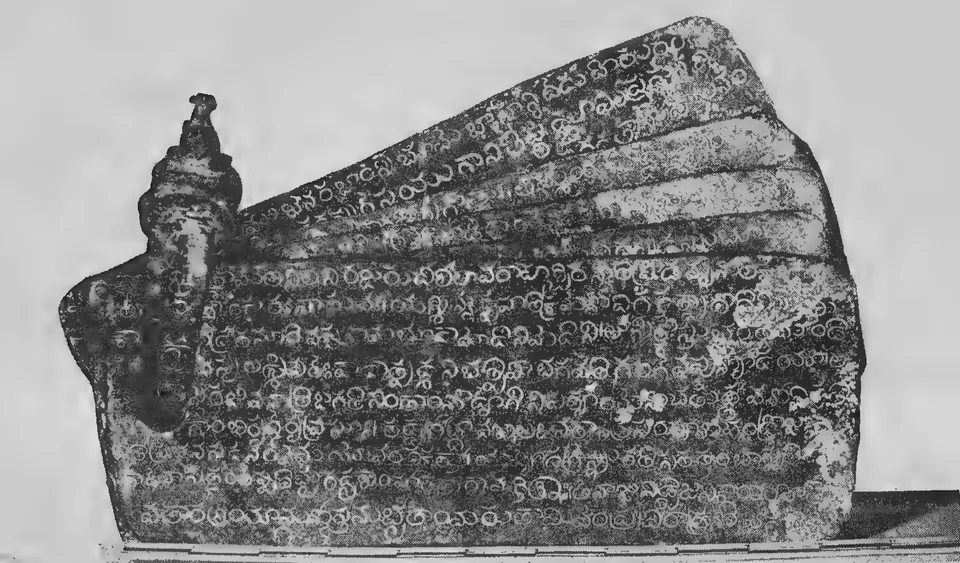
He signed his grants Pallava-Trinetra.13 The ring of his Puvvada grant of 1346 is inscribed with the same name.13
Ramayya read the Harivamsa as saying that Prola’s wife Annama was a daughter of Dodda.1 He also read it as saying that Dodda’s grandson Nako was a close friend of Vema.1 Robert Sewell’s pedigree instead makes the daughter of Dodda the wife of Prolaya Vema himself.7
The Kistna District Manual of 1883, following local tradition, calls him Pulayya Vema Reddi.89 It makes him the eldest son of a founder named Donti Aliya Reddi.89 A tradition that Sewell recorded at Kondavidu made him only “a guest” in Donti Alla Reddi’s house.10
Rise after the Kakatiyas
The grant of 1345 says that Vema restored all the agraharas (villages granted to Brahmans).4 These villages “had been taken away by the wicked Mlechchha kings from (the time of) king Vira-Rudra of the Kakati-vamsa” (Mlechchha means foreigner).4 This king Vira-Rudra was Prataparudra.4
Ramayya pointed out that this was then “the only epigraphical reference as yet discovered to the Muhammadan conquest of Warangal”.2 It showed that the Reddis were the political successors of the Kakatiyas.2 But it gave no date for their rise to power.2
N. Ramesan placed Vema among the chiefs who followed the Musunuri leaders Prolaya Nayaka and Kapaya Nayaka in driving out the sultan’s officers.1112 He cited the Kaluvacheru grant of 1423 for the statement that Vema had been one of Kapaya’s seventy-five subordinate chiefs before he ruled in his own right.1112 Sewell connected the restoration of the agraharas with a league of Hindu rulers formed about 1344 against the Muslims.13
A local chronicle, the Kondavidu Dandakavili, explains the family’s wealth with a story.2 Donti Allada Reddi is said to have robbed a Komati (merchant caste) guest of a philosopher’s stone, a stone believed to make gold.2 With the money, Prolaya Vema raised troops and seized Dharanikota from Prataparudra’s officers.2
Ramayya doubted the story.2 He suggested a more ordinary source of funds.2 He pointed to the poet Srinatha’s Haravilasam, which says that a Komati merchant of Nellore, Avachi Devaya, was Vema’s chief supporter.2
The kingdom
The grant of 1345 names his capital as “the city of Addanki in the country of Pungi”.1 This country “extended from the eastern slopes of Srigiri to the eastern sea on both sides of the river Kundi”.1 The Kundi is the Gundlakamma.1
Ramayya concluded that Vema extended his rule at least to the north bank of the Krishna.214 He also concluded that an inscription at Amaravati showed Vema’s territories reaching the banks of the Godavari.214 In his view the capital moved to Kondavidu only under Vema’s son Anavema.214
Sewell found Vema ruling at Amaravati (Dharanikota) in 1345, and in part of the Kurnool district in 1346.15 The Godavari gazetteer says that he “boasts that he conquered Raichur”.16 It also calls him “a great patron of Telugu and Tamil literature”.16
His brothers served him. M. Somasekhara Sarma credits the youngest, Malla, with the conquest of the port of Motupalli, and the Reddis of Kandukur later traced their descent from him.17
The Puvvada grant calls Vema an Agastya to “the ocean of the Mlechchhas”.1812 Agastya was the sage who drank the ocean.1812 Ramesan took a Mackenzie manuscript’s account of Vema’s victories over the Turushka (Turkish) hosts of “Alavadin” to mean a fight with the first Bahmani sultan.1812
Grants and buildings
On 18 March 1345, at an eclipse of the moon, Vema gave the village of Atukuru on the Krishna to a group of Brahmans.1 He renamed it Vemapuram after himself.1 Ramayya called this “the earliest inscription of the Reddi dynasty as yet discovered”.1
In 1346 he gave Puvvada, “between the two forts of Addanki and Vinukonda”, in sixty-four shares, in the presence of the god of Srisailam.181920 The village was renamed Vemapuri.181920
An inscription of 1345 at Amaravati records that he set five golden pinnacles (pointed tops) on the Amaresvara temple.211 He did this for the merit of his younger brother Malla Reddi.211 See the Madras Museum plates and the Puvvada grant.
Almost every later inscription of the family remembers him for one work.2223 This was a flight of steps up to the shrine at Srisailam, from the Patalaganga stream at the foot of the hill.2223
The Pedapalakaluru plates of 1378 credit him with a second flight at Ahobilam.24 They call the two flights of steps “permanent pillars of victory”.24 Ramayya noticed that Vema’s own grant of 1345 does not mention the steps.14 He suggested that they were not yet finished.14
Errapragada
The poet Errapragada completed the Telugu Mahabharata.2526 According to the History of Telugu Literature of 1928, he “was attached to Proliah Vema Reddy, the ruler of the district”.25 He dedicated his Harivamsa to Vema.2526
H. K. Narasimhaswami found a donee (receiver of a gift) named “Erraya-pregada”, with an unusually large share in a grant of Vema’s sons.26 He took this donee to be the poet.26
Succession and dates
Vema had two sons, Anavota and Anavema, who ruled after him one after the other.2724 His daughter Doddambika married Kata II, of the family that later ruled at Rajahmundry.28 Another daughter, Vemasani, married a chief named Nallanunka.29
Robert Sewell’s pedigree says that Vemasani and Nallanunka had a daughter, Hemambika, who married Deva Raya I of Vijayanagara.7 See Anavota Reddi, Anavema Reddi and Kataya Vema.
His reign cannot be fixed exactly. The sources give these dates (Saka years belong to an Indian era):
- in the Dandakavili, Saka 1242–1253 (about 1320–1331)30
- in Ramayya’s view, to fit the inscriptions, Saka 1242–1271 (about 1320–1349)30
- in the Kistna manual, independence from 13289
- in Somasekhara Sarma and Ramesan, from an inscription of 1325 at Mallavaram to 1353313233
The editors of a plate from Chimakurti read its date as 1336, but thought it a later copy.34 Narasimhaswami gave Vema’s earliest known date as Saka 1254 (1332–33).35 He gave the latest as Saka 1268 (1346), when an inscription at Tripurantakam already names his son as crown prince.35
Footnotes
-
Ramayya, Madras Museum Plates of Vema (1905–06), p. 10 (archive.org (opens in a new tab)). ↩ ↩2 ↩3 ↩4 ↩5 ↩6 ↩7 ↩8 ↩9 ↩10 ↩11 ↩12 ↩13 ↩14 ↩15 ↩16 ↩17
-
Ramayya, Madras Museum Plates of Vema (1905–06), p. 11 (archive.org (opens in a new tab)). ↩ ↩2 ↩3 ↩4 ↩5 ↩6 ↩7 ↩8 ↩9 ↩10 ↩11 ↩12 ↩13 ↩14
-
Ramesan, Copper Plate Inscriptions, Vol. I (1962), p. 173 (archive.org (opens in a new tab)). ↩ ↩2 ↩3
-
J. Ramayya, Madras Museum Plates of Vema, A.D. 1345, Epigraphia Indica VIII (1905–06), p. 9 (archive.org (opens in a new tab)). ↩ ↩2 ↩3 ↩4 ↩5 ↩6 ↩7 ↩8
-
Ramesan, Copper Plate Inscriptions, Vol. I (1962), p. 174 (archive.org (opens in a new tab)). ↩
-
E. Hultzsch, Vanapalli Plates of Anna-Vema, Saka-Samvat 1300, Epigraphia Indica III (1894–95), p. 59 (archive.org (opens in a new tab)). ↩
-
Sewell, Historical Inscriptions (1932), p. 385 (archive.org (opens in a new tab)). ↩ ↩2
-
Gordon Mackenzie, A Manual of the Kistna District (1883), p. 9 (archive.org (opens in a new tab)). ↩ ↩2
-
Mackenzie, Kistna District (1883), p. 10 (archive.org (opens in a new tab)). ↩ ↩2 ↩3
-
Robert Sewell, Lists of Inscriptions, and Sketch of the Dynasties of Southern India (1884), p. 187 (archive.org (opens in a new tab)). ↩
-
N. Ramesan, Copper Plate Inscriptions of Andhra Pradesh Government Museum, Hyderabad, Vol. I (1962), pp. 163–164 (archive.org (opens in a new tab)). ↩ ↩2
-
Ramesan, Copper Plate Inscriptions, Vol. I (1962), p. 166 (archive.org (opens in a new tab)). ↩ ↩2 ↩3 ↩4 ↩5
-
Robert Sewell, The Historical Inscriptions of Southern India (1932), p. 189 (archive.org (opens in a new tab)). ↩
-
Ramayya, Madras Museum Plates of Vema (1905–06), p. 12 (archive.org (opens in a new tab)). ↩ ↩2 ↩3 ↩4 ↩5
-
Sewell, Historical Inscriptions (1932), p. 190 (archive.org (opens in a new tab)). ↩
-
F. R. Hemingway, Madras District Gazetteers: Godavari, Vol. I (1907), p. 26 (archive.org (opens in a new tab)). ↩ ↩2
-
Somasekhara Sarma, History of the Reddi Kingdoms (1948), p. 194 (archive.org (opens in a new tab)). ↩
-
Ramesan, Copper Plate Inscriptions, Vol. I (1962), p. 175 (archive.org (opens in a new tab)). ↩ ↩2 ↩3 ↩4 ↩5
-
Ramesan, Copper Plate Inscriptions, Vol. I (1962), p. 176 (archive.org (opens in a new tab)). ↩ ↩2
-
Ramesan, Copper Plate Inscriptions, Vol. I (1962), p. 178 (archive.org (opens in a new tab)). ↩ ↩2
-
V. Rangacharya, A Topographical List of the Inscriptions of the Madras Presidency, Vol. II (1919), p. 825, Guntur No. 634 (archive.org (opens in a new tab)). ↩ ↩2
-
J. Ramayya, Tottaramudi Plates of Kataya-Vema, Saka-Samvat 1333, Epigraphia Indica IV (1896–97), p. 319 (archive.org (opens in a new tab)). ↩ ↩2
-
Hultzsch, Vanapalli Plates of Anna-Vema (1894–95), p. 64 (archive.org (opens in a new tab)). ↩ ↩2
-
Ramesan, Copper Plate Inscriptions, Vol. I (1962), p. 189 (archive.org (opens in a new tab)). ↩ ↩2 ↩3
-
P. Chenchiah and Raja M. Bhujanga Rao, A History of Telugu Literature (1928), p. 48 (archive.org (opens in a new tab)). ↩ ↩2 ↩3
-
H. K. Narasimhaswami, Koduru Grant of Ana-Vota-Reddi; Saka 1280, Epigraphia Indica XXV (1939–40), p. 138 (archive.org (opens in a new tab)). ↩ ↩2 ↩3 ↩4
-
E. Hultzsch, Nadupuru Grant of Anna-Vema, Saka-Samvat 1296, Epigraphia Indica III (1894–95), p. 286 (archive.org (opens in a new tab)). ↩
-
Ramayya, Tottaramudi Plates of Kataya-Vema (1896–97), p. 321 (archive.org (opens in a new tab)). ↩
-
Hultzsch, Nadupuru Grant of Anna-Vema (1894–95), p. 287 (archive.org (opens in a new tab)). ↩
-
Ramayya, Madras Museum Plates of Vema (1905–06), p. 13 (archive.org (opens in a new tab)). ↩ ↩2
-
M. Somasekhara Sarma, History of the Reddi Kingdoms (1948), p. 41 (archive.org (opens in a new tab)). ↩
-
Somasekhara Sarma, History of the Reddi Kingdoms (1948), p. 47 (archive.org (opens in a new tab)). ↩
-
Ramesan, Copper Plate Inscriptions, Vol. I (1962), pp. 164–165 (archive.org (opens in a new tab)). ↩
-
A. Rangaswami Saraswati and N. Lakshminarayan Rao, Three Copper-plate Inscriptions of the Reddis, Epigraphia Indica XXI (1931–32), p. 268 (archive.org (opens in a new tab)). ↩
-
Narasimhaswami, Koduru Grant of Ana-Vota-Reddi (1939–40), p. 139 (archive.org (opens in a new tab)). ↩ ↩2
Photos
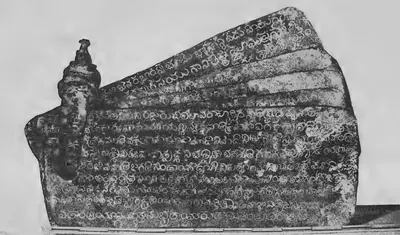 Puvvada grant of Prolaya Vema, Saka 1268 (A.D. 1346): general view of the five plates on their ring with the seal (Ramesan 1962, Plate XI (d), PDF p. 231)Photograph · 1962
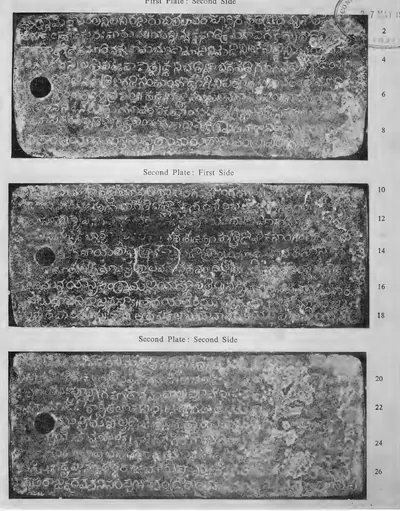 Puvvada grant of Prolaya Vema, Saka 1268 (A.D. 1346): photographs of the plates, first plate second side, second plate both sides (lines 1-27) (Ramesan 1962, Plate XI (a), PDF p. 226)Photograph · 1962
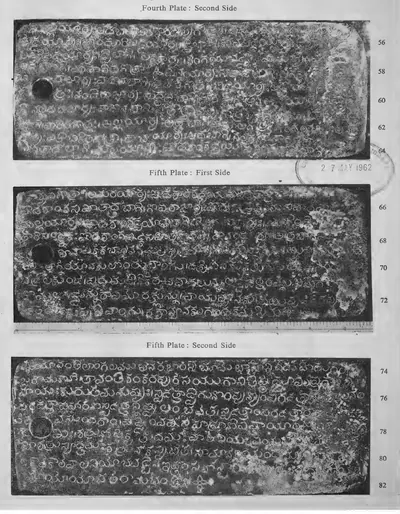 Puvvada grant of Prolaya Vema, Saka 1268 (A.D. 1346): photographs of the plates, fourth plate second side, fifth plate both sides (lines 55-82) (Ramesan 1962, Plate XI (c), PDF p. 230)Photograph · 1962
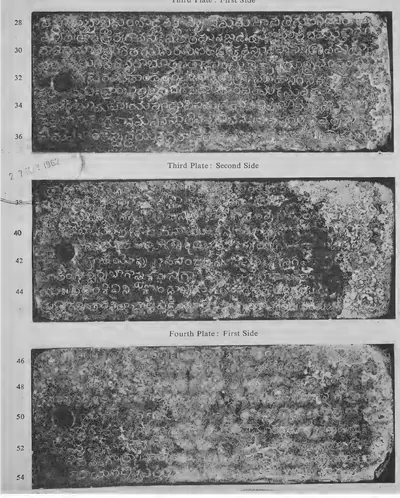 Puvvada grant of Prolaya Vema, Saka 1268 (A.D. 1346): photographs of the plates, third plate both sides, fourth plate first side (lines 28-54) (Ramesan 1962, Plate XI (b), PDF p. 227)Photograph · 1962
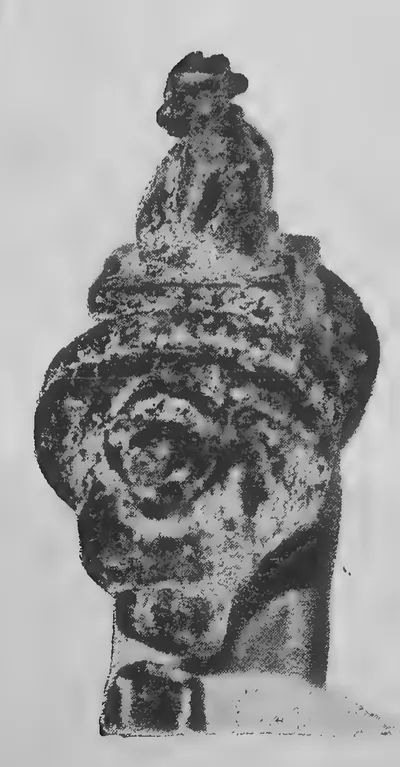 Puvvada grant of Prolaya Vema, Saka 1268 (A.D. 1346): the Nandi seal on the ring (Ramesan 1962, Plate XI (d), PDF p. 231)Photograph · 1962
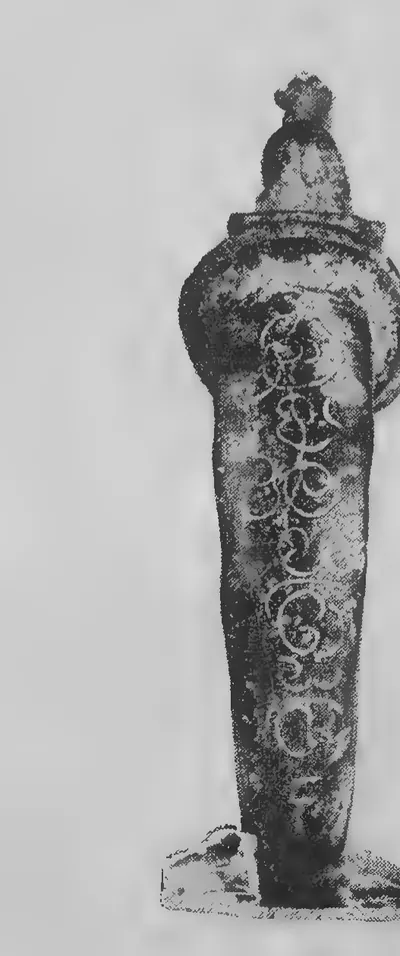 Puvvada grant of Prolaya Vema, Saka 1268 (A.D. 1346): the ring, inscribed "Sri Pallava Trinetra" (Ramesan 1962, Plate XI (d), PDF p. 231)Photograph · 1962
Related
Dynasties
References
Notes (0)
Sources (13)
Spotted an error on this page? Tell us
Last updated: