Addanki
Town on the Gundlakamma river, formerly in Ongole taluk. A stone here carries the 9th-century Telugu verse inscription of Pandaranga. Later records name it as the centre of the 'Addanki country'.
Location
Addanki stands on the banks of the Gundlakamma river, at 15°49′ N and 79°58′ E.1 In 1908 it was a town of 7,230 people (1901 census) in the Ongole taluk of Guntur district.1 It was 23 miles from Ongole railway station.1 The Imperial Gazetteer described it as the centre of a pulse-growing and cattle-breeding country with a large grain trade.2
When Ongole taluk still belonged to Nellore district, the government held an annual cattle show at Addanki, begun in 1859.3 In 1870 the show was held experimentally at Ongole instead.4
The Pandaranga inscription
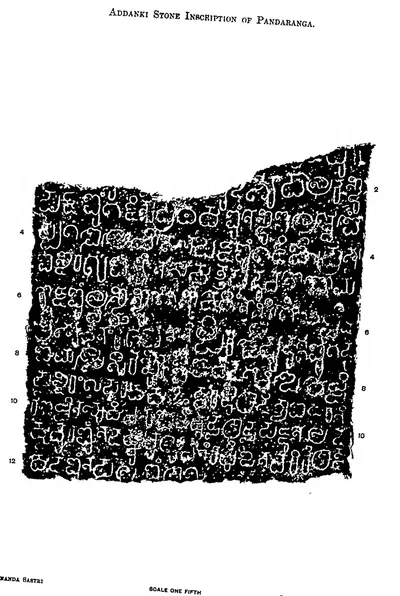
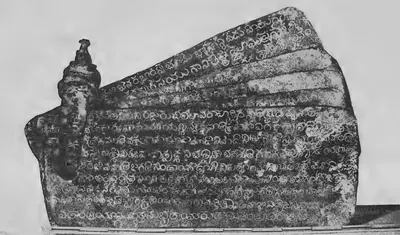
Addanki is best known for the stone inscription of Pandaranga, army commander of the Eastern Chalukya king Gunaga-Vijayaditya III. When it was edited in the 1920s, the stone lay in a field at Addanki.5 Its opening Telugu verse is in the taruvoja metre.6 Its editor took this verse as evidence that Telugu poetry was being written by the middle of the 9th century.6
The prose part records a gift of land to the Sun god at Dammavuram.6 The editor identified Dammavuram with Dharmavaram near Addanki, where two more inscriptions of Pandaranga were known.6 He guessed that Pandaranga had reached Addanki from the Kurnool side after his campaign against the Boyas.7
Later records
The 1905 Nellore inscription survey found eight short inscriptions on the pillars of the Nageswara temple at Addanki.8 It judged them “not worth printing”.8 It also recorded a Telugu inscription on the Ramaswami temple wall, about the plastering of that wall.8 That inscription is dated in Saka 1326 (about 1404–05; Saka is an Indian way of counting years).8
A Vijayanagara copper-plate grant of 1390–91 (Saka 1312) was issued in the name of Devaraya.9 It places the village it grants near Parachur “in the kingdom of Addanki” (Addanki-rashtra).9
Fort
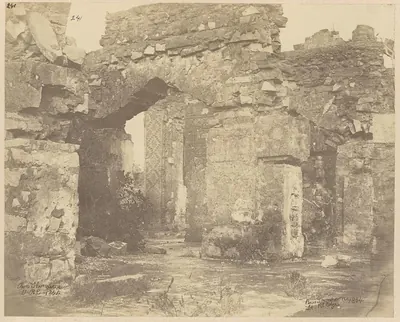
The town had a ruined mud fort of about 79 acres. Local tradition, as reported in 1908, held that it was built or restored around 1400 by Haripaludu, son of Prataparudra. The same source says the Mondapati family of Ongole had ruled here about two centuries earlier.12 These are traditions recorded by the gazetteer, not facts established from inscriptions.
Footnotes
-
Imperial Gazetteer of India: Madras, Vol. I (1908), p. 331 (archive.org (opens in a new tab)). ↩ ↩2 ↩3 ↩4
-
Imperial Gazetteer of India: Madras, Vol. I (1908), p. 332 (archive.org (opens in a new tab)). ↩ ↩2
-
Boswell, Manual of the Nellore District (1873), p. 74 (archive.org (opens in a new tab)). ↩
-
John A. C. Boswell, A Manual of the Nellore District (1873), p. 76 (archive.org (opens in a new tab)). ↩
-
K. V. Lakshmana Rao, “The Addanki Stone Inscription of Pandaranga”, Epigraphia Indica XIX (1928), p. 272 (archive.org (opens in a new tab)). ↩
-
Lakshmana Rao, “Addanki Stone Inscription”, Epigraphia Indica XIX (1928), p. 273 (archive.org (opens in a new tab)). ↩ ↩2 ↩3 ↩4
-
Lakshmana Rao, “Addanki Stone Inscription”, Epigraphia Indica XIX (1928), p. 274 (archive.org (opens in a new tab)). ↩
-
A. Butterworth and V. Venugopaul Chetty, Nellore District Inscriptions, Part II (1905), p. 895 (archive.org (opens in a new tab)). ↩ ↩2 ↩3 ↩4
-
A. Butterworth and V. Venugopaul Chetty, Nellore District Inscriptions, Part I (1905), pp. 1–2 (archive.org (opens in a new tab)). ↩ ↩2
Photos
Related
Dynasties
People

Gunaga Vijayaditya III
c. 844–888 CE
Eastern Chalukya king of Vengi (c. 844–888). His records claim victories over the Gangas, the Nolamba king Mangi, a chief Sankila of Dahala and the Rashtrakuta Krishna, and the burning of Kiranapura and Chakrakuta. Historians have seen him both as the man who sacked the Rashtrakuta capital and as a Rashtrakuta vassal. His general Pandaranga is praised in one of the earliest Telugu verse inscriptions.
Pandaranga
c. 844–888 CE
Army commander of the Eastern Chalukya king Gunaga Vijayaditya III in the second half of the 9th century, praised in the Telugu verse inscription at Addanki. Later grants credit him with burning Kiranapura, the home of the Rashtrakuta Krishna II and his ally Sankila. He was the executor of his king's grants, and his descendants held the office of Katakaraja under the later kings.
Errapragada
c. 1280–1350 CE
Telugu poet of the 14th century, the third of the 'Kavitraya' who completed the Telugu Mahabharata. He finished the Aranya Parva that Nannaya had left incomplete. He was a Niyogi Brahman of Gudluru in the Nellore country and a devotee of Siva (Sambhudasa). He was attached to Prolaya Vema, the founder of the Reddi kingdom, and dedicated his Harivamsa to him. He also wrote a Ramayana and the Narasimha Purana for the god of Ahobilam.
Prolaya Vema Reddi
c. 1325–1353 CE
Founder of the Reddi kingdom of Addanki and Kondavidu (c. 1325–1353). He took over the country between Srisailam and the sea after the fall of the Kakatiyas. His grants of 1345 and 1346 say he restored the Brahman villages seized by the Muslim conquerors of Warangal. Later records remember him for the flights of steps at Srisailam and Ahobilam, and the poet Errapragada dedicated his Harivamsa to him.
Anavota Reddi
c. 1353–1364 CE
Second Reddi king of Addanki (c. 1353–1364), elder son of Prolaya Vema. His only known copper-plate grant, from Koduru (1358), and his renewal of the Kakatiya charter for sea merchants at Motupalli (1358) survive. A Velama chronicle claims a victory over him at Dharanikota in 1361. His son Kumaragiri and his son-in-law Kataya Vema later ruled at Kondavidu and Rajahmundry.
Inscriptions
References
Notes (0)
Sources (5)
Spotted an error on this page? Tell us
Last updated: